
Memristors
- 17 Apr 2026
In News:
In a significant leap for Neuromorphic Computing, researchers from the University of Cambridge have developed a new type of nanodevice—a hafnium-oxide memristor. Published in Science Advances (2026), this innovation promises to slash the energy consumption of Artificial Intelligence (AI) by over 70%, addressing one of the most critical sustainability challenges of the digital age.
What is a Memristor?
The term ‘Memristor’ is a portmanteau of “memory” and “resistor.” It is the fourth fundamental circuit element (alongside the resistor, capacitor, and inductor), first theorized by Leon Chua in 1971 and physically realized by HP Labs in 2008.
- Core Function: Unlike a standard resistor which has a fixed resistance, a memristor has a variable resistance that depends on the history of the electric current that has passed through it.
- The "Memory" Aspect: Even when the power is turned off, the memristor "remembers" its last resistance state. This makes it a non-volatile device, meaning it retains information without needing a continuous power supply.
The Cambridge Breakthrough: Hafnium-Oxide Memristors
While memristors traditionally used titanium dioxide (TiO2), the Cambridge team utilized Hafnium Oxide (HfO2), a material already common in the semiconductor industry.
Key Innovations:
- Shift from Filaments to Interfaces: Older memristors relied on "conductive filaments" that were often unpredictable and unstable. The new device uses p-n junctions (electronic gates) created by adding strontium and titanium. This allows for smooth, uniform resistance changes.
- Ultra-Low Power: It operates at switching currents nearly a million times lower than conventional oxide-based devices.
- Analogue Capability: Unlike binary systems (0 and 1), these memristors can achieve hundreds of distinct conductance levels, allowing for analogue "in-memory" computing.
Why is this relevant for AI?
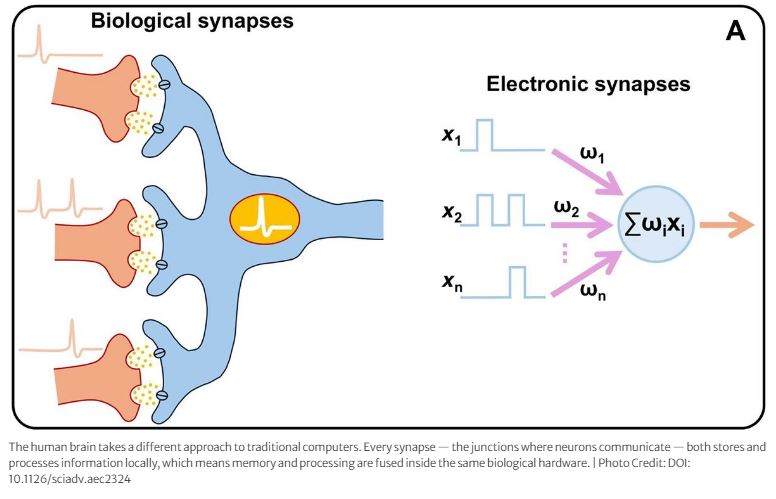
Current computer architecture (Von Neumann architecture) separates the Processing Unit (CPU) from the Memory (RAM). In AI tasks, moving massive amounts of data back and forth between these two units creates a "bottleneck" that consumes enormous energy.
- Mimicking the Brain: In the human brain, neurons and synapses both process and store information in the same place.
- Synaptic Plasticity: The new memristor replicates Spike-Timing-Dependent Plasticity (STDP)—the mechanism where biological connections strengthen or weaken based on the timing of signals.
- Efficiency: By performing "In-Memory Computing," memristors eliminate the energy-intensive data shuffling, making AI hardware significantly more efficient.
Applications and Significance
- Sustainable AI: As global demand for AI (like ChatGPT and Large Language Models) explodes, memristors can prevent an energy crisis in data centers.
- Edge Computing: Their small size and low power demand make them ideal for "Edge devices" like smartphones, sensors, and wearable medical tech that need to process AI locally without draining batteries.
- Internet of Things (IoT): Enables smart devices to "learn" and adapt to user patterns autonomously.
- Industrial Automation: Reliable Non-Volatile RAM (NVRAM) for systems that cannot afford data loss during power failures.
Challenges to Overcome
Despite the promise, commercialization faces hurdles:
- Thermal Constraints: Current fabrication requires temperatures of 700°C, which is higher than what standard silicon chip manufacturing (CMOS) can typically tolerate.
- Scalability: Moving from laboratory prototypes to mass-produced integrated circuits (ICs) requires further refinement of the material layers.