
RuTAG Initiative
- 17 Nov 2025
In News:
The Rural Technology Action Group (RuTAG)is an initiative launched in 2004 by the Office of the Principal Scientific Adviser (OPSA) to the Government of India. It was conceptualised as a mechanism to bring science and technology interventions to rural areas by focusing on demand-driven solutions.
RuTAG functions as a bridge between research institutions and grassroots communities, aiming to upgrade existing rural technologies, fill technology gaps, and support training, demonstrations and field adoption. Its approach emphasises stakeholder collaboration-engaging NGOs, self-help groups, community organisations and rural start-ups to identify local challenges and design technology interventions suited to socio-economic and regional priorities.
RuTAG’s major objectives include:
- Identifying rural technology needs through engagement with community-based organisations and field partners.
- Developing demand-driven technologies based on socio-economic data aligned with national and regional development priorities.
- Validating prototypes and exploring scalability and field deployment.
- Commercialising viable technologies for national and global markets to ensure wider dissemination.
In April 2023, the OPSA launched RuTAG 2.0, marking a shift from prototype development to commercialisation and large-scale dissemination of technologies. RuTAG 2.0 places greater emphasis on converting innovations into market-ready products, ensuring broader accessibility and measurable socio-economic impact in rural India. The initiative aims to strengthen rural value chains, support micro-enterprises, and promote sustainable livelihoods through technology-enabled solutions.
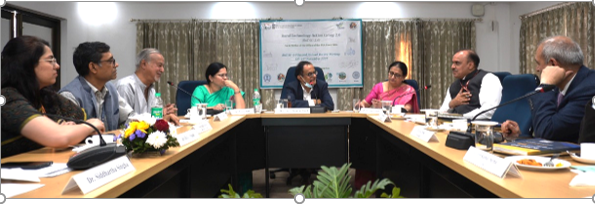
Recently, the Principal Scientific Adviser, Prof. Ajay Kumar Sood, chaired the second annual review meeting of RuTAG 2.0 at IIT Guwahati. The meeting reviewed progress made across all seven RuTAGCentres—IIT Guwahati, IIT Delhi, IIT Bombay, IIT Roorkee, IIT Madras, SKUAST-Kashmir and ICAR-NAARM Hyderabad. Discussions focused on scaling validated technologies, strengthening inter-centre collaboration and deepening partnerships with state governments, industries and community organisations. The review highlighted significant achievements, including expanding collaborations with state departments, demonstration of drone-based rural applications, and increased field-level adoption of technologies.
The PSA released the RuTAG 2.0 Annual Progress Report 2024–25, documenting 56+ ongoing projects addressing rural challenges in agriculture, animal husbandry, post-harvest management, renewable energy, water purification and rural crafts. Many of these projects have reached prototype validation and field deployment stages. The event also saw the inauguration of the Centre for Innovation in Agri & Aqua Voltaics (CIAAV) and the Integrated Facility for Wellness-Product Innovation (IFWPI) at IIT Guwahati, intended to promote interdisciplinary research and rural entrepreneurship in the North-East region.
A Grassroots Innovation and Startup Exhibition showcased prototypes and rural technologies developed under RuTAG 2.0, while drone-based applications were demonstrated at the School of Agro and Rural Technology (SART), IIT Guwahati. A multi-stakeholder meeting involving representatives from MDoNER, MSME Ministry, NECTAR, ASTEC, NABARD, ASRLM, and state governments focused on strategies for scaling technologies and integrating them into rural livelihood programmes.
The two-day review concluded with a strategic roadmap emphasising:
- Commercialisation of proven technologies
- Stronger industry–academia–community partnerships
- Standardisation and quality control across RuTAGCentres
- Measurable socio-economic impact through technology deployment
RuTAG 2.0 reinforces the role of science and technology in empowering rural communities and building self-reliance by ensuring that innovations developed in research institutions translate into meaningful, scalable solutions for rural India.
Man-Portable Autonomous Underwater Vehicles

- 17 Nov 2025
In News:
The Defence Research and Development Organisation (DRDO) has successfully developed a new generation of Man-Portable Autonomous Underwater Vehicles (MP-AUVs) for mine countermeasure missions. These systems have been designed by the Naval Science & Technological Laboratory (NSTL), Visakhapatnam, a premier DRDO establishment responsible for underwater naval systems. MP-AUVs mark a major step in enhancing India’s underwater surveillance and mine-neutralisation capability.
The MP-AUV system comprises multiple autonomous underwater vehicles, each equipped with advanced sensors for underwater mine detection.
Primary payloads include:
- Side Scan Sonar – for seabed mapping and mine-like object detection
- Underwater Cameras – for visual identification and classification
These vehicles incorporate deep learning-based target recognition algorithms, enabling autonomous classification of underwater threats. This reduces operator workload, enhances accuracy, and shortens mission duration. The system also integrates a robust underwater acoustic communication network, allowing AUV-to-AUV data exchange and enabling networked operations. This improves situational awareness and allows coordinated search patterns without direct human control.
The MP-AUV design prioritisesrapid response capability and low logistical footprint, making it suitable for deployment from small naval vessels or shore platforms. Its man-portable nature allows fast mobilisation and reduces operational risk by minimising diver involvement in hazardous minefields. Field trials conducted at NSTL/harbour sites have successfully validated key performance parameters, including detection accuracy, communication reliability and autonomous navigation.
This development aligns closely with India's push for indigenous defence technologies and intelligent autonomous systems. It enhances operational readiness in underwater mine warfare and supports the broader goal of strengthening maritime security. DRDO, headquartered in New Delhi and established in 1958, continues to lead India’s indigenous defence R&D, focusing on strategic capabilities and advanced naval systems.
India Skills Report 2026

- 17 Nov 2025
In News:
- The India Skills Report 2026 captures major shifts in India’s workforce, driven by artificial intelligence, digitalisation and evolving hiring practices.
- A significant benchmark highlighted is that women’s employability (54%) has surpassed men’s (51.5%) for the first time in five years, indicating structural shifts in the labour market.
- The overall narrative shows India transitioning towards a skills-first employment ecosystem rather than one centred purely on academic degrees.
About the India Skills Report
- This annual nationwide analysis is prepared by ETS, CII, AICTE, AIU and Taggd.
- It measures workforce readiness, skill gaps and hiring trends across sectors.
- The aim is to help align education, training and industry expectations.
- The report uses extensive surveys of students, graduates and employers to map workforce preparedness.
Overall Employability Trends
The report states that India’s overall employability has risen to 56.35%, up from ~54.8% in the previous cycle. Over a span of four years, employability has grown by nearly 10 percentage points, signalling improved industry alignment, better training models and strengthening digital competencies.
Women Surpass Men in Employability
The report emphasises a key milestone: women’s employability has reached 54%, while men’s is at 51.5%. This improvement is driven by growing female participation in BFSI, education and healthcare, as well as rising opportunities in Tier-2 and Tier-3 cities.
Gender preference data indicates women’s dominant interest in legal jobs (96.4%) and healthcare roles (85.95%), while men prefer graphic design (83.11%) and engineering design (64.67%). This shift reflects both diversification and deepening inclusion in the workforce.
Dominance of Tech and AI Skills
The report highlights strong performance among technical streams, with computer science graduates showing 80% employability and IT engineering graduates at 78%. This dominance is linked to high demand in AI, data analytics, cloud computing, automation and cybersecurity.
Despite improvements, industries continue to face shortages in specialised AI and data skills, demonstrating the need for sustained skilling and curriculum upgrades. The rise of micro-credentials, stackable certificates and project-based training further reinforces the shift toward a skills-first hiring culture.
Rise of the Gig Economy
The gig and freelance workforce has expanded rapidly, with gig hiring increasing by ~38% and gig roles now accounting for around 16% of all jobs. This growth is supported by remote work opportunities, digital platforms and flexible work models. Projections suggest India’s gig labour pool may reach tens of millions by 2030, reshaping traditional employment structures.
Demand for Internships and Practical Training
The report notes that 92.8% of students are actively seeking internships or practical exposure, reflecting the high demand for hands-on industry experience. States like Karnataka, Madhya Pradesh and Tamil Nadu show especially strong internship interest. This trend highlights the necessity of integrating apprenticeships, live projects and experiential learning into mainstream education.
Hiring Intent Across Sectors
Hiring projections are optimistic, with companies planning to increase recruitment by 40%, significantly higher than the previous 29%. The IT sector leads in fresher hiring at 35%, compared to a 14% cross-industry average last year. Pharma and healthcare sectors show heavy recruitment for professionals with 1–5 years of experience, followed by BFSI, manufacturing and FMCG. These patterns reflect ongoing digital transformation and India’s strengthening knowledge economy.
Employability Across Streams
The report provides stream-wise improvements: commerce graduates now show 62.81% employability (up from 55%), science graduates stand at 61%, and arts graduates at 55.55%. Vocational education has shown progress as well, with ITI graduates’ employability rising to 45.95% (from 41%) and polytechnic diploma holders reaching 32.92%. These trends indicate stronger demand for financial, digital and interdisciplinary skills, alongside gradual improvements in vocational skilling.
Opportunities for India
India’s demographic advantage, coupled with rising digital literacy, positions it as a potential global talent supply hub. Strength in computer science, IT and AI opens pathways to indigenous technological development. The increasing employability in Tier-2 and Tier-3 cities may decentralise growth and create new hubs of innovation. Flexible work arrangements, including gig and remote work, allow Indian workers to access global opportunities. Strengthened linkages between industry and academia—through internships and micro-credentials—can further streamline talent pipelines.
Challenges Ahead
Despite progress, access gaps remain. Advanced skilling in AI and data technologies is still concentrated in urban and premier institutions, leaving rural and Tier-3 learners behind. Persistent deficits in soft skills—communication, teamwork and critical thinking-affect job readiness. Curriculum and teaching methods often lag behind rapidly evolving technological requirements. The digital divide limits access to high-speed internet and devices. Dependence on foreign AI tools restricts domestic innovation. Additionally, gig workers face unstable income patterns and lack of social security, creating economic vulnerabilities.
Way Forward
To address these challenges, the report suggests integrating AI, data literacy, sustainability and digital skills into all disciplines. Strengthening ITIs, polytechnics and community-based skilling initiatives is crucial. Expanding blended learning platforms, subsidising devices and improving broadband access can reduce digital inequalities. Industry-linked internships, apprenticeships and project-based learning should be mainstreamed. Faculty upskilling in emerging technologies is necessary to modernise academic delivery. Promoting indigenous AI ecosystems and multilingual digital tools will help India transition from being primarily a user of technology to a creator of intellectual property.
Fourier Transform Infrared Spectroscopy (FTIR) in Post-Blast Forensics
- 17 Nov 2025
In News:
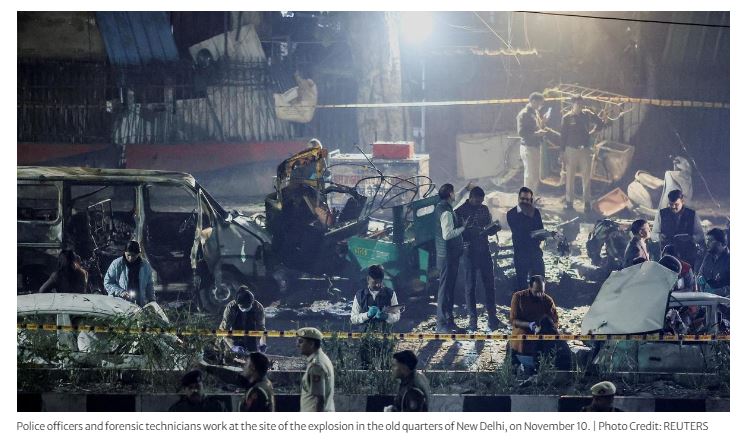
Recent investigative reports highlight the use of Fourier Transform Infrared Spectroscopy (FTIR) in forensic examinations following explosions, such as the blast near Delhi’s Red Fort on 10 November. Forensic experts from the Explosives Department of the Delhi Forensic Laboratory reached the scene promptly, collecting material for scientific analysis to determine the cause and nature of the explosion.
Role of Forensic Experts in Blast Investigations
- Immediate Objective: Identify the cause of the explosion - whether accidental or deliberate.
- Tasks at the Scene:
- Collect samples of debris, residues, metallic fragments, and vehicle parts.
- Document burn marks, pressure wave patterns, and dispersion of fragments.
- Preserve traces that may indicate type of explosive used or triggering mechanism.
- Lab Analysis:
- Rapid chemical and physical testing of recovered samples.
- Collaboration across divisions: explosives chemistry, ballistics, toxicology, materials science, and fingerprint/DNA units.
- Outcome: Scientific verification of:
- Type of explosive (commercial, military, improvised)
- Method of detonation (mechanical/electrical)
- Presence of accelerants or chemical signatures
- Identity of individuals involved (via biological traces)
FTIR plays a key role in this analytical pipeline.
What is FTIR (Fourier Transform Infrared Spectroscopy)?
- Also known as FTIR Analysis / FTIR Spectroscopy.
- An advanced analytical technique used to identify chemical constituents by studying molecular vibrational modes.
- Provides information about:
- Functional groups
- Molecular composition
- Chemical bonding and structure
How FTIR Works
- Uses infrared light to interact with a sample.
- Molecules absorb IR radiation at specific frequencies, corresponding to unique vibrational transitions.
- FTIR measures these absorption patterns, producing an infrared spectrum.
- The spectrum acts as a molecular fingerprint, enabling identification of:
- Organic compounds
- Polymers
- Explosive residues
- Molecular fragments or contaminants
Capabilities
- Effective for:
- Small particles (10–50 microns)
- Surface-level chemical mapping
- Solid, liquid, or gaseous samples
- Resistant to interference and highly precise.
Applications of FTIR
1. Forensic Science
- Identification of explosive residues (e.g., nitrates, nitro-aromatics)
- Analysis of burnt materials, accelerants, or chemical sensitizers
- Distinguishing between accidental combustion and explosive detonation
2. Industrial Quality Control
- Assessing composition of manufactured materials
- Ensuring consistency of polymers, coatings, adhesives, and composites
3. Environmental Monitoring
- Tracking pollutants in:
- Air (particulate matter, gases)
- Water (organic contaminants)
- Soil (industrial chemicals, toxins)
4. Chemical and Material Sciences
- Identification of organic and polymeric substances
- Limited use in analysing certain inorganic compounds
Significance in Blast Investigations
- Detects chemical signatures of commercial or improvised explosives.
- Helps determine:
- Type of explosive used
- Purity and formulation
- Possible source or manufacturer
- Assists in reconstructing the chain of events and intention behind the blast.
- Provides evidence admissible in court due to scientific validity.
INVAR Missile
- 17 Nov 2025
In News:
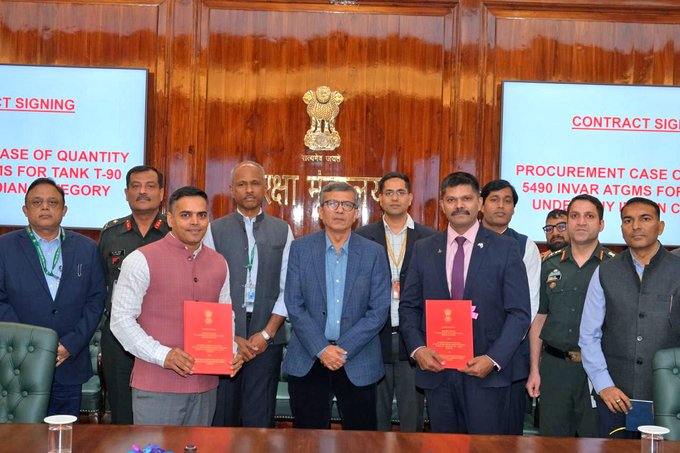
The Ministry of Defence has recently signed a ?2,095 crore agreement with Bharat Dynamics Limited (BDL) for the procurement of INVAR Anti-Tank Guided Missiles (ATGMs). The acquisition aims to enhance the lethality and combat effectiveness of T-90 main battle tanks in the Indian Army.
About INVAR Missile
- Type: Laser-guided Anti-Tank Guided Missile (ATGM)
- Launch Platform: Fired from the 125 mm gun barrel of T-90 tanks
- Origin: Developed by Rosoboronexport (Russia); produced in India under licence by BDL
- Category: Procured under the ‘Buy (Indian)’ category to promote domestic defence capability and align with the goal of Aatmanirbhar Bharat.
Key Features
1. Guidance and Accuracy
- Uses semi-automatic laser beam-riding guidance.
- High resistance to electronic jamming.
- Offers high hit probability against fortified armour.
2. Penetration Capability
- Equipped with a tandem warhead designed to defeat:
- Explosive Reactive Armour (ERA) on modern tanks
- Both stationary and moving targets (up to 70 km/hr)
3. Range and Performance
- Effective range: Up to 5 km
- Calibre: 125 mm
- Weight: 17.2 kg
- Length:
- Missile: 695 mm
- Throwing device: 395 mm
4. Operational Integration
- Fired directly through the T-90 tank’s gun tube.
- Guidance and tracking through the tank’s integrated fire-control optics.
Significance of the Procurement
1. Enhanced Mechanised Warfare Capability
- Strengthens India’s ability to neutralise heavily armoured enemy platforms.
- Provides precision strike capability at extended ranges.
2. Boost to Defence Manufacturing
- Encourages utilisation of DPSU expertise, primarily BDL.
- Supports development of niche defence technologies by Indian industry.
3. Strategic Impact
- Improves India’s frontline preparedness along sensitive borders.
- Modernises the equipment profile of mechanised forces.