
Methanol
- 11 Apr 2026
In News:
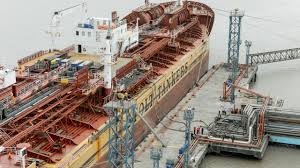
In a major leap toward decarbonizing the maritime sector, the Deendayal Port Authority (Kandla Port) on India's western coast has successfully advanced its methanol bunkering capabilities. This milestone, aligns with the Maritime Amrit Kaal Vision 2047 and India’s commitment to achieving a net-zero maritime future by 2050.
Methanol: The Fuel of the Future
Methanol, also known as wood alcohol (CH3OH), is the simplest alcohol and is emerging as a critical alternative to traditional bunker fuels (like Heavy Fuel Oil) in shipping.
1. Production and Properties
- Process: Typically produced via steam-reforming natural gas to create synthesis gas (syngas), which is then reacted over a catalyst to produce methanol.
- Physical State: A colorless, volatile liquid with a faintly sweet odor. It is completely miscible in water.
- Performance: It is a high-octane, clean-burning fuel. Unlike solid or heavy liquid fuels, its combustion results in significantly lower emissions of SOx (Sulfur Oxides), NOx (Nitrogen Oxides), and particulate matter.
2. Why Methanol for Shipping?
- Energy Security: It can be manufactured from various domestic feedstocks, including coal, natural gas, and biomass, reducing dependency on imported crude.
- Safety: Methanol has a lower risk of flammability compared to gasoline and is biodegradable in marine environments.
- Cost-Efficiency: It is relatively cheaper to produce and store than other emerging alternatives like liquid hydrogen.
- Existing Infrastructure: Since Kandla Port has handled "grey methanol" as cargo for years, much of the necessary storage, pipeline, and jetty infrastructure is already compatible.
Milestone at Deendayal Port (Kandla)
The port has transitioned from a cargo-handling hub to a bunkering hub (a location where ships refuel).
Key Achievements:
- Trial Success: On April 2, 2026, the port successfully conducted a shore-to-ship methanol bunkering trial in collaboration with partners like Indian Oil (IOCL) and Stolt Tankers. This validated safety protocols and transfer processes.
- Port Readiness Level (PRL): Following an assessment by DNV Maritime Advisory Services, the port was rated at Level 6 on the International Association of Ports and Harbors (IAPH) scale, indicating high operational readiness.
- Future Target: The port aims to supply 500 KTPA of e-methanol (Renewable Fuel of Non-Biological Origin) by 2028-29 to support dual-fuel vessels on the Asia-Europe trade route.
Woolly-Necked Stork
- 11 Apr 2026
In News:
The recent sighting of the Woolly-Necked Stork (Ciconia episcopus) in the paddy fields near Thanjavur, Tamil Nadu, has garnered significant attention from ornithologists and conservationists.
Biological Profile and Key Features
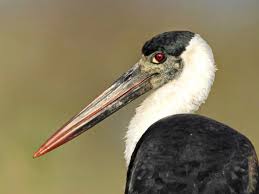
The Woolly-Necked Stork, colloquially known as the White-necked Stork or Bishop Stork, is a large wading bird belonging to the Ciconiidae family.
- Distinctive Morphology: It is characterized by its almost entirely black plumage, contrasted sharply by a white, "woolly" textured neck and a white lower belly. The upper body often exhibits a dark green gloss, while the breast and belly areas can display a subtle purple hue.
- Flight Dynamics: As a broad-winged soaring bird, it utilizes thermals (rising columns of hot air) to sustain long-distance flight with minimal energy expenditure.
- Dietary Habits: It is predominantly carnivorous. Its diet is diverse, including fish, amphibians (frogs and toads), reptiles (snakes and lizards), and a wide array of invertebrates such as large insects, crabs, and mollusks.
- Foraging Behavior: The species is a patient hunter, typically foraging by walking slowly through shallow water or dense vegetation, using its powerful bill to stab at prey.
Habitat and Global Distribution
The Woolly-Necked Stork is a widespread tropical species with a distribution range extending across Africa and Asia (from India to Indonesia).
- Ecosystem Preferences: It thrives in varied environments, including open grasslands, riverbanks, ponds, and freshwater wetlands.
- Agricultural Synergy: Interestingly, this species has shown a high degree of adaptability to man-made landscapes, particularly paddy fields. These fields act as artificial wetlands, providing a rich supply of aquatic prey, which explains the recent sightings in Thanjavur.
- Breeding: Unlike some other stork species that form massive colonies, the Woolly-Necked Stork tends to breed singly or in small, loose groups.
Conservation Status and Threats
- IUCN Red List: It is currently classified as 'Near Threatened'.
- Conservation Concerns: While the species is adaptable, it faces threats from habitat loss due to the drainage of wetlands, the intensification of agriculture (leading to a reduction in prey diversity), and the contamination of water bodies by pesticides.
- Importance of the Thanjavur Sighting: The presence of the bird in Tamil Nadu’s "rice bowl" underscores the ecological health of the region's traditional irrigation systems. It serves as an indicator species, suggesting that the local paddy ecosystem still supports a robust food chain.
Prototype Fast Breeder Reactor
- 11 Apr 2026
In News:
In a landmark achievement for its energy security, India’s indigenously designed 500 MWe Prototype Fast Breeder Reactor (PFBR) at Kalpakkam, Tamil Nadu, successfully attained first criticality on April 6, 2026. This milestone signifies the initiation of a sustained nuclear chain reaction and officially transitions India into the Second Stage of its visionary three-stage nuclear power programme.
With this breakthrough, India becomes only the second country in the world, after Russia, to operate a commercial-scale fast breeder reactor, reinforcing its position as a global leader in advanced nuclear technology.
Understanding the Fast Breeder Reactor (FBR)
Developed by the Indira Gandhi Centre for Atomic Research (IGCAR) and built by BHAVINI, the PFBR is an engineering marvel that "breeds" more fuel than it consumes.
- Fuel Mechanism: Unlike conventional reactors that use natural uranium, the PFBR utilizes Uranium-Plutonium Mixed Oxide (MOX) fuel.
- The Breeding Process: The reactor core is surrounded by a "blanket" of fertile Uranium-238. When fast neutrons strike this blanket, they transmute it into fissile Plutonium-239, effectively creating new fuel during operation.
- Coolant Technology: It uses liquid sodium as a coolant, which is highly efficient for heat transfer but requires precision engineering due to its reactive nature with air and water.
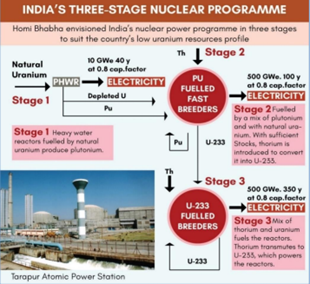
The Three-Stage Nuclear Roadmap:
Formulated by Dr. Homi J. Bhabha in the 1950s, this programme is designed to tackle India’s unique resource profile: possessing only 1–2% of global uranium but over 25% of the world’s thorium reserves.
|
Stage |
Technology |
Fuel Source |
Key Outcome |
|
Stage 1 |
PHWRs |
Natural Uranium |
Power generation Plutonium by-product |
|
Stage 2 |
FBRs (Current) |
Plutonium Uranium |
Breeds more fuel; converts Thorium to U-233 |
|
Stage 3 |
AHWRs |
Thorium U-233 |
Massive, long-term energy independence |
Strategic Significance for India
- Energy Sovereignty: FBRs extract up to 60 times more energy from the same amount of uranium compared to conventional reactors, crucial for a uranium-scarce nation.
- The Thorium Bridge: Stage 2 is the essential "gateway" to Stage 3, where India’s vast monazite sands (found in Kerala, Odisha, and Tamil Nadu) will finally be utilized for power.
- Net-Zero by 2070: Nuclear power currently provides a stable baseload of 3.1% of India’s electricity. Scaling this is vital to displace coal and meet climate targets.
- Waste Management: The "closed fuel cycle" reprocesses spent fuel, drastically reducing the volume and long-term radiotoxicity of nuclear waste.
Challenges and the Road to 100 GW
Despite the milestone, accelerating nuclear capacity to the targeted 100 GW by 2047 faces hurdles:
- Technological Complexity: The PFBR faced over a decade of delays due to safety testing and supply chain bottlenecks.
- Supply Chain Vulnerability: Dependence on global partners (like Russia for Kudankulam) remains a risk, as seen during recent geopolitical disruptions.
- Capital Intensity: High initial costs and the "Plutonium Economy" invite intense international safeguards and security requirements.
Future Outlook: Policy and Innovation
The Union Budget 2025–26 and the newly enacted SHANTI Act, 2025 (Sustainable Harnessing and Advancement of Nuclear Energy for Transforming India) have modernized the sector's governance:
- Private Participation: For the first time, limited private sector investment is permitted under strict regulatory oversight.
- Small Modular Reactors (SMRs): A ?20,000 crore allocation aims to develop five indigenous SMRs by 2033, providing flexible, decentralized power.
- Next-Gen Designs: Development of the BSMR-200 and reactors for hydrogen generation is underway to diversify nuclear applications.
United Nations Economic and Social Council (ECOSOC)
- 11 Apr 2026
In News:
India achieved a major diplomatic milestone by winning elections to four key subsidiary bodies of the United Nations Economic and Social Council (ECOSOC).
Understanding the ECOSOC
Established by the UN Charter in 1945, ECOSOC is one of the six principal organs of the United Nations. It serves as the primary venue for fostering innovative thinking, forging consensus on international development goals, and coordinating policy across economic, social, and environmental sectors.
Core Mandate and Functions:
- The Triple Integration: It aims to harmonize the three pillars of sustainable development: Economic, Social, and Environmental.
- 2030 Agenda: It is the specialized body responsible for policy-making and monitoring the implementation of the Sustainable Development Goals (SDGs).
- Global Coordinator: ECOSOC links regional economic commissions and specialized UN agencies, translating high-level commitments into actionable changes.
- Partnership Gateway: It facilitates dialogue between policymakers, academics, businesses, and over 6,500 registered Non-Governmental Organizations (NGOs).
- Emerging Challenges: The council identifies and addresses new global threats, such as pandemic recovery and climate crises, through intergovernmental discussions.
India’s 2026 Election Success
During the elections held in April 2026, India was elected to the following four distinct and influential bodies:
- Committee on Economic, Social and Cultural Rights (CESCR): In a notable personal victory, former diplomat Preeti Saran was re-elected. This ensures that India’s 36-year diplomatic legacy continues to influence international normative frameworks regarding cultural and social rights.
- Commission on Science and Technology for Development (CSTD): A platform where India can share its digital public infrastructure (DPI) expertise and advocate for technological equity for developing nations.
- Committee on Non-Governmental Organisations: A critical body that monitors the consultative status of NGOs with ECOSOC, giving India a say in how civil society engages with the UN.
- Committee for Programme and Coordination (CPC): The main subsidiary organ of ECOSOC and the General Assembly for planning, programming, and coordination.
Naphthalene Diimide (NDI)
- 11 Apr 2026
In News:
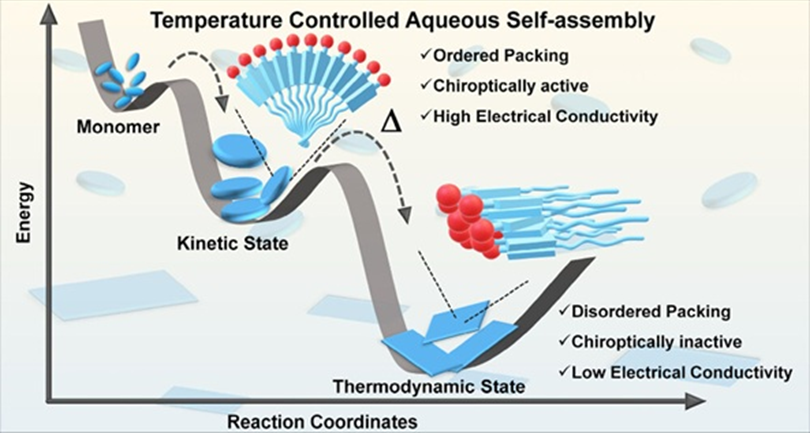
In a significant breakthrough for the field of material science, researchers from the Centre for Nano and Soft Matter Sciences (CeNS) and the Jawaharlal Nehru Centre for Advanced Scientific Research (JNCASR)—both autonomous institutes under the Department of Science and Technology (DST)have pioneered a method to manipulate the structural and electrical properties of organic nanomaterials using temperature as a sole trigger. This discovery centers on the molecule Naphthalene Diimide (NDI) and leverages the principles of supramolecular self-assembly.
The Science of Naphthalene Diimide (NDI)
NDI is characterized as an amphiphilic molecule, a dual-natured chemical entity containing both hydrophilic (water-attracting) and hydrophobic (water-repelling) components. This unique "Janus-like" nature drives the molecule to organize itself into intricate architectures when introduced to an aqueous environment.
The Mechanism of Aqueous Assembly: The transformation is governed by noncovalent interactions (weaker than traditional chemical bonds), which allow for a reversible and dynamic "Lego-like" building process at the molecular level.
- Room Temperature (Phase 1): At standard temperatures, NDI molecules naturally group into circular nanodisks. In this state, the material is highly conductive and exhibits specific interactions with polarized light.
- Thermal Trigger (Phase 2): Upon heating, the molecules undergo a structural reorganization.
- State Switch (Phase 3): The circular nanodisks transform into two-dimensional nanosheets. This morphological shift results in the loss of light-interacting properties and a dramatic sevenfold drop in electrical conductivity.
Supramolecular Self-Assembly: Nature’s Engineering
The research highlights the potential of supramolecular self-assembly, a process where molecules spontaneously organize into well-defined structures without human intervention. By using environmental factors like temperature or solvent type as a "switch," scientists can dictate the final shape and functional behavior of the material. This mimics biological processes where nature builds complex systems using weak interactions to maintain flexibility and responsiveness.
Potential Applications and Significance
The ability to use temperature as an "electrical dimmer switch" for nanomaterials opens diverse avenues in technology and medicine:
- Next-Generation Electronics: Development of organic circuits where electrical flow can be precisely tuned or switched without mechanical parts.
- Smart Thermal Sensors: Creation of sensors that provide immediate optical or electrical feedback in response to minute thermal changes.
- Tunable Optoelectronics: Advancing photonics and display technologies by switching between different optical states.
- Bioelectronic Interfaces: Designing adaptive materials for medical monitoring that can respond dynamically to the biological environment.
- Adaptive Surfaces: Developing "smart" coatings that change their physical properties based on external environmental conditions.