
Mud Volcanoes
- 13 Feb 2026
In News:
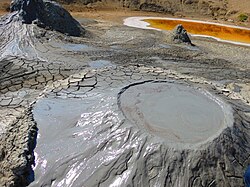
Mud volcanoes are non-igneous “sedimentary volcanoes” formed in young oil-field regions, where methane and hydrocarbons under compactional stress force mud and gases to the surface.
A recent eruption of a mud volcano in Diglipur, Andaman Islands, has drawn attention to this rare geological phenomenon. Mud volcanoes differ fundamentally from magmatic volcanoes as they do not involve molten lava but are driven by sedimentary and hydrocarbon processes.
What is a Mud Volcano?
Mud volcanoes, also called sedimentary volcanoes or gas-oil volcanoes are surface expressions of subsurface pressure systems associated with hydrocarbon-rich sedimentary basins.
Key Characteristics
- Non-igneous in origin (no magma involved).
- Occur mainly in young oil-field regions with soft, unconsolidated sediments.
- Erupt mud, water, methane and other gases instead of lava.
- Often form cone-shaped structures.
- Can release flames if methane ignites.
- May emit hot mud and steam due to deep compactional heat.
Though different in origin, their eruptive behaviour can resemble magmatic volcanoes in intensity.
Formation Mechanism
Mud volcanoes develop due to:
- Compactional Stress
- Deep sediment layers experience pressure over time.
- Methane and hydrocarbons accumulate in porous formations.
- Gas Build-up and Upward Migration
- Trapped gases mix with mud and water.
- The pressurized mixture forces its way upward through fractures.
- Surface Eruption
- Mud and gases erupt, forming a cone.
- Repeated eruptions may enlarge the structure.
Due to the depth of origin, expelled mud is sometimes warm and accompanied by steam clouds.
Global Distribution
- Around 1,000 mud volcanoes have been identified globally on land and in shallow waters.
- Prominent concentrations occur in:
- Azerbaijan (Caspian region)
- Indonesia
- Mediterranean region
- Many also occur on the ocean floor, forming islands, banks, and altering coastal geomorphology.
Mud Volcanoes in India
In India, mud volcanoes are confined to the Andaman and Nicobar Islands.
Major Locations
- Baratang Island – Known site of India’s mud volcano.
- Diglipur – Recent eruption reported after several years of dormancy.
These eruptions are linked to the tectonically active Andaman subduction zone, where sediment compression and hydrocarbon accumulation occur.
Geological Significance
- Indicator of hydrocarbon-rich sedimentary basins.
- Provide insights into subsurface gas migration and petroleum systems.
- Important for understanding:
- Methane emissions (climate relevance)
- Coastal geomorphology changes
- Seismic and tectonic processes in subduction zones
Differences: Mud Volcano vs Magmatic Volcano
|
Feature |
Mud Volcano |
Magmatic Volcano |
|
Origin |
Sedimentary |
Igneous |
|
Material Ejected |
Mud, water, gases |
Lava, ash, pyroclasts |
|
Energy Source |
Gas pressure |
Magma pressure |
|
Temperature |
Relatively lower |
Extremely high |
Ayushman Sahakar Scheme

- 13 Feb 2026
In News:
Ayushman Sahakar (2020) enables cooperative societies to access NCDC loans (up to 90% of project cost) for healthcare infrastructure, with a 1% interest rebate for women-majority cooperatives.
The National Cooperative Development Corporation (NCDC), a statutory body set up under an Act of Parliament in 1963 and functioning under the Ministry of Cooperation—notified the Ayushman Sahakar Scheme in 2020. The scheme aligns with the National Health Policy, 2017 to expand affordable, community-owned healthcare through cooperative institutions.
Objectives
- Provide affordable and holistic healthcare via cooperative hospitals, healthcare and education facilities.
- Promote AYUSH services through cooperatives.
- Enable participation in the National Digital Health Mission (digital health/ICT integration).
- Support comprehensive healthcare including services, education, insurance, and allied activities.
Coverage: Activities & Infrastructure
The scheme supports creation, modernization, expansion, repair, and renovation of healthcare infrastructure, including:
- Hospitals; Medical/AYUSH/Dental/Nursing/Pharmacy/Paramedical/Physiotherapy colleges (UG/PG)
- Yoga wellness centres; Panchkarma/Unani regimental therapy centres
- Elderly care, palliative care, disability services, mental healthcare
- Emergency/trauma centres; physiotherapy; mobile clinics
- Diagnostics, laboratories, blood banks, ophthalmic & dental centres
- AYUSH pharmaceutical manufacturing & drug testing labs
- Maternal & child health; RCH services
- Telemedicine, remote procedures, digital health ICT
- Health insurance (IRDAI-accredited)
- Margin money & working capital for day-to-day operations
Eligibility
- Any Cooperative Society registered under a State Act or the Multi-State Cooperative Societies Act, with healthcare/health education provisions in its bye-laws.
- Financial assistance provided after technical and financial appraisal to ensure long-term viability.
Financial Architecture
Nature of Assistance
- Term/Investment loans (as per actual project requirement).
- Loan tenure up to 8 years, including 1–2 years moratorium on principal (project-dependent).
Interest Incentive
- 1% interest rebate for the entire tenure to cooperatives where women members are in majority, subject to timely repayment.
Funding Pattern (Illustrative)
- Through State Govt. route:
- NCDC → State Govt. → Society
- Loan up to 90% (infrastructure); Society share ~10%
- Direct funding (NCDC → Society) (as per direct funding guidelines):
- Loan up to 70% (or structured mix with share capital)
- Society share ~30%
- Margin Money: Up to 100% loan (subject to assessment).
- Working Capital: As per requirement (loan).
- Loan quantum may be reduced proportionately if dovetailed with subsidy/grant/VGF of GoI/States/other agencies.
Security Options
- Mortgage of assets (incl. project assets) up to 1.5× loan
- Govt./PSU/Statutory body guarantees
- Pledge of FDRs or assignment of Govt. securities (≈1.2× loan)
- Bank guarantees, as acceptable to NCDC
Institutional Context
- NCDC: Apex statutory institution (1963) to promote cooperative principles in production, processing, marketing, storage and services; assists cooperatives at Primary, District, and Apex/Multi-State levels.
- Scheme details and implementation update were shared in Parliament by the Union Minister for Home and Cooperation.
Significance for Governance & Health
- Cooperative Federalism: Decentralizes healthcare delivery via grassroots cooperatives.
- Community Ownership & Accountability: Participatory governance model in health services.
- Boost to AYUSH & Integrative Care: Expands traditional systems alongside allopathy.
- Digital Health Enablement: Supports ICT, telemedicine, and insurance integration.
- Gender Incentivization: Financial rebate encourages women-led cooperatives.
Tamil-Brahmi Inions in Egypt
- 13 Feb 2026
In News:
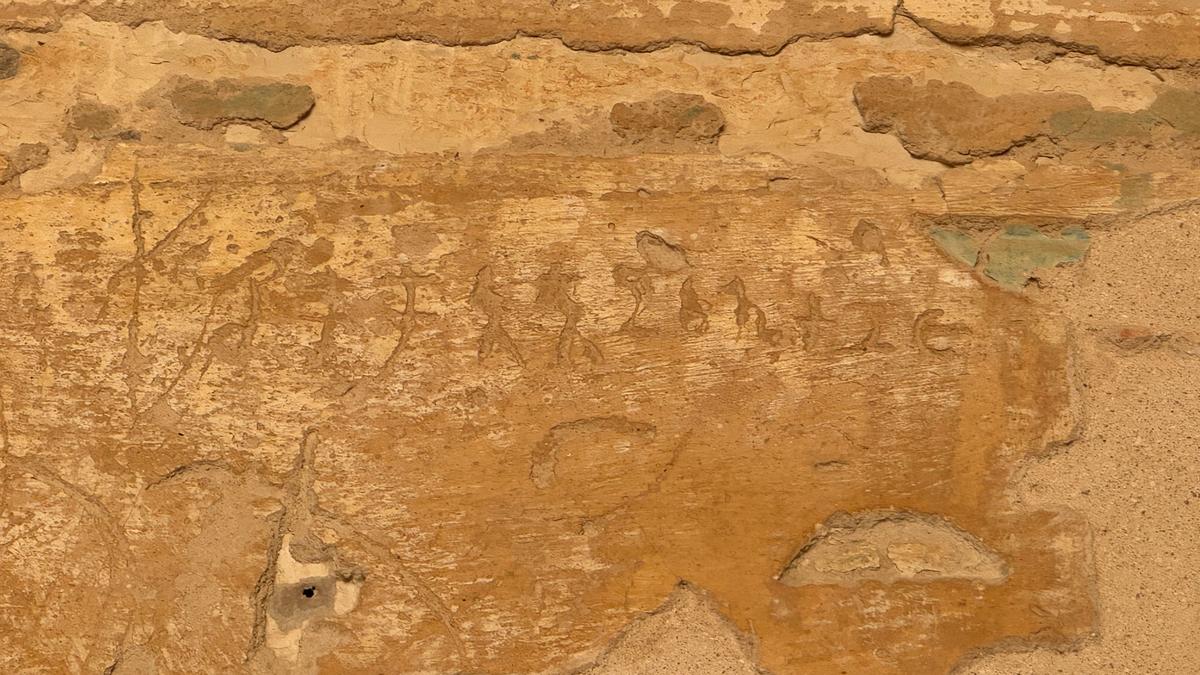
Nearly 30 Tamil-Brahmi, Prakrit and Sanskrit inions (1st–3rd century CE) have been identified inside tombs in Egypt’s Valley of the Kings, indicating direct Indian presence in Roman-era Egypt.
Researchers have documented around 30 ancient Indian inions inside six tombs at the Valley of the Kings, dating to the 1st–3rd centuries CE. These inions, written in Tamil-Brahmi, Prakrit, and Sanskrit, provide fresh evidence of maritime trade and cultural interactions between ancient Tamilakam and Roman Egypt.
About the Discovery
Location
- Found in six rock-cut tombs within the Valley of the Kings.
- The site forms part of the Theban Necropolis on the west bank of the Nile near Luxor.
Nature of Inions
- Nearly 30 inions identified.
- s used:
- Tamil-Brahmi
- Prakrit
- Sanskrit
- Suggests presence of people from diverse regions of ancient India.
Repeated Tamil Names
- The name “Cikai Korran” appears eight times across five tombs, indicating repeated visits or extended presence.
- Other names recorded: Kopan, Catan, Kiran - associated with Sangam-era Tamil culture.
- The inions resemble a graffiti tradition, similar to Greek inions left by visitors.
Link to Indo-Roman Trade
Maritime Trade Context
- Dating (1st–3rd century CE) coincides with peak Indo-Roman maritime trade.
- Trade route connected:
- Tamilakam (South India)
- Red Sea ports of Roman Egypt
- Nile Valley and Mediterranean world
Parallel Evidence
- Similar Tamil names were earlier found at Berenike, a major Roman port on the Red Sea.
- Confirms sustained contact beyond coastal ports.
Significance
- Demonstrates that Indian traders likely travelled beyond Egyptian ports into the Nile valley.
- Suggests deeper commercial and cultural exchanges, not merely port-level transactions.
- Reinforces literary references from:
- Periplus of the Erythraean Sea
- Sangam literature describing Yavana (Greek/Roman) trade.
About the Valley of the Kings
What It Is
A major burial site of pharaohs of Egypt’s New Kingdom.
Location
- West bank of the Nile River
- Near modern Luxor (ancient Thebes), Upper Egypt
- Designated a UNESCO World Heritage Site (1979) as part of Ancient Thebes.
Historical Period
- Primarily used during the 18th–20th Dynasties (c. 1539–1075 BCE).
- Royal burials from Thutmose I to Ramses X.
Architectural Features
- Rock-cut tombs with descending corridors.
- Pillared halls and burial chambers.
- Deep shafts to deter robbers.
- Walls decorated with funerary texts:
- Book of the Dead
- Book of Gates
- Book of That Which Is in the Underworld
Archaeological Importance
- Over 60 tombs discovered.
- Includes the famous tomb of Tutankhamun (KV62).
Historical Context: Tamil-Brahmi
- Early used to write Old Tamil.
- Dates back to at least the 3rd century BCE.
- Associated with the Sangam period.
- Previously found in Tamil Nadu, Sri Lanka, and Southeast Asia.
- Now documented in Egypt — expanding the geographical footprint of early Indian s.
Tamil-Brahmi Inions in Egypt
- 13 Feb 2026
In News:
Nearly 30 Tamil-Brahmi, Prakrit and Sanskrit inions (1st–3rd century CE) have been identified inside tombs in Egypt’s Valley of the Kings, indicating direct Indian presence in Roman-era Egypt.
Researchers have documented around 30 ancient Indian inions inside six tombs at the Valley of the Kings, dating to the 1st–3rd centuries CE. These inions, written in Tamil-Brahmi, Prakrit, and Sanskrit, provide fresh evidence of maritime trade and cultural interactions between ancient Tamilakam and Roman Egypt.
About the Discovery
Location
- Found in six rock-cut tombs within the Valley of the Kings.
- The site forms part of the Theban Necropolis on the west bank of the Nile near Luxor.
Nature of Inions
- Nearly 30 inions identified.
- s used:
- Tamil-Brahmi
- Prakrit
- Sanskrit
- Suggests presence of people from diverse regions of ancient India.
Repeated Tamil Names
- The name “Cikai Korran” appears eight times across five tombs, indicating repeated visits or extended presence.
- Other names recorded: Kopan, Catan, Kiran - associated with Sangam-era Tamil culture.
- The inions resemble a graffiti tradition, similar to Greek inions left by visitors.
Link to Indo-Roman Trade
Maritime Trade Context
- Dating (1st–3rd century CE) coincides with peak Indo-Roman maritime trade.
- Trade route connected:
- Tamilakam (South India)
- Red Sea ports of Roman Egypt
- Nile Valley and Mediterranean world
Parallel Evidence
- Similar Tamil names were earlier found at Berenike, a major Roman port on the Red Sea.
- Confirms sustained contact beyond coastal ports.
Significance
- Demonstrates that Indian traders likely travelled beyond Egyptian ports into the Nile valley.
- Suggests deeper commercial and cultural exchanges, not merely port-level transactions.
- Reinforces literary references from:
- Periplus of the Erythraean Sea
- Sangam literature describing Yavana (Greek/Roman) trade.
About the Valley of the Kings
What It Is
A major burial site of pharaohs of Egypt’s New Kingdom.
Location
- West bank of the Nile River
- Near modern Luxor (ancient Thebes), Upper Egypt
- Designated a UNESCO World Heritage Site (1979) as part of Ancient Thebes.
Historical Period
- Primarily used during the 18th–20th Dynasties (c. 1539–1075 BCE).
- Royal burials from Thutmose I to Ramses X.
Architectural Features
- Rock-cut tombs with descending corridors.
- Pillared halls and burial chambers.
- Deep shafts to deter robbers.
- Walls decorated with funerary texts:
- Book of the Dead
- Book of Gates
- Book of That Which Is in the Underworld
Archaeological Importance
- Over 60 tombs discovered.
- Includes the famous tomb of Tutankhamun (KV62).
Historical Context: Tamil-Brahmi
- Early used to write Old Tamil.
- Dates back to at least the 3rd century BCE.
- Associated with the Sangam period.
- Previously found in Tamil Nadu, Sri Lanka, and Southeast Asia.
- Now documented in Egypt — expanding the geographical footprint of early Indian s.
Dolphin Census in Odisha
- 13 Feb 2026
In News:
Odisha has registered its highest marine dolphin population in the past five years, with 765 dolphins recorded in the 2026 State-wide census. The estimation highlights stable to improving population trends and underscores the role of sustained conservation, habitat protection, and community participation.
About the Dolphin Census in Odisha
What is it?
- An annual scientific population estimation exercise assessing the abundance, distribution, and diversity of dolphins and other cetaceans in Odisha’s marine, estuarine, and lagoon ecosystems.
Conducting Authority
The census is conducted by the Wildlife Wing of the Forest, Environment and Climate Change Department, Government of Odisha. It involves:
- Forest officials and frontline staff
- Marine experts
- Boat-based and shore-based transect surveys
- Training in species identification and safety protocols
The exercise began in Chilika in 2008 and expanded to all coastal forest divisions since 2015.
Key Findings: Dolphin Census 2026
Total Population: 765 dolphins (An increase of 55 individuals compared to the previous year)
Species-wise Distribution
- Humpback Dolphins – 497
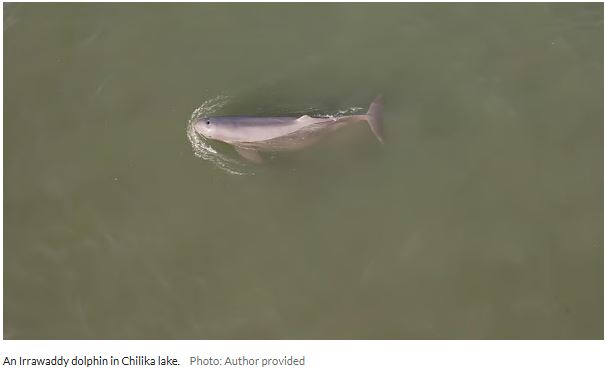
- Irrawaddy Dolphins – 208
- Bottlenose Dolphins – 55
- Spinner Dolphins – 3
- Finless Porpoise – 2
Key Conservation Zones
Chilika Lake
- Recorded 159 Irrawaddy dolphins.
- Hosts the largest single-area concentration of Irrawaddy dolphins globally.
- It is a Ramsar Site (wetland of international importance).
- Population has remained stagnant for two years due to:
- Slow breeding rate
- Habitat stress (prawn gheries, nylon fishing nets)
- Possible migration to other areas
Irrawaddy dolphins were also sighted in:
- Balasore
- Berhampur
- Puri Wildlife Division
- Rajnagar Mangrove Division
Gahirmatha Marine Sanctuary
- Emerged as a strong marine conservation zone.
- Recorded 474 Humpback dolphins, the highest among surveyed regions.
Conservation Significance
- Dolphins are protected under Schedule I of the Wildlife (Protection) Act, 1972 (highest level of legal protection).
- The Irrawaddy dolphin is classified as Endangered on the IUCN Red List.
- Dolphins serve as flagship and indicator species of marine ecosystem health.
Reasons for Population Improvement
- Habitat protection measures
- Regulation of fishing practices
- Community participation drives
- Scientific monitoring and inter-divisional coordination
- Capacity building of field staff
About Dolphins (General Features)
Dolphins are aquatic marine mammals belonging to the order Cetacea.
Key Characteristics:
- Highly intelligent; capable of complex communication.
- Use echolocation for navigation and hunting.
- Social animals living in pods.
- Slow breeding rate (especially Irrawaddy dolphins).
- Indicators of marine ecosystem health.
Species Found in Odisha
- Humpback Dolphin
- Irrawaddy Dolphin
- Bottlenose Dolphin
- Spinner Dolphin
- Finless Porpoise (closely related cetacean)
National Song and National Anthem
- 13 Feb 2026
In News:
The Ministry of Home Affairs (MHA) has issued fresh guidelines to States and government bodies regarding the sequence, occasions, and manner of rendering the National Song and National Anthem at official events.
1. Sequence of Play
- If both are played at the same event, Vande Mataram (National Song) must be sung/played first.
- It shall be followed by Jana Gana Mana (National Anthem).
- This establishes a clear ceremonial order of precedence.
2. Mandatory Respect
- The audience must stand to attention when the official version of Vande Mataram (approx. 3 minutes 10 seconds) is sung or played.
- However, if it is played as part of a newsreel, documentary, or film, the audience is not required to stand, as this may disrupt the screening.
3. Occasions for Playing Vande Mataram
The National Song is mandated at specific high-level functions:
- Presidential/Gubernatorial Events: On arrival and departure of the President or Governor/Lieutenant Governor at formal State functions.
- Presidential Addresses: Immediately before and after the President’s address to the nation on All India Radio or television.
- Flag Ceremonies: When the National Flag is brought on parade.
- Cultural/Ceremonial Functions: During unfurling of the National Flag (other than parades).
4. Musical Protocol
- When played by a band, it must be preceded by a roll of drums to alert the audience.
5. Instructions for Schools
- Schools may begin the day with community singing of the National Song.
- Authorities are directed to promote both the National Song and Anthem to foster respect for national symbols.
These instructions align with Article 51A(a) of the Constitution, which makes it a Fundamental Duty to respect the Constitution, National Flag, and National Anthem. While the Constitution does not explicitly mention a National Song, its respect is institutionally recognized.
About Vande Mataram
Origin and Composition
- Composed by Bankim Chandra Chatterjee.
- First published in Bangadarshan (1875).
- Later included in the novel Anandamath (1882).
- Set to music by Rabindranath Tagore.
- Written in Sanskritized Bengali.
National Status
- On 24 January 1950, Dr. Rajendra Prasad announced that while Jana Gana Mana would be the National Anthem, Vande Mataram would be honoured equally for its historic role in the freedom struggle.
- The Constitution does not explicitly mention a National Song.
Role in the Freedom Movement
- 1896: Sung by Rabindranath Tagore at the Calcutta Session of the Indian National Congress.
- 1905 (Varanasi Session): Adopted for all-India occasions.
- 7 August 1905: First used as a political slogan during anti-partition protests at Calcutta Town Hall.
- Became the rallying cry of the Swadeshi Movement against the Partition of Bengal.
- Lord Curzon ordered arrests for singing it due to its mobilising power.
Revolutionary and International Influence
- 1907: Madam Bhikaji Cama unfurled a tricolour flag at Stuttgart, Germany, bearing the words “Vande Mataram.”
- 1909: Madan Lal Dhingra reportedly uttered “Bande Mataram” before execution in England.
- 1912: Gopal Krishna Gokhale was welcomed in Cape Town with chants of “Vande Mataram.”
Jana Gana Mana
Origin and Composition
- Written and composed by Rabindranath Tagore in 1911.
- First stanza of the five-stanza poem Bharoto Bhagyo Bidhata.
- Originally written in Bengali (Sadhu Bhasha).
First Rendition
- First sung publicly on 27 December 1911 at the Calcutta Session of the Indian National Congress.
Official Adoption
- Adopted as the National Anthem by the Constituent Assembly on 24 January 1950.
Translation and Versions
- Translated into English by Tagore at Madanapalle (Andhra Pradesh) as “The Morning Song of India.”
- A Hindustani version titled Subh Sukh Chain was prepared under Subhas Chandra Bose for the Indian National Army.
Supreme Court Ruling (2005)
- A petition seeking replacement of the word “Sindh” with “Kashmir” was rejected.
- The Court held that “Sindh” represents cultural heritage, not merely territorial reference.
Unique Distinction
Rabindranath Tagore is the only individual to have written national anthems of two countries:
- India – Jana Gana Mana
- Bangladesh – Amar Sonar Bangla