
Omen Drone

- 16 Nov 2025
In News:
The United States and the United Arab Emirates announced a new defence cooperation initiative involving joint capability development during the U.S. President’s visit to Abu Dhabi.As part of this partnership, American defence technology firm Anduril Industries and the UAE’s state-owned EDGE Group are co-developing a new AI-enabled Omen drone at a research facility in Abu Dhabi.
Omen Drone: Overview
- The Omen drone is an advanced, hybrid-electric, tail-sitting vertical takeoff and landing (VTOL) unmanned aerial vehicle (UAV).
- It is being developed under a joint U.S.–UAE defence technology initiative, reflecting deeper bilateral defence ties.
- Development Centre:
- A dedicated 50,000 sq ft (≈4,645 sqm) research and production facility has been established in Abu Dhabi.
- Joint development integrates:
- U.S. high-tech autonomous systems expertise
- UAE’s expanding defence manufacturing ecosystem
Key Features of Omen Drone
- Tail-sitting VTOL Design
- Takes off and lands vertically in a tail-sitting position (approx. 10 feet in height).
- Eliminates the need for runways or large launch infrastructure.
- Enables deployment from rugged terrain or forward operating bases.
- Hybrid-electric Propulsion
- Combines electric and combustion systems for:
- Extended endurance
- Greater operational range
- Quieter operation compared to fully combustion UAVs
- Combines electric and combustion systems for:
- Aerodynamic Configuration
- Long, slender main wings mounted toward the rear.
- Canard foreplanes near the nose for stability.
- Twin-boom tail extending from each wing nacelle.
- Dual Flight Mode: Capable of:
- Hovering like a rotorcraft
- Transitioning to fixed-wing flight for longer and faster missions
This hybrid ability makes it highly versatile across different mission profiles.
- Compact, Modular, and Portable
- Foldable and lightweight design.
- Can be carried and assembled by a two-person team.
- Supports multiple payload options due to open architecture.
Operational Roles and Mission Applications
The Omen drone is designed for both military and civilian use-cases.
Military Roles
- Maritime surveillance
- Border security
- Persistent intelligence, surveillance, and reconnaissance (ISR)
- Monitoring choke points and coastal zones
- Complementing larger UAV systems in tactical operations
Civilian/Non-military Roles
- Critical infrastructure protection
- Search and rescue support
- Communication relay in remote areas
The modular configuration allows integration of:
- Electro-optical (EO) sensors
- Infrared (IR) sensors
- Communication and data-link systems
Geopolitical and Strategic Significance
- Represents deepening US–UAE defence cooperation through co-development, not just arms transfers.
- Shows the UAE’s increasing focus on domestic defence R&D and manufacturing.
- Strengthens U.S. strategic presence and influence in the Gulf region.
- Demonstrates the growing role of AI, autonomy, and hybrid propulsion in next-generation unmanned systems.
- Reflects a broader defence trend of modular, multi-role drones replacing older single-purpose platforms.
Hydrogen Valley Innovation Clusters
- 16 Nov 2025
In News:
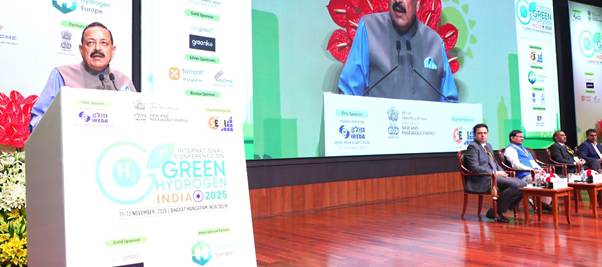
India has announced the development of four Hydrogen Valley Innovation Clusters (HVICs) as part of its transition toward a self-reliant hydrogen economy. The initiative was highlighted at the 3rd International Conference on Green Hydrogen (ICGH 2025) by the Union Minister of Science and Technology.
What are Hydrogen Valley Innovation Clusters?
- Hydrogen Valley Innovation Clusters are integrated ecosystems designed to demonstrate the complete green hydrogen value chain, including:production, storage, transport and utilization across industries, mobility, and energy systems
- Locations: Four HVICs are being developed at:Pune, Jodhpur, Bhubaneswar and Kerala.
- Funding Structure: Total investment: ?485 crore
- ?169.89 crore under the National Green Hydrogen Mission (NGHM)
- ?315.43 crore from industry and consortium partners
- Purpose of HVICs:
- Build a localized hydrogen economy linking supply and demand.
- Promote R&D, innovation, skill development, and technology validation.
- Serve as living laboratories for policy formulation and standardization.
- Support India’s drive toward energy security, industrial competitiveness, and clean mobility.
Originally conceptualized by the Department of Science and Technology (DST), they are now integrated under the Ministry of New and Renewable Energy (MNRE) through the National Green Hydrogen Mission.
National Vision for Green Hydrogen
India sees green hydrogen as a critical component of:
- Viksit Bharat 2047
- energy transition
- industrial decarbonization
- strategic technological leadership
The Minister emphasized that clean energy is an economic, technological, and strategic imperative, driven through collaboration between government, industry, and academia.
What is Green Hydrogen?
Green hydrogen is produced using renewable energy (solar/wind) for splitting water into hydrogen and oxygen via electrolysis.
Indian Standards
Hydrogen is classified as “green” when:
- Total emissions are ≤ 2 kg CO? equivalent per kg of hydrogen produced.
It can also be sourced from biomass (agri-waste) if it meets the same emission threshold.
Key National Initiatives:
1. RDI Scheme (2025)
- Launched in November 2025.
- Total corpus: ?1 lakh crore
- ?20,000 crore allocated to DST.
- Supports deep-tech, clean energy innovation, and start-up participation.
- Aims to close the gap between research and deployment.
2. Anusandhan National Research Foundation (ANRF)
- Integrates academia, industry, and government into a mission-oriented innovation system.
- Focuses on clean energy, advanced manufacturing, and sustainability.
3. MAHA–EV Mission
- Promotes indigenous innovation in:
- electric vehicles
- fuel cells
- battery technologies
- hydrogen mobility solutions
4. Mission Innovation 2.0
- India aims to reduce global clean hydrogen cost to USD 2/kg.
- Global replication of Hydrogen Valley model by 2030.
ESCAPEDE Mission
- 16 Nov 2025
In News:
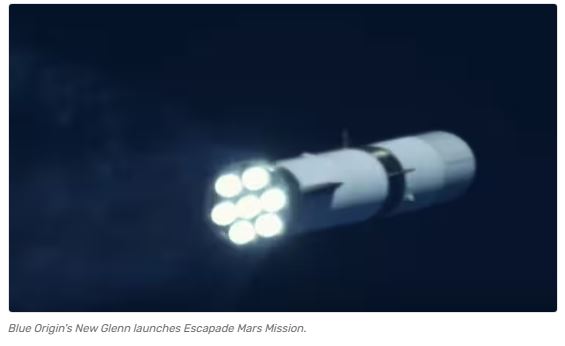
Blue Origin successfully launched NASA’s ESCAPADE (Escape and Plasma Acceleration and Dynamics Explorers) mission to Mars aboard the New Glenn heavy-lift rocket from Cape Canaveral.
The launch marks a major milestone for both interplanetary science and commercial reusable rocket technology.
About ESCAPADE Mission
ESCAPADE is NASA’s first coordinated dual-spacecraft orbital science mission to Mars.
Key Components
- Twin spacecraft named Blue and Gold.
- Designed for simultaneous observations from different regions of Martian space.
- Developed under NASA’s SIMPLEx (Small Innovative Missions for Planetary Exploration) program.
- Utilises a “launch and loiter” flight strategy:
- Spacecraft first travel toward the Sun–Earth Lagrange Point 2 (L2).
- They remain at L2 until the optimal Mars-transfer window opens.
- Cruise toward Mars in late 2026, with arrival expected by 2027.
Mission Objectives
- Study the interaction between the solar wind and the Martian magnetosphere.
- Investigate how space weather affects Mars’ atmospheric dynamics.
- Understand the process of atmospheric escape, a key factor behind:
- Mars losing its thick ancient atmosphere
- Decline in surface habitability
- Generate real-time data on:
- Magnetic field variations
- Plasma environment
- Solar wind–atmosphere coupling
These insights support future human exploration and long-term Mars climate modelling.
Scientific Rationale
- The solar wind continually erodes Mars’ upper atmosphere.
- By observing from dual vantage points, ESCAPADE will map:
- Plasma flow patterns
- Energy transfer from solar particles
- Changes in the induced magnetosphere over time
- Understanding these processes helps reconstruct the planet’s evolution and potential for past habitability.
Launch Details and Timeline
- Launched using Blue Origin’s New Glenn rocket.
- Mission timeline:
- Up to one year in Earth orbit (loiter phase)
- Mars transit: 2026–2027
- Science operations: 2027–2029
Significance of Blue Origin’s Role
- Advancement in Heavy-Lift Commercial Launches
- This was the second flight of the 321-foot New Glenn rocket.
- Demonstrates Blue Origin’s readiness for planetary missions.
- Breakthrough in Reusability
- Rocket’s first stage successfully landed on the recovery ship “Jacklyn” in the Atlantic.
- Places Blue Origin alongside SpaceX in recovering large boosters.
- Enhances competitiveness in:
- NASA contracts
- Deep-space mission launches
- Commercial satellite markets
- Expansion of Infrastructure
- Over $1 billion invested in Florida launch facilities.
- Signals Blue Origin’s long-term commitment to reusable, cost-efficient spaceflight.
ARISE Program
- 16 Nov 2025
In News:
At the COP30 Climate Summit in Belém, Brazil, the Climate Investment Funds (CIF) launched a new climate-resilience initiative -ARISE (Accelerating Resilience Investments and Innovations for Sustainable Economies).Germany and Spain jointly committed USD 100 million as the program’s initial funding.
About ARISE Program
- ARISE is a next-generation climate resilience initiative aimed at enabling developing nations to withstand and adapt to increasing climate shocks such as floods, droughts, storms, and economic disruptions.
- Objectives
- Integrate climate resilience into national economic planning.
- Strengthen the adaptive capacity of vulnerable economies.
- Mobilisecatalytic finance for adaptation.
- Convert climate risks into opportunities for sustainable and inclusive growth.
- Facilitate investments from:
- Multilateral Development Banks (MDBs)
- Climate funds
- Private sector
- Key Functions
- Support countries in embedding resilience into development strategies.
- Unlock new financing channels and reduce investment risks.
- Enhance institutional and community-level preparedness.
About Climate Investment Funds (CIF)
- A $13 billion multilateral climate finance mechanism established in 2008, housed within the World Bank Group.
- Purpose: To provide concessional finance to developing countries for:
- Low-carbon development
- Climate resilience
- Clean technology deployment
- Nature-based solutions
- Coverage: Supports climate action in 70+ low- and middle-income countries.
- Institutional Framework: CIF is implemented through six Multilateral Development Banks (MDBs) including:
- World Bank
- IFC
- Asian Development Bank (ADB)
- African Development Bank (AfDB)
- European Bank for Reconstruction and Development (EBRD)
- Inter-American Development Bank (IDB)
This MDB-based structure ensures country-led implementation and strong international coordination.
Structure of CIF
CIF consists of two core funding windows:
1. Clean Technology Fund (CTF)
Focus:
- Renewable energy
- Clean transportation
- Energy efficiency
2. Strategic Climate Fund (SCF)
Focuses on innovative pilot initiatives such as:
- Pilot Program for Climate Resilience (PPCR)
- Forest Investment Program (FIP)
- Smart Cities Program
Finance Model
CIF operates on a blended finance approach:
- Combines concessional funding with MDB and private investments.
- Reduces financial risks to attract large-scale commercial capital.
- Catalyses transformational climate investments.
National Database for Emergency Management (NDEM)
- 16 Nov 2025
In News:
The Ministry of Road Transport and Highways (MoRTH) has made it mandatory to incorporate ISRO’s National Database for Emergency Management (NDEM) analysis in all Detailed Project Reports (DPRs) for highway construction. This marks a shift towards geospatially informed, risk-aware infrastructure planning wherein satellite-based decision support systems become integral to national development.
Key Highlights:
- NDEM is a national-level geospatial platform providing real-time, multi-temporal satellite data for disaster preparedness, mitigation, response, and infrastructure planning.
Institutional Architecture
- Developer: National Remote Sensing Centre (NRSC), ISRO
- Guidance: National Disaster Management Authority (NDMA) & Ministry of Home Affairs (MHA)
- Users: Central and State agencies, NDRF, SDRFs, SDMA, infrastructure planners
Core Functionalities
- Multi-hazard mapping (floods, earthquakes, cyclones, landslides, droughts)
- Digital Elevation Models (DEM) for terrain, slope, and drainage
- Land Use / Land Cover (LULC)
- Decision-support tools for emergency response
- Geospatial analytics for risk modelling and vulnerability assessment
Rationale Behind MoRTH’s Mandate
- Addressing Infrastructure Vulnerability: India’s highways traverse diverse geomorphological zones—floodplains, seismic zones, fragile Himalayan slopes - making them prone to natural hazards. NDEM’s geospatial datasets reduce the probability of faulty alignment, slope failure, and drainage mismanagement.
- Enhancing Project Feasibility and Efficiency: The mandate seeks to:
- Reduce field-level uncertainties
- Prevent cost overruns due to unforeseen terrain constraints
- Align infrastructure with long-term climatic and hydrological trends
- Enabling Evidence-Based Governance: By mandating NDEM analysis, MoRTHinstitutionalises:
- Data-driven DPR preparation
- Accountability in route design
- Standardisation of hazard-informed planning
Key Areas Where NDEM Strengthens Highway Planning
- Route Alignment Optimisation: NDEM helps engineers identify:
- Landslide-prone slopes
- Flood-prone lowlands
- Seismic fault lines
- Ecologically sensitive zones
- This enables selection of safer, cost-optimal corridors.
- Improved Engineering Design
- Hazard zonation supports:
- Slope stabilisation design
- Optimum bridge and culvert placement
- Scientific drainage planning
- Protection structures in vulnerable zones
- Social and Environmental Risk Reduction: NDEM layers assist in:
- Avoiding densely populated risk zones
- Minimising displacement and ecological impact
- Strengthening environmental and social screening
- Strengthening Disaster Resilience: In the context of rising climate-driven hazards, NDEM supports planning that ensures:
- Continuity of road networks during disasters
- Reduced damage to assets
- Better deployment of emergency services