
Divyangjan-Focused Initiatives in Budget 2026–27
- 02 Feb 2026
In News:
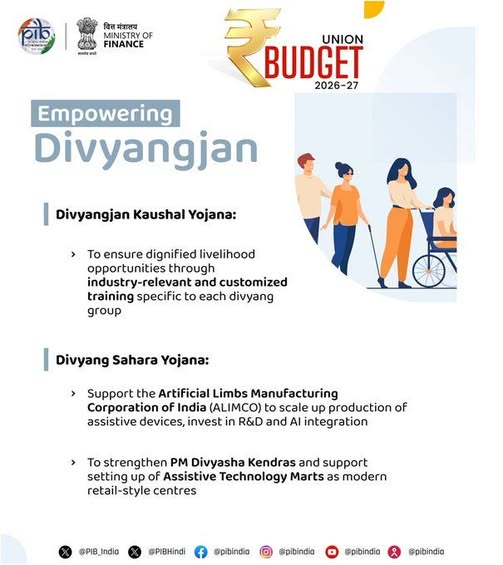
The Union Budget 2026–27 reinforces the commitment to inclusive development by introducing two targeted initiatives for persons with disabilities (Divyangjan): the Divyangjan Kaushal Yojana and the Divyang Sahara Yojana. These schemes aim to enhance dignified livelihood opportunities and ensure access to advanced assistive technologies, aligning with the broader vision of equitable participation in economic and social life.
Divyangjan Kaushal Yojana: Industry-Linked Skilling
The Divyangjan Kaushal Yojana focuses on providing customised, industry-relevant skill training tailored to different disability categories. With an allocation of ?200 crore, the scheme targets sectors that offer task-oriented and process-driven roles, making them more adaptable for diverse abilities.
Key Features:
- Training in Information Technology (IT)
- Skills development in Animation, Visual Effects, Gaming and Comics (AVGC)
- Employment pathways in Hospitality, Food & Beverages
- Emphasis on customised pedagogy, assistive learning tools, and workplace readiness
The scheme shifts the approach from welfare to capability-building, enabling Divyangjan to access mainstream employment and entrepreneurial avenues.
Divyang Sahara Yojana: Expanding Assistive Technology Access
With an allocation of ?100 crore, the Divyang Sahara Yojana aims to strengthen the ecosystem for assistive devices and rehabilitation services.
Major Components:
- Support to Artificial Limbs Manufacturing Corporation of India (ALIMCO) to:
- Scale up production of high-quality assistive devices
- Invest in R&D and AI-enabled innovations
- Improve design, durability, and affordability
- Strengthening of PM Divyasha Kendra: These centres provide integrated services including:
- Assessment and evaluation
- Counselling
- Distribution of assistive aids
- Post-distribution care and follow-up
- Establishment of Assistive Technology Marts: These will function as modern retail-style centres where Divyangjan and senior citizens can:
- See and compare assistive products
- Try devices before purchase
- Access professional guidance
This retail-style approach improves choice, awareness, and accessibility, reducing dependence on ad hoc distribution models.
Significance for Inclusive Development
These initiatives reflect a rights-based and empowerment-oriented approach:
- Promote economic independence through skill integration
- Leverage technology and AI for better assistive solutions
- Support accessible infrastructure and service delivery models
- Align with the goals of social justice, human dignity, and equal opportunity
By combining skilling, employment linkage, and assistive support, the government seeks to ensure that Divyangjan move from beneficiaries of aid to active participants in India’s growth story.
Guru Ravidas
- 02 Feb 2026
In News:
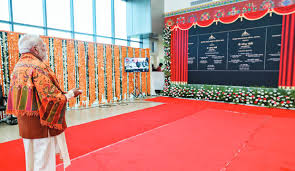
The recent inauguration and renaming of Adampur Airport in Punjab after Sri Sant Guru Ravidas Ji highlights the continued relevance of medieval Bhakti saints in India’s socio-cultural landscape. Such recognition goes beyond symbolic tribute and reflects the enduring influence of Guru Ravidas’s teachings on equality, dignity, and spiritual freedom.
Guru Ravidas
- Guru Ravidas (c. 1377–1527 CE) was a prominent saint-poet of the Bhakti Movement, born in Sir Gobardhanpur near Varanasi (Uttar Pradesh). His life coincided with other major Bhakti figures such as Kabir, and he is traditionally regarded as a disciple of Ramananda.
- Guru Ravidas composed devotional poetry in local dialects, making spiritual ideas accessible to common people. His verses emphasised direct devotion to the divine without ritualism or priestly mediation.
Teachings and Philosophy
Guru Ravidas’s philosophy was deeply egalitarian and reformist:
- Rejected the caste hierarchy and social discrimination
- Advocated human dignity and equality
- Promoted spiritual freedom over ritual orthodoxy
- Emphasised Nirguna Bhakti (devotion to a formless divine)
A central idea in his teachings is “Beghumpura” — an ideal city without sorrow, fear, or discrimination, symbolising a just and casteless society. This vision makes him a powerful voice in India’s historical struggle against untouchability and social exclusion.
Literary and Religious Legacy
Guru Ravidas’s influence transcended religious boundaries:
- 41 hymns attributed to him are included in the Guru Granth Sahib, the holy scripture of Sikhism
- His verses also appear in the Panch Vani of the Dadu Panthi tradition
- The Bhakti saint Meera Bai is believed to have regarded him as her spiritual guide
Over time, his teachings became the foundation of the Ravidassia religion, whose followers revere him as their central spiritual authority. The community follows the Amrit Bani Guru Ravidass as its holy book and has developed distinct religious symbols and practices.
Biopharma SHAKTI and Health Sector Reforms
- 02 Feb 2026
In News:
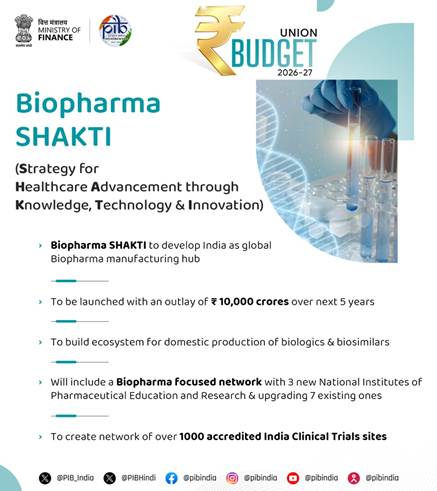
The Union Budget 2026–27 places health at the centre of India’s development strategy, aligning with the broader goals of capacity building, inclusive growth, and economic resilience. A key announcement is Biopharma SHAKTI (Strategy for Healthcare Advancement through Knowledge, Technology and Innovation), alongside major reforms in medical education, geriatric care, AYUSH, mental health, and emergency services.
Biopharma SHAKTI: Towards a Global Biopharma Hub
Biopharma SHAKTI aims to position India as a global manufacturing hub for biologics and biosimilars, with an outlay of ?10,000 crore over five years.
Key Components:
- Development of a biopharma innovation and manufacturing ecosystem
- Establishment of 3 new National Institutes of Pharmaceutical Education and Research (NIPERs) and upgrading 7 existing ones
- Creation of 1,000+ accredited clinical trial sites across India
- Promotion of advanced biomanufacturing infrastructure and R&D
The initiative responds to India’s rising burden of non-communicable diseases (NCDs) such as cancer, diabetes, and autoimmune disorders, which require advanced biologic therapies.
- Biologics are complex medicines derived from living organisms, often expensive and technologically demanding to produce.
- Biosimilars are highly similar, cost-effective alternatives that expand access to life-saving treatments while maintaining safety and efficacy.
Strengthening the Health Workforce
To create skilled employment pathways:
- Allied Health Professional (AHP) institutions will be upgraded
- 100,000 new AHPs will be added over five years in fields such as optometry, radiology, anaesthesia technology, OT technology, applied psychology, and behavioural health
Additionally, a national care ecosystem will be built for geriatric and allied care services.
- 1.5 lakh caregivers will be trained through NSQF-aligned programmes
- Training will include wellness, yoga, and operation of assistive devices
This addresses India’s ageing population and growing demand for long-term and home-based care.
Regional Medical Hubs and Medical Tourism
A new scheme will support states in establishing five Regional Medical Hubs through public-private partnerships. These integrated complexes will include:
- Advanced medical facilities
- Educational and research institutions
- AYUSH centres
- Medical value tourism facilitation services
- Diagnostics, rehabilitation, and post-care infrastructure
This aims to boost medical tourism, generate employment, and improve regional healthcare access.
Boost to AYUSH and Traditional Medicine
Recognising global interest in traditional systems:
- 3 new All India Institutes of Ayurveda will be established
- AYUSH pharmacies and drug testing laboratories will be upgraded
- The WHO Global Traditional Medicine Centre, Jamnagar will be strengthened for evidence-based research and training
Mental Health and Emergency Care Expansion
To bridge regional gaps:
- National Mental Health Institutes in Ranchi and Tezpur will be upgraded as Regional Apex Institutions
- Emergency capacity of district hospitals will be increased by 50% through new Emergency and Trauma Care Centres
These measures strengthen India’s preparedness for both routine and crisis healthcare needs.
Mahatma Gandhi Gram Swaraj Initiative (MGGSI)
- 02 Feb 2026
In News:
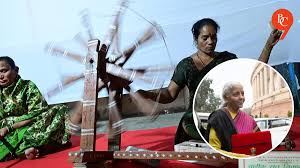
The Union Budget 2026–27 introduced the Mahatma Gandhi Gram Swaraj Initiative (MGGSI) as a focused intervention to revitalise India’s traditional rural industries. The programme seeks to strengthen khadi, handloom, and handicrafts by improving competitiveness, market access, and sustainability of artisan livelihoods. In doing so, it draws inspiration from the Gram Swaraj vision of Mahatma Gandhi, which emphasised self-reliant villages built on local production and decentralized economic power.
Objectives and Target Groups
MGGSI is designed to make traditional sectors economically viable in a modern market environment while preserving India’s craft heritage. It focuses on:
- Weavers and artisans in khadi, handloom, and handicrafts
- Village industries and rural micro-enterprises
- Beneficiaries under the One District One Product (ODOP) initiative
- Rural youth, encouraging them to view traditional industries as viable careers
The initiative recognises that these sectors not only sustain livelihoods but also represent cultural capital and employment-intensive growth, particularly in labour-surplus rural regions.
Addressing Structural Challenges
Traditional craft sectors suffer from long-standing bottlenecks:
- Fragmented supply chains that raise costs and reduce efficiency
- Inconsistent quality standards, limiting access to premium and export markets
- Weak branding and marketing, leading to dependence on middlemen
- Limited integration with modern retail and e-commerce platforms
MGGSI aims to address these constraints through institutional support, quality standardisation, design innovation, and better market linkages. It encourages artisans to adopt modern production techniques and tools without compromising traditional craftsmanship.
Market Access and Branding
A core pillar of MGGSI is improving global and domestic market access. The initiative promotes:
- Professional branding and packaging
- Entry into organised retail chains
- Access to export markets
- Integration with digital and online marketplaces
This shift from subsistence production to market-oriented enterprise aligns with the broader “Vocal for Local” philosophy and the push to strengthen MSMEs as engines of inclusive growth.
Link to Gandhi’s Gram Swaraj Vision
Gandhi’s concept of Gram Swaraj envisioned villages as self-sufficient republics, economically independent and socially cohesive. However, contemporary rural India faces challenges such as agrarian distress, migration, inequality, and weak non-farm employment opportunities, which prevent villages from achieving that ideal.
MGGSI attempts to reinterpret Gram Swaraj for the 21st century by:
- Promoting local production for wider markets
- Generating non-farm rural employment
- Reducing distress migration
- Enhancing economic self-reliance through village industries
Thus, instead of isolation, the modern approach combines local production with global connectivity.
SHE-Marts
- 02 Feb 2026
In News:
The Union government has announced SHE-Mart (Self-Help Entrepreneur Mart) as a new institutional platform to promote women entrepreneurship in rural India. The initiative represents a shift from traditional micro-credit support towards structured, market-linked enterprises owned and managed by women.
Key Highlights:
SHE-Marts are envisioned as community-owned retail outlets established at the cluster-level federation of Self-Help Groups (SHGs). They will be supported through enhanced and innovative financing mechanisms, ensuring sustainability and scalability.
Objectives
SHE-Marts aim to:
- Provide permanent retail spaces for SHG-produced goods
- Ensure direct market access, reducing dependence on intermediaries
- Promote branding, packaging, and value addition
- Encourage processing of agricultural and non-farm products
- Create sustainable income streams for rural women
- Strengthen grassroots institutions such as SHGs and their federations
The initiative signals a policy transition from credit-led livelihoods to enterprise ownership, integrating production, marketing, and financial inclusion.
Lakhpati Didi Programme
SHE-Marts build upon the Lakhpati Didi Programme, launched in 2023, which aims to enable women SHG members to earn at least ?1 lakh per year through skill development and enterprise promotion.
Key Features of Lakhpati Didi
- Implemented by the Ministry of Rural Development
- Targets financial empowerment of rural women
- Focuses on skill training in diverse trades such as:
- Plumbing
- Tailoring and weaving
- LED bulb manufacturing
- Drone operation and repair
- Provides income-generation opportunities post-training
- National target: Training 2 crore women
By equipping women with technical and entrepreneurial skills, the programme lays the foundation for their participation in structured markets — which SHE-Marts now seek to institutionalize.
Significance for Inclusive Development
Together, Lakhpati Didi and SHE-Mart represent a comprehensive rural transformation model based on:
- Women-led economic growth
- Local value addition and market integration
- Strengthening SHG federations as economic institutions
- Reducing rural poverty through enterprise ownership