
FATF’s New Asset Recovery Framework

- 07 Nov 2025
In News:
The Financial Action Task Force (FATF) has recently released an extensive 340-page global guidance on asset recovery, marking a significant shift in international financial crime enforcement. Moving beyond its traditional focus on corruption, the new framework expands asset recovery mechanisms to cover a wide range of economic and financial crimes, including fraud, cybercrime, investment scams, money laundering, and cryptocurrency-related offences.
This development reflects the evolving nature of transnational crime and the growing need for coordinated international responses to trace, seize, and repatriate illicit assets.
What is new in the FATF Asset Recovery Guidance?
The updated guidance introduces a comprehensive lifecycle approach to asset recovery. It outlines best practices across every stage, including:
- Establishing robust legal and policy frameworks
- Identifying and tracing illicit assets
- Preserving and managing seized properties
- Ensuring international cooperation for cross-border recovery
- Restitution and compensation of victims
A notable feature of the guidance is its victim-centric orientation, which emphasizes restoring assets to affected individuals rather than limiting recovery to punitive confiscation.
Expansion Beyond Corruption
Unlike earlier frameworks that primarily addressed corruption-linked assets, the new guidance broadens its scope to include:
- Financial fraud and Ponzi schemes
- Cyber-enabled crimes and digital laundering
- Investment scams and real estate fraud
- Cryptocurrency misuse and virtual asset laundering
This expansion acknowledges that modern financial crimes increasingly exploit digital platforms, complex financial instruments, and cross-border networks.
India’s Contribution: Enforcement Directorate as a Model
The FATF guidance draws extensively from India’s enforcement experience, particularly the work of the Directorate of Enforcement (ED) under the Prevention of Money Laundering Act (PMLA). Several Indian cases are highlighted as global best practices:
- Agri Gold Investment Scam: Coordination between ED and Andhra Pradesh CID led to the attachment and restoration of assets worth ?6,000 crore to defrauded investors.
- IREO Realty Case: Demonstrated India’s use of value-based confiscation, with assets worth ?1,800 crore attached, equivalent to proceeds of crime transferred abroad.
- BitConnect Crypto Fraud: ED seized cryptocurrencies worth ?1,646 crore, secured them in cold wallets, and attached additional properties worth ?500 crore, showcasing effective handling of virtual assets.
- Rose Valley Scheme: Cited as an example of victim restitution, where funds collected through fraudulent debentures were diverted via shell companies.
The guidance also refers to India’s Fugitive Economic Offenders Act, highlighting the principle of fugitive disentitlement, which allows confiscation of assets belonging to offenders who evade judicial processes.
About FATF
The Financial Action Task Force is an intergovernmental body established in 1989 by G7 countries at the Paris Summit. Headquartered in Paris, France, FATF sets global standards to combat:
- Money laundering
- Terrorist financing
- Proliferation financing
Its core functions include:
- Issuing and updating FATF Recommendations
- Conducting mutual evaluations of member countries
- Identifying high-risk jurisdictions through grey and black lists
- Promoting international cooperation in financial investigations
- Addressing emerging threats such as crypto laundering and cyber-financing
FATF’s work aligns closely with UN Security Council resolutions and G20 mandates.
Significance for Global and Indian Context
The new asset recovery guidance strengthens the global financial architecture by:
- Enhancing cross-border cooperation in financial investigations
- Improving recovery of illicit assets in complex digital crimes
- Reinforcing the credibility of national enforcement agencies
- Supporting victim justice and economic stability
For India, FATF’s recognition reinforces its position as a key stakeholder in global financial governance and validates its evolving legal tools to combat economic offences.
Operation White Cauldron

- 07 Nov 2025
In News:
In a significant action against the illicit drug trade, the Directorate of Revenue Intelligence (DRI) recently dismantled a clandestine alprazolam manufacturing unit in Valsad, Gujarat, under an intelligence-led operation codenamed “Operation White Cauldron.” The bust highlights the growing challenge of synthetic drug production in India and underscores the role of enforcement agencies in implementing the Narcotic Drugs and Psychotropic Substances (NDPS) Act, 1985.
Alprazolam
Alprazolam belongs to the benzodiazepine class of drugs, which act as central nervous system (CNS) depressants. Medically, it is prescribed for anxiety and panic disorders, but its misuse can lead to addiction, cognitive impairment, and overdose. Due to its abuse potential, alprazolam is classified as a psychotropic substance under the NDPS Act, 1985, making its unauthorised manufacture, possession, and trafficking a serious criminal offence.
NDPS Act, 1985: Legal Framework
The Narcotic Drugs and Psychotropic Substances Act, 1985 forms the backbone of India’s drug control regime. It:
- Prohibits unauthorised production, cultivation, manufacture, sale, transport, storage, and consumption of narcotic drugs and psychotropic substances.
- Enables forfeiture of property derived from or used in illicit drug trafficking.
- Empowers the government to add or remove substances from the list of controlled drugs.
- Seeks to implement India’s obligations under international drug control conventions.
The Act aims not only at law enforcement but also at prevention, regulation, and deterrence of drug abuse and trafficking.
Wider Implications and Trends
The Valsad bust is part of a broader pattern. In 2025 alone, the DRI dismantled four illegal drug manufacturing units across multiple states. A similar operation earlier in the year in Andhra Pradesh uncovered another alprazolam unit, with drugs again intended for Telangana. These cases highlight:
- The rise of domestic synthetic drug manufacturing.
- Increasing misuse of pharmaceutical psychotropics.
- The need for tighter monitoring of precursor chemicals and supply chains.
Relevance to National Initiatives
Such enforcement actions directly support the government’s Nasha Mukt Bharat Abhiyaan, which seeks to reduce drug demand, disrupt supply networks, and protect vulnerable communities from substance abuse.
Project Suncatcher

- 07 Nov 2025
In News:
In a significant technological development, Google has announced a new research initiative called Project Suncatcher, aimed at exploring the feasibility of hosting AI data centres in space using solar-powered satellite constellations. The project reflects an emerging intersection of artificial intelligence, space technology, and sustainable energy, with potential long-term implications for global computing infrastructure.
What is Project Suncatcher?
Project Suncatcher is a “moonshot” research initiative by Google that seeks to examine whether space can serve as a scalable and sustainable platform for AI compute systems. The core idea is to deploy high-performance AI accelerators on satellites powered directly by solar energy, thereby creating a space-based data centre ecosystem.
The initiative has been driven by the rapidly growing energy and water footprint of terrestrial AI data centres, which are increasingly straining environmental resources. According to Google, space offers access to virtually uninterrupted solar power, making it an attractive alternative for energy-intensive AI workloads.
Key Features and Technical Architecture
- Solar-Powered Satellite Constellation
- The proposed system consists of a constellation of modular satellites, likely placed in dawn–dusk sun-synchronous low Earth orbit (LEO), ensuring near-continuous exposure to sunlight.
- Solar panels in space could generate significantly more power than those on Earth due to the absence of atmospheric losses.
- AI Compute in Space
- Each satellite would host Google’s Tensor Processing Units (TPUs), which are specialised chips designed for machine learning and AI tasks.
- Google claims that space-based solar generation could make these systems several times more powerful than Earth-based equivalents.
- High-Speed Optical Communication
- Satellites would be interconnected using free-space optical communication (laser-based links), enabling data transfer at tens of terabits per second.
- Early terrestrial tests have demonstrated bidirectional speeds of over 1.6 Tbps, which Google believes can be scaled further in space.
- Prototype Testing and Partnerships
- Google plans to launch two prototype satellites by early 2027, in partnership with Planet Labs, to test durability, performance, and reliability in orbit.
- Initial experiments indicate that Google’s Trillium-generation TPUs can withstand radiation levels equivalent to a five-year space mission without permanent failure.
Engineering and Operational Challenges
Despite its promise, Project Suncatcher faces several complex challenges:
- Thermal management of high-performance chips in the vacuum of space.
- Ensuring long-term on-orbit reliability of AI hardware.
- Maintaining ultra-high-speed inter-satellite communication at close orbital distances.
- High launch and maintenance costs, along with space debris and regulatory concerns.
These challenges imply that Project Suncatcher remains a long-term research effort rather than a near-term commercial deployment.
Emissions Gap Report 2025
- 07 Nov 2025
In News:
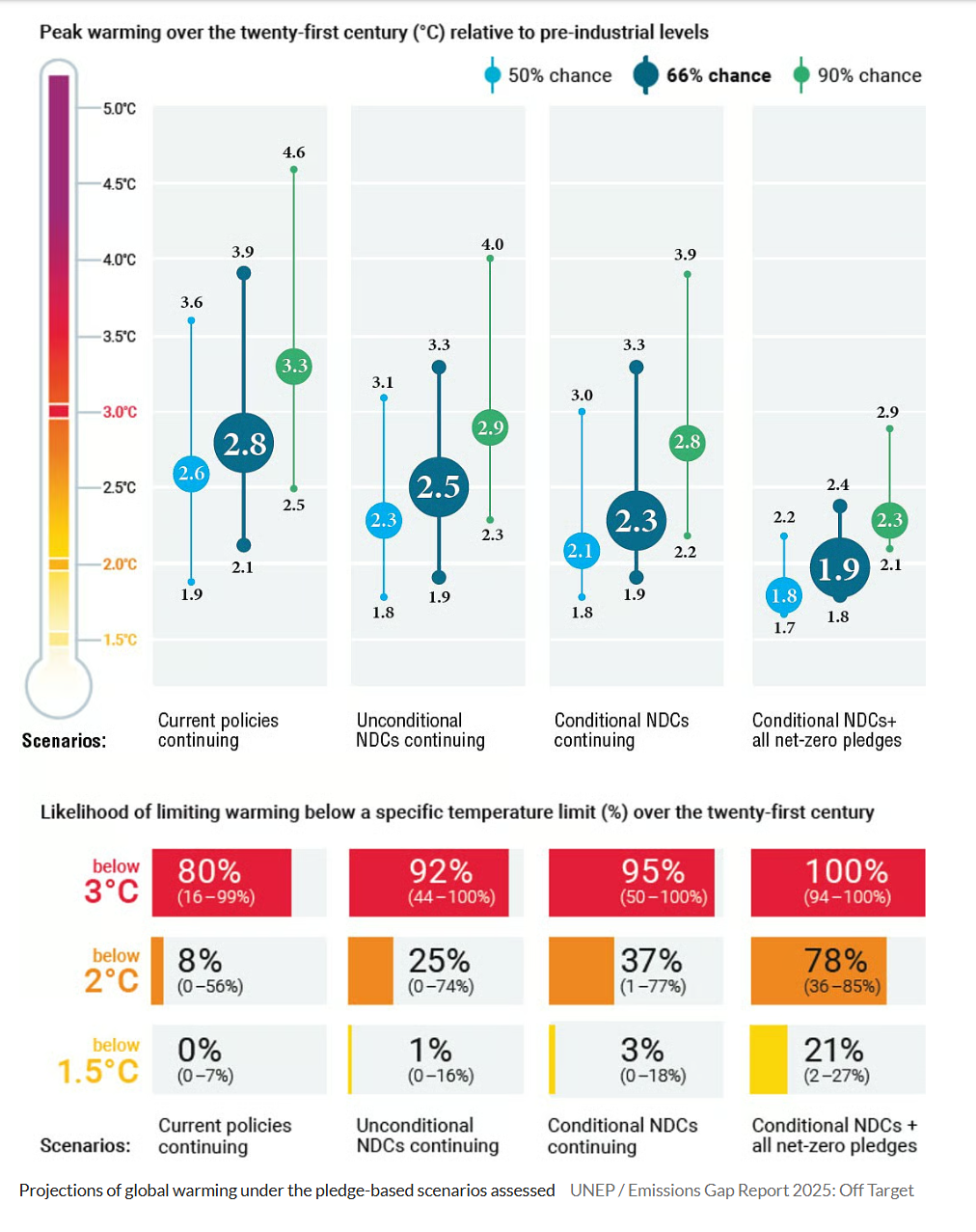
The United Nations Environment Programme (UNEP), in its Emissions Gap Report (EGR) 2025 – “Off Target”, has warned that despite updated climate pledges by countries, the world remains dangerously off course to meet the Paris Agreement temperature goals. Current trajectories indicate that global warming will reach 2.3–2.5°C this century, far exceeding the ambition of limiting warming to well below 2°C, preferably 1.5°C.
About the Emissions Gap Report
The Emissions Gap Report is an annual flagship publication of UNEP, co-produced with the UNEP Copenhagen Climate Centre (UNEP-CCC). It assesses the gap between where global greenhouse gas (GHG) emissions are heading under current pledges and where they should be to meet Paris Agreement targets. The report is released every year ahead of the UN Climate Change Conference of Parties (COP).
Key Findings of Emissions Gap Report 2025
- Marginal Progress in Climate Pledges
- Even if all countries fully implement their latest Nationally Determined Contributions (NDCs), global temperature rise is projected at 2.3–2.5°C.
- This is only a modest improvement from last year’s estimate of 2.6–2.8°C, and UNEP notes that much of this improvement is due to accounting and methodological changes, not real emission reductions.
- Rising Global Emissions
- Global GHG emissions rose by 2.3% in 2024, reaching a record 57.7 gigatonnes of CO? equivalent.
- This growth rate is over four times the annual average of the 2010s, signalling a reversal of earlier decarbonisation trends.
- Low Participation and Weak Ambition
- As of September 30, 2025, only 60 Parties, representing 63% of global emissions, had submitted or announced new 2035 NDCs.
- Even full implementation of existing NDCs would reduce global emissions by only 15% by 2035 (from 2019 levels), whereas a 55% reduction is required to stay on the 1.5°C pathway.
- Implementation Gap
- Most countries are not on track to meet even their 2030 targets, revealing a “huge implementation gap” between commitments and action.
- Overshoot of 1.5°C is Now Likely
- UNEP warns that global temperatures are very likely to exceed 1.5°C within the next decade.
- The policy focus has shifted from prevention to ensuring that this overshoot is temporary and limited, as every fraction of warming avoided reduces climate damages, health risks, and dependence on uncertain carbon dioxide removal (CDR) technologies.
Role of the G20
The G20, responsible for about 77% of global emissions (excluding the African Union), holds the key to closing the emissions gap. Despite some members submitting new NDCs, the group as a whole remains off track for its 2030 goals, undermining global mitigation efforts.
Geopolitical and Structural Challenges
UNEP highlights that geopolitical uncertainties, including the proposed withdrawal of the United States from the Paris Agreement in 2026, could offset climate gains. According to the report, this alone could negate around 0.1°C of the projected improvement.
Opportunities and Way Forward
Despite the bleak outlook, UNEP notes that the world is technically well-positioned to accelerate climate action due to:
- Rapidly declining costs of renewable energy technologies such as solar and wind.
- Proven solutions that can deliver economic growth, jobs, energy security, and health benefits alongside emission reductions.
UNEP’s Key Recommendations
To close the emissions gap, UNEP calls for:
- Removal of policy, governance, institutional, and technical barriers.
- A massive scale-up of climate finance and technology transfer to developing countries.
- Redesign of the international financial architecture to unlock affordable and predictable climate finance.
Second World Summit for Social Development (WSSD-2), 2025

- 07 Nov 2025
In News:
The Second World Summit for Social Development (WSSD-2) is being held Doha, Qatar, under the aegis of the United Nations. India is represented at the summit by the Minister for Labour & Employment and Youth Affairs & Sports, Dr. Mansukh Mandaviya, underscoring India’s commitment to global social development and social justice.
Background and Evolution
The first World Summit for Social Development was held in Copenhagen in 1995, marking a watershed moment in global consensus on placing people-centric development at the heart of economic policy. It resulted in the Copenhagen Declaration, which laid down 10 commitments focused on poverty eradication, employment generation, and social inclusion.
Three decades later, WSSD-2 seeks to reassess global progress, address emerging challenges, and reinvigorate global solidarity in the context of widening inequalities, technological disruption, climate stress, and demographic transitions.
Objectives of WSSD-2
The summit aims to:
- Reaffirm commitment to poverty eradication, full and productive employment, and decent work for all.
- Promote social inclusion, equality, and well-being, particularly for vulnerable and marginalized groups.
- Assess gaps in implementation of social development commitments since 1995.
- Strengthen the implementation of the 2030 Agenda for Sustainable Development and the Sustainable Development Goals (SDGs).
- Reaffirm the 10 commitments of the Copenhagen Declaration.
- Enhance global cooperation and solidarity in social development.
Importantly, WSSD-2 is aligned with other key global processes, including the 2023 SDG Summit Political Declaration, the Pact of the Future, and the forthcoming Fourth International Conference on Financing for Development (FfD4), ensuring policy coherence across global development frameworks.
India’s Participation and Contributions
At the summit, Dr. Mansukh Mandaviya is participating in the Opening Plenary, delivering India’s National Statement, and joining global leaders in adopting the Doha Political Declaration, which will guide future international action on social development.
India is actively contributing to the High-Level Round Table on the Three Pillars of Social Development:
- Poverty Eradication
- Full and Productive Employment and Decent Work for All
- Social Inclusion
In this forum, India is showcasing its inclusive and digitally enabled growth model, highlighting how digital public infrastructure, financial inclusion, and targeted welfare delivery have strengthened social protection and employment outcomes.
Bilateral and Multilateral Engagements
On the sidelines of WSSD-2, India is strengthening international cooperation through bilateral meetings with representatives from Qatar, Romania, Mauritius, and the European Union, as well as interactions with the Director-General of the International Labour Organization (ILO) and senior UN officials. These engagements focus on:
- Labour mobility
- Skilling and workforce development
- Social protection frameworks
- Employment generation
Additionally, India is highlighting institutional innovations such as the National Career Service (NCS) Portal, which connects job seekers and employers, improving transparency and inclusivity in labour markets.