
Cyclone Ditwah and Cyclone Senyar
- 29 Nov 2025
In News:
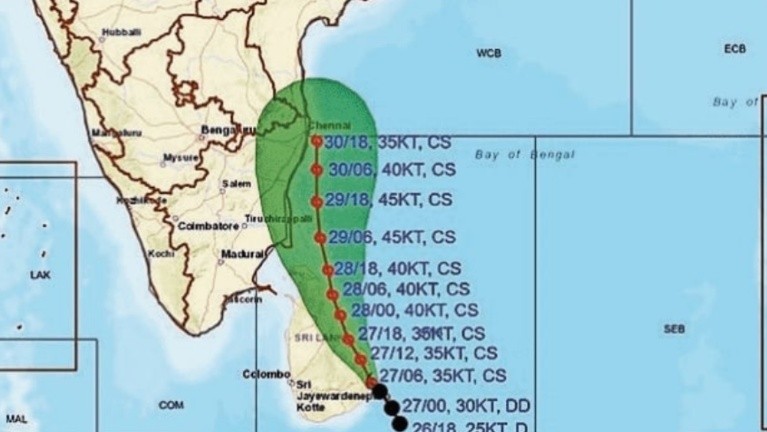
Two tropical cyclonic systems, Cyclone Ditwah and Cyclone Senyar, developed almost simultaneously over the Bay of Bengal–Andaman Sea region, drawing attention to the heightened cyclogenesis during the retreating phase of the Southwest Monsoon (October–November). The India Meteorological Department (IMD) has issued alerts for India’s east coast due to associated heavy rainfall and wind impacts.
Cyclone Ditwah: Key Facts
- Nature: Tropical cyclonic storm
- Area of formation: Southwest Bay of Bengal
- Development: Rapid intensification from a depression to a cyclonic storm in less than 24 hours
- Movement & impact: Moving towards the coasts of Tamil Nadu, Puducherry and southern Andhra Pradesh, with heavy rainfall and gusty winds expected
- Naming: Ditwah is the recommended name by Yemen
Cyclone Senyar: Key Facts
- Nature: Cyclonic system originating from a low-pressure area
- Area of formation: Near Malaysia/Strait of Malacca, over the South Andaman Sea and adjoining Bay of Bengal
- Development: Intensified into a depression and further strengthened before weakening over the Strait of Malacca
- Impact: Though it weakened, its remnant circulation and moisture feed triggered very heavy rainfall over parts of the Andaman & Nicobar Islands and South India
- Naming: Senyar is the recommended name by the UAE
Why are cyclones frequent in the Bay of Bengal During the Retreating Monsoon?
- Warm Sea Surface Temperatures (SSTs): Post-monsoon SSTs of ~28–30°C or higher provide abundant latent heat for cyclone formation.
- High Moisture Content: Strong moisture inflow from the equatorial Indian Ocean and the Bay creates a deep, humid troposphere, favouring convection.
- Southward Shift of ITCZ: During monsoon withdrawal, the Inter-Tropical Convergence Zone (ITCZ) and monsoon trough move southward over the Bay, enhancing convergence and vorticity.
- Low Vertical Wind Shear: October–early November typically sees reduced wind shear over the Bay, allowing systems to organise and intensify.
- Re-intensification of Monsoon Lows: Remnant lows/depressions moving back over warm Bay waters can re-strengthen into cyclones.
- Bay vs Arabian Sea Contrast: The Bay’s semi-enclosed nature, large river freshwater inflows (e.g., Ganga–Brahmaputra), and warmer, stratified surface waters make it more cyclone-prone than the Arabian Sea in this season.
Regional Implications
- East Coast Vulnerability: Tamil Nadu, Puducherry and Andhra Pradesh face risks of heavy rain, flooding and wind damage.
- Island Territories: The Andaman & Nicobar Islands are particularly susceptible to rainfall bursts from systems forming near the Andaman Sea.
- Hydro-meteorological Risk: Back-to-back systems can compound impacts through soil saturation, runoff and riverine flooding.
Superbugs
- 29 Nov 2025
In News:
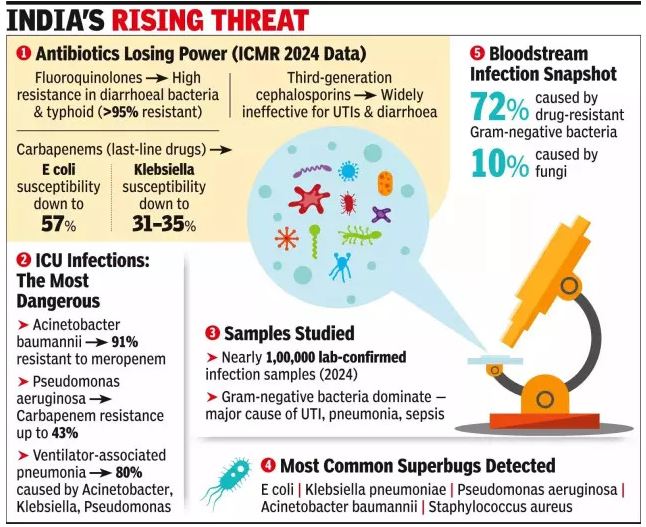
The Indian Council of Medical Research (ICMR), through its Antimicrobial Resistance Research & Surveillance Network (AMRSN) Report 2024, has warned that common infections in India are becoming increasingly difficult to treat due to rapidly rising antimicrobial resistance (AMR). Routine and even last-line antibiotics are losing effectiveness against widely prevalent hospital pathogens.
Key Findings of AMRSN Report 2024
- Common infections affected: Urinary tract infections (UTIs), pneumonia, sepsis, and diarrhoeal diseases.
- Failing antibiotics:
- Fluoroquinolones
- Third-generation cephalosporins
- Carbapenems (last-line drugs)
- Piperacillin–tazobactam
- Based on nearly one lakh lab-confirmed samples from major hospitals, drug-resistant Gram-negative bacteria dominate hospital infections.
Major Superbugs Identified
- Escherichia coli (E. coli):
- Leading cause of UTIs, abdominal and bloodstream infections.
- Shows declining susceptibility even to strong antibiotics.
- Klebsiella pneumoniae:
- Major cause of pneumonia and sepsis.
- Resistant to piperacillin–tazobactam in ~75% cases and to carbapenems in most samples.
- Acinetobacter baumannii:
- Particularly severe in ICUs.
- Shows ~91% resistance to meropenem, severely limiting treatment options.
- Pseudomonas aeruginosa:
- Rising resistance, especially in ventilator-associated pneumonia.
Overall, 72% of bloodstream infections and most ventilator-associated pneumonia cases were caused by highly drug-resistant Gram-negative bacteria.
Fungal Resistance Trends
- Candida auris: Nearly 10% resistance among isolates.
- Aspergillus species: Around one-third resistant to amphotericin B, a key antifungal drug.
What are Superbugs?
Superbugs are bacteria or fungi resistant to multiple antimicrobial drugs, making routine infections hard or impossible to treat.
Key causes:
- Overuse and misuse of antibiotics
- Incomplete treatment courses
- Excessive use of high-end antibiotics in hospitals
- Gene transfer between microbes
Implications of Rising AMR
- Treatment failure: Doctors are forced to use toxic or expensive drug combinations.
- Higher mortality: ICU infections become life-threatening.
- Longer hospital stays: Increased isolation and healthcare burden.
- Economic impact: Higher treatment costs and productivity losses.
- Public health risk: Routine infections may resemble the pre-antibiotic era in severity.
Significance for India
- Highlights the urgent need for antibiotic stewardship, infection prevention and control (IPC) protocols, and rational prescribing.
- Underlines the importance of regulated antibiotic sales, stronger surveillance, and new drug discovery.
- Signals India’s contribution to the global AMR crisis, threatening progress toward SDG 3 (Good Health and Well-being).
Scheme to Promote Manufacturing of Sintered Rare Earth Permanent Magnets (REPM)

- 29 Nov 2025
In News:
The Union Cabinet, chaired by the Prime Minister, has approved the Scheme to Promote Manufacturing of Sintered Rare Earth Permanent Magnets (REPM) with a total financial outlay of ?7,280 crore. This is a first-of-its-kind initiative aimed at establishing a domestic and integrated REPM manufacturing ecosystem in India, reducing import dependence and strengthening strategic supply chains.
What are Rare Earth Permanent Magnets (REPM)?
REPMs, such as Neodymium–Iron–Boron (NdFeB) and Samarium–Cobalt (SmCo) magnets, are among the strongest permanent magnets globally. They are critical components in electric vehicles (EVs), wind turbines, electronics, aerospace, defence systems, and strategic technologies. Owing to their strategic importance, REPMs are classified as critical materials worldwide.
Key Features of the Scheme
- Objective: Establish 6,000 Metric Tonnes Per Annum (MTPA) of integrated REPM manufacturing capacity in India.
- Nature: Central Sector scheme focused on end-to-end manufacturing.
- Manufacturing Scope: Conversion of rare earth oxides → metals → alloys → finished REPMs, enabling full value-chain integration.
- Beneficiaries: Capacity to be allocated to five beneficiaries through a global competitive bidding process, with up to 1,200 MTPA per beneficiary.
- Duration: 7 years
- 2 years: Gestation period for setting up facilities
- 5 years: Incentive disbursement period
Financial Structure
- Total Outlay: ?7,280 crore
- Sales-linked incentive: ?6,450 crore (linked to REPM sales for five years)
- Capital subsidy: ?750 crore for setting up integrated manufacturing facilities
Rationale for the Scheme
- Rising Demand: India’s REPM demand is projected to double by 2030, driven by EVs, renewables, electronics and defence.
- Import Dependence: India currently imports almost its entire REPM requirement (~900 tonnes annually).
- Supply Chain Vulnerability: Global shortages during 2021–22 led to 200–300% price spikes, highlighting strategic risks.
- Mineral Potential: India has the 5th-largest rare earth reserves (~6.9 million tonnes), mainly in Andhra Pradesh, Odisha, Kerala, Jharkhand and Rajasthan, but lacks downstream manufacturing.
Strategic Significance
- Atmanirbhar Bharat: Establishes India’s first integrated REPM manufacturing facilities, enhancing self-reliance.
- National Security: Secures supply for defence, aerospace and strategic sectors.
- Energy Transition: Supports electric mobility and renewable energy, contributing to Net Zero 2070 goals.
- Global Positioning: Aims to position India as a key player in the global REPM market, currently dominated by China (≈85–90% share).
- Employment & Industrial Growth: Generates skilled employment and strengthens advanced manufacturing capabilities.
Complementary Measures
The scheme aligns with broader initiatives such as the National Critical Mineral Mission (2025), modernisation of rare earth processing by IREL (India) Limited, R&D by BARC, ARCI and IITs, and international cooperation through platforms like the Minerals Security Partnership (MSP).
Tex-Ramps Scheme

- 29 Nov 2025
In News:
The Ministry of Textiles, Government of India, has approved the Textiles Focused Research, Assessment, Monitoring, Planning and Start-up (Tex-RAMPS) Scheme to address long-standing gaps in research, innovation, data systems and capacity development in the textiles sector. The scheme reflects India’s intent to future-proof its Textiles and Apparel (T&A) ecosystem amid rapid technological change and global competition.
What is the Tex-RAMPS Scheme?
Tex-RAMPS is a Central Sector Scheme, fully funded and implemented by the Ministry of Textiles. It has a total outlay of ?305 crore for the period FY 2025-26 to FY 2030-31, co-terminus with the upcoming Finance Commission cycle, ensuring medium-term continuity and stability in policy support.
The core objective is to enhance innovation capacity, strengthen data-driven policymaking, support start-ups, and improve global competitiveness of India’s textile sector.
Key Components of Tex-RAMPS
1. Research & Innovation: The scheme promotes advanced research in areas such as smart textiles, sustainable manufacturing, process efficiency and emerging textile technologies, aiming to move India up the value chain and reduce dependence on low-value exports.
2. Data, Analytics & Diagnostics: Tex-RAMPS envisages creation of robust sectoral data systems, including employment assessments, supply-chain mapping, and the India-Size study, to support evidence-based decisions and targeted interventions.
3. Integrated Textiles Statistical System (ITSS): A major feature is the ITSS, a real-time integrated data and analytics platform that will enable structured monitoring of the sector and informed strategic planning by government and stakeholders.
4. Capacity Development & Knowledge Ecosystem: The scheme focuses on State-level planning support, dissemination of best practices, capacity-building workshops, and organisation of sectoral knowledge events to strengthen institutional capabilities across the country.
5. Start-up & Innovation Support: Tex-RAMPS provides support to incubators, hackathons, and academia–industry collaborations, encouraging high-value textile start-ups and entrepreneurship, particularly in technical and smart textiles.
Key Features
- ?305 crore outlay (2025–31) with assured central funding
- Central Sector Scheme ensuring uniform nationwide implementation
- Strong emphasis on smart, sustainable and technology-driven textiles
- Real-time monitoring through ITSS for transparency and accountability
Significance of the Scheme
- Boosts global competitiveness of Indian textiles on quality, sustainability and technology parameters
- Strengthens the R&D ecosystem, creating a pipeline for innovation in technical and smart textiles
- Improves policymaking through high-quality, real-time data
- Generates employment and promotes collaboration among States, industry, academia and government institutions
- Aligns the textile sector with India’s broader goals of Atmanirbhar Bharat and green manufacturing
UN ESCAP Asia-Pacific Disaster Report 2025
- 29 Nov 2025
In News:
The UN Economic and Social Commission for Asia and the Pacific (ESCAP), in its Asia-Pacific Disaster Report 2025, has warned that Asian megacities such as Delhi, Karachi, Dhaka, Manila, Shanghai and Seoul face severe and potentially deadly heat stress due to the combined impact of global warming and the urban heat island (UHI) effect.
Urban Heat Island Effect and Temperature Rise
The report highlights that even if global warming is limited to 1.5–2°C, dense urban areas could experience an additional 2–7°C rise in local temperatures. This amplification is caused by concrete-dominated landscapes, limited green cover, waste heat from vehicles and air conditioners, and poor urban ventilation. As a result, cities heat up far beyond surrounding rural areas, pushing everyday temperatures into dangerous zones.
Heat Index and Measurement of Risk
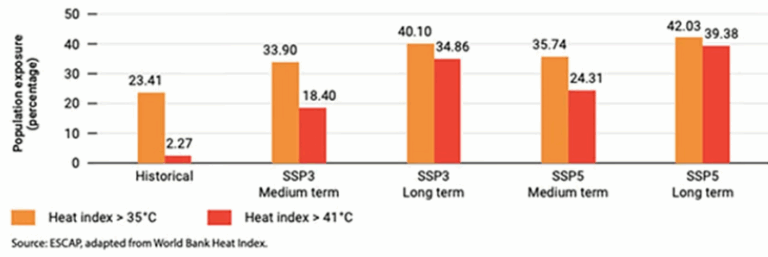
To assess extreme heat risk, ESCAP used the heat index, which combines air temperature and relative humidity to reflect “felt temperature.”
- 35°C and above: Severe heat stress
- 41°C and above: Extreme danger with high risk of heat stroke
The analysis used four thresholds-35°C, 37°C, 39°C and 41°C, corresponding to the World Bank’s heat risk index categories. South and Southwest Asia fall in the highest risk categories (3 and 4).
Regional Exposure Patterns
- India, Pakistan and Bangladesh may face over 300 days annually with heat index above 35°C, and more than 200 days above 41°C in several regions.
- Over 40% of South Asia’s population is projected to experience chronic exposure to extreme heat in both medium- and long-term scenarios, regardless of climate mitigation pathways.
- Southeast Asia could see nearly 30% of its population exposed to extreme heat under business-as-usual scenarios.
Extreme Heat: Fastest Growing Climate Hazard
The report identifies extreme heat as the fastest-growing climate-related hazard in Asia-Pacific.
- 2024 was the hottest year on record globally.
- The Bangladesh heatwave (April–May 2024) affected ~33 million people, the largest single disaster by population impacted.
- In India, prolonged heatwaves caused around 700 deaths, making it the second deadliest event in the region that year.
According to EM-DAT, over 180 natural and climate-induced disasters were recorded in Asia-Pacific in 2024.
Health, Inequality and Air Pollution Linkages
Extreme heat overwhelms the body’s thermoregulation, increasing risks of cardiovascular, respiratory and kidney disorders, as well as heatstroke. Urban poor communities are disproportionately affected due to crowded housing, lack of cooling, water stress and limited healthcare access. Heat also worsens air pollution, as droughts and wildfires increase PM10, PM2.5, VOCs and nitrogen oxides, creating a dangerous heat–pollution feedback loop.
Economic and Livelihood Impacts
Heat stress severely affects productivity in labour-intensive sectors such as agriculture, construction and industry. Across Asia-Pacific, working hours lost to heat stress are projected to more than double—from 3.75 million to over 8.1 million full-time job equivalents by 2030.
Using probabilistic risk modelling, ESCAP estimates average annual disaster losses could rise from $418 billion currently to $498 billion under high-emission scenarios, reflecting rising exposure and insufficient adaptation.
Way Forward Highlighted by the Report
The report stresses the need to place extreme heat at the centre of multi-hazard planning, including:
- Heat–health early warning systems with last-mile communication
- Heat-sensitive urban design (cool roofs, urban forests, shaded corridors)
- Legal protection for outdoor workers
- Strengthened health systems and cooling shelters
- Inclusive adaptation policies targeting vulnerable populations