
SWOT Satellite and Ocean Mapping
- 29 Mar 2026
In News:
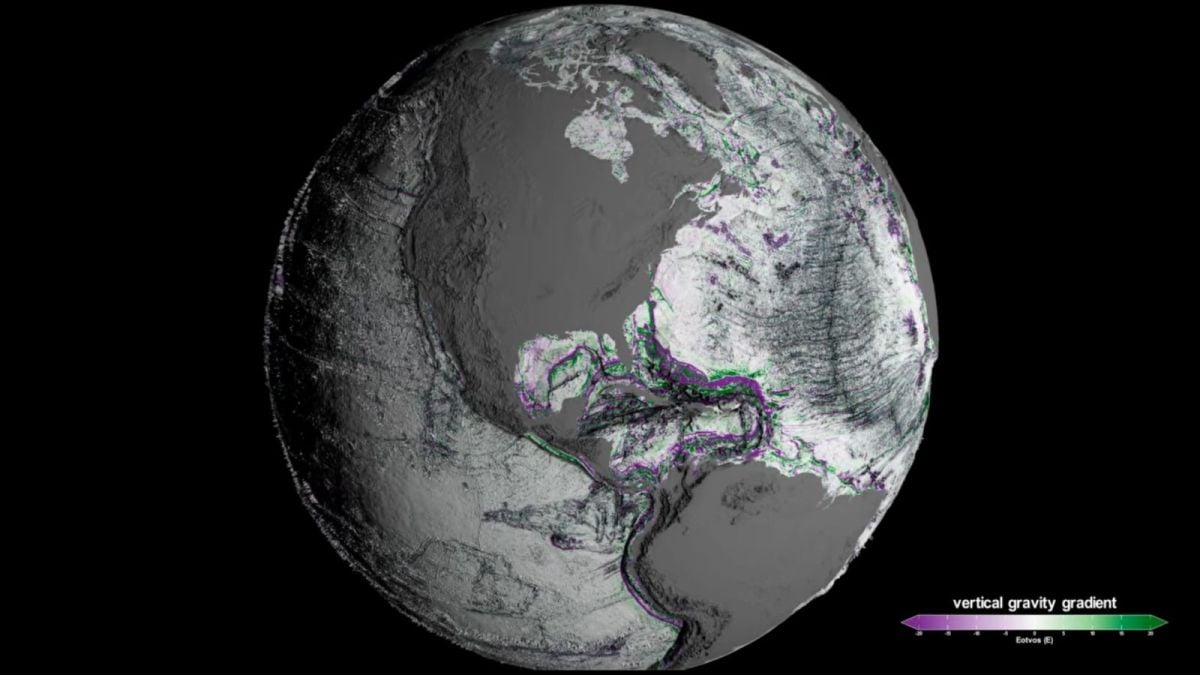
Recently, NASA used data from the Surface Water and Ocean Topography Satellite to develop a new high-resolution map of the ocean floor, improving understanding of underwater features and ocean dynamics.
About SWOT Satellite
· The Surface Water and Ocean Topography (SWOT) satellite, launched in 2022, is a joint mission of NASA and CNES.
· Its primary objective is to measure and monitor changes in Earth’s water bodies, including oceans, rivers, lakes, and reservoirs.
· Unlike traditional satellites, SWOT provides high-resolution, two-dimensional measurements of water surfaces, enabling scientists to track even subtle changes in water levels and flow patterns over time.
Key Features and Technology
At the core of SWOT’s capability is the Ka-band Radar Interferometer (KaRIn), which uses microwave signals to measure the height, width, and surface elevation of water bodies with high precision.
· It scans nearly 90% of the Earth every 21 days, ensuring regular global coverage
· Can observe:
o Rivers wider than 330 feet
o Over 1 million lakes and reservoirs larger than 5 acres
· Captures over 55% of global flood events during their lifecycle
· Detects small-scale ocean features such as currents and eddies, crucial for climate processes
Ocean Floor Mapping Significance
SWOT does not directly “see” the ocean floor but maps it indirectly by measuring variations in sea surface height, which reflect gravitational differences caused by underwater features like mountains and trenches.
This has enabled:
· Creation of more accurate seabed maps
· Better understanding of plate tectonics and ocean circulation
· Insights into how oceans absorb heat and carbon, especially through small eddies
Importance
The SWOT mission represents a major advancement in hydrology and oceanography:
· Enhances flood monitoring and disaster management
· Improves water resource planning
· Supports climate change studies, especially ocean heat uptake
· Strengthens global efforts in sustainable water management
Periodic Labour Force Survey (PLFS) Annual Report, 2025
- 29 Mar 2026
In News:
The Ministry of Statistics and Programme Implementation released the PLFS Annual Report 2025, prepared by the National Statistical Office. This is the first report based on the calendar year (Jan–Dec 2025) with a revised methodology.
About PLFS
Launched in 2017, the Periodic Labour Force Survey provides comprehensive data on employment and unemployment in India. It uses two key approaches—Usual Status (ps ss) (365-day reference) and Current Weekly Status (CWS) (7-day reference)—to capture labour market dynamics.
Key indicators include:
- LFPR: Share of population working or seeking work
- WPR: Share of employed population
- UR: Share of unemployed in labour force
Key Trends in PLFS 2025
India’s labour market in 2025 shows stability with gradual improvement in employment conditions. The Labour Force Participation Rate (LFPR) remained stable at 59.3%, while the Worker Population Ratio (WPR) stood at 57.4%, indicating sustained employment levels. The Unemployment Rate (UR) declined to 3.1%, reflecting better labour absorption.
- Youth unemployment (15–29 years) fell to 9.9%
- Rural unemployment remained low (~2.4%), while urban unemployment stood at ~4.8%
Structural Changes in Employment
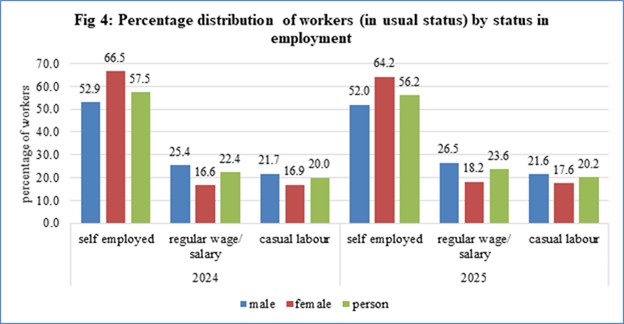
There is a slow shift towards better-quality jobs. The share of regular wage/salaried employment increased to 23.6%, while self-employment declined to 56.2%, indicating gradual formalisation.
Sectorally:
- Agriculture continues to dominate but declined to 43.0%
- Manufacturing increased to 12.1%
- Services also expanded
Gender and Social Dimensions
Despite improvements, gender disparities remain significant. Female LFPR is still low at 40.0%, and social factors continue to influence participation.
- Many men stay out of labour force for education (69.8%)
- Women cite childcare and domestic responsibilities (44.4%)
However, a positive trend is visible in rising female wages:
- Self-employed: 8.8%
- Salaried: 7.2%
A notable work-hour gap persists, with men working significantly longer hours than women.
Education, Skills and Challenges
The average years of schooling reached 10 years, and a majority of the population has at least secondary education. However, skill development remains weak, with only 4.2% of individuals receiving formal vocational training.
A major concern is the NEET category, with about 25% of youth (15–29 years) not in employment, education, or training—posing a risk to India’s demographic dividend.
Methodological Changes
From 2025 onwards:
· Survey cycle shifted to calendar year
· Sample size significantly increased
· Higher-frequency estimates introduced
Due to these changes, comparisons with earlier PLFS reports should be made cautiously.
Euthalia Zubeengargi

- 29 Mar 2026
In News:
A new butterfly species, Euthalia zubeengargi, has been recorded from Arunachal Pradesh, adding to India’s rich biodiversity, particularly in the Northeast.
About Euthalia zubeengargi
Euthalia zubeengargi is a butterfly species belonging to the genus Euthalia, which is widely distributed across South and Southeast Asia. The discovery highlights the ecological richness of Arunachal Pradesh, a known biodiversity hotspot.
- Habitat: Found in semi-evergreen forests at elevations of about 600–750 metres, particularly in cool and shaded interiors.
- Distribution: Part of a genus with 80 species recorded in Northeast India, indicating high regional diversity.
Physical and Behavioural Features
Members of the Euthalia genus, including this species, are typically associated with forest ecosystems and exhibit:
- Appearance:
- Earthy brown wings with pale spots
- Camouflaged coloration suited for forest habitats
- Behaviour:
- Prefer low vegetation and shaded areas
- Feed on:
- Tree sap
- Minerals from damp surfaces near streams
- Show activity mainly during late morning to early afternoon
- Characterised by short, slow flights between nearby plants
Ecological Significance
- Butterflies like Euthalia zubeengargi serve as important bioindicators:
- Their presence, diversity, and population reflect the health of ecosystems
- Sensitive to environmental changes such as:
o Habitat loss
o Climate change
o Pollution
Thus, their discovery aids in monitoring biodiversity and conservation status of forest ecosystems.
Waste Foundry Sand

- 29 Mar 2026
In News:
The Institute of Indian Foundrymen (IIF) and CSIR-Central Road Research Institute have collaborated to develop solutions for the use of Waste Foundry Sand (WFS) in road construction, highlighting a push towards sustainable infrastructure.
What is Waste Foundry Sand?
Waste Foundry Sand (WFS) is a byproduct generated during metal casting processes in both ferrous and non-ferrous industries. It primarily consists of high-quality silica sand, which is repeatedly used in molds and cores before being discarded. Its physical and chemical properties vary depending on the casting process and type of metal industry, but it generally retains good strength and uniformity.
Types of Foundry Sand
Foundry sand is classified based on the binder system used:
- Clay-bonded (Green Sand):
- Contains about 85–95% silica sand and 4–10% bentonite clay
- Made from natural materials and widely used in conventional casting
- Chemically Bonded Sand:
- Uses synthetic binders
- Preferred for core making and high-strength molds that must withstand molten metal
Environmental Concerns and Need for Reuse
Large-scale generation of WFS creates disposal and environmental challenges, including landfill pressure and potential contamination risks. Since it is produced in bulk, its scientific reuse becomes crucial.
Use in Road Construction
WFS can be effectively utilised in road subgrades, embankments, and pavement layers as a partial substitute for natural sand. This not only reduces construction costs but also decreases dependence on natural resources.
Significance
The reuse of WFS aligns with:
- Circular economy principles
- Resource efficiency and waste minimisation
- Sustainable and eco-friendly infrastructure development
It represents an important step in integrating industrial waste into mainstream construction practices.
QS World University Rankings

- 29 Mar 2026
In News:
The Indian Institute of Management–Kozhikode (IIM-K) has entered the global Top 100 in the QS World University Rankings by Subject 2026, marking a significant milestone for Indian higher education.
About QS World University Rankings
- Published annually by Quacquarelli Symonds (QS).
- Provides global comparative assessment of universities across subjects and overall performance.
Evaluation Framework
QS uses a multi-layered methodology:
1. Lenses (Thematic Categories):
- Research & Discovery
- Employability & Outcomes
- Global Engagement
- Learning Experience
- Sustainability
2. Indicators (Performance Areas):
- Academic Reputation
- Employer Reputation
- Citations per Faculty
- Employment Outcomes
3. Metrics:
- Quantitative tools used to calculate scores within each indicator.
Key Highlights – QS Rankings 2026
India’s Performance
- 120 new Indian institutions entered the rankings.
- India ranks 4th globally in new entries:
- USA: 287
- China: 181
- UK: 159
- India now has the 4th largest institutional representation, after:
- USA
- China
- UK
Notable Achievements by Indian Institutions
- Indian Institute of Management Kozhikode : Entered Top 100 globally (by subject) for the first time.
- Indian Institute of Technology (ISM) Dhanbad
- Secured global rank 21 (India’s highest).
- Maintains dominance in Mineral & Mining Engineering.
- Indian Institute of Management Ahmedabad
- Achieved Top 25 globally in:
- Business & Management Studies
- Marketing
- Achieved Top 25 globally in:
- Computer Science Domain:
- 6 Indian institutions in global Top 100.
- All improved their rankings compared to the previous year.