
Sahakar Taxi Cooperative Limited

- 20 Feb 2026
In News:
The Union Home and Cooperation Minister launched ‘Bharat Taxi’, India’s first cooperative-based taxi service, aimed at transforming the unorganised taxi sector into an ownership-driven, driver-led model.
The initiative seeks to replace the commission-based aggregator model with a cooperative ownership framework, ensuring greater income security and social protection for drivers.
Sahakar Taxi Cooperative Limited
Sahakar Taxi Cooperative Limited is the multi-state cooperative society operating the Bharat Taxi platform.
- Registered under the Multi-State Cooperative Societies Act, 2002
- Established on June 6, 2025
- Drivers are referred to as “Sarathis”
- Ownership and governance lie with driver-members rather than corporate investors
Promoted By
Leading cooperative institutions including:
- National Cooperative Development Corporation (NCDC)
- Indian Farmers Fertiliser Cooperative Limited (IFFCO)
- Gujarat Cooperative Milk Marketing Federation (GCMMF – Amul)
- Krishak Bharati Cooperative Limited (KRIBHCO)
- National Agricultural Cooperative Marketing Federation of India (NAFED)
- National Bank for Agriculture and Rural Development (NABARD)
- National Dairy Development Board (NDDB)
- National Cooperative Exports Limited (NCEL)
Objectives
- Driver Empowerment
- Shift from gig-worker status to ownership rights.
- Drivers become “Malik” (owners) of the platform.
- Economic Freedom
- Eliminate high commission charges (20–30%) taken by private aggregators.
- Ensure maximum income retention for drivers.
- Women’s Safety & Inclusion: Promote safe and dignified travel options for women.
- Social Security for Gig Workers: Integrate welfare benefits and financial security measures.
How the Model Works
1. Share-Based Membership
- Drivers join by purchasing cooperative shares (starting from ?500).
- Members receive voting rights and share in profits.
2. Zero-Commission Model
- No percentage cut per ride.
- Instead, a flat daily access fee:
- Approx. ?30 for cabs
- Approx. ?18 for autos
3. Direct Payments: Ride fares are transferred directly to the Sarathi’s bank account.
4. Democratic Governance: Two Sarathi representatives sit on the Board of Directors.
Key Features
1. Sarathi Didi Initiative
- Dedicated in-app option for women passengers.
- Enables booking rides with female drivers (Sarathi Didis).
2. No Surge Pricing: Transparent and fixed pricing, even during peak hours.
3. Integrated Mobility Services: Two-wheelers, three-wheelers, and four-wheelers on a single platform.
4. Social Safety Net Integration
- Linked with the e-Shram portal.
- Access to welfare schemes such as:
- Pradhan Mantri Jan Arogya Yojana (PM-JAY – coverage up to ?5 lakh)
- Other gig worker social protection benefits.
5. Digital Payments Integration: Partnerships with fintech platforms enable seamless mobile payments.
BHASHINI National Infrastructure
- 20 Feb 2026
In News:
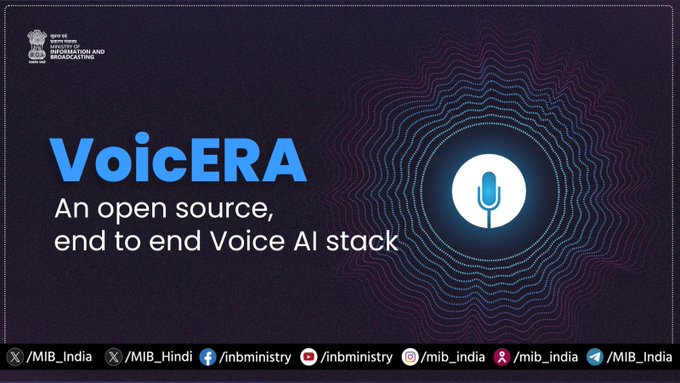
- VoicERA, an open-source end-to-end Voice AI stack, was launched at the India AI Impact Summit 2026 on the BHASHINI National Language Infrastructure, marking a major expansion of India’s Digital Public Infrastructure (DPI).
- The initiative was launched by the Digital India BHASHINI Division (DIBD) under the Digital India Corporation (DIC), Ministry of Electronics and Information Technology (MeitY).
What is VoicERA?
- VoicERA is an open-source, end-to-end Voice AI execution stack deployed on BHASHINI (National Language Infrastructure).
- It functions as a national execution layer for multilingual Voice and Language AI, enabling scalable and secure deployment of speech-based systems across government and research ecosystems.
Institutional Framework
- Launched at: India AI Impact Summit 2026
- Developed by:
- Digital India BHASHINI Division (MeitY)
- EkStep Foundation
- COSS
- IIIT Bengaluru
- AI4Bharat
Objectives
- Enable citizens to access government services through natural speech interfaces across Indian languages.
- Provide an interoperable and open-standard framework to reduce duplication and vendor lock-in.
- Ensure secure, scalable deployment of multilingual Voice AI systems for governance and innovation.
Key Features
1. Open-Source & Digital Public Good
- Modular design for easy adoption and integration.
- Reduces dependency on proprietary systems.
2. Pluggable & Interoperable Architecture
- Compatible with existing government applications and APIs.
- Supports seamless integration across departments.
3. Cloud & On-Premise Deployment
- Flexible hosting options depending on security and operational needs.
4. Multilingual Voice AI
- Real-time speech recognition.
- Conversational AI systems.
- Multilingual telephony support at population scale.
5. Secure Execution Layer
- Ensures safe processing of voice data.
- Enables scalable citizen engagement.
Expansion of BHASHINI’s Role
With VoicERA integration, BHASHINI’s capabilities expand from:
- Translation services
- Language technology tools
to:
- Real-time speech systems
- Conversational AI
- Voice-enabled citizen service delivery
This marks a shift toward voice as a primary interface for governance, especially for non-textual and non-English-speaking users.
Governance Applications
Departments can rapidly deploy voice-enabled services in:
- Agriculture advisories
- Education support
- Livelihood services
- Grievance redressal
- Citizen feedback systems
- Government scheme discovery
India-UK Offshore Wind Taskforce
- 20 Feb 2026
In News:
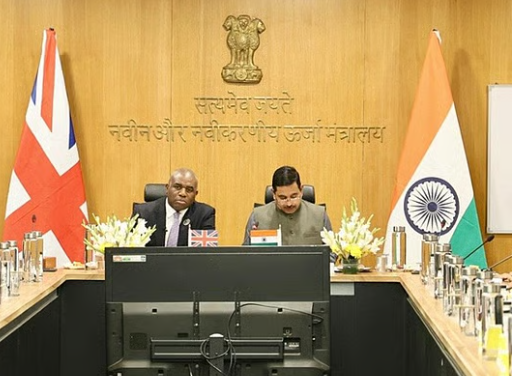
India and the United Kingdom have launched the India–UK Offshore Wind Taskforce under Vision 2035 to accelerate offshore wind energy development and strengthen long-term clean energy cooperation.
The initiative was announced during the Fourth India–UK Energy Dialogue, reflecting deepening collaboration in climate action, energy security, and green industrial growth.
What is the India–UK Offshore Wind Taskforce?
The Taskforce is a bilateral cooperation platform that brings together:
- Policymakers
- Industry stakeholders
- Technical experts
It aims to combine the UK’s expertise in offshore wind deployment with India’s growing renewable energy market, to develop India’s nascent offshore wind sector.
Objectives
- Accelerate offshore wind deployment through structured India–UK cooperation.
- Develop a comprehensive offshore wind ecosystem (policy, infrastructure, finance).
- Enhance long-term energy security and industrial competitiveness under Vision 2035.
- Support India’s broader clean energy transition commitments.
Key Features
1. Strategic Leadership Platform
- Provides coordinated guidance for offshore wind policy design and implementation.
- Facilitates knowledge transfer from the UK (a global offshore wind leader).
2. Three Priority Pillars
(i) Ecosystem Planning & Market Design
- Seabed leasing frameworks
- Revenue certainty mechanisms
- Transparent regulatory architecture
(ii) Infrastructure & Supply Chains
- Port modernisation
- Domestic manufacturing of turbines and components
- Marine logistics and grid connectivity
(iii) Financing & Risk Mitigation
- Blended finance mechanisms
- Mobilisation of institutional capital
- De-risking tools for early-stage offshore projects
Identified Offshore Wind Zones
- Initial development planned off the coasts of Gujarat and Tamil Nadu.
- These regions offer high wind potential and proximity to industrial corridors.
Government Support Mechanisms
- Viability Gap Funding (VGF) of ?7,453 crore announced to support early-stage offshore wind projects.
- Aims to reduce cost disparities between offshore wind and conventional energy sources.
- Encourages private sector participation.
Linkages with India’s Energy Transition
- National Green Hydrogen Mission: Offshore wind can supply renewable electricity for coastal green hydrogen production.
- Energy Security: Diversifies renewable energy mix beyond solar and onshore wind.
- Climate Commitments: Contributes toward India’s renewable energy targets and Net Zero goal (2070).
- Industrial Competitiveness: Boosts domestic manufacturing and job creation in turbine production, marine engineering and grid infrastructure.
India’s Drone Ecosystem
- 20 Feb 2026
In News:
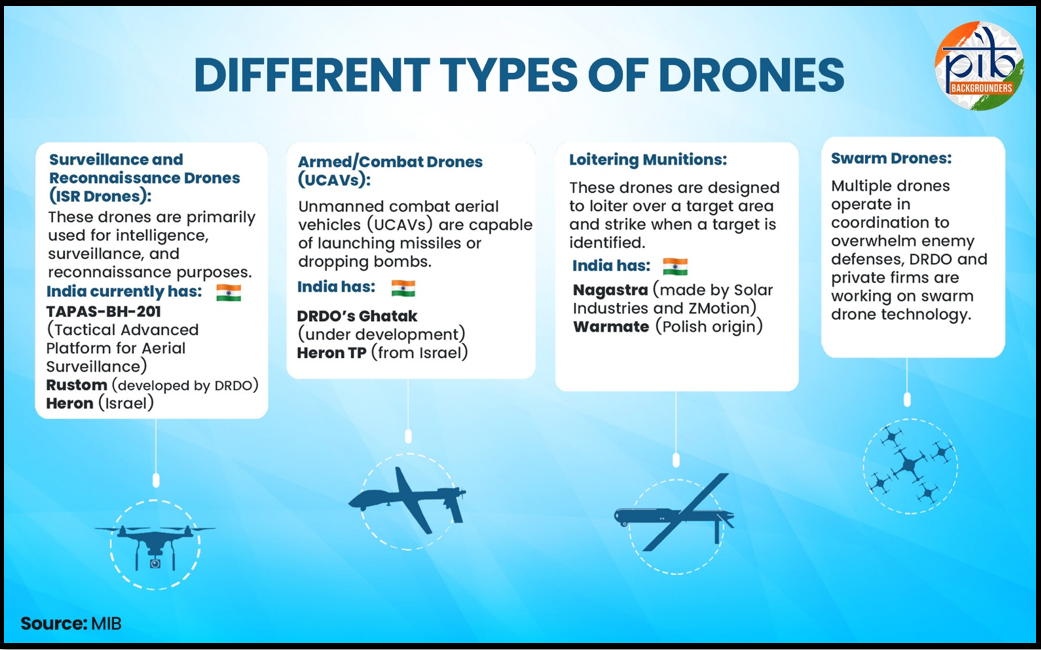
As of February 2026, India has over 38,500 registered drones (UINs), 39,890 DGCA-certified remote pilots, and 244 approved training organisations, reflecting a mature and regulated drone ecosystem.
India has transitioned from experimental drone usage to a structured, innovation-driven ecosystem integrated into governance, agriculture, infrastructure, and defence.
Evolution of India’s Drone Ecosystem
Over two decades, drone technology in India has evolved into a comprehensive framework involving:
- Manufacturers and component developers
- Drone-as-a-Service (DaaS) providers
- Start-ups and MSMEs
- Certified pilots and training institutes
- Digital regulatory platforms
Drones are now embedded in public service delivery, infrastructure monitoring, precision agriculture, disaster response, and national security.
Major Applications
1. Agriculture and Farmer Services
- Integrated with PMFBY (Pradhan Mantri Fasal Bima Yojana) for crop assessment.
- Used for precision spraying, crop monitoring and input optimisation.
Namo Drone Didi Scheme (2023)
- Provides drones to Women Self-Help Groups (SHGs).
- 1,094 drones distributed, including 500 under the core initiative.
- Enhances productivity, reduces costs, and promotes women-led rural entrepreneurship.
2. Land Mapping – SVAMITVA Scheme
The SVAMITVA (Survey of Villages and Mapping with Improvised Technology in Village Areas) scheme (launched April 2020) uses drones for mapping rural abadi areas.
Key Data (as of Dec 2025):
- Target: ~3.44 lakh villages
- 3.28 lakh villages surveyed (~95%)
- 2.76 crore property cards prepared
- Covers 1.82 lakh villages across 31 States/UTs
Objectives:
- Reduce land disputes
- Improve access to institutional credit
3. Highway and Infrastructure Monitoring
- NHAI mandates monthly drone video recording of highway projects.
- Footage stored in data lakes for audit and dispute resolution.
- Enhances transparency and project monitoring.
4. Railways
- Ministry of Railways deploying UAVs for inspection of tracks and bridges.
- Railway Protection Force uses drones for surveillance and crowd management.
- Improves safety and monitoring of critical infrastructure.
5. Disaster Management
- NECTAR (North East Centre for Technology Application and Reach) developed specialised drones for flood and landslide monitoring.
- Provides real-time aerial visuals to improve rescue coordination.
6. Defence Applications
- Used for border surveillance, intelligence gathering and precision strikes.
- During Operation SINDOOR, drones and loitering munitions destroyed enemy targets.
- Integrated with radar and air defence systems for national security.
Policy and Regulatory Framework
1. Drone Rules, 2021 (Amended 2022–23)
Key reforms:
- Forms reduced from 25 to 5
- Approvals reduced from 72 to 4
- ~90% airspace designated as Green Zone (up to 400 ft)
- Pilot licence replaced by Remote Pilot Certificate (RPC)
- Civilian drones permitted up to 500 kg
- Passport requirement removed
2. Digital Sky & eGCA
- Regulatory services (registration, certification, RPTO authorisation) shifted to eGCA.
- Operational services (flight plans, airspace maps) integrated with Digital Sky.
Achievements (Feb 2026):
- 38,575 drones registered (UIN)
- 39,890 Remote Pilot Certificates issued
- 244 DGCA-approved RPTOs
3. Production Linked Incentive (PLI) Scheme
- Outlay: ?120 crore
- Promotes domestic drone and component manufacturing.
- Encourages MSMEs and start-ups.
4. GST Rationalisation
- GST reduced to 5% (September 2025) from earlier 18–28%.
- Applies to drones and flight simulators.
- Encourages commercial adoption and training ecosystem.
Capacity Building & Innovation
- SwaYaan Programme: HR development in Unmanned Aircraft Systems.
- 857 activities
- 26,000 beneficiaries
- National Innovation Challenge for Drone Application and Research (NIDAR)
- ?40 lakh prize pool
- Promotes autonomous drones in disaster management & agriculture
- Platforms like Bharat Drone Shakti and Bharat Drone Mahotsav promote DaaS and indigenous technologies.
India’s Sovereign AI Push
- 20 Feb 2026
In News:
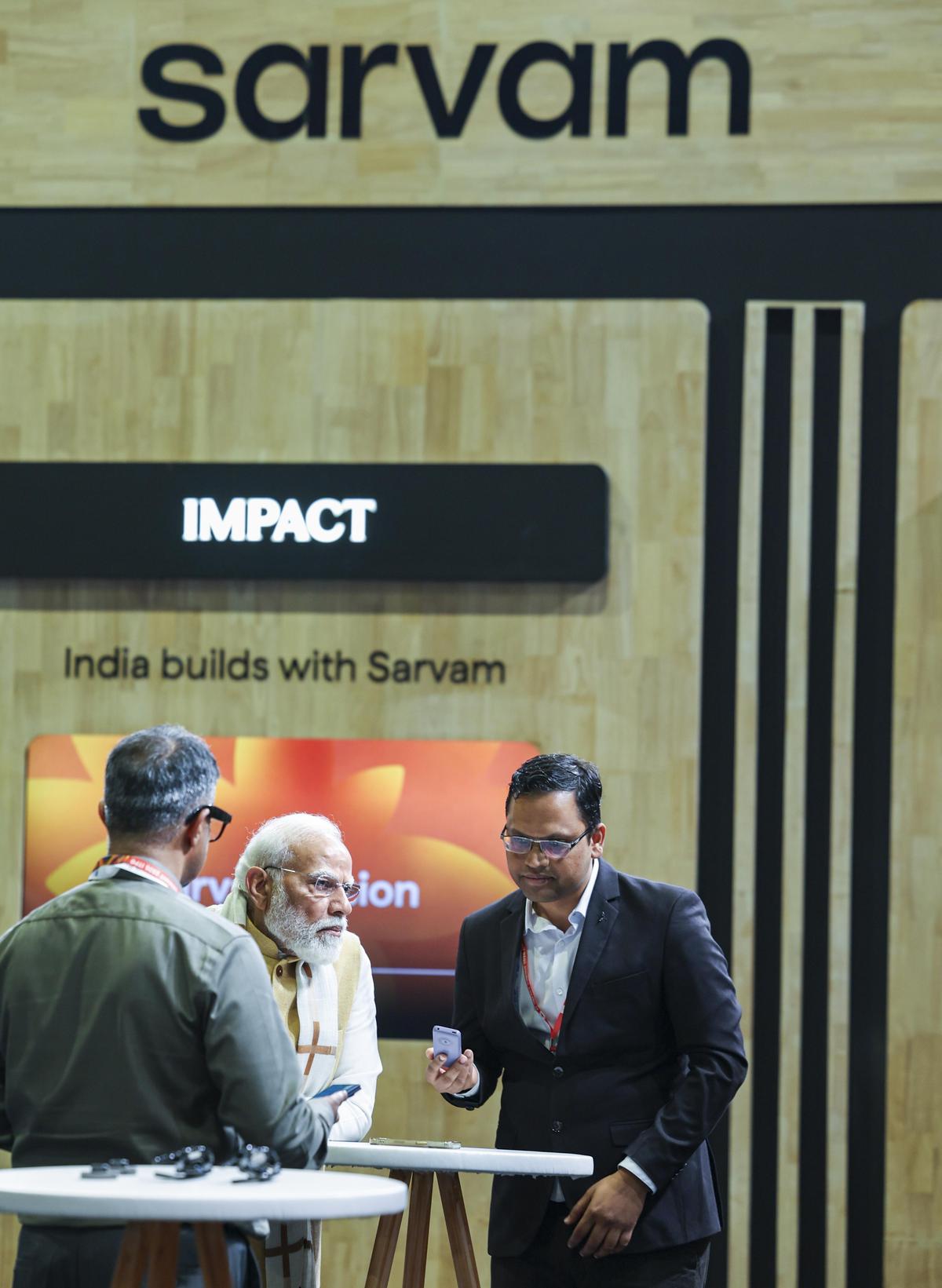
At the AI Impact Summit, Bengaluru-based startup Sarvam AI unveiled two indigenous large language models (LLMs) under the collective name “Vikram.” The development coincides with global technology firms such as Nvidia and OpenAI announcing partnerships with Indian industry and academic institutions to strengthen India’s artificial intelligence (AI) ecosystem.
This marks a significant step in India’s efforts toward building Sovereign AI capabilities.
Sarvam AI
- Founded in 2023, headquartered in Bengaluru.
- Objective: Develop foundational AI models tailored to Indian languages and socio-economic contexts.
- Focus on multilingual and multimodal AI suited for India’s governance and development needs.
Key Features of the “Vikram” Models
- India-Specific Optimisation
- Designed for Indian administrative, social and economic applications.
- Strong performance in Indian language document processing and speech recognition.
- Multimodal Capabilities
- Integrates text, speech and visual understanding.
- Enables use cases in governance, healthcare, education and digital services.
- Edge and Offline AI Models
- Models capable of running on devices without continuous internet connectivity.
- Supports translation, speech-to-text and other AI functions locally.
- Reduces dependence on cloud-based foreign infrastructure.
Sovereign AI: Meaning and Significance
Sovereign AI refers to the development of AI systems using domestically controlled infrastructure, data and expertise, covering the entire lifecycle - from data collection and model training to deployment and governance.
It aims to:
- Reduce dependence on US/China-based AI platforms.
- Ensure data security and privacy.
- Promote cultural and linguistic relevance.
- Strengthen national security and strategic autonomy.
Large Language Models (LLMs)
- LLMs are AI systems based on deep learning techniques.
- Trained on large volumes of unstructured data.
- Capable of understanding, summarising, generating and predicting text.
- Use probabilistic modelling to recognise patterns in language without explicit programming.
Potential Benefits for India
- Technological & Economic Gains
- Boosts domestic innovation ecosystem.
- Encourages startup growth and high-skill employment.
- Enhances productivity across sectors.
- Human Capital Development
- AI integration in education and skilling programmes.
- Supports India’s demographic dividend with future-ready skills.
- Improved Governance
- Multilingual AI can enhance e-governance delivery.
- Applications in healthcare diagnostics, agriculture advisory, climate modelling and urban planning.
- Digital Inclusion
- Bridges linguistic barriers for non-English speakers.
- Expands participation in the digital economy.
- Strategic Autonomy: Reduces reliance on foreign AI infrastructure and proprietary systems.