
Horn-Eyed Ghost Crab
- 10 Dec 2025
In News:
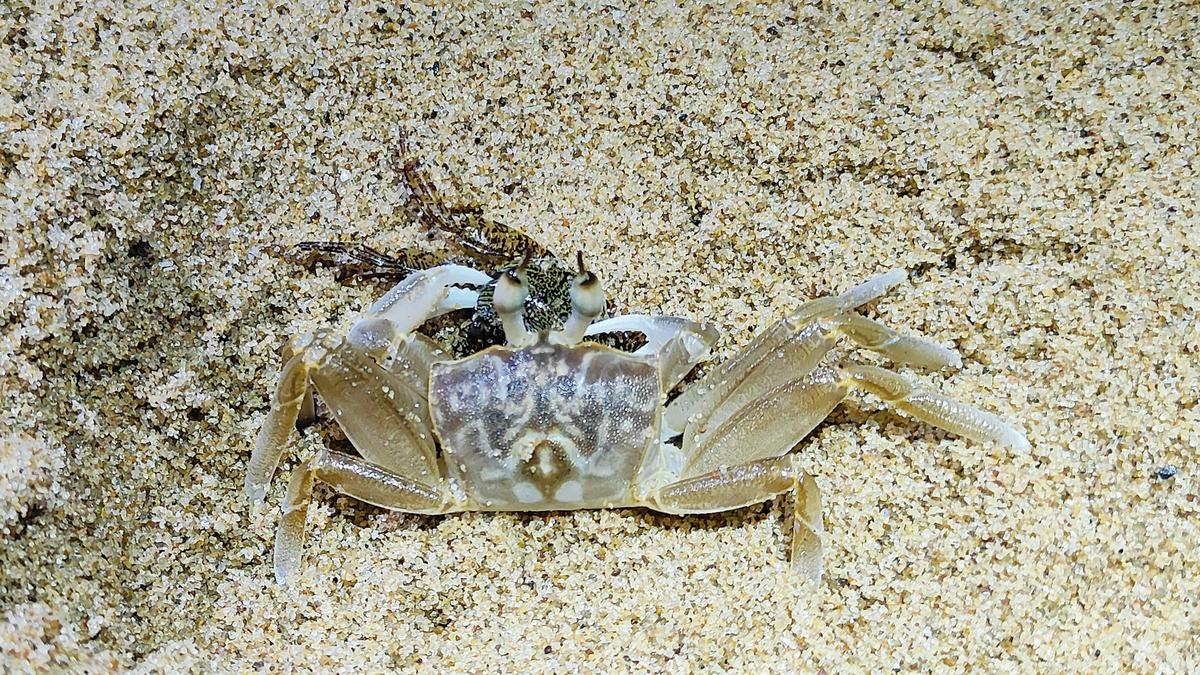
Researchers recently documented unusual predatory behaviour of a horn-eyed ghost crab at Rushikonda Beach, Visakhapatnam, drawing attention to the ecological role of ghost crabs in coastal ecosystems.
Taxonomy
- Belongs to the genus Ocypode
- Commonly known as ghost crabs due to their pale colour and rapid, almost “vanishing” movements on beaches
Habitat
- Found primarily in sandy intertidal zones
- Builds deep burrows above the high-tide line on beaches
- Most active during dawn, dusk, and night, avoiding daytime heat
Distribution
- Occurs widely across the Indo-Pacific region
- Range extends from the east coast of Africa to the Philippines, and from Japan to the Great Barrier Reef
- Absent in the Red Sea
- Six species of ghost crabs have been recorded along the Indian coastline
Physical and Behavioural Features
- Pale, sand-coloured body helps in camouflage against predators
- Possesses long legs adapted for fast sideways running
- The term “horn-eyed” refers to eye stalks that may appear elongated or horn-like
- Known for agile hunting and burrow-dwelling behaviour
Feeding Habits
Although traditionally considered scavengers, recent observations show active predation.
Diet includes:
- Clams
- Snails
- Marine worms
- Isopods
- Shrimps
- Insects
- Other crabs, including small hermit crabs
This highlights their role not just as scavengers but also as important predators in beach ecosystems.
Ecological Role
Horn-eyed ghost crabs are considered:
- Keystone species in sandy shore ecosystems
- Bio-indicators of coastal health
Why important?
- Their burrowing activity aerates sand and influences sediment structure
- Their feeding controls populations of smaller invertebrates
- Healthy ghost crab populations generally indicate less-disturbed beaches
Threats
Ghost crabs are sensitive to environmental disturbances. Major threats include:
- Coastal pollution
- Beach tourism and human trampling
- Changes in sediment patterns due to erosion or construction
- Rising sea temperatures
- Altered tidal cycles due to climate change
Such pressures may force them to shift habitats in search of food and suitable burrowing sites.
Shani Shingnapur Temple
- 10 Dec 2025
In News:
Two employees of the Shani Shingnapur Temple Trust were recently arrested for allegedly diverting funds by manipulating online applications used for booking pooja services, bringing the temple into the news.
Location
- Situated in Shingnapur village, Ahilyanagar (formerly Ahmednagar) district, Maharashtra
- The village itself is culturally famous for its doorless houses
Deity and Religious Significance
- Dedicated to Lord Shanidev (Shani), the Hindu deity associated with the planet Saturn
- The idol is a five-and-a-half-foot-high black stone slab
- Believed to be Swayambhu (self-manifested), not sculpted by humans
- Devotees worship Shani for relief from malefic planetary effects and life hardships
Unique Traditions of Shingnapur Village
- The village is widely known for houses without doors or locks
- The belief is that Lord Shani protects the village, and theft does not occur due to divine fear
- This tradition has made Shingnapur a symbol of faith-based social trust
Temple Architecture and Features
The Shani Shingnapur Temple is architecturally distinct:
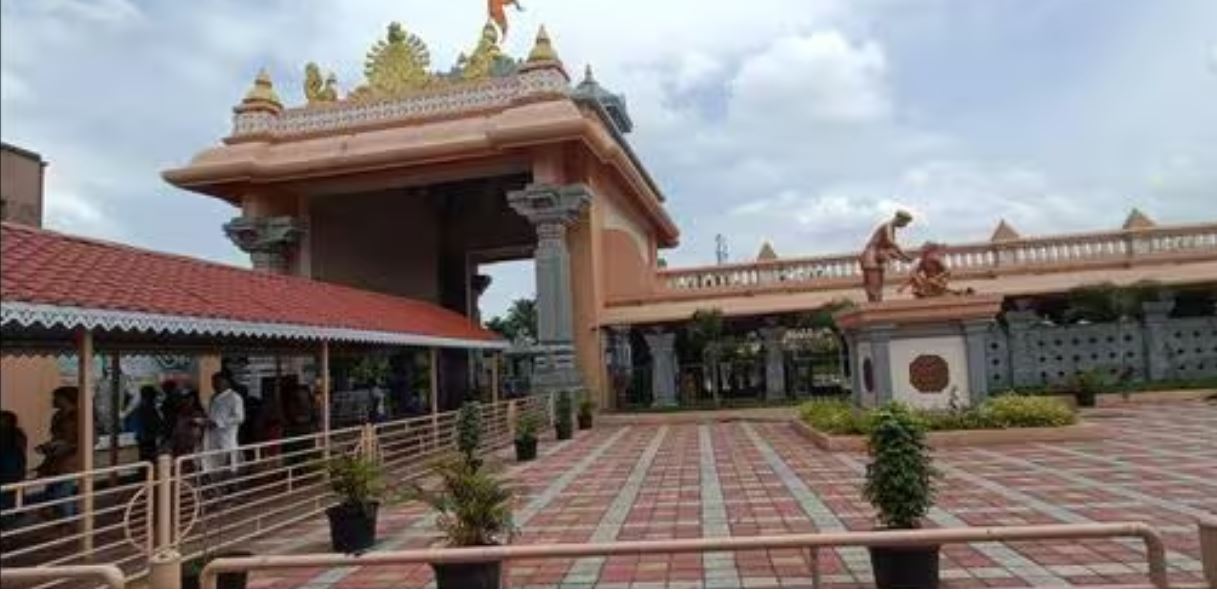
- The idol is placed in the open, under the sky
- There is no enclosed sanctum (garbhagriha) with roof or walls over the main deity
- Devotees traditionally offer mustard oil to Lord Shani, poured over the idol from a suspended copper vessel
Other features within the temple complex include:
- A Trishul (trident) near the idol
- A Nandi statue located to the south of the idol
- Small images of Lord Shiva and Hanuman in front of the Shani idol
- A later-built east-facing multi-deity temple situated west of the Shani stone
- A samadhi (tomb) of Saint Udasi Baba
- A temple dedicated to Lord Dattatreya
Cultural and Pilgrimage Importance
- One of the most important Shani temples in India
- Attracts thousands of devotees, especially on Shani Amavasya and Saturdays
- Reflects a blend of folk belief, astrology, and devotional Hindu practices
Significance
- Represents a unique open-sky form of deity worship
- Illustrates strong links between faith and social customs (doorless homes tradition)
- An important religious and cultural landmark in Maharashtra
Dolomedes indicus
- 10 Dec 2025
In News:
Researchers have discovered a new spider species, Dolomedes indicus, in the evergreen rainforests of the Western Ghats, specifically in Wayanad district, Kerala.
What is Dolomedes indicus?
- Dolomedes indicus is a newly identified species of spider belonging to the genus Dolomedes, commonly known as raft spiders or fishing spiders.
- This discovery marks the first recorded member of the Dolomedes genus in India.
Genus Dolomedes (Raft/Fishing Spiders)
- Members of this genus are known for their semi-aquatic lifestyle.
- Unlike web-building spiders, they are active hunters.
- They are typically found near freshwater streams, ponds, and wetlands.
Habitat
- Found in evergreen forest streams of the Western Ghats, a global biodiversity hotspot.
- Prefers cool, clean, shaded freshwater habitats under dense forest canopies.
- Its presence indicates pristine stream ecosystems with minimal disturbance.
Behaviour and Hunting Strategy
Dolomedes indicus is a semi-aquatic predator that:
- Uses surface tension of water to stand and move on water surfaces
- Detects vibrations caused by insects or small aquatic animals struggling in water
- Swiftly lunges across the water to capture prey
- Is capable of swimming and diving to escape predators or catch prey
This makes it ecologically different from typical web-dependent house spiders.
Physical Characteristics
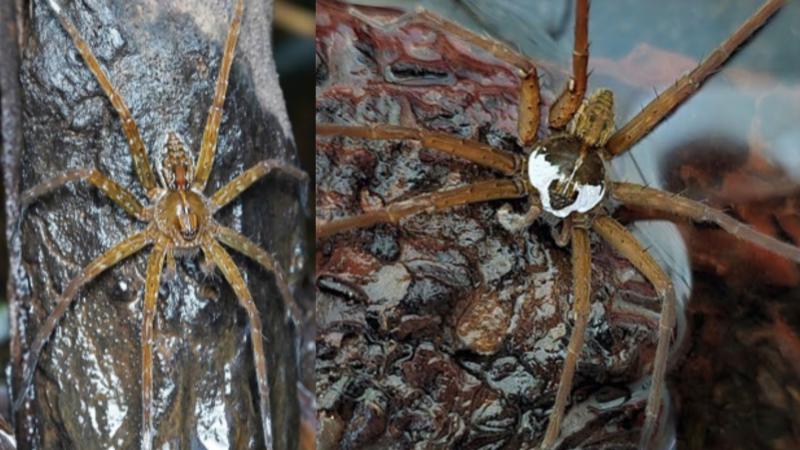
- Males: Identified by a distinctive snow-white marking extending from the face to the middle of the back
- Females: Larger in size and greenish-brown, helping them camouflage against mossy rocks and streamside vegetation
Sexual dimorphism (difference in appearance between males and females) is clearly visible.
Ecological Importance
- Being highly sensitive to environmental changes, Dolomedes indicus may serve as an indicator species
- Its survival depends on:
- Clean freshwater
- Stable forest canopy cover
- Undisturbed stream ecosystems
Thus, its presence can help scientists monitor freshwater ecosystem health and assess the impact of habitat degradation.
Significance of Discovery
- Highlights the rich but understudied biodiversity of the Western Ghats
- Expands the known geographical range of the Dolomedes genus
- Emphasizes the importance of conserving freshwater habitats within forest ecosystems
Infrastructure Investment Trust (InvIT)
- 10 Dec 2025
In News:
The National Highways Authority of India (NHAI) has received SEBI’s in-principle approval to register “Raajmarg Infra Investment Trust (RIIT)” as an Infrastructure Investment Trust (InvIT). This is a step toward expanding public participation in highway infrastructure financing and asset monetisation.
What is an InvIT?
An Infrastructure Investment Trust (InvIT) is a collective investment vehicle, similar in structure to a mutual fund, that allows investors to invest in income-generating infrastructure assets.
- It is set up as a trust and registered with SEBI under the SEBI (Infrastructure Investment Trusts) Regulations, 2014.
- InvITs pool money from retail and institutional investors to invest in infrastructure projects such as highways, power transmission lines, pipelines, and telecom towers.
- Investors receive units of the trust, representing a share in the underlying assets and their cash flows.
Objective of InvITs
InvITs aim to:
- Provide retail investors access to infrastructure investment opportunities that were earlier limited to large institutions
- Enable long-term financing for infrastructure
- Help infrastructure developers monetise operational assets and recycle capital into new projects
Structure of an InvIT
An InvIT typically involves four key entities:
- Sponsor(s)
- Usually infrastructure developers or financial institutions
- Transfer infrastructure assets to the InvIT
- Hold a minimum required stake in the trust
- Trustee
- Registered with SEBI
- Ensures the InvIT operates in the interest of unit holders
- Investment Manager: Responsible for managing the InvIT’s assets and making investment decisions
- Project Manager: Handles the operation and maintenance of the underlying infrastructure assets
How InvITs Work
- Sponsors transfer revenue-generating infrastructure assets to the InvIT
- The InvIT raises funds by issuing units to investors
- Income generated from tolls, tariffs, or user charges is distributed to investors, typically as regular cash flows
- InvITs are designed for stable, long-term returns rather than rapid capital appreciation
Regulatory Framework
- Governed by SEBI (Infrastructure Investment Trusts) Regulations, 2014
- SEBI prescribes norms for:
- Asset composition
- Minimum public holding
- Disclosure and reporting standards
- Distribution of cash flows to investors
- Ensures transparency, investor protection, and standardised governance
NHAI and Raajmarg Infra Investment Trust (RIIT)
- RIIT is NHAI’s proposed Public InvIT for monetising national highway assets
- It aims to unlock value from operational highway projects and provide a long-term investment instrument mainly for domestic and retail investors
- As part of the process for final registration, RIIT must meet regulatory conditions such as:
- Appointment of directors
- Submission of financial statements
- Compliance with SEBI norms within a specified timeframe
NHAI has also set up Raajmarg Infra Investment Managers Pvt. Ltd. (RIIMPL) as the Investment Manager, with participation from major banks and financial institutions.
InvITs in India’s Infrastructure Financing
NHAI has already raised significant funds through:
- -Operate-Transfer (TOT) model – Monetising completed highway stretches
- Private InvITs – Attracting domestic and global investors
Public InvITs like RIIT represent the next step, allowing wider public participation in infrastructure financing.
Significance of InvITs
- Mobiliselong-term capital for infrastructure
- Reduce pressure on government budgets and bank lending
- Improve asset recycling by freeing up developer capital
- Offer investors an avenue for steady income from infrastructure assets
AstroSat
- 10 Dec 2025
In News:
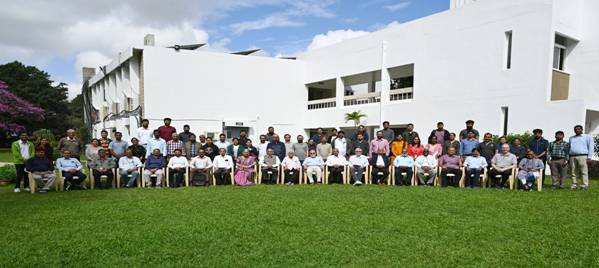
The Indian Institute of Astrophysics (IIA) recently marked 10 years of successful operations of the UltraViolet Imaging Telescope (UVIT) aboard AstroSat, highlighting India’s achievements in space-based ultraviolet astronomy.
About AstroSat
AstroSat is India’s first dedicated astronomy satellite, designed to study celestial objects across multiple wavelengths simultaneously. It enables coordinated observations in ultraviolet (UV), optical, and X-ray bands, making it comparable to international space observatories.
- Launched: 28 September 2015 by ISRO
- Type: Multi-wavelength space observatory
- Orbit Control: Managed by the Mission Operations Complex (MOX) at ISRO’s ISTRAC, Bengaluru
- Significance: Allows simultaneous study of high-energy cosmic processes with a single platform
Scientific Payloads on AstroSat
AstroSat carries five instruments, each designed to observe different energy bands:
- UltraViolet Imaging Telescope (UVIT) – Observes in near-UV, far-UV, and visible wavelengths
- Large Area X-ray Proportional Counter (LAXPC) – Studies high-energy X-ray sources
- Cadmium–Zinc–Telluride Imager (CZTI) – Detects hard X-rays and gamma-ray bursts
- Soft X-ray Telescope (SXT) – Observes low-energy X-rays
- Scanning Sky Monitor (SSM) – Monitors variable X-ray sources across the sky
Together, these cover an energy range of roughly 0.3 keV to 100 keV, along with ultraviolet and limited optical bands.
UltraViolet Imaging Telescope (UVIT)
UVIT is one of the mission’s flagship instruments and was designed and developed by the Indian Institute of Astrophysics (IIA).
- Comprises two telescopes:
- One for near-UV and visible
- One for far-UV
- UV observations must be done from space because Earth’s atmosphere absorbs ultraviolet radiation
- Provides high spatial resolution (≈1.5 arcseconds) with a relatively wide field of view
Over a decade of operation, UVIT has:
- Observed over 1,400 celestial targets
- Contributed to hundreds of scientific research papers and multiple PhD theses
- Provided key insights into stars, star clusters, galaxies, and energetic cosmic phenomena
UVIT data products are made available through ISRO’s PRADAN data archive for the global scientific community.
Scientific Objectives of AstroSat
AstroSat was designed to address major questions in high-energy and stellar astrophysics:
- Study high-energy processes in systems containing neutron stars and black holes
- Estimate magnetic fields of neutron stars
- Investigate star formation regions
- Observe X-ray binaries and transient X-ray sources
- Conduct deep-field surveys in the ultraviolet
- Examine active galactic nuclei (AGN) and distant galaxies
Major Scientific Contributions
Observations from UVIT and other payloads have enabled studies such as:
- Identification of hot companion stars in binary systems
- Study of blue straggler stars in clusters
- Mapping extended UV disks in dwarf galaxies
- Observations of novae in the Andromeda galaxy
- Detection of UV emission from distant galaxies
- Understanding links between UV and X-ray activity in active galaxies
Institutional Collaboration
AstroSat was developed through a national collaboration, involving:
- ISRO centres
- Indian Institute of Astrophysics (IIA)
- IUCAA (Pune)
- TIFR (Mumbai)
- International support including the Canadian Space Agency
Future Outlook
Experience gained from UVIT is feeding into plans for INSIST (Indian Spectroscopic and Imaging Space Telescope), a proposed next-generation space observatory to expand India’s capabilities in ultraviolet and optical astronomy.