
Global Value Chain Development Report 2025
- 20 Dec 2025
In News:
The Global Value Chain (GVC) Development Report 2025 has been released by the World Trade Organization (WTO). The report analyses recent structural shifts in global production networks and assesses how economies are adapting to changing trade, technology and resilience imperatives.
What is a Global Value Chain (GVC)?
A Global Value Chain refers to the entire sequence of activities involved in producing a good or service, where these stages are geographically dispersed across multiple countries. Each stage adds value, and countries participate according to their comparative advantage.
Key Stages of a GVC
- Research & Design
- Sourcing of raw materials
- Manufacturing and assembly
- Logistics and distribution
- Marketing, sales and after-sales services
Illustration: A smartphone may be designed in the US, components manufactured in East Asia, assembled in India or Vietnam, and sold globally.
Major Findings of the GVC Development Report 2025
1. Continued Centrality of GVCs
- GVCs account for 46.3% of global trade in value-added terms (slightly below the 2022 peak).
- Despite global shocks, value chains remain integral to international trade.
2. Shift from Pure Efficiency to Resilience
- Firms and governments are increasingly prioritisingsupply chain diversification and risk mitigation, alongside cost efficiency.
- This reflects lessons from the pandemic and geopolitical disruptions.
3. Structural Shift Towards Services
- Services now contribute more than one-third of value added in manufacturing exports.
- Business services, ICT, logistics and digital platforms are becoming key GVC enablers.
4. Regional Reconfiguration
- Asia, Europe and North America continue to dominate GVC trade.
- However, production networks are becoming more regionally clustered.
5. Reshoring and Regionalisation
- Major economies such as China, the United States and the European Union are reducing dependence on foreign value-added in domestic consumption.
- This trend is driven by concerns over supply chain security and strategic autonomy.
6. Electric Vehicle (EV) Value Chains
- EV production is reshaping automotive GVCs, with China accounting for a large share of global EV output (2023).
- Critical minerals (lithium, cobalt, etc.) are emerging as strategic inputs, creating opportunities for resource-rich developing countries but also risks due to supply concentration.
7. Role of Technology
- Digitalisation, automation, AI and advanced ICT are enabling finer fragmentation of production and lowering coordination costs.
- Economies with strong infrastructure and absorptive capacity benefit most, while others risk exclusion.
India-Specific Findings
- India, along with the Philippines and several African economies, has strengthened its role in business-process and digital service exports.
- India is now among the top 10 value-adding economies globally, with a 2.8% share of global Domestic Value Added (DVA) in exports (2024).
- This highlights India’s growing integration into digital and services-led GVCs, rather than traditional manufacturing alone.
Challenges for India in GVC Integration
- Infrastructure and Logistics Bottlenecks: High logistics costs, port inefficiencies and delays reduce export competitiveness.
- Regulatory and Policy Uncertainty: Frequent policy changes and compliance burdens discourage long-term investment.
- Limited Trade Agreements: Fewer Free Trade Agreements (FTAs) limit preferential access to major markets.
- Skill and Technology Gaps: Shortage of skilled manpower in advanced manufacturing and high-tech sectors.
- Sustainability Constraints: Carbon border taxes and ESG norms may increase compliance costs for exporters.
Policy Recommendations from the Report
For Policymakers
- Invest in digital and logistics infrastructure to deepen GVC participation.
- Align climate and trade policies to balance sustainability and competitiveness.
- Improve access to trade finance, especially for MSMEs.
- Promote transparent and coordinated industrial policies that enhance resilience without fragmenting global trade.
For Firms
- Invest in digital tools, AI and automation to enhance adaptability.
- Diversify supply networks to balance efficiency with resilience.
- Leverage regional value chains where strategic advantages exist.
Param Vir Chakra (PVC)
- 20 Dec 2025
In News:
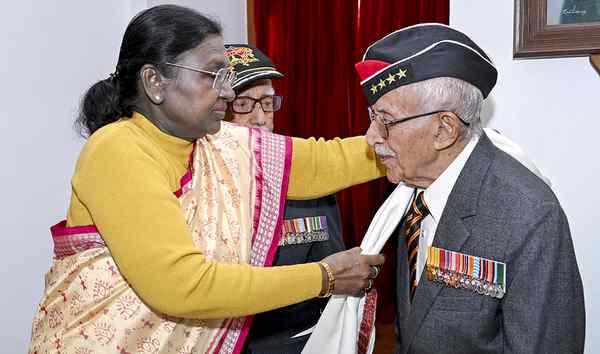
On Vijay Diwas 2025, the President of India, Droupadi Murmu, inaugurated the ‘Param Vir Dirgha’ at the Rashtrapati Bhavan, New Delhi.
The gallery showcases portraits of all 21 recipients of the Param Vir Chakra (PVC), India’s highest military gallantry award.
Notably, this display replaced portraits of 96 British Aide-de-Camps (ADCs) from the colonial era, symbolising India’s continued effort to decolonise public memory and national symbols.
Param Vir Chakra (PVC): India’s Highest Gallantry Award
The Param Vir Chakra is the highest military decoration for valour in India, awarded for the most conspicuous bravery, indomitable courage and supreme sacrifice in the presence of the enemy during wartime.
- Instituted: 26 January 1950, coinciding with the enforcement of the Constitution
- Eligibility: Personnel of all ranks from the Army, Navy, Air Force, Territorial Army and other lawfully constituted armed forces
- Nature: Can be awarded posthumously
Key Features
- Awarded only during wartime
- Recognises acts of extraordinary courage against the enemy
- Includes a monthly honorarium of ?3,000, with an additional ?3,000 for every bar
Recipients
- Total awardees: 21
- Posthumous awards: 14
- Conflicts covered: Four major wars fought by India
The high proportion of posthumous awards underlines the supreme sacrifice associated with the honour.
Param Vir Dirgha: Symbolism and National Memory
The establishment of the Param Vir Dirgha serves multiple purposes:
- Institutionalising remembrance of India’s war heroes
- Educating citizens and visitors about acts of exceptional military valour
- Reinforcing national pride and military ethos
According to the Rashtrapati Bhavan, the initiative helps visitors understand the “dauntless resolve and unconquerable spirit” of India’s soldiers and represents a conscious move to replace colonial symbolism with Indian national heroes.
Who are Aide-de-Camps (ADCs)?
An Aide-de-Camp is a personal military officer attached to high constitutional authorities such as the President or Governors.
Key Characteristics
- Typical Rank:
- Major (Army)
- Lieutenant Commander (Navy)
- Squadron Leader (Air Force)
Functions
- Managing official schedules and engagements
- Coordinating ceremonial and protocol duties
- Acting as liaison between the dignitary and civil/military authorities
- Assisting in security and coordination
While ADCs continue to serve an important functional role today, the earlier display of British ADC portraits reflected colonial legacy rather than independent India’s military ethos.
Natyashastra
- 20 Dec 2025
In News:
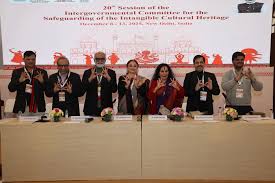
The Indira Gandhi National Centre for the Arts (IGNCA)organised an academic programme titled “Natyashastra – Synthesis of Theory and Praxis” during the 20th Session of the Intergovernmental Committee for the Safeguarding of Intangible Cultural Heritage of UNESCO, held at the Red Fort, New Delhi.
The event highlighted the continued global relevance of India’s classical knowledge systems in the domain of performing arts.
Natyashastra: An Overview
The Natyashastra is an ancient Sanskrit treatise that lays the foundational framework of Indian performing arts.
- Authorship: Composed by sage Bharata Muni
- Period: Dated between 2nd century BCE and 2nd century CE
- Nature: Earliest comprehensive treatise on drama, dance and music in South Asia
- Etymology:
- Natya – dance and drama
- Shastra – systematic science or discipline
The text legitimiseddrama as a means of moral, social and spiritual instruction, making performance a medium of religious and philosophical enlightenment.
Core Concepts in the Natyashastra
The Natyashastra consists of nearly 36,000 verses, dealing with both theoretical principles and practical aspects of performance:
- Natya: Dramatic composition
- Abhinaya: Modes of expression (body, speech, emotion and costume)
- Sangita: Music and rhythm
- Bhava: Emotional states expressed by the performer
- Rasa: Aesthetic experience felt by the audience
Doctrine of Rasa – A Key Contribution
One of the most enduring contributions of the Natyashastra is the theory of Rasa, which explains how art evokes emotional responses.
Bharata Muni identified eight primary Rasas:
- Shringara – Love
- Hasya – Humour
- Karuna – Compassion
- Raudra – Anger
- Veera – Heroism
- Bhayanaka – Fear
- Bibhatsa – Disgust
- Adbhuta – Wonder
Through skilful use of bhava, the performer evokes these rasas, resulting in aesthetic transcendence for the audience. This framework continues to guide Indian classical dance, theatre and music traditions.
Global Recognition
The Natyashastra has been included in UNESCO’s Memory of the World Register, recognising its universal cultural value and its influence on global theories of aesthetics, dramaturgy and performance studies.
Indira Gandhi National Centre for the Arts (IGNCA)
The IGNCA functions as a premier national institution for cultural research and preservation.
- Status: Autonomous body under the Ministry of Culture
- Mandate:
- Documentation, preservation and dissemination of Indian arts and cultural heritage
- Training of professionals in specialised cultural disciplines
Functional Units of IGNCA
- Kalanidhi – Multi-form reference library
- Kalakosa – Study and publication of fundamental texts (largely Sanskrit)
- Janapada Sampada – Lifestyle and folk culture studies
- Kaladarsana – Exhibitions and visual interpretation of research
- Cultural Informatics Lab – Digital tools for cultural preservation
- Sutradhara – Administrative and coordination unit
AH-64E Apache Attack Helicopter
- 20 Dec 2025
In News:
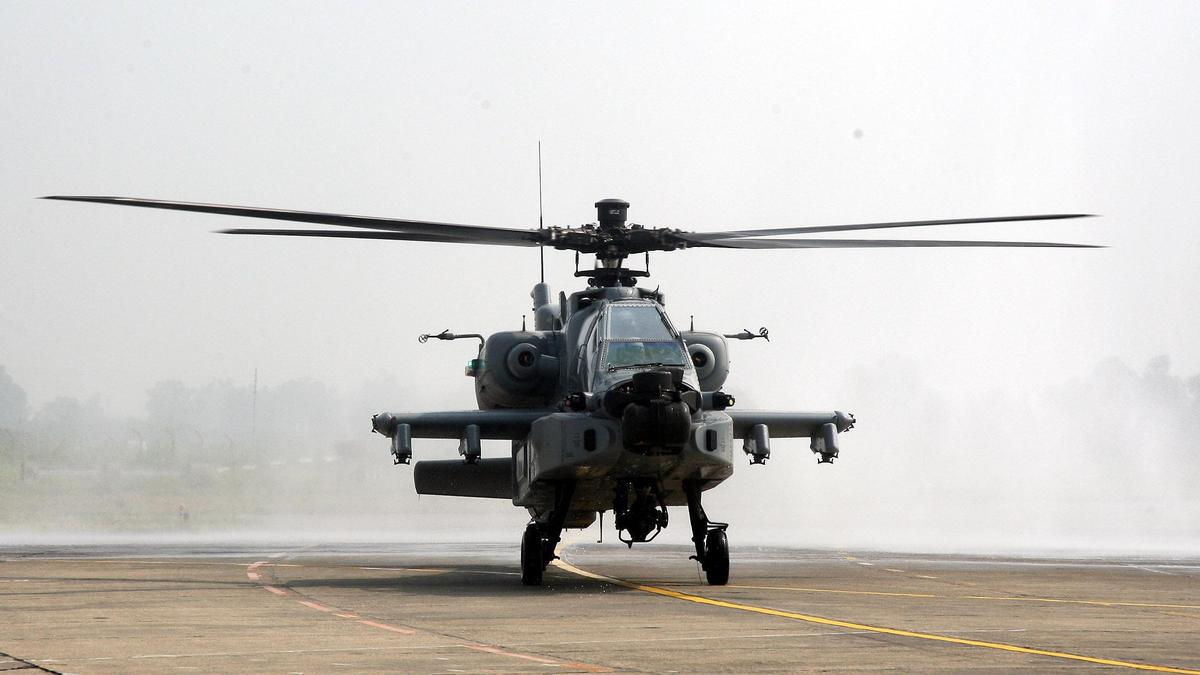
The Indian Army has received the final batch of three AH-64E Apache attack helicopters, completing its sanctioned fleet of six helicopters. These platforms have been inducted into the 451 Army Aviation Squadron based at Jodhpur, Rajasthan, marking a key step in enhancing India’s offensive rotary-wing capability.
About the AH-64E Apache Attack Helicopter
The AH-64E Apache, also known as the Apache Guardian, is regarded as the world’s most advanced multi-role combat helicopter. It is designed for advanced reconnaissance, precision strike and close air support (CAS) missions in high-intensity battlefield environments.
- Country of Origin: United States
- Manufacturer: Boeing
- User Nations: United States, India, Israel, Japan, South Korea, UK, UAE, Saudi Arabia, Qatar, Netherlands, among others
- Operational Variant: Latest version currently used by the US Army
Apache in India’s Defence Architecture
India operates the Apache across two services, reflecting a shift towards service-specific combat roles:
- Indian Air Force: Operates 22 AH-64E helicopters, inducted primarily for air force-led strike and support roles
- Indian Army: Inducted 6 AH-64E helicopters (contract signed in 2020) to strengthen Army Aviation Corps’ direct battlefield support
This dual induction enhances jointness, while enabling the Army to independently conduct armoured warfare support and offensive air manoeuvres.
Key Technical and Combat Features
The AH-64E is a twin-engine, heavily armed attack helicopteroptimised for survivability and lethality:
- Length: 17.8 metres
- Maximum Speed: ~300 km/h
- Maximum Operating Weight: 10,432 kg
- Rate of Climb: Over 2,800 feet per minute
Weapons Suite:
- AGM-114 Hellfire missiles (anti-tank and precision strike)
- 70 mm rockets
- 30 mm chain gun (nose-mounted)
- Stinger air-to-air missiles (short-range aerial threats)
Advanced Avionics & Sensors:
- Integrated infrared laser designator
- Enhanced night-fighting capability combining infrared and night vision imagery
- Ability to track up to 128 targets per minute and prioritise threats in real time
These features enable operations in all-weather, day-night and high-threat environments.
Strategic Significance for India
The induction of AH-64E Apaches into the Indian Army has multiple strategic implications:
- Enhanced anti-armour capability, especially in desert and plains sectors
- Improved close air support for mechanised and infantry formations
- Greater operational autonomy for the Army Aviation Corps
- Boost to network-centric warfare, surveillance and precision strike capacity
The deployment at Jodhpur is particularly relevant for western theatre preparedness, including rapid response in desert warfare scenarios.
DHRUV64
- 20 Dec 2025
In News:
India has achieved a significant milestone in its semiconductor journey with the development of DHRUV64, the country’s first 1.0 GHz, 64-bit dual-core indigenous microprocessor. Developed by Centre for Development of Advanced Computing (C-DAC) under the Microprocessor Development Programme (MDP) of Ministry of Electronics and Information Technology (MeitY), DHRUV64 represents a major step towards technological self-reliance in advanced chip design, a core requirement for India’s digital and strategic autonomy.
Why Indigenous Microprocessors Matter
Microprocessors form the backbone of modern digital infrastructure, powering devices ranging from smartphones and automobiles to defence systems, satellites and medical equipment. For India, dependence on imported processors poses risks related to supply chain disruptions, strategic vulnerabilities and high foreign exchange outflows. Given that India consumes nearly 20% of globally manufactured microprocessors, indigenous capability is critical for sustaining the country’s expanding digital economy.
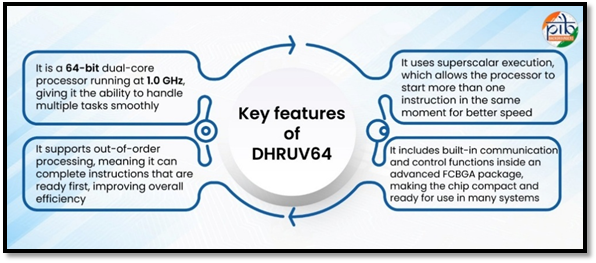
Key Features of DHRUV64
DHRUV64 incorporates modern architectural features that enhance efficiency, multitasking capability and system reliability. Its design enables seamless integration with diverse external hardware platforms, making it suitable for a wide range of applications, including:
- 5G and telecom infrastructure
- Automotive electronics
- Industrial automation
- Consumer electronics
- Internet of Things (IoT) ecosystems
The processor thus bridges the gap between strategic requirements and commercial scalability, a long-standing challenge in India’s chip ecosystem.
Strategic Significance for India
DHRUV64 strengthens India’s indigenous processor pipeline and reduces long-term reliance on foreign technologies. It contributes to:
- Secure digital infrastructure, especially for strategic sectors
- Technological sovereignty in critical electronics
- Capacity building for India’s large pool of chip design engineers
The development of DHRUV64 builds upon earlier indigenous processors such as SHAKTI (IIT Madras), AJIT (IIT Bombay), VIKRAM (ISRO–SCL) and THEJAS64 (C-DAC), collectively fostering a national processor ecosystem rather than isolated projects.
Role of RISC-V and Digital India RISC-V (DIR-V) Programme
DHRUV64 has been developed under the Digital India RISC-V Programme (DIR-V) initiative, which aims to establish India as a global hub for Electronics System Design and Manufacturing (ESDM).
RISC-V, being an open-source instruction set architecture, eliminates licence fees and enables shared innovation among academia, startups and industry. Its adoption:
- Lowers entry barriers for indigenous chip development
- Encourages collaborative research and standardisation
- Supports long-term scalability of Indian processors
Under DIR-V, DHRUV64 is the third fabricated chip, following THEJAS32 and THEJAS64, while next-generation DHANUSH and DHANUSH System-on-Chip (SoC) variants are currently under development.
Impact on R&D, Innovation and Human Capital
DHRUV64 provides a homegrown, affordable platform for startups, academia and industry to prototype and scale computing products without foreign dependence. It strengthens India’s R&D ecosystem by:
- Enabling low-cost system architecture experimentation
- Supporting indigenous product development
- Enhancing skill formation for semiconductor professionals
Given that India already accounts for nearly 20% of the world’s chip design workforce, such platforms are crucial for converting talent into domestic intellectual property.
Institutional and Policy Support Framework
India’s indigenous processor development is supported by a coordinated institutional ecosystem:
- MeitY: Provides policy direction, funding and long-term planning through programmes such as MDP, DIR-V, Chips to Startup (C2S) and the India Semiconductor Mission.
- C-DAC: Leads processor IP design, SoCs, development boards and toolchains, and is spearheading future RISC-V processors like Dhanush and Dhanush .
Key national programmes strengthening this ecosystem include:
- India Semiconductor Mission (ISM) – facilitating large-scale semiconductor investments
- Chips to Startup (C2S) – building manpower and fabless design capacity
- Design Linked Incentive (DLI) Scheme – incentivising semiconductor design
- INUP-i2i Programme – providing access to national nanofabrication facilities