
Adaptive Testing in JEE-Advanced
- 04 Feb 2026
In News:
- The IIT Council has recommended exploring adaptive testing for JEE Advanced, signalling a major shift in India’s high-stakes entrance examination framework. An expert committee is expected to guide a phased transition between 2026 and 2028, with free adaptive mock tests proposed to familiarise students and help calibrate question banks.
- This reform aims to make assessment fairer, more precise, and less stressful, while aligning Indian testing practices with global standards.
What is Adaptive Testing?
Adaptive testing is a computer-based dynamic assessment system that adjusts question difficulty in real time based on a candidate’s responses. It relies on Item Response Theory (IRT), a psychometric framework used to estimate a candidate’s true ability level after each answer.
Unlike traditional exams where all students attempt the same fixed paper, adaptive testing personalises the test pathway while maintaining comparability through a standardised ability scale.
How It Works
1. Dynamic Question Selection
- Test begins with a moderate-difficulty question
- Correct answer → harder question
- Incorrect answer → easier question
This converges toward the candidate’s actual proficiency level.
2. Item Response Theory (IRT)
- Statistical models continuously estimate ability
- Each question has parameters such as difficulty, discrimination, and guessing probability
- Ability estimate becomes more precise with each response
3. Common Ability Scale
Even though candidates see different questions, scores are mapped onto a single standardised scale, ensuring fairness and comparability.
4. Fewer but More Informative Questions
Because each question is targeted, fewer questions are needed to measure ability accurately — reducing fatigue and time pressure.
5. Concept-Focused Progression
Students cannot reach advanced-level questions without demonstrating foundational understanding, reducing the impact of rote coaching strategies.
6. Fully Computerised Delivery
Requires:
- Secure digital infrastructure
- Large calibrated item banks
- Real-time computation engines
NeophyteID App

- 04 Feb 2026
In News:
Kerala has taken a significant step in tech-enabled environmental governance with the launch of the NeophyteID mobile application by Chief Minister Pinarayi Vijayan. The app represents a convergence of artificial intelligence, citizen science, and biodiversity conservation, aimed at tackling the growing threat of invasive plant species in the state.
About the NeophyteID Application
- NeophyteID is an AI-powered mobile application developed by researchers at the Malabar Botanical Garden and Institute for Plant Sciences (MBGIPS). It is designed as a citizen-friendly digital tool to identify, report, and map invasive (neophyte) plant species across Kerala.
- The app enables local communities, students, researchers, and ecologists to collaboratively monitor plant invasions that threaten native biodiversity and ecosystem stability.
Key Features
1. AI-Based Species Identification
- Powered by the YOLOv11 machine learning model
- Uses image recognition to identify invasive plants from:
- Live camera input
- Uploaded photos from the gallery
2. Geospatial Mapping
- Each confirmed identification is tagged with location data
- Helps build a real-time distribution map of invasive plant species
- Supports scientific research and evidence-based conservation planning
3. Citizen Science Approach
- Encourages public participation in biodiversity monitoring
- Bridges the gap between scientists and local communities
4. Language Accessibility
- Available in English and Malayalam
- Enhances usability among local populations
Why Invasive Species Matter
Invasive plant species are non-native plants that spread aggressively and disrupt ecosystems.
Ecological Impacts
- Outcompete native flora for nutrients, sunlight, and space
- Reduce biodiversity
- Alter soil chemistry and hydrology
- Disrupt food chains and wildlife habitats
Economic & Social Impacts
- Damage agriculture and forestry
- Increase management costs
- Affect water bodies, fisheries, and tourism
Union Budget 2026–27 and the Rise of India’s Orange Economy
- 04 Feb 2026
In News:
The Union Budget 2026–27 marks a decisive shift in India’s development strategy by placing creative industries at the heart of a services-led growth model. By investing in digital content creation, design education, and skill development, the government has signalled strong support for the Orange Economy, a sector where ideas, culture and intellectual property generate economic value.
Understanding the Orange Economy
The Orange Economy, also known as the Creative Economy, refers to knowledge-based activities where value arises from creativity, cultural heritage, and intellectual property rather than physical production.
- The term was popularised by Iván Duque Márquez and Felipe Buitrago in their 2013 book The Orange Economy: An Infinite Opportunity.
- The colour orange symbolises culture, identity and creativity across civilizations.
- Globally, the creative economy generates over $2 trillion annually and supports nearly 50 million jobs.
For India, this sector represents the intersection of culture, technology, and entrepreneurship.
Key Budget Proposals for the Creative Sector
1. AVGC Content Creator Labs
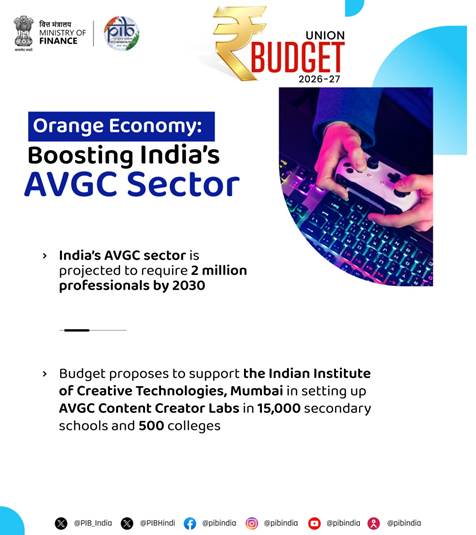
The Budget proposes setting up Animation, Visual Effects, Gaming and Comics (AVGC) Content Creator Labs in:
- 15,000 secondary schools
- 500 colleges
These labs will be anchored by the Indian Institute of Creative Technologies (IICT), Mumbai, envisioned as a premier institution for creative technology training.
Financial Allocation: ?250 crore earmarked for AVGC talent development.
Objective: Early exposure to digital storytelling tools, immersive technologies and creative entrepreneurship.
2. Expansion of Design Education
A new campus of the National Institute of Design (NID) will be established in Eastern India through a competitive “challenge route”.
Significance:
- Addresses shortage of trained designers
- Supports product innovation and branding for MSMEs
- Reduces regional disparities in access to design education
Why the Orange Economy Matters for India
1. Economic Growth Driver
- India’s media and entertainment sector was valued at ?2.5 trillion in 2024 (Economic Survey 2025–26).
- Creative exports grew by 20% in 2023–24, earning over $11 billion.
This highlights the sector’s potential to become a major contributor to services exports and GDP growth.
2. Employment Generation
- Employs around 8% of India’s workforce
- Offers large-scale opportunities for youth, freelancers, women and gig workers
- AVGC sector alone projected to need 2 million professionals by 2030
The sector’s low entry barriers and digital reach make it a powerful employment engine.
3. Strengthening Soft Power
Creative industries export stories, culture and intellectual property, enhancing India’s global influence.
- Indian films, gaming content, music, and digital art expand India’s cultural footprint
- Promotes Brand India globally
Thus, the Orange Economy is not just economic policy, but also cultural diplomacy.
4. Democratization of Creative Opportunity
By establishing AVGC labs in schools and colleges beyond metros, the budget aims to:
- Provide access to high-end creative tools in semi-urban and rural areas
- Unlock hidden talent across regions
- Reduce digital and opportunity divides
This aligns with the vision of inclusive and distributed growth.
India’s Structural Advantages
India is well-positioned to lead in the creative economy due to:
- A young demographic profile
- Rapid urbanisation and rising incomes
- Expanding internet and smartphone penetration
- Strong tradition of storytelling, arts and crafts
When combined with digital platforms, these factors create a fertile ecosystem for creative entrepreneurship.
Bharat Parv 2026
- 04 Feb 2026
In News:
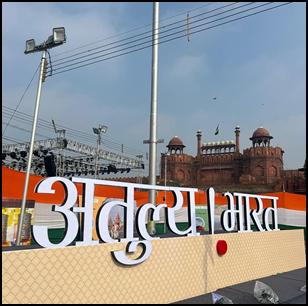
- As the Republic Day celebrations extend beyond the ceremonial parade, Bharat Parv 2026 emerged as a vibrant platform reflecting India’s civilisational continuity and cultural plurality.
- Organised by the Ministry of Tourism from 26–31 January 2026 at the lawns in front of the Red Fort, the festival functioned as a cultural bridge between citizens, regions and traditions. Since its inception in 2016, Bharat Parv has grown into a flagship cultural showcase aligned with national integration, tourism promotion and participatory heritage awareness.
Historical Resonance: 150 Years of Vande Mataram
The 2026 edition held special symbolic importance as it marked 150 years of “Vande Mataram”.
- Composed by Bankim Chandra Chatterjee
- First published in Bangadarshan (1875)
- Later included in the novel Anandamath (1882)
- Set to music by Rabindranath Tagore
The commemoration linked India’s freedom struggle ethos with the constitutional values of unity, participation and collective identity.
Bharat Parv as an Instrument of National Integration
The festival reinforced key national initiatives:
- Ek Bharat Shreshtha Bharat – Promoting inter-state cultural exchange
- Dekho Apna Desh – Encouraging domestic tourism and heritage awareness
By bringing diverse traditions into a shared public space, Bharat Parv translated the constitutional vision of unity in diversity into lived experience.
Major Attractions and Cultural Dimensions
1. Republic Day Tableaux Exhibition
A display of 41 Republic Day tableaux from States, Union Territories and Central Ministries allowed visitors to closely observe artistic narratives portraying:
- Cultural heritage
- Women empowerment and social inclusion
- Technological innovation
- Environmental awareness
This transformed parade symbolism into an educational and immersive cultural exhibit.
2. Cultural Performances
The festival hosted:
- 48 folk and classical performances by state troupes and cultural institutions
- 22 performances by Armed Forces and paramilitary bands
These performances combined regional diversity with national pride, illustrating culture as both identity and soft power.
3. Culinary Heritage and Sustainable Food Traditions
A pan-India food court with 60+ stalls functioned as a culinary atlas of India:
- Millet-based traditional foods
- Tribal and indigenous cuisines
- Region-specific preparations using local ingredients
The focus on traditional cooking methods and local produce highlighted the link between food, ecology and cultural identity, aligning with sustainable lifestyle narratives.
4. Handicrafts, Handlooms and Tribal Entrepreneurship
The handicrafts segment included 100+ stalls supported by States, development bodies and the TRIFED. Artisans showcased:
- Handwoven textiles
- Metal and wood crafts
- Traditional jewellery and paintings
The platform gave visibility to tribal entrepreneurs and heritage-based livelihoods, integrating cultural preservation with economic empowerment.
5. Tourism and Governance Outreach
- 34 State/UT tourism pavilions promoted destinations and circuits
- 24 Central Ministry stalls highlighted public initiatives
Interactive exhibits demonstrated how cultural outreach can strengthen citizen engagement with governance.
6. Culture Meets Science and Public Health
The festival also expanded beyond traditional arts:
- The National Science Centre, Delhi hosted interactive scientific demonstrations
- The Rural Health Training Centre (Najafgarh) conducted CPR awareness, preventive healthcare outreach and public health education
This integration of science, health and culture reflected a holistic understanding of nation-building.
Bharat-VISTAAR: AI for Agricultural Transformation
- 04 Feb 2026
In News:
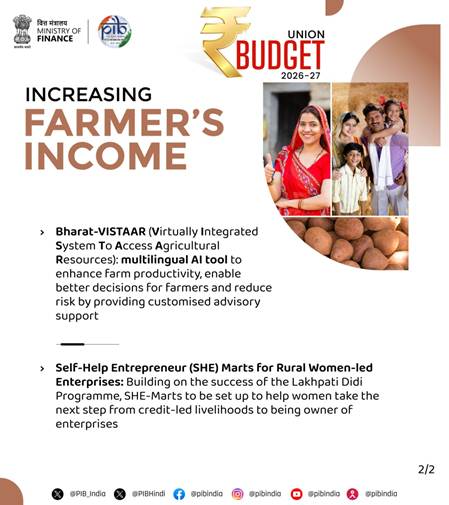
The Union budget 2026-27 has proposed ‘Bharat-VISTAAR’ (Virtually Integrated System to Access Agricultural Resources).
Key Features
- A key innovation is Bharat-VISTAAR is a multilingual AI-based advisory platform aimed at strengthening farm-level decision-making.
- Integrates AgriStack databases with scientific advisories from the Indian Council of Agricultural Research (ICAR)
- Provides customised, real-time advisory on:
- Crop planning and packages of practices
- Pest and disease management
- Weather forecasts
- Market trends and price signals
- Government schemes, eligibility and grievance redressal
- Initially launched in Hindi and English, with gradual expansion to regional languages
- Budget Allocation: ?150 crore for 2026–27
Significance
|
Challenge in Agriculture |
How Bharat-VISTAAR Responds |
|
Information asymmetry |
Local-language AI advisories |
|
Climate uncertainty |
Weather-linked crop guidance |
|
Market volatility |
Real-time market intelligence |
|
Scheme awareness gaps |
Integrated scheme information |
The initiative marks a shift from generic extension services to data-driven, farmer-specific digital advisories, potentially improving productivity, incomes and risk resilience.