
Climate Change Performance Index
- 22 Nov 2025
In News:
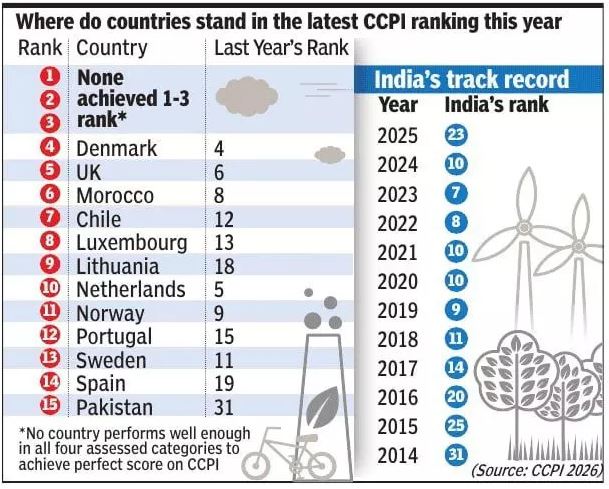
India slipped 13 places to rank 23rd in the Climate Change Performance Index (CCPI) 2026, released on the sidelines of COP30 at Belém, Brazil.
About the Climate Change Performance Index (CCPI)
- Published by:Germanwatch, NewClimate Institute, and Climate Action Network
- First published: 2005
- Coverage: 63 countries + EU, accounting for >90% of global GHG emissions
- Purpose: Independent assessment of countries’ climate mitigation performance
Assessment Pillars (4):
- GHG Emissions
- Renewable Energy
- Energy Use
- Climate Policy
(Top three ranks are kept vacant if no country achieves a “very high” overall score.)
CCPI 2026: Global Highlights
- Top performers: Denmark, United Kingdom, Morocco
- Lowest-ranked G20 members: China (54th), Russia (64th), United States (65th), Saudi Arabia (67th)
India’s Performance – Key Facts
- Rank:23rd (down from 10th last year)
- Score: 61.31
- Category ratings:
- GHG Emissions: Medium
- Climate Policy: Medium
- Energy Use: Medium
- Renewable Energy: Low
Why the Decline?
- Rising GHG emission trends (ranked last on emission trend indicator)
- Increasing energy consumption
- Absence of a concrete coal phase-out plan
- Reclassification from “high” to “medium” performer, as India is also among the largest producers of oil, gas and coal
India’s Positives
- Renewables growth: Nearly 14% share in total energy mix (2015–2023)
- Installed capacity:>50% of electricity capacity from non-fossil sources (≈ 256 GW)
Indira Gandhi Peace Prize

- 22 Nov 2025
In News:
Former Chilean President Michelle Bachelet has been awarded the Indira Gandhi Prize for Peace, Disarmament and Development for 2024, recognising her global contributions to human rights, social justice and inclusive governance.
About the Indira Gandhi Peace Prize
- Instituted:1986, in memory of former Prime Minister Indira Gandhi
- Instituted by: Indira Gandhi Memorial Trust
- Official Name:Indira Gandhi Prize for Peace, Disarmament and Development
- Nature: Annual international award
- Eligibility: Individuals or organisationsirrespective of nationality, race or religion
- Award Components:
- ?25 lakh cash prize
- Citation
Objectives of the Award
The prize recognisescreative and sustained efforts towards:
- Promotion of international peace, disarmament, racial equality, and harmony among nations
- Strengthening economic cooperation and a new international economic order
- Accelerating the all-round development of developing countries
- Using science and modern knowledge for the larger good of humanity
- Expanding freedom, human dignity and the human spirit
Why Michelle Bachelet was Awarded
- Political Leadership: Two-time President of Chile (2006–10, 2014–18); first woman to hold the office
- Global Human Rights Role: Former UN High Commissioner for Human Rights and first Director of UN Women
- Domestic Reforms in Chile:
- Education and tax reforms
- Establishment of the Ministry of Women and Gender Equality
- Creation of the National Institute for Human Rights and the Museum of Memory and Human Rights
- Promotion of women’s political participation and LGBTQ rights
- Global Standing: Known for advocacy on civil liberties, democratic values and protection of vulnerable groups
Select Past Recipients
- 1987: Mikhail Gorbachev
- 1989: UNICEF
- 1997: Jimmy Carter
- 2003: United Nations & Kofi Annan
- 2013: Angela Merkel
- 2014: Indian Space Research Organisation (ISRO)
- 2017: Manmohan Singh
- 2019: Sir David Attenborough
- 2021: Pratham NGO
- 2022: Indian Medical Association & Trained Nurses Association of India
- 2023: Daniel Barenboim & Ali Abu Awwad
YUVA AI for ALL Initiative
- 22 Nov 2025
In News:
The Ministry of Electronics and Information Technology (MeitY) has launched YUVA AI for ALL, a free national course on Artificial Intelligence, under the IndiaAI Mission. The initiative aims to democratise AI knowledge and make India’s citizensespecially youthfuture-ready in the age of emerging technologies.
About YUVA AI for ALL
- Nature: First-of-its-kind free, self-paced national AI course
- Duration: ~ 4.5 hours, divided into six short modules
- Target Group: Students, professionals, government employees and general learners
- Coverage Goal:1 crore (10 million) citizens with foundational AI skills
- Certification:Official Government of India certificate on completion
Key Features
- Accessible & Inclusive:
- 100% free and open to all
- Learn anytime, anywhere, at one’s own pace
- Practical & Contextual:
- Uses real-life Indian examples
- Blends global AI knowledge with India-specific context
- Ethical Focus:Emphasises safe, responsible and inclusive use of AI
- Delivery Platforms:
- FutureSkills Prime
- iGOTKarmayogi
- Other popular ed-tech portals
What Learners Gain
- Understanding of what AI is and how it works
- Awareness of AI’s impact on education, creativity and work
- Basics of ethical and responsible AI usage
- Exposure to Indian AI use cases
- Insights into future opportunities in the AI ecosystem
Why the Initiative Matters
- Bridges the Digital Divide: Makes AI literacy accessible beyond elite technical institutions.
- Workforce Readiness: Prepares India’s large youth population for AI-driven jobs.
- Ethical AI Adoption: Promotes trust, accountability and inclusiveness in AI use.
- Whole-of-Society Approach: Enables schools, universities, organisations and states to partner for nationwide outreach.
About the IndiaAI Mission
- Launched: Initially in 2023 as a joint initiative of MeitY and NASSCOM
- Core Objectives:
- “Making AI in India” – Encourage domestic AI research and innovation
- “Making AI Work for India” – Apply AI to sectors like governance, health, education and agriculture
- Ecosystem Support:
- Access to high-end computing resources
- Support for startups, researchers and innovators
Major Non-NATO Ally (MNNA)
- 22 Nov 2025
In News:
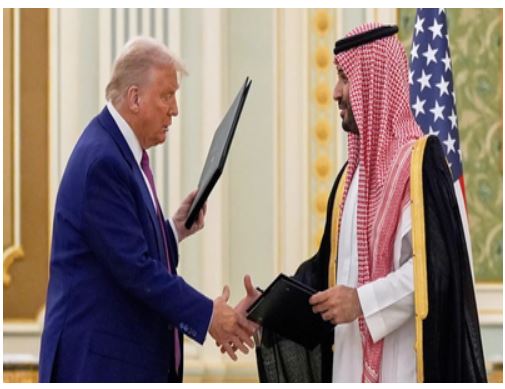
The United States has officially designated Saudi Arabia as a Major Non-NATO Ally (MNNA), marking a significant upgrade in bilateral defence ties following high-level engagement between President Donald Trump and Crown Prince Mohammed bin Salman. The move places Saudi Arabia among a select group of countries enjoying privileged security cooperation with the U.S.
What is Major Non-NATO Ally (MNNA)?
- MNNA is a special U.S. strategic designation for close defence partners outside NATO.
- It does not provide NATO-style collective defence guarantees, but confers substantial military, technological and financial privileges.
Background & Objective
- Origin: Created under U.S. law in the 1980s.
- Purpose:
- Strengthen U.S. alliance networks beyond NATO
- Promote defence collaboration, advanced weapons access, joint training, and security coordination
- Reinforce partnerships in geopolitically sensitive regions
Key Privileges of MNNA Status
- Priority Defence Access: Preferential delivery of U.S. Excess Defence Articles and smoother access to advanced military equipment.
- War Reserve Stockpiles: Eligibility to host U.S. war reserve stockpiles for rapid joint operations.
- Joint R&D: Participation in cooperative research, development, testing and evaluation (RDT&E) of defence technologies.
- Training & Contracting:
- Bilateral and multilateral military training programmes
- MNNA firms can bid for certain U.S. Department of Defense overseas contracts
- Counter-Terror & Security Funding: Access to U.S. funding for counter-terrorism technologies and advanced security research.
MNNA Countries (Illustrative)
Currently 20+ countries across regions hold MNNA status, including:Argentina, Australia, Bahrain, Brazil, Colombia, Egypt, Israel, Japan, Jordan, Kenya, Kuwait, Morocco, New Zealand, Pakistan, Philippines, Qatar, South Korea, Thailand, Tunisia — and now Saudi Arabia.
Why Saudi Arabia’s Designation Matters
- Defence Upgrade: Signals deeper military interoperability and long-term defence cooperation with Washington.
- Technology & Sales: Follows major U.S.–Saudi agreements covering defence, civil nuclear cooperation, and advanced technologies (including future fighter aircraft).
- Regional Security: Reinforces U.S. strategic alignment in the Middle East, with implications for regional balance and security architectures.
- Symbolic & Strategic: Elevates Riyadh’s status among U.S. partners without extending NATO obligations.
India’s Position
- India is NOT an MNNA.
- India has been designated a Major Defence Partner (MDP) since 2016 — a unique category granting access to high-end U.S. defence technology without MNNA status.
Ratanmahal Wildlife Sanctuary
- 22 Nov 2025
In News:
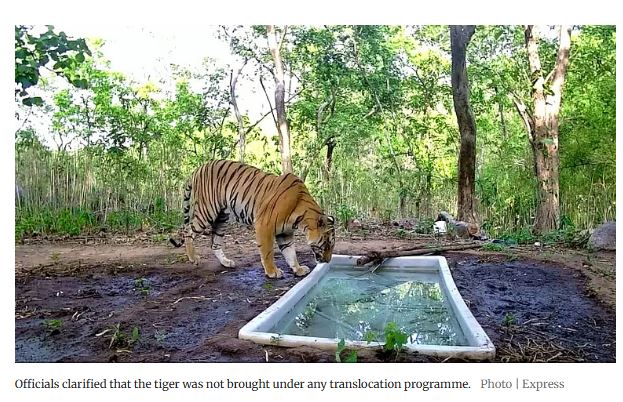
A wild tiger has established a sustained presence for about nine months in Ratanmahal Wildlife Sanctuary, marking the first long-term tiger residency in Gujarat in decades. The tiger, first sighted in February 2025, is believed to have naturally dispersed from Madhya Pradesh, highlighting improving habitat connectivity and ecosystem health along the inter-state border.
About Ratanmahal Wildlife Sanctuary
- Location:Gujarat; along the Gujarat–Madhya Pradesh border (major portion within Gujarat)
- Established: March 1982
- Also Known As:Ratanmahal Sloth Bear Sanctuary (hosts the highest sloth bear population in Gujarat)
- Hydrology: Forms the catchment of the Panam River, a key river of Central Gujarat
Habitat & Vegetation
- Forest Types:
- Dry teak forests at foothills
- Mixed deciduous forests with dry bamboo brakes on the periphery
- Plateau Vegetation: Dominance of Mahuda (Mahudo) with patches of Sadad and Timru
- Key Flora: Teak, bamboo, amla, dhavdo, kakadiyo, mahuda, tanach, charoli, ber, jamun, khakhro, dudhlo
Faunal Diversity
- Mammals: Leopard, Sloth bear, Palm civet, Indian civet, Four-horned antelope
- Birds:Loten’s sunbird, Large green barbet, Yellow-cheeked tit
- Recent Addition:Tiger (Panthera tigris)
Ecological Significance of the Tiger’s Return
- Indicator Species: Tigers are apex predators; their presence signals healthy prey base, water availability, and habitat quality.
- Natural Dispersal: The tiger was not translocated; it migrated naturally from MP, aided by landscape connectivity and population pressure there.
- Contrast with Past: A tiger that reached Mahisagar (2019) did not survive due to inadequate prey—underscoring the improved conditions now at Ratanmahal.
- Monitoring: Continuous surveillance via camera traps and field teams to track movement and behaviour.
Conservation Implications
- Unique Coexistence: Gujarat now hosts all three big cats—Asiatic lion, Indian leopard, and tiger—within the same broader landscape.
- Management Challenges: Overlapping ranges demand enhanced corridor management, conflict mitigation, and community safety measures.
- Policy Signal: Validates habitat restoration, prey augmentation, and inter-state ecological linkages.