
New START Treaty
- 07 Feb 2026
In News:
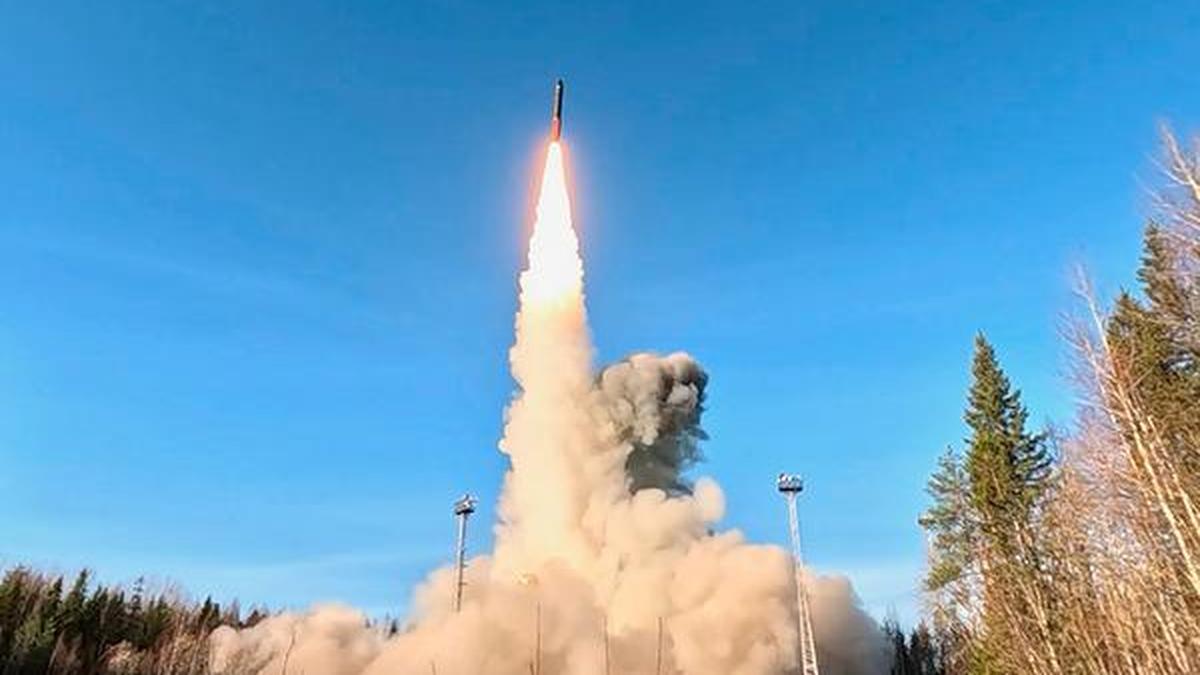
The New Strategic Arms Reduction Treaty (New START) expired on 5 February 2026, ending the last legally binding nuclear arms control agreement between the United States and Russia.
Context
The expiry of New START marks a major setback to global nuclear arms control. For the first time since 1972, there are no legally enforceable limits on U.S.–Russia strategic nuclear arsenals, raising concerns over arms racing, miscalculation, and erosion of nuclear deterrence stability.
Together, the United States and Russia possess about 87% of the world’s nuclear warheads, making bilateral arms control central to global strategic stability.
What is the New START Treaty?
Background
- START (Strategic Arms Reduction Treaty) framework began during the Cold War.
- START-I: Signed in 1991 between the US and USSR; entered into force in 1994.
- Followed by SORT (Strategic Offensive Reductions Treaty).
- New START:
- Signed in 2010
- Entered into force in 2011
- Extended in 2021 for five years until 2026
Parties Involved
- United States
- Russia
Key Provisions of New START
Arms Limitations
The treaty imposed verifiable ceilings on strategic nuclear forces:
- 700 deployed:
- Intercontinental Ballistic Missiles (ICBMs)
- Submarine-Launched Ballistic Missiles (SLBMs)
- Heavy bombers
- 1,550 deployed nuclear warheads
- 800 deployed and non-deployed launchers and bombers
Verification Mechanism
- On-site inspections
- Data exchange and notifications
- Transparency to reduce mistrust and miscalculation
Scope
- Covered long-range strategic weapons capable of striking critical targets such as:
- Command centres
- Infrastructure
- Population hubs
Suspension and Collapse
- In 2023, Russia suspended participation amid the Ukraine war.
- Inspections and data sharing were halted.
- Negotiations for a post-New START framework stalled (2024–25) due to:
- Strategic mistrust
- Disagreements over missile defence
- Scope of future limits
- The treaty formally expired on 5 February 2026.
Sources of Strategic Friction
- U.S. missile defence systems
- Conventional prompt-strike capabilities
- Russian development of advanced weapons:
- Kinzhal hypersonic missile
- Avangard hypersonic glide vehicle
Both sides viewed each other’s capabilities as destabilising, undermining arms control confidence.
Global Implications of New START Expiry
- Unconstrained nuclear arsenals of US and Russia
- Higher risks of:
- Arms buildup
- Strategic miscalculation
- Crisis escalation
- Weakens prospects for:
- Future bilateral arms reduction
- Multilateral arms control
- Complicates efforts to include China and other nuclear powers in future frameworks
- Undermines the global non-proliferation architecture
Global Nuclear Arms Control Frameworks
1. Treaty on the Non-Proliferation of Nuclear Weapons (NPT), 1968
- Prevents spread of nuclear weapons
- Promotes disarmament and peaceful nuclear energy
- Recognises five Nuclear Weapon States (NWS):
- US, Russia, UK, France, China
2. Comprehensive Nuclear-Test-Ban Treaty (CTBT), 1996
- Prohibits nuclear test explosions
- Not yet in force
3. Treaty on the Prohibition of Nuclear Weapons (TPNW), 2017
- Bans use, possession, testing and transfer of nuclear weapons
- Not supported by nuclear-armed states
Sodium-ion Battery Technology
- 07 Feb 2026
In News:
Sodium-ion batteries are emerging as a strategic alternative to lithium-ion technology, offering India a safer, resource-secure and cost-effective pathway for energy storage and electric mobility.
Context
Batteries are a critical backbone of modern infrastructure-supporting electric vehicles (EVs), renewable energy integration, and grid stability. India’s current dependence on lithium-ion batteries exposes it to import dependence, supply-chain vulnerabilities, and geopolitical risks, as key minerals like lithium, cobalt, nickel and graphite are scarce domestically and globally concentrated. This has prompted India to re-evaluate its battery strategy, with sodium-ion batteries (SiBs) gaining attention.
What are Sodium-ion Batteries?
- Sodium-ion batteries (SiBs) are rechargeable batteries that use sodium ions (Na?) as charge carriers instead of lithium ions.
- They belong to the same “rocking-chair” battery family as lithium-ion cells.
Working Principle
- Charging: Sodium ions move from cathode to anode through the electrolyte.
- Discharging: Sodium ions migrate back to the cathode, releasing electrical energy.
- Current collectors: Aluminium is used on both electrodes (unlike lithium-ion, which uses copper on the anode).
Key Features and Advantages
1. Resource Abundance and Security
- Sodium is abundantly available from sea salt and soda ash.
- Reduces reliance on imported critical minerals.
- Enhances energy security and strategic autonomy.
2. Safety Profile
- Intrinsically safer than lithium-ion batteries.
- Lower thermal runaway risk and lower peak temperatures during failure.
- Can be stored and transported at 0% state of charge, unlike lithium-ion batteries (classified as dangerous goods).
3. Cost Potential
- Use of aluminium instead of copper lowers material cost.
- Simplified logistics reduce transportation and insurance costs.
- Cost projections indicate SiBs could become cheaper than lithium-ion batteries by the mid-2030s.
4. Manufacturing Compatibility
- Can be produced using existing lithium-ion manufacturing lines with minor modifications.
- Aligns well with PLI-incentivised battery infrastructure in India.
Energy Density Comparison
- Historically, SiBs had lower energy density due to heavier sodium ions.
- Recent advances using layered transition-metal oxide cathodes have brought SiBs close to Lithium Iron Phosphate (LFP) batteries.
- Suitable for applications where ultra-high energy density is not critical.
Significance for India
- Reduced Import Dependence: Insulates India from global supply shocks and price volatility.
- Mass-market suitability: Ideal for electric two-wheelers, three-wheelers, buses, and grid storage.
- Grid-scale storage: Well-suited for renewable energy integration.
- Geopolitical resilience: Less exposure to mineral supply chains dominated by a few countries.
India’s Policy and Institutional Initiatives
- PLI Scheme for Advanced Chemistry Cell (ACC):
- Target: 50 GWh domestic capacity.
- 40 GWh awarded, but only ~1 GWh commissioned so far, indicating slow progress.
- National Critical Minerals Mission: Focus on exploration, mining, processing, recycling and overseas sourcing.
- Overseas mineral acquisition via Khanij Bidesh India Limited.
- Battery Waste Management Rules, 2022: Extended Producer Responsibility (EPR) for recycling and refurbishment.
Challenges in Scaling Sodium-ion Batteries
- Lower energy density limits use in long-range and premium EVs.
- Weight penalty compared to lithium-ion batteries.
- Moisture sensitivity requires deeper vacuum drying and tighter process control.
- Underdeveloped supply chain for sodium-specific cathodes, anodes and electrolytes.
- Policy gaps: Incentives and safety standards remain lithium-centric.
- Low market confidence due to limited real-world deployments.
Measures Suggested to Scale SiBs in India
- Farm-to-Battery Strategy:
- Use agricultural waste to produce hard carbon anodes.
- Convert stubble-burning problem into a resource solution.
- Desert-centric Manufacturing Clusters: Locate plants in low-humidity regions (Rajasthan, Kutch) to reduce energy costs.
- Standardisation for Early Markets: Focus on buses and three-wheelers where size and weight constraints are lower.
- Hybrid Battery Packs: Combine sodium-ion (cost efficiency) with lithium-ion (performance).
- Chemical Upgradation Support: Upgrade industrial soda ash to battery-grade sodium carbonate domestically.
International Space Station (ISS)
- 07 Feb 2026
In News:
The International Space Station (ISS) is scheduled to be de-orbited in 2030, marking the end of nearly three decades of continuous human presence in low Earth orbit.
What is the International Space Station (ISS)?
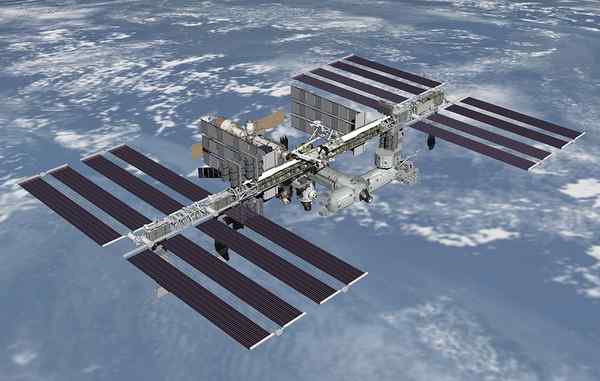
The International Space Station (ISS) is a permanently crewed, modular and habitable microgravity laboratory orbiting the Earth at an average altitude of ~400 km in Low Earth Orbit (LEO). It has remained continuously inhabited since November 2000, making it the longest-running human space mission in history.
Timeline and Development
- 1998: Assembly began with the launch of the first module Zarya.
- November 2000: Continuous human habitation started (Expedition 1).
- 1998–2011: Station assembled in orbit through multiple missions.
- 2030 (planned): Controlled de-orbit and re-entry over a remote oceanic region.
Participating Agencies
The ISS is operated through a unique international partnership involving five major space agencies:
- NASA (United States)
- Roscosmos (Russia)
- European Space Agency
- JAXA (Japan)
- Canadian Space Agency
The ISS is governed through shared responsibility, with each partner managing the hardware it contributes.
Key Features
- Largest human-made structure in space
- Mass: ~400,000 kg
- Length: ~109 metres
- Power Source: Large solar arrays generating tens of kilowatts of electricity.
- Modular Architecture: Multiple pressurised and truss modules assembled in orbit.
- Permanent Human Presence: Astronauts onboard 24/7 since 2000.
- Orbital Speed: ~7.7–8 km per second (one orbit every ~90 minutes).
Objectives and Functions
- Conduct microgravity research in biology, physics and materials science.
- Study long-term effects of spaceflight on humans:
- Bone density loss
- Muscle atrophy
- Immune system changes
- Radiation exposure
- Test technologies for deep-space missions (Moon and Mars).
- Enable Earth observation and climate-related studies.
- Support the emerging Low Earth Orbit (LEO) economy by hosting private experiments and technology demonstrations.
Planned De-orbit (2030)
- Ageing structure and outdated systems have necessitated retirement.
- A dedicated U.S. Deorbit Vehicle will slow the station and guide it into a controlled re-entry.
- The ISS will break up over a remote oceanic area (near Point Nemo) to avoid risk to human life.
- Similar controlled ocean disposal was used for earlier stations like Mir.
Significance
- Global Cooperation: A rare symbol of sustained peaceful collaboration even during geopolitical tensions.
- Scientific Legacy: Advanced understanding of human health, materials and long-duration spaceflight.
- Exploration Readiness: Operational experience critical for future lunar and Martian missions.
- Transition Phase: After 2030, China’s Tiangong will be the only operational space station in LEO, while focus shifts towards commercial space stations by private players.
Frontier Nagaland Territorial Authority (FNTA)
- 07 Feb 2026
In News:
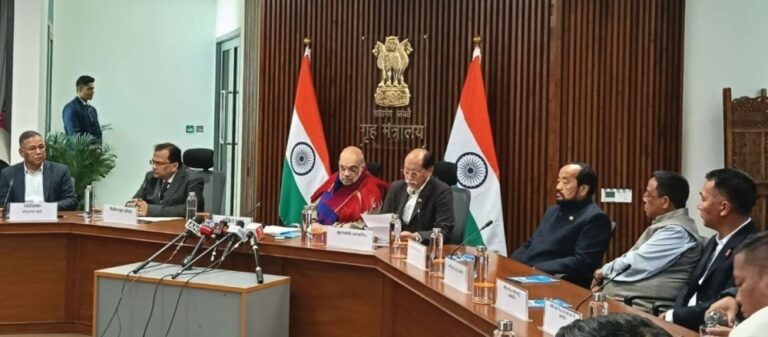
A historic tripartite agreement was signed in New Delhi between the Government of India, the Government of Nagaland, and the Eastern Nagaland Peoples’ Organisation (ENPO) for the creation of the Frontier Nagaland Territorial Authority (FNTA).
Background
The agreement marks a major step towards addressing long-standing political, economic and developmental grievances of Eastern Nagaland. It aligns with the Government of India’s broader objective of achieving a peaceful, dispute-free and developed North-East through dialogue and negotiated settlements.
Since 2019, multiple peace and autonomy agreements have been concluded in the North-East, reflecting a shift from conflict-driven approaches to democratic and constitutional solutions.
Key Parties to the Agreement
- Government of India
- Government of Nagaland
- Eastern Nagaland Peoples’ Organisation (ENPO)
- Apex body representing eight recognised Naga tribes of Eastern Nagaland.
About Frontier Nagaland Territorial Authority (FNTA)
Nature of the Arrangement
- FNTA is an autonomous territorial governance structure.
- It remains within the State of Nagaland (not a separate state or UT).
- Designed to provide enhanced administrative and financial autonomy.
Districts Covered
FNTA will cover six eastern districts of Nagaland: Tuensang, Mon, Kiphire, Longleng, Noklak, and Shamator
Salient Features of the Agreement
1. Devolution of Powers
- 46 subjects transferred to FNTA.
- Enables localised decision-making and faster development execution.
2. Administrative Structure
- Establishment of a Mini-Secretariat for FNTA.
- Headed by an Additional Chief Secretary / Principal Secretary–level officer.
3. Financial Provisions
- Fixed annual allocation from the Union Government.
- Development outlay shared proportionate to population and area.
- Initial establishment expenditure to be borne by the Union Ministry of Home Affairs.
- Ensures financial autonomy and predictable funding.
4. Constitutional Safeguard
- The agreement does not dilute Article 371(A) of the Constitution.
- Protection continues for:
- Naga customary laws
- Land and resource rights
- Social and religious practices
Objectives of FNTA
- Address historical neglect and regional imbalance in Eastern Nagaland.
- Promote balanced regional development.
- Enable financial autonomy and participatory governance.
- Strengthen peace, stability and democratic engagement in the North-East.
Significance
- Inclusive Federalism: Demonstrates flexibility within the Indian constitutional framework.
- Peace-building: Reduces scope for political alienation and separatist demands.
- Developmental Push: Facilitates infrastructure development, economic empowerment and efficient resource use.
- Democratic Resolution: Reinforces dialogue and negotiation over violence and insurgency.
- Strategic Importance: Eastern Nagaland’s location enhances the significance of stable governance.
India AI Stack
- 07 Feb 2026
In News:
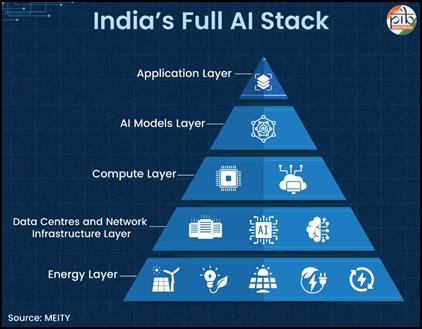
The India AI Stack is a five-layer integrated framework designed to democratise Artificial Intelligence and enable reliable, affordable and sovereign AI deployment at population scale.
Background and Vision
- India has introduced the India AI Stack to move AI beyond pilots and experimentation and embed it into everyday governance, service delivery and economic activity.
- Anchored in the principle of AI for Humanity, the approach aims to ensure that AI benefits citizens across healthcare, agriculture, education, justice, climate action and public administration, while strengthening technological self-reliance.
- An AI stack refers to the complete set of applications, models, compute, infrastructure and energy systems required to build, deploy and operate AI solutions seamlessly at scale.
Five Layers of the India AI Stack
1. Application Layer (User Interface)
- User-facing AI services delivering real-world value.
- Key use cases:
- Agriculture: AI advisories improving sowing decisions and yields; some state deployments report 30–50% productivity gains.
- Healthcare: Early detection of TB, cancer, neurological disorders.
- Education: AI integration under NEP 2020 via CBSE, DIKSHA, YUVAi.
- Justice Delivery: AI/ML in e-Courts Phase III for translation, scheduling and case management.
- Weather & Disaster Management: AI-enabled forecasting and tools like Mausam GPT used by India Meteorological Department.
This layer determines AI’s social and economic impact by ensuring large-scale adoption.
2. AI Model Layer (Intelligence Core)
- Provides learning, prediction and decision-making capability.
- Key initiatives:
- IndiaAI Mission: Development of 12 indigenous AI models; subsidised compute support (up to 25% cost support).
- BharatGen: India-centric foundation and multimodal models.
- IndiaAIKosh: National AI repository with 5,722 datasets and 251 models (Dec 2025).
- Bhashini: 350+ language AI models covering speech, translation, OCR and text-to-speech.
Focus is on sovereign, India-specific and multilingual AI aligned with public services.
3. Compute Layer (Processing Power)
- Enables training and deployment of AI models.
- Key facts:
- ?10,300+ crore allocation under IndiaAI Mission (5 years).
- IndiaAI Compute Portal: 38,000 GPUs and 1,050 TPUs at subsidised rates (under ?100/hour).
- National secure GPU cluster: 3,000 next-generation GPUs.
- India Semiconductor Mission: ?76,000 crore, 10 approved semiconductor projects.
- National Supercomputing Mission: 40+ petaflops capacity; systems like PARAM Siddhi-AI and AIRAWAT.
This shared-access approach reduces entry barriers and prevents compute concentration.
4. Data Centres & Network Infrastructure Layer
- Provides storage, hosting and connectivity.
- Key data:
- Nationwide optical fibre network.
- 5G coverage in 99.9% districts, ~85% population.
- Installed data centre capacity: ~960 MW (~3% of global capacity).
- Projected growth to 9.2 GW by 2030.
- Major hubs: Mumbai–Navi Mumbai (25%+), Bengaluru, Hyderabad, Chennai, Delhi-NCR.
- Large investments by global firms (Microsoft, Amazon, Google).
Ensures low-latency, secure and domestic hosting of AI systems.
5. Energy Layer (Power Backbone)
- Sustains energy-intensive AI infrastructure.
- Key facts:
- Peak demand met: 242.49 GW (FY 2025–26); shortage reduced to 0.03%.
- Total installed capacity: 509.7 GW (Nov 2025).
- Non-fossil capacity: 256.09 GW (>51%).
- Targets: 57 GW pumped storage by 2031–32; 43,220 MWh battery storage.
- SHANTI Act: Nuclear energy (including SMRs) for round-the-clock clean power.
Aligns AI growth with sustainability and grid stability.