
India’s UPI: Global Leader in Real-Time Digital Payments
- 12 Dec 2025
In News:
The International Monetary Fund (IMF) in its June 2025 report “Growing Retail Digital Payments – The Value of Interoperability”recognisedIndia’s UPI as the world’s largest retail fast payment system (FPS) by transaction volume.
What is UPI?
Unified Payments Interface (UPI) is an instant, real-time, interoperable payment system enabling bank-to-bank transfers via mobile.
- Developed and operated by National Payments Corporation of India (NPCI)
- Regulated by the Reserve Bank of India (RBI)
- Pilot launched on 11 April 2016 by then RBI Governor Raghuram Rajan
Core Features of UPI
|
Feature |
Description |
|
Real-time |
Transfers in seconds, available 24×7 |
|
Interoperable |
Works across banks, apps, QR codes & merchants |
|
Low/Zero MDR |
Boosts adoption among small merchants |
|
Scalable |
Handles billions of transactions monthly |
|
Versatile |
Supports P2P, P2M, Autopay, credit lines, RuPay linkage |
IMF & Global Recognition
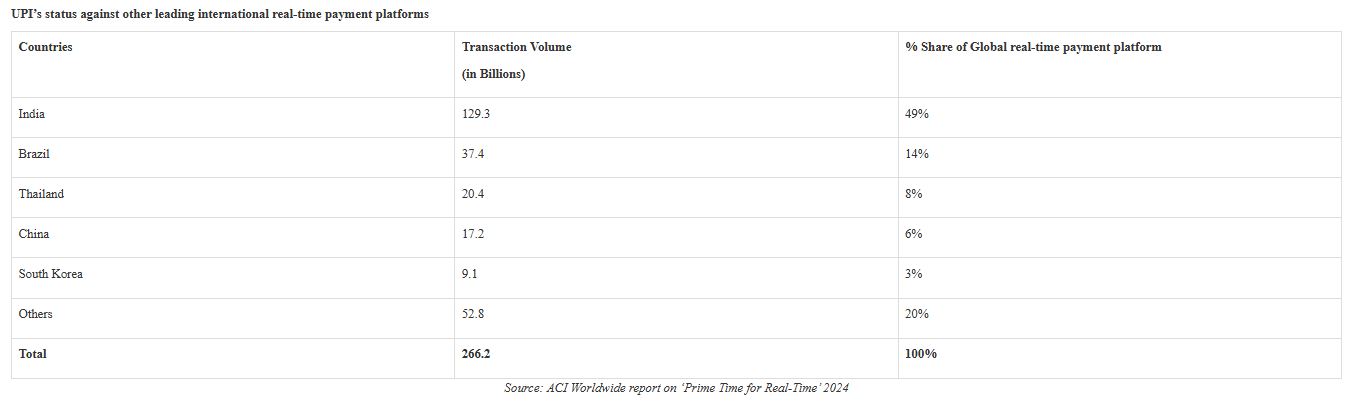
According to IMF and ACI Worldwide (2024):
- UPI share of global real-time payments: 49%
- Annual transaction volume: 129.3 billion
- India is the undisputed global leader in fast digital payments
Comparison with Other Major Systems
|
Country |
Platform |
Volume (Bn) |
Global Share |
|
India |
UPI |
129.3 |
49% |
|
Brazil |
Pix |
37.4 |
14% |
|
Thailand |
PromptPay |
20.4 |
8% |
|
China |
UnionPay / WeChat Pay / Alipay |
17.2 |
6% |
|
South Korea |
— |
9.1 |
3% |
|
Others |
— |
52.8 |
20% |
Total global real-time transactions:266.2 billion
Government & RBI Measures to Boost Adoption
- Incentives for Small Transactions: Promotion of low-value transactions via BHIM–UPI incentive schemes
- Payments Infrastructure Development Fund (PIDF)
- RBI fund to expand digital payment infrastructure in Tier-3 to Tier-6 centres
- Supports deployment of:
- POS terminals
- QR codes
- As of Oct 31, 2025:5.45 crore digital touchpoints deployed
- Merchant QR Expansion
- 56.86 crore QR codes deployed
- Covers ~6.5 crore merchants (FY 2024-25)
RuPay& Sectoral Expansion
- Deepening digital payments via RuPay–UPI integration
- Expansion across:
- Public services
- Transportation
- E-commerce
Internationalisation of UPI
India is enabling cross-border interoperability with several countries:
|
Country |
Local System Linked with UPI |
|
Singapore |
PayNow |
|
UAE |
Merchant QR acceptance |
|
France |
Tourist payments |
|
Nepal |
Cross-border linkage |
|
Bhutan |
UPI acceptance |
|
Mauritius |
QR interoperability |
|
Sri Lanka |
Planned linkage |
|
Indonesia |
Ongoing discussions |
Sudden Stratospheric Warming (SSW)
- 12 Dec 2025
In News:
Meteorologists have recently warned of a potential Sudden Stratospheric Warming (SSW) event, which may cause below-average temperatures across parts of the United States and other mid-latitude regions later this month.
What is Sudden Stratospheric Warming?
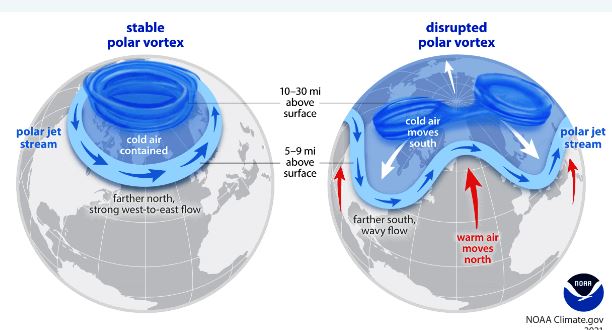
- Sudden Stratospheric Warming (SSW) is a phenomenon marked by a rapid increase in stratospheric temperatures, sometimes by 30–50°C within a few days.
- It results in the weakening, displacement, or splitting of the polar vortex, a cold air system usually confined to the polar regions.
Mechanism of SSW
- SSW events are triggered by large-scale atmospheric (Rossby) waves generated in the troposphere.
- These waves propagate upward into the stratosphere and break over the polar vortex, similar to ocean waves.
- If sufficiently strong:
- The westerly winds of the polar vortex weaken or reverse to easterlies
- The vortex loses its circular symmetry
- This causes descending air to warm adiabatically, leading to sudden temperature rise in the stratosphere.
Impact of SSW
- The weakened or split polar vortex allows cold Arctic air to spill southward into the mid-latitudes.
- This can result in:
- Cold waves
- Severe winter weather
- Below-normal temperatures over regions such as:
- North America
- Europe
- Asia
Polar Vortex: Key Features
- A large, persistent low-pressure system containing cold air around both poles.
- Extends from:
- Tropopause
- Through the stratosphere
- Up to the mesosphere (above ~50 km)
- Seasonal behavior:
- Stronger in winter
- Weaker in summer
- During winter, it can expand and interact with the jet stream, pushing cold air southward.
Role of Jet Streams
- Jet streams are narrow bands of strong winds located in the upper troposphere (~9–12 km altitude).
- They act as a conduit for polar air outbreaks during polar vortex disturbances.
- Such interactions are common during Northern Hemisphere winters.
India International Science Festival (IISF), 2025
- 12 Dec 2025
In News:
The 11th edition of the India International Science Festival (IISF) 2025 commenced in Panchkula, Haryana, reaffirming India’s commitment to science-led national development and public engagement with science.
About IISF
- Launched: 2015
- Vision: Conceived under the guidance of the Hon’ble Prime Minister of India to promote scientific temper, innovation, and public participation in science
- Nature: India’s flagship annual science outreach and collaboration platform
- Aim:
- Strengthen India’s science culture
- Highlight India’s position as a global S&T leader
- Support national goals in research, innovation, and talent development
- Bridge traditional knowledge systems with modern science
IISF 2025: Key Details
- Edition: 11th
- Venue: Panchkula, Haryana
- Dates: 6–9 December 2025
- Theme:“Vigyan Se Samruddhi: for Aatmanirbhar Bharat”
- Organised by: Ministry of Earth Sciences (MoES)
- Coordinating Institution: Indian Institute of Tropical Meteorology (IITM), Pune
Theme Significance
- Emphasisesscience-led prosperity and self-reliance (Aatmanirbharta)
- Aligns science and technology with:
- Economic growth
- Indigenous innovation
- National and global development goals
- Reflects the broader vision: “Innovation. Aatmanirbharta. India for Global Good”
Scale and Participation
- Expected Participants: Over 40,000 from India and abroad
- Sessions: More than 150 technical and thematic sessions
- Stakeholders Involved:
- Scientists and researchers
- Students and educators
- Startups, industry leaders and investors
- Policy-makers (Union & State Governments)
- Science communicators and media professionals
- Women scientists and early-career researchers
Major Thematic Focus Areas (2025)
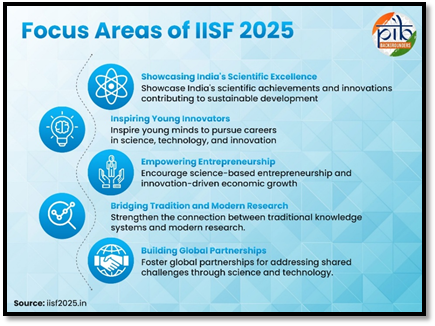
- Science, Technology & Ecology of North-West India and Himalayan Region
- Science for Society and Education
- Aatmanirbhar Bharat through Science & Technology
- Biotechnology and Bio-Economy
- Integration of Traditional Knowledge with Modern Science
Priority domains include:
- Artificial Intelligence (AI) and Artificial General Intelligence (AGI)
- Quantum technologies
- Gene editing
- Bio-manufacturing and genomics
- Space science (satellites, launch systems, applications)
- Climate and Himalayan science
Key Components of IISF 2025
- Large-scale science and technology exhibitions
- Business-to-business (B2B) meetings
- Competitions, cultural programmes and outreach activities
- Special sessions for:
- Women in science
- School students
- Young entrepreneurs
- Early-career researchers
Partner Ministries and Institutions
- Department of Science and Technology (DST): Quantum tech, AI, advanced materials
- Department of Biotechnology (DBT): Genomics, health tech, bio-economy
- Council of Scientific & Industrial Research (CSIR): Clean energy, materials, aerospace, sensors
- Department of Space: Satellites, launch vehicles, space applications
- Department of Atomic Energy: Nuclear science, radiation tech, medical isotopes
- Vijnana Bharati (VIBHA): Public outreach and student engagement
Evolution and Significance of IISF (2015–2025)
- Hosted across major Indian cities including Delhi, Kolkata, Lucknow, Chennai, Goa, Bhopal, Faridabad, Assam
- Conducted in virtual and hybrid modes during COVID-19
- Known for:
- Guinness World Records
- Massive public footfall (up to 10 lakh+ visitors in earlier editions)
- Introduction of science villages, innovation expos, and science communication platforms
- Continual emphasis on Swadeshi science, indigenous innovation, and societal relevance
Shyok Tunnel
- 12 Dec 2025
In News:
The Defence Minister inaugurated 125 infrastructure projects built by the Border Roads Organisation (BRO), including the strategically significant Shyok Tunnel in eastern Ladakh. The projects, worth about ?5,000 crore, mark the largest single-day inauguration in BRO’s history.
Shyok Tunnel
Location & Type
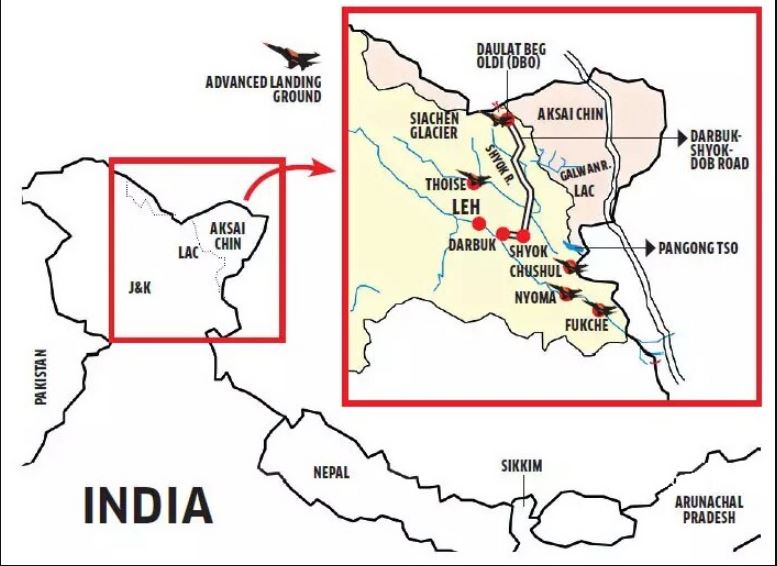
- Situated on the Darbuk–Shyok–Daulat Beg Oldie (DS-DBO) Road in eastern Ladakh
- Close to the Line of Actual Control (LAC) with China
- Length: 920 metres
- Type: Cut-and-cover tunnel
- Altitude: Over 12,000 feet
Purpose
- Ensures all-weather connectivity by bypassing avalanche- and landslide-prone stretches
- Reduces dependence on air supply for forward posts
Strategic Importance
- Provides reliable surface access to Daulat Beg Oldie (DBO), India’s northernmost military outpost
- Critical for logistics and surveillance near the Siachen region
- Gains added importance after the 2020 Galwan Valley clashes
Karnataka Hate Speech and Hate Crimes (Prevention) Bill, 2025
- 12 Dec 2025
In News:
Karnataka has introduced the first state-level legislation in India specifically aimed at tackling hate speech and hate crimes. The move highlights a long-standing legal gap although the term “hate speech” is widely used, Indian criminal law does not formally define it.
What is Hate Speech?
According to the 267th Report of the Law Commission (2017), hate speech includes words, signs, or visible representations intended to incite hatred, discrimination, or violence against individuals or groups based on identity markers such as religion, caste, race, gender, or sexual orientation.
Constitutional Context
- Article 19(1)(a) guarantees freedom of speech and expression.
- Article 19(2) allows reasonable restrictions in the interests of public order, morality, sovereignty, defamation, and incitement to offences.
Thus, hate speech regulation must balance free expression and social harmony.
Existing Legal Framework in India
India currently regulates hate speech through scattered provisions, mainly focused on public order:
Under the Bharatiya Nyaya Sanhita (BNS), 2023
- Section 196 (earlier IPC 153A): Promoting enmity between groups and acts prejudicial to harmony.
- Section 299 (earlier IPC 295A): Deliberate acts intended to outrage religious feelings.
- Section 353: Statements or misinformation inciting offences or disturbing public order.
These offences are cognisable, allowing arrest without warrant, and usually carry punishment up to three years.
Other Relevant Laws
- Representation of the People Act, 1951 – Disqualification for certain hate-related offences.
- SC/ST (Prevention of Atrocities) Act, 1989 – Penalises caste-based insults and humiliation.
- Protection of Civil Rights Act, 1955 – Addresses promotion of untouchability.
Digital Dimension
Section 66A of the IT Act, 2000 was widely used for online speech but was struck down in Shreya Singhal v. Union of India for being vague and unconstitutional.
Supreme Court’s Approach
The Supreme Court of India has increasingly intervened:
- Shaheen Abdulla v. Union of India – Directed police to take suo motu action on hate speech.
- Tehseen S. Poonawalla v. Union of India – Mandated nodal officers to prevent mob violence.
- Later observations stressed that implementation failures, not legal vacuum alone, are the key challenge.
Karnataka Hate Speech and Hate Crimes (Prevention) Bill, 2025
Key Features
- Clear Definition of Hate Speech: Expression causing injury or disharmony against a person or group based on:Religion, Race, Caste, Gender, Sexual orientation, Place of birth and Disability
- Inclusion of gender and sexual orientation expands protection beyond current BNS scope.
- Collective Liability: If hate speech is committed through an organisation, office bearers or responsible persons can also be held liable.
- Online Regulation: State government empowered to block or remove hateful online content, addressing digital propagation.
- Stringent Punishment
- First offence: 1–7 years imprisonment + ?50,000 fine
- Repeat offence: 2–10 years imprisonment + ?1 lakh fine
- Offences are cognisable and non-bailable
- Victim Compensation: Mandates adequate compensation for victims.
- Public Good Exception: Books, art, research, or material published in good faith for public interest may be exempt.
Past Attempts to Define Hate Speech
- Law Commission 267th Report (2017) – Proposed IPC Sections 153C & 505A.
- Private Member’s Bill (2022) in Rajya Sabha sought a comprehensive definition but was not enacted.
- Committees like Viswanathan (2015) and Bezbaruah (2014) also suggested legal reforms.
Significance of the Karnataka Bill
- First dedicated state law on hate speech
- Attempts to shift focus from public order to dignity and equality
- Recognisesdigital hate propagation
- Expands protection to LGBTQ+ communities and persons with disabilities