
Appropriation Bill 2026
- 18 Mar 2026
In News:
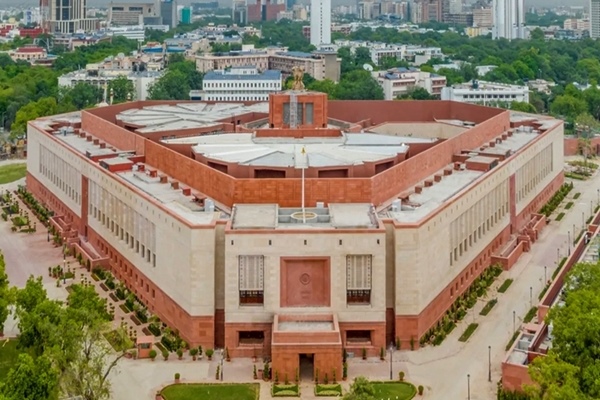
The Indian Parliament has passed the Appropriation Bill 2026, completing a crucial stage in the Union Budget process. The Bill, returned by the Rajya Sabha after discussion, enables the government to legally withdraw funds for its expenditure. This highlights the central role of Parliament in ensuring financial accountability and legislative control over public finances.
What is the Appropriation Bill?
- The Appropriation Bill is a legislative instrument that authorizes the government to withdraw money from the Consolidated Fund of India (CFI) to meet its expenditure for a given financial year.
- Even after the presentation of the Budget, no money can be spent without the passage of this Bill, making it an essential component of fiscal governance.
Constitutional Provisions
The Appropriation Bill derives its authority from the Constitution:
- Article 114: No withdrawal from the Consolidated Fund of India is permitted without parliamentary approval through an Appropriation Act
- Article 115: Provides for Supplementary, Additional, or Excess Grants, requiring further appropriation
- Article 116: Deals with Vote on Account, Vote of Credit, and Exceptional Grants, ensuring continuity of government expenditure
Budgetary Process and Passage of the Bill
The passage of the Appropriation Bill follows a structured legislative process:
- Presentation of Budget (Annual Financial Statement) by the Finance Minister
- General Discussion in both Houses of Parliament
- Voting on Demands for Grants in the Lok Sabha (only House with voting powers on expenditure)
- Introduction of Appropriation Bill to authorize expenditure
- Passage in Lok Sabha
- Transmission to Rajya Sabha, which can only recommend changes and must return it within 14 days
- Presidential Assent, after which it becomes law
Key Features of the Appropriation Bill
1. Covers All Expenditure
- Includes both:
- Voted Expenditure (approved by Lok Sabha)
- Charged Expenditure (non-votable, e.g., salaries of constitutional authorities like the President and judges)
2. No Scope for Amendments
- Parliament cannot propose amendments that:
- Alter the amount of grants
- Change their purpose
3. Classified as a Money Bill
- Under Article 110, it is treated as a Money Bill, limiting the powers of the Rajya Sabha to making recommendations only.
Significance of the Appropriation Bill
1. Ensures Legislative Control over Finances: It upholds the principle that public money can only be spent with parliamentary approval, reinforcing democratic accountability.
2. Legal Basis for Government Expenditure: It provides the legal authority for the executive to implement policies, schemes, and programmes.
3. Promotes Transparency and Fiscal Discipline: The process ensures that government spending is scrutinized, debated, and authorized, enhancing transparency.
4. Strengthens Parliamentary Supremacy: It reinforces the role of the Lok Sabha as the custodian of public finances, reflecting the principle of “no taxation or expenditure without representation.”
Prambanan Temple Restoration

- 18 Mar 2026
In News:
India and Indonesia have recently partnered for the restoration of the Prambanan Temple complex in the Special Region of Yogyakarta, Java. This initiative reflects deep-rooted civilizational ties, cultural diplomacy, and shared heritage between the two nations, while also highlighting India’s growing role in global heritage conservation.
About Prambanan Temple
- The Prambanan Temple is the largest Hindu temple complex in Indonesia, located in Sleman, Yogyakarta (Central Java).
- Built in the 9th century by the Sanjaya dynasty, it represents the flourishing of Hindu culture in Southeast Asia.
- Locally known as Roro Jonggrang (Temple of the Slender Virgin), the complex is dedicated to the Hindu Trimurti—Shiva, Vishnu, and Brahma.
- After being buried and neglected for centuries, it was rediscovered and restored during the 19th century, and later recognised as a UNESCO World Heritage Site in 1991.
Architectural Features
Prambanan reflects a remarkable fusion of indigenous Javanese and South Indian (Pallava) architectural styles, showcasing cultural exchange across regions.
- The complex comprises 240 temples, arranged in concentric layouts
- The central compound includes eight main and eight minor temples built on an elevated platform
- The Shiva Temple, standing at 47 metres, is the tallest and most prominent structure
- Other major temples are dedicated to Brahma and Vishnu
- The walls are adorned with intricate carvings depicting the Ramayana and other Hindu epics, reflecting advanced craftsmanship
Interestingly, while primarily a Hindu complex, the surrounding area also contains Buddhist shrines, indicating religious coexistence and syncretism in ancient Java.
India China Trade Deficit
- 18 Mar 2026
In News:
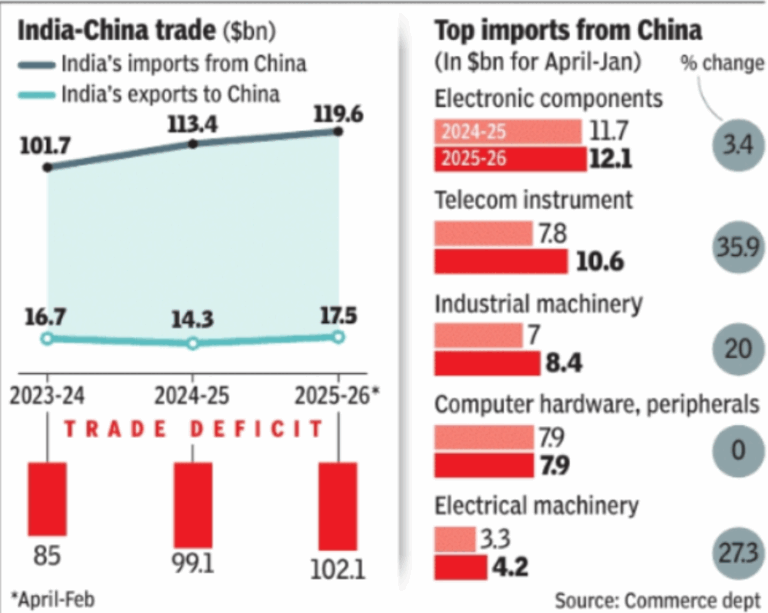
India’s trade deficit with China has crossed a historic threshold, reaching approximately $102 billion during April–February FY2025–26. This marks the first time the deficit has exceeded $100 billion, underscoring deep structural imbalances in bilateral trade and raising concerns about economic resilience and strategic dependence.
Understanding Trade Deficit
- A trade deficit occurs when the value of a country’s imports exceeds its exports over a given period.
- In the India–China context, the imbalance is driven by high-value imports from China vis-à-vis relatively low-value Indian exports.
- India imports critical goods such as electronic components, telecom equipment, machinery, and pharmaceutical APIs, while exporting petroleum products, copper, and limited electronic goods, resulting in a widening gap.
Key Features of India–China Trade Imbalance
1. Persistent Import Dependence: India heavily relies on China for intermediate and capital goods that feed into domestic industries. Sectors like electronics, pharmaceuticals (APIs), renewable energy equipment, and heavy machinery depend significantly on Chinese imports.
2. Sectoral Imbalance: Imports from China are concentrated in high-value, technology-intensive goods, whereas India’s exports are largely low-value or resource-based products. This structural asymmetry limits India’s ability to narrow the deficit.
3. Market Access Asymmetry: Indian exporters face non-tariff barriers, stringent quality standards, and regulatory hurdles in China. This restricts access for Indian goods, particularly in sectors like agriculture, pharmaceuticals, and IT-enabled services.
Implications of the Rising Deficit
1. Pressure on Current Account: A large and persistent trade deficit contributes to the Current Account Deficit (CAD), impacting foreign exchange reserves and macroeconomic stability.
2. Strategic and Economic Vulnerability: Dependence on Chinese imports in critical sectors creates supply chain risks, especially during geopolitical tensions or disruptions such as pandemics.
3. Impact on Domestic Manufacturing: Cheap imports can undermine domestic industries, particularly MSMEs, affecting employment and industrial competitiveness.
Underlying Causes
- Cost competitiveness of Chinese manufacturing due to economies of scale
- Inadequate domestic manufacturing capacity in high-tech sectors
- Limited diversification of export basket
- Global value chain integration favouring China
Government Measures and Policy Response
- Production Linked Incentive (PLI) Schemes to boost domestic manufacturing in electronics, pharmaceuticals, and solar equipment
- Atmanirbhar Bharat initiative to reduce import dependence
- Import diversification strategies targeting alternative partners like Vietnam, South Korea, and the EU
- Quality control orders and standards to regulate imports
NMDC Limited and India’s Iron Ore Sector
- 18 Mar 2026
In News:
India’s mining sector achieved a significant milestone as NMDC Limited became the first company in the country to produce 50 million tonnes (MT) of iron ore in a single financial year. This achievement reflects the growing efficiency, mechanisation, and strategic importance of India’s mineral sector in supporting industrial growth and infrastructure development.
About NMDC Limited
- NMDC Limited (formerly National Mineral Development Corporation) is a Central Public Sector Enterprise (CPSE) established in 1958 under the Ministry of Steel.
- Headquartered in Hyderabad, it has evolved into India’s largest producer and exporter of iron ore.
- The company operates major mechanised iron ore mines in Chhattisgarh and Karnataka, contributing over 45 MT annually. Beyond iron ore, NMDC is engaged in the exploration of a diverse range of minerals including copper, limestone, dolomite, gypsum, bentonite, magnesite, diamond, tin, tungsten, graphite, and beach sands.
- It also operates India’s only mechanised diamond mine at Panna (Madhya Pradesh). Recognising its strategic and financial importance, NMDC was granted Navratna status in 2008, providing greater operational and financial autonomy.
Significance of the 50 MT Milestone
1. Boost to Industrial Growth: Iron ore is a critical raw material for the steel industry, which is the backbone of infrastructure, construction, and manufacturing. NMDC’s record production strengthens domestic supply, reducing dependence on imports and supporting initiatives like Make in India.
2. Enhanced Mining Efficiency: The achievement reflects improved mechanisation, technological adoption, and operational efficiency in India’s mining sector. It signals a transition towards large-scale, modernised mining practices.
3. Contribution to Economic Development: Higher production translates into:
- Increased government revenue through royalties and taxes
- Greater foreign exchange earnings via exports
- Employment generation in mining regions
4. Strategic Resource Security: With rising global demand for steel, ensuring a stable supply of iron ore is essential for economic resilience and industrial competitiveness.
Role of NMDC in India’s Mining Sector
NMDC plays a pivotal role as:
- The largest iron ore producer in India
- A key contributor to raw material security for steel plants
- A driver of regional development, particularly in mineral-rich but underdeveloped areas
Its diversified mineral portfolio also positions it as an important player in strategic and critical mineral exploration, which is vital for future technologies and energy transitions.
Safe Disposal of Unused Medicines
- 18 Mar 2026
In News:
The United Nations Environment Programme (UNEP) in its 2026 report “Safe Disposal of Unused Medicines” highlights the growing environmental and public health crisis posed by pharmaceutical waste. With rising drug consumption globally, improper disposal practices are contributing to ecological degradation and antimicrobial resistance (AMR), necessitating a comprehensive, multisectoral response.
Key Features of the UNEP Report
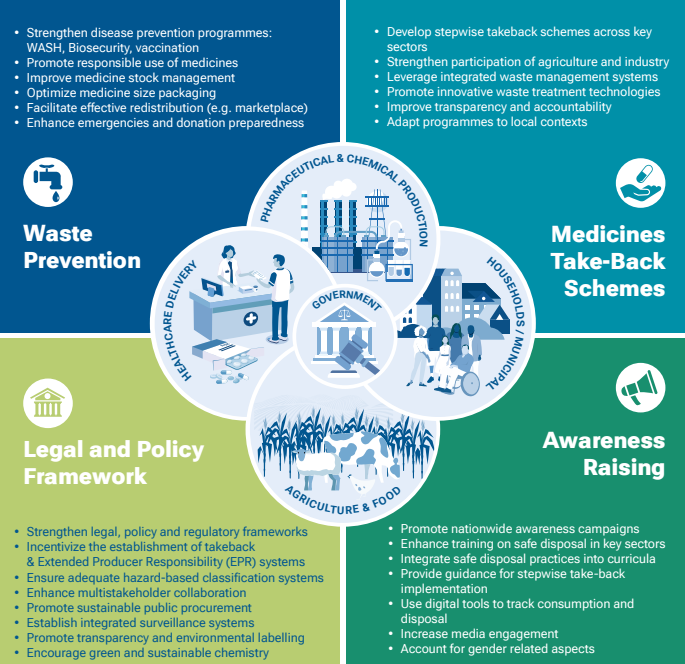
- The report adopts a One Health approach, recognizing the interconnectedness of human, animal, and environmental health. It proposes an integrated framework that combines waste prevention, safe disposal mechanisms, legal regulations, and public awareness across sectors such as healthcare, agriculture, and households.
- A major emphasis is placed on waste prevention as the most effective strategy, alongside the development of medicine take-back systems and strengthening governance structures.
Major Findings
1. Environmental and Health Risks
Improper disposal of medicines—through flushing, dumping, or burning—introduces pharmaceutical residues into ecosystems. This leads to:
- Antimicrobial Resistance (AMR): Identified as a major driver, with AMR directly causing 1.27 million deaths globally (2019)
- Endocrine disruption and toxicity affecting aquatic life and biodiversity
- Persistent contamination due to the inability of conventional wastewater treatment plants to remove pharmaceutical compounds completely
2. Scale of the Problem
- Up to 50% of household medicines become waste globally
- Unused medicines constitute about 3% of hazardous healthcare waste
- The unused medicine management market is projected to reach US$2.54 billion by 2032, reflecting rising healthcare consumption
3. Inefficiencies and Opportunities
- Prevention potential: Countries like the Netherlands show that 40% of medicine waste can be avoided
- Redistribution scope: Nearly 19% of unused medicines could be safely reused under strict quality conditions
- Over-preion, bulk packaging, and lack of awareness contribute significantly to wastage
Methods of Safe Disposal
The report outlines scientifically approved disposal methods:
- High-temperature incineration (800–1200°C): Most effective for hazardous pharmaceutical waste
- Waste immobilization: Encapsulation or inertization to prevent chemical leakage
- Engineered landfills: Secure containment systems for residual waste
- Co-processing: Use of cement kilns or industrial furnaces to destroy pharmaceutical compounds
Key Challenges
1. Lack of Awareness: A significant proportion of people are unaware of proper disposal methods. For instance, studies show over 50% of respondents in some countries lack knowledge of associated risks.
2. Infrastructure Gaps
- Rural and remote areas lack incineration and waste treatment facilities
- Limited access to organized collection systems hinders safe disposal
3. Weak Regulatory Frameworks
- Many countries lack mandatory take-back policies
- Fragmented governance leads to inconsistent implementation (e.g., reliance on voluntary systems in some developed countries)
4. Financial Constraints: Advanced treatment technologies such as advanced oxidation processes are effective but expensive, especially for developing nations.
5. Emergency and Humanitarian Risks: During crises, excess or mismatched drug donations lead to accumulation of expired medicines, increasing disposal burdens.
UNEP Recommendations
1. Prioritising Waste Prevention
- Improve WASH (Water, Sanitation, and Hygiene), vaccination, and disease prevention
- Promote rational drug use and better diagnostics
2. Establishing Take-Back Systems
- Implement national-level collection programmes for households, pharmacies, and farms
- Ensure safe channels for returning unused medicines
3. Strengthening Legal Frameworks
- Introduce Extended Producer Responsibility (EPR) to make pharmaceutical companies responsible for post-consumer waste
- Develop binding regulations for safe disposal
4. Promoting Rational Use of Medicines
- Encourage unit-dose packaging
- Reduce over-preion and patient stockpiling
5. Enhancing Monitoring and Awareness
- Use digital tracking systems to monitor medicine usage and disposal
- Conduct public awareness campaigns to change consumer behavior