
MXene-Based Catalyst

- 19 Mar 2026
In News:
Researchers at IIT Guwahati have developed a MXene-based catalyst capable of simultaneously enabling efficient hydrogen production from water and functioning as a photocatalyst for desalination. This innovation holds promise for addressing both clean energy and water scarcity challenges.
About MXenes
MXenes are a class of two-dimensional (2D) advanced materials, first discovered in 2011, known for their exceptional physicochemical properties.
Composition and Structure
- Derived from a precursor material known as MAX phase.
- General formula: Mn 1XnTx
- M: Early transition metal
- X: Carbon and/or nitrogen
- T: Surface functional groups (O, OH, F)
- The most widely studied MXene is Titanium Carbide (Ti?C?Tx).
Key Properties of MXenes
- High electrical conductivity
- Excellent mechanical strength
- Good chemical stability
- Hydrophilicity (water-attracting nature)
- Tunable surface chemistry
These properties make MXenes highly versatile for multiple advanced technological applications.
MXene-Based Catalyst: Key Features
- Enables efficient hydrogen generation through water splitting.
- Functions as a photocatalyst for desalination, using light energy to purify water.
- Integrates energy production and water treatment in a single material system.
Applications of MXenes
1. Clean Energy
- Used in hydrogen production, supporting the transition to green hydrogen economy.
- Applicable in energy storage systems such as:
- Lithium-ion batteries
- Supercapacitors
2. Water Treatment and Desalination
- Effective in removing salts and impurities from seawater.
- Useful in wastewater treatment due to high adsorption capacity.
3. Separation and Filtration
- Suitable for industrial filtration processes owing to:
- High surface area
- Flexibility
- Conductivity
Significance
1. Addressing Dual Challenges: Simultaneously tackles energy demand (hydrogen fuel) and water scarcity.
2. Sustainable Technology: Promotes eco-friendly solutions by using light-driven processes and reducing reliance on fossil fuels.
3. Advancement in Material Science: Demonstrates the potential of 2D materials in next-generation technologies.
4. India’s Scientific Progress: Highlights the role of Indian institutions like IIT Guwahati in cutting-edge research and innovation.
Ladakh Magmatic Arc
- 19 Mar 2026
In News:
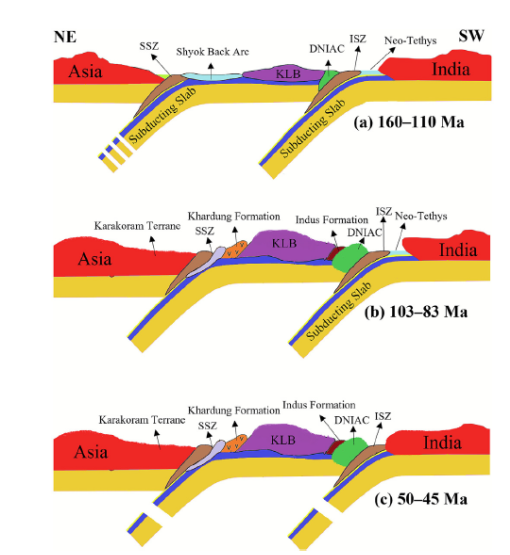
Recent scientific studies have traced the evolution of the Ladakh Magmatic Arc (LMA) in the north-western Himalaya, providing new insights into the geological history of the Indian subcontinent and plate tectonic processes.
About Ladakh Magmatic Arc (LMA)
- The Ladakh Magmatic Arc is a belt of igneous rocks located in the Trans-Himalayan region. It represents a long-extinct volcanic arc system formed due to tectonic activity associated with the closure of the Neo-Tethys Ocean.
- Time Period: Formed between the Jurassic and Eocene periods (~201 million years ago to ~34 million years ago)
Geological Formation Process
Role of Plate Tectonics
- The region was once part of the Neo-Tethys Ocean.
- The Indian Plate moved northwards and subducted beneath the Eurasian Plate.
- This subduction led to melting in the mantle, generating magma.
- The rising magma formed a chain of volcanic features, giving rise to the magmatic arc.
Phases of Evolution of LMA
1. Early Island Arc Formation (160–110 Ma)
- Ladakh initially resembled a chain of volcanic islands.
- Represented by the Dras–Nidar Island Arc Complex (DNIAC).
- Magma was primarily derived from the mantle, with minimal sediment contribution.
2. Crustal Enrichment & Batholith Formation (103–45 Ma)
- Occurred during intensified convergence between the Indian and Eurasian plates.
- Formation of large granitic bodies known as the Ladakh Batholith.
- Increased contribution from:
- Continental crust
- Subducted sediments
- Indicates magma mixing and deep crustal processes.
- This phase coincided with the approaching continental collision.
3. Post-Collisional Magmatism (<45 Ma)
- Continued tectonic activity even after the closure of the Neo-Tethys Ocean.
- Formation of mafic dykes (vertical intrusions of magma).
- Magma sourced from an enriched mantle.
- Suggests lingering magmatic activity post-collision.
Key Geological Features
- Ladakh Batholith: Large granitic intrusions indicating crustal melting.
- Mafic Dykes: Evidence of late-stage magmatic activity.
- DNIAC: Represents early volcanic island arc phase.
Floating LiDAR Buoy System
- 19 Mar 2026
In News:
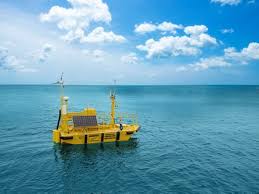
The National Institute of Ocean Technology (NIOT) has successfully tested an indigenously developed Floating LiDAR Buoy System off the coast of Muttom, Tamil Nadu. The development marks a significant step in enhancing India’s ocean-based meteorological and renewable energy assessment capabilities.
About Floating LiDAR Buoy System
The Floating LiDAR Buoy System is a state-of-the-art oceanographic instrument designed to measure wind and atmospheric conditions over the sea.
Key Features
- Combines a floating buoy platform with LiDAR (Light Detection and Ranging) technology.
- Uses laser pulses to capture highly accurate atmospheric data.
- Capable of measuring wind speed, direction, and vertical wind profiles.
- Can collect data up to 300 metres above sea level, surpassing many conventional instruments.
Working Mechanism
- The buoy is deployed on the ocean surface and remains stable under marine conditions.
- It emits laser pulses into the atmosphere.
- These pulses reflect off airborne particles such as aerosols.
- The returned signals are analysed to determine:
- Wind speed
- Wind direction
- Variations at different altitudes
This enables real-time, high-resolution data collection, even in remote offshore regions where traditional meteorological tools face limitations.
Significance
1. Improved Weather Forecasting
- Enhances accuracy of marine weather predictions.
- Supports better storm and cyclone tracking, crucial for coastal safety.
2. Boost to Offshore Wind Energy
- Provides precise wind data necessary for site assessment of offshore wind farms.
- Reduces uncertainty in renewable energy planning and investments.
3. Climate Change Studies
- Helps monitor long-term atmospheric and oceanic interactions.
- Contributes to understanding the impact of climate change on marine systems.
4. Indigenous Technological Advancement
- Reflects India’s progress in developing advanced ocean observation systems.
- Reduces reliance on imported technologies.
About National Institute of Ocean Technology (NIOT)
- It operates under the Ministry of Earth Sciences.
- It focuses on ocean engineering, resource exploration, and marine technology development.
- Plays a key role in initiatives like deep-sea exploration and offshore energy.
Exercise Sea Dragon
- 19 Mar 2026
In News:
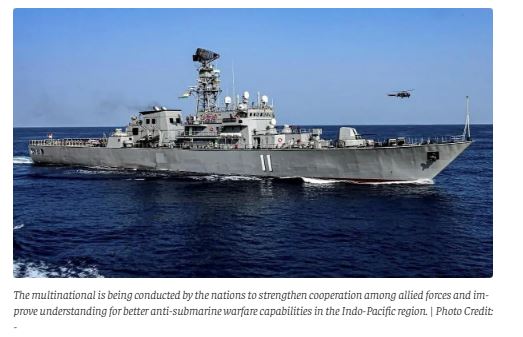
The Indian Navy, along with partner nations, is participating in Exercise Sea Dragon 2026.
About Exercise Sea Dragon
Exercise Sea Dragon is an annual multinational anti-submarine warfare (ASW) drill initiated and led by the United States Navy since 2019. It is held at Andersen Air Force Base, Guam, in the Western Pacific.
Key Features
- Focuses on anti-submarine warfare operations, a critical aspect of modern naval strategy.
- Participation involves long-range maritime patrol aircraft, notably the P-8 Poseidon.
- Provides a platform for operational coordination and interoperability among partner nations.
- Enhances real-time information sharing, communication protocols, and tactical alignment.
Participating Countries in 2026
Exercise Sea Dragon 2026 includes participation from:
- United States Navy
- Indian Navy
- Royal Australian Air Force
- Japan Maritime Self-Defence Force
- Royal New Zealand Air Force
This reflects a growing strategic convergence among Indo-Pacific democracies.
Operational Objectives
The exercise aims to:
1. Enhance ASW Capabilities
- Participants progress from simulated tracking to live submarine detection and tracking.
- Improves the ability to counter underwater threats in real-world scenarios.
2. Promote Interoperability
- Enables seamless coordination between forces operating similar platforms like P-8 aircraft.
- Standardises data-sharing systems, communication networks, and tactical procedures.
3. Build Aircrew Proficiency
- Crews are evaluated on speed, accuracy, and mission coordination.
- Structured scenarios test operational readiness under competitive conditions.
Competitive Element: Dragon Belt Award
- Each mission during the exercise is graded.
- The country achieving the highest cumulative score is awarded the prestigious “Dragon Belt”.
- Encourages excellence and operational efficiency among participants.
Strategic Significance
1. Indo-Pacific Security
- Reinforces collective efforts to maintain freedom of navigation and maritime stability.
- Addresses emerging threats, including submarine proliferation in the region.
2. India’s Maritime Role
- Demonstrates India’s growing role as a net security provider in the Indo-Pacific.
- Aligns with India’s SAGAR (Security and Growth for All in the Region) vision.
3. Strengthening Partnerships
- Deepens defence ties among Quad-like partners and other regional actors.
- Enhances multilateral defence cooperation beyond bilateral engagements.