
Titanidiops Kolhapurensis

- 08 Feb 2026
In News:
A new species of trapdoor spider, Titanidiops kolhapurensis, has been discovered in the grasslands of Kolhapur district.
About Titanidiops kolhapurensis
- Habitat: Flat or gently sloping grassy meadows.
- Burrow structure: Constructs vertical or slanted burrows with entrances expertly camouflaged to blend with surrounding soil, making them nearly invisible.
- Distribution pattern: Found in native grasslands and natural forests, but absent in areas dominated by exotic plantations such as Gliricidia sepium (Undirmari).
- Conservation concern: On the verge of local extinction due to rapid habitat degradation and land-use change.
What are Trapdoor Spiders?
- A group of large-bodied, burrowing spiders found across several taxonomic families.
- Burrowing behaviour: Dig burrows up to 15 cm (6 inches) deep, sealed with a silken-hinged trapdoor.
- Feeding strategy: Ambush predators—rapidly open the door to seize passing insects or arthropods.
- Behaviour: Reclusive and timid; retreat quickly into burrows when disturbed.
- Human impact: Bite not medically significant to humans.
- Climate preference: Tropical, subtropical and warm regions.
- Size: Typically ~2.5 cm (1 inch) long; some species up to 4 cm (1.5 inches).
- Threats: Predation by spider-hunting wasps; low dispersal ability (juveniles remain close to maternal burrows), making populations highly vulnerable to habitat loss.
Why this discovery matters
- Highlights the ecological importance of native grasslands, often overlooked in conservation.
- Demonstrates the negative impact of exotic tree plantations on indigenous fauna.
- Strengthens the case for habitat-specific conservation planning in the Western India landscape.
Deep Tech Start-ups

- 08 Feb 2026
In News:
The Union Government has formally defined and notified eligibility criteria for “Deep Tech Start-ups” through a gazette notification issued by the Department for Promotion of Industry and Internal Trade (DPIIT). This provides a clear regulatory and financing framework for high-risk, high-impact technology ventures in India.
What is Deep Tech?
Deep technology (Deep Tech) refers to advanced, science-based and engineering-driven technologies that are disruptive in nature and capable of delivering transformational solutions. Unlike platform or incremental innovations, deep tech involves fundamental research, long gestation periods and high technical uncertainty.
Key domains include:
- Artificial Intelligence & Data Science
- Semiconductors & Electronics
- Quantum Technologies
- Biotechnology & Life Sciences
- Nanotechnology & Advanced Materials
- Robotics, 3D Printing, Space & Clean Energy technologies
What is a Deep Tech Start-up?
According to the DPIIT notification, a deep tech start-up is an enterprise whose core activity involves the creation of new scientific or engineering knowledge, supported by intensive R&D and novel intellectual property, with a clear pathway to commercialisation.
Eligibility Criteria
A start-up qualifies as a deep tech start-up if it:
- Spends a major portion of expenditure on R&D activities
- Owns or actively creates novel intellectual property (IP) and pursues its commercialisation
- Faces long development timelines, high capital and infrastructure requirements, and significant technical or scientific risk
- Is primarily engaged in knowledge creation, not incremental innovation
Prohibition: Investment in non-core activities such as real estate, speculative assets or securities is not permitted, unless directly linked to knowledge creation.
Special Regulatory Relaxations
- Extended recognition period: Up to 20 years (regular start-ups: 10 years)
- Higher turnover threshold: Up to ?300 crore (regular start-ups: ?200 crore)
- Mandatory certification: Start-ups must apply to DPIIT for deep tech certification
Certification Mechanism
- DPIIT is the final certifying authority
- Certification guided by an Inter-Ministerial Technical Board, including:
- Joint Secretary, DPIIT (Convener)
- Representatives from the Department of Science and Technology (DST)
- Representatives from the Department of Biotechnology (DBT)
Financing & Institutional Support
- Anusandhan National Research Foundation (Anusandhan National Research Foundation – ANRF) is the custodian of the ?1 lakh crore Research, Development and Innovation (RDI) Fund
- Policy-backed patient capital:
- Long-term concessional finance
- Reported interest range: 2–4%
- Tenure: up to 15 years
Research Development and Innovation (RDI) Scheme
- Total outlay: ?1 lakh crore over 6 years
- FY 2025–26 allocation: ?20,000 crore
- Funding source: Consolidated Fund of India
- Nodal Department: DST
Key Objectives:
- Scale up private sector R&D in sunrise and strategic sectors
- Finance projects at higher Technology Readiness Levels (TRLs)
- Support acquisition of critical and strategic technologies
- Facilitate creation of a Deep-Tech Fund of Funds
Significance of the Policy
- Patient capital for high-risk innovation (AI, semiconductors, quantum, biotech)
- Strengthens technological sovereignty and reduces import dependence
- Positions India as a global R&D hub in the “China+1” ecosystem
- Enables India-specific solutions in healthcare, agriculture, energy and defence
- Helps India move up the global value chain from services to IP-led growth
Peregrine Falcon
- 08 Feb 2026
In News:
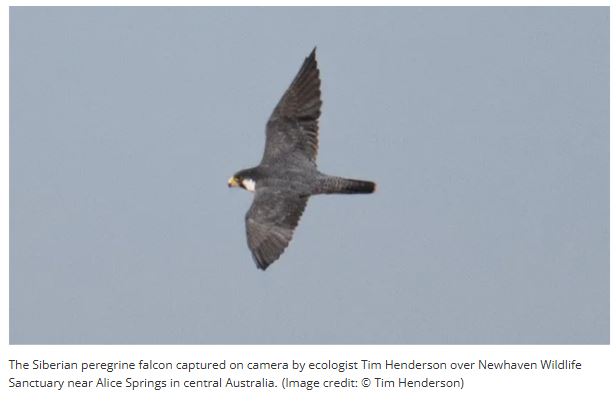
A wildlife researcher has recorded the first-ever sighting of the Siberian peregrine falcon in central Australia, a region where this subspecies had never been documented earlier. The observation expands the known range and movement patterns of this migratory raptor.
About the Peregrine Falcon
- A large cosmopolitan bird of prey belonging to the Falconidae family.
- Global distribution: Present on all continents except Antarctica, including several oceanic islands.
- Known for exceptional adaptability, occurring from Arctic tundra to temperate coastal regions.
Habitat & Nesting
- Preferred habitats: Open landscapes such as grasslands, tundra and meadows.
- Most abundant in tundra and coastal regions; relatively rare in tropical and sub-tropical zones.
- Nesting sites: Typically nests on cliff faces, rock ledges and crevices; in urban areas, may use tall buildings.
Key Characteristics
- Fastest bird in the world and the fastest animal during its hunting dive (stoop), reaching speeds over 300 km/h.
- Diurnal (active during the day).
- Behaviour: Solitary outside the breeding season; strongly territorial.
- Highly efficient aerial hunter, preying mainly on medium-sized birds.
Ecological Significance
- A top-level predator in avian food chains.
- Helps regulate populations of prey species such as pigeons and doves, contributing to ecological balance.
- Considered an important indicator species for ecosystem health due to its sensitivity to environmental changes.
Conservation Status
- IUCN Red List: Least Concern
- Earlier population declines due to pesticide use (notably DDT) were reversed through conservation measures, making it a global conservation success story.
Agni-3 Intermediate-Range Ballistic Missile (IRBM)
- 08 Feb 2026
In News:
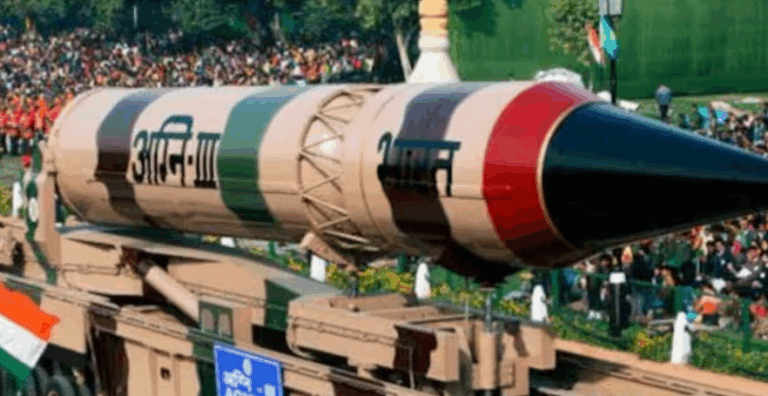
India has successfully test-fired the Intermediate-Range Ballistic Missile (IRBM) Agni-3 from the Integrated Test Range (ITR), Chandipur, Odisha, validating all operational and technical parameters. The launch was conducted under the aegis of the Strategic Forces Command, confirming the missile’s operational readiness.
What is Agni-3?
- Agni-3 is an indigenously developed Intermediate-Range Ballistic Missile (IRBM).
- It is a surface-to-surface missile and a key component of India’s land-based nuclear deterrent.
- Developed by Defence Research and Development Organisation (DRDO).
- It has already been inducted into the armed forces and is operationally deployed under the Strategic Forces Command.
Key Technical Features
- Type: Intermediate-Range Ballistic Missile (IRBM)
- Range: 3,000–3,500 km
- Propulsion: Two-stage, solid-fuelled
- Payload Capacity: ~1.5 tonnes (1,500 kg)
- Warhead: Conventional or nuclear
- Estimated Nuclear Yield: 200–300 kilotons
- Length: 16.7 metres
- Diameter: 2 metres
- Launch Weight: ~48,300 kg
Guidance & Accuracy
- Uses strap-down inertial navigation system (INS) supported by GPS
- Accuracy: ~40 metres Circular Error Probable (CEP)
- Considered one of the most accurate strategic ballistic missiles in its range class
Structural & Design Highlights
- First Stage: Maraging steel motor case
- Second Stage: Carbon-fibre motor case
- Thrust Vector Control (TVC) in both stages for enhanced stability and precision
Launch & Mobility
- Launch Platforms: Road-mobile and rail-mobile launchers
- Enhances survivability, flexibility and second-strike capability
Strategic Objectives
- Ensures credible minimum deterrence
- Strengthens second-strike capability
- Provides strategic depth beyond short- and medium-range missiles
- Enhances deterrence across extended regional theatres
Agni Missile Series
Conceptualised under the Integrated Guided Missile Development Programme (IGMDP) in the 1980s
- Agni-I: 700–1,250 km
- Agni-II: 2,000–2,500 km
- Agni-III: 3,000–3,500 km
- Agni-IV: 3,000–4,000 km (advanced systems, field trials)
- Agni-V: ~5,000+ km (ICBM-class, canisterised, road-mobile)
- Agni-VI: Under development (expected 8,000–10,000 km; land & sea-based)
- Agni Prime: New-generation, lighter, canisterised missile (1,000–2,000 km)
Bharat GenAI
- 08 Feb 2026
In News:
The Government of India has announced that text-based Large Language Models (LLMs) under Bharat GenAI will be completed in all 22 Constitutionally recognised (Scheduled) Indian languages within this month, while speech and vision capabilities are already available in 15 Indian languages.
What is Bharat GenAI?
Bharat GenAI (BharatGen) is India’s first government-supported sovereign foundational Artificial Intelligence initiative, designed specifically for Indian languages, culture, and societal needs. It aims to build indigenous AI models rather than relying on foreign, linguistically homogeneous systems.
Key Objectives
- Develop sovereign AI capabilities for India
- Ensure linguistic inclusiveness and cultural authenticity
- Support domain-specific AI applications such as agriculture, Ayurveda, and legal systems
- Build a national AI research and innovation ecosystem
Core Components
Bharat GenAI has three principal AI components:
- Text – Large Language Models (LLMs)
- Speech – Text-to-Speech (TTS) and Automatic Speech Recognition (ASR)
- Vision – Vision and vision-language models
Languages Covered (Present)
Hindi, Assamese, Bengali, Gujarati, Kannada, Maithili, Malayalam, Marathi, Nepali, Odia, Punjabi, Sanskrit, Sindhi, Tamil and Telugu.
Institutional & Governance Framework
- Developed under the National Mission on Interdisciplinary Cyber-Physical Systems (NM-ICPS)
- Implemented through the TIH Foundation for IoT and IoE at IIT Bombay
- Executed via a network of 25 Technology Innovation Hubs (TIHs)
- 4 TIHs upgraded to Technology Translational Research Parks (TTRPs) at:
- IIT Indore
- IIT Kanpur
- IIT Dhanbad
- IISc Bengaluru
- Consortium partners include IIT Hyderabad, IIT Madras, IIT Kanpur, IIT Mandi and IIT Indore
Four Pillars of Bharat GenAI
- Technology Development
- Entrepreneurship & Start-ups
- Human Resource Development
- International Collaboration
Key Features
- Multilingual and multimodal AI models
- Training on Bhartiya (India-specific) datasets
- Open-source orientation
- Emphasis on ethical, inclusive and indigenous AI
Compute & Funding Support
- Dedicated AI Compute Pillar under IndiaAI Mission
- Access to shared GPU resources at subsidised rates
- Encouragement of private sector participation
- Backed by ?1 lakh crore Research, Development and Innovation (RDI) funding initiative
Significance for India
- Reduces dependence on foreign AI models
- Strengthens digital sovereignty
- Promotes inclusive AI access across regions
- Enables AI adoption in governance, judiciary, healthcare and agriculture