
African Grey Parrot
- 26 Nov 2025
In News:
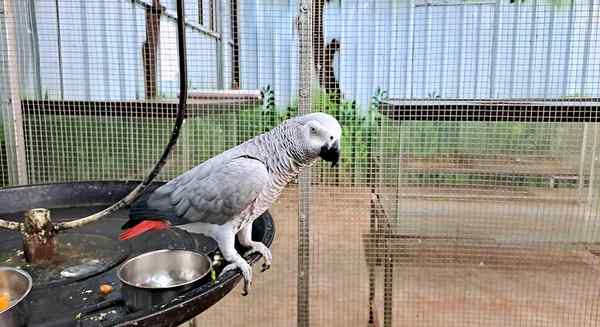
RTI responses from 19 States and Union Territories reveal that State Forest Departments have no records of registered breeders or authorised pet shops dealing in the African grey parrot, despite the species being widely available in Indian pet markets. This has raised concerns about illegal and unreported exotic wildlife trade in India.
About the African Grey Parrot
- Common Name: African grey parrot
- Scientific Name: Psittacus erithacus
- Natural Range: West and Central Africa (savannas, mangroves, forest edges and clearings)
- Subspecies:
- Congo African Grey (CAG) – bright red tail
- Timneh African Grey (TAG) – maroon tail
- Distinctive Traits:
- Among the most intelligent parrots; exceptional mimicry and contextual speech
- Grey plumage, orange eyes; highly social and sensitive
- Ecological Role: Important seed disperser in African ecosystems
Conservation Status
- International Union for Conservation of Nature (IUCN): Endangered
- Convention on International Trade in Endangered Species of Wild Fauna and Flora (CITES): Appendix I
- Commercial international trade prohibited
- Requires individual CITES permits and strict documentation
Legal Framework for Trade in India
- Import & Breeding Requirements (for CITES Appendix I species):
- CITES import permit
- Directorate General of Foreign Trade (DGFT) import licence
- Prior approval / No-Objection Certificate from the Chief Wildlife Warden
- Breeding licence under Breeders of Species Licence Rules, 2023
- Obligation of States: Forest Departments are mandated to maintain registries of exotic species.
Higher Education Commission of India (HECI) Bill 2025
- 26 Nov 2025
In News:
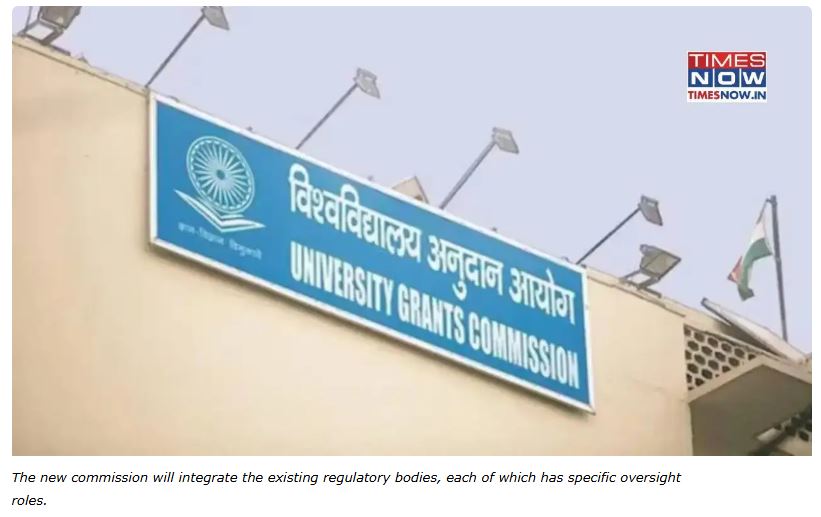
The Union Government is set to table the Higher Education Commission of India (HECI) Bill, 2025 in Parliament, nearly five years after the National Education Policy (NEP 2020) recommended a single, integrated regulator for higher education.
What is the HECI Bill, 2025?
- Nature: A draft legislation to establish a single regulatory authority for higher education in India.
- Coverage: All higher education except medical and legal education.
- Core Change: Replaces the existing multi-regulator system led by University Grants Commission (UGC), All India Council for Technical Education (AICTE) and National Council for Teacher Education (NCTE).
Objectives of the Bill
- Streamline and simplify higher education regulation.
- Remove fragmentation, overlap, and conflicts of interest.
- Implement NEP 2020’s vision of a transparent, outcome-based, and less intrusive regulatory architecture.
- Promote institutional autonomy and academic freedom.
Key Features of the HECI Framework
1. Single Regulator Model
- HECI will subsume the regulatory roles of UGC, AICTE, and NCTE.
- Medical and legal education will continue to be regulated separately.
2. Four-Vertical Structure (as envisaged in NEP 2020)
- National Higher Education Regulatory Council (NHERC): Regulation and compliance for institutions (excluding medical & legal).
- National Accreditation Council (NAC): Accreditation and quality benchmarking.
- General Education Council (GEC): Academic standards, learning outcomes, and curricular frameworks.
- Higher Education Grants Council (HEGC): Funding-related functions (with major financial control likely retained by the Ministry).
3. Functional Separation
- Clear separation of:
- Regulation
- Accreditation
- Funding
- Academic standard-setting
- Intended to avoid concentration of power and conflicts of interest.
4. Independent, Expert-Driven Governance
- Each vertical to function as an autonomous professional body.
- HECI to act as a light, coordinating commission rather than a heavy regulator.
5. Reduced Regulatory Burden
- Addresses criticism of the current regime being bureaucratic and compliance-heavy.
- Aims to cut duplication, delays, and inconsistent rules across regulators.
6. Institutional Autonomy
- Encourages higher education institutions to become self-governing and academically independent.
- Accreditation outcomes linked with graded autonomy.
Significance of the HECI Bill, 2025
- Major Governance Reform: Ends decades of fragmented higher education regulation.
- Quality Enhancement: Focus on outcomes, accreditation, and professional standards.
- Ease of Doing Academia: Reduces regulatory overlap and administrative friction.
- NEP 2020 Implementation: Converts policy vision into a statutory framework.
US 28-Point Peace Proposal on the Russia–Ukraine War

- 26 Nov 2025
In News:
The United States has reportedly shared a 28-point draft peace proposal with Volodymyr Zelenskyy to explore a negotiated end to the Russia–Ukraine war. The draft is associated with the foreign-policy team of former US President Donald Trump and has been discussed in Geneva between US and Ukrainian officials. European partners are preparing a counter-proposal to safeguard Ukraine’s sovereignty.
What is the 28-Point Peace Plan?
- Nature: A US-drafted roadmap for a negotiated settlement of the Russia–Ukraine conflict.
- Objective:
- Freeze the conflict and prevent further territorial expansion.
- Rework European security arrangements by limiting NATO expansion.
- Enable Ukraine’s economic reconstruction via US–EU mechanisms.
Key Provisions
1) Security Architecture Reset
- Ukraine to forgo NATO membership and enshrine permanent neutrality in its Constitution.
- Restrictions on Ukraine’s military strength (reported cap ~600,000 troops).
- NATO to formally guarantee Ukraine’s non-admission and avoid stationing troops on Ukrainian soil.
2) Territorial & Political Elements
- Ukraine expected to make territorial concessions to Russia (details unspecified).
- Tripartite dialogue (Russia–Ukraine–Europe) to resolve long-standing disputes.
3) Economic Reconstruction
- Ukraine Development Fund for technology, energy, AI, urban rebuilding, and resources.
- Use of ~$100 billion frozen Russian assets for reconstruction under US management; profit-sharing reported (US share) with additional EU contributions.
4) Russia’s Global Re-engagement
- Phased sanctions relief.
- Invitation for Russia to rejoin the G8.
- Prospective US–Russia cooperation in energy, rare earths, AI, and Arctic projects.
Diplomatic Process & Reactions
- Geneva talks: US and Ukraine termed discussions “productive,” aiming to align positions and refine the draft.
- Process concerns: Reports suggest Ukraine and some US officials were initially excluded from drafting; European allies seek safeguards.
- Ukraine’s stance: Any final deal must respect sovereignty and ensure durable security; Kyiv prefers territorial talks after stabilisation on current lines.
- Next steps: Continued US–Ukraine engagement; any agreement requires approval by Ukraine, the US, and Russia.
Significance
- Most detailed US-linked proposal since the war began.
- Potential to reshape NATO–Russia–Ukraine security dynamics.
- Controversial: Criticised as Russia-leaning and constraining Ukraine’s sovereignty.
Bharat NCAP 2.0
- 26 Nov 2025
In News:
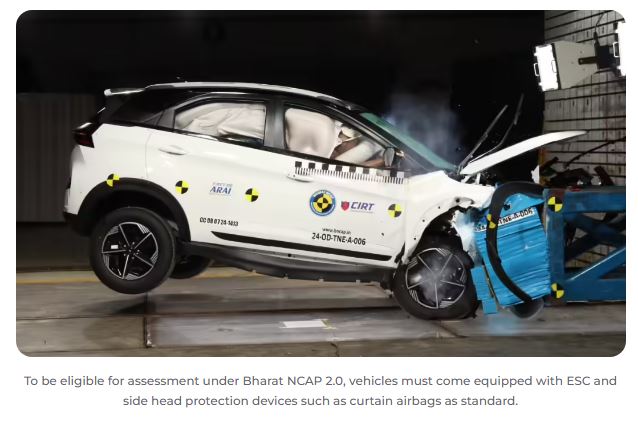
The Ministry of Road Transport and Highways (MoRTH) has released the draft Bharat NCAP 2.0, significantly upgrading India’s vehicle safety assessment framework by introducing new crash-test categories, higher benchmarks, and pedestrian safety norms.
What is Bharat NCAP 2.0?
- Nature: Revised vehicle safety rating programme for passenger cars sold in India.
- Background: Updates the Bharat NCAP guidelines notified in 2023.
- Objective:
- Align India’s crash-safety standards with global NCAP norms.
- Protect vehicle occupants as well as pedestrians and other vulnerable road users (VRUs).
- Push manufacturers to adopt advanced safety technologies.
Implementing & Testing Agency
- Certification & Testing: Central Institute of Road Transport (CIRT), Pune
- Nodal Ministry: MoRTH
Key Features of Bharat NCAP 2.0
1. Five Safety Assessment Verticals
- Safe Driving
- Accident Avoidance
- Crash Protection
- Vulnerable Road User (VRU) Protection (New)
- Post-Crash Safety (New)
2. Expanded Crash-Test Regime
- Existing Tests:
- Frontal impact
- Side impact
- Oblique pole impact
- New Tests Added:
- Full-width frontal crash test
- Rear impact test
3. Advanced Injury Evaluation: Use of Advanced Test Dummies (ATDs) to assess injury risks to different body regions under multiple crash scenarios.
4. Vulnerable Road User (VRU) Protection
- Pedestrian Safety Tests:
- Legform impact test
- Adult and child head impact tests
- Optional Safety Tech: Autonomous Emergency Braking (AEB) for pedestrians and motorcyclists earns additional points.
5. Accident-Avoidance Technologies
- Mandatory: Electronic Stability Control (ESC)
- Optional (Extra Score): Autonomous Emergency Braking System (AEBS)
6. Post-Crash Safety Assessment
- Fire and electrical safety checks
- Ease of occupant escape (functioning doors, seat-belt buckles after crash)
Revised Star Rating System
- Stricter thresholds for higher star ratings.
- A vehicle cannot receive a 5-star rating if:
- Any assessment vertical scores zero, or
- There is evidence of severe or life-threatening injury risk.
Significance of Bharat NCAP 2.0
- Moves India closer to global vehicle safety benchmarks.
- Addresses pedestrian safety—pedestrians account for over 20% of road accident deaths in India.
- Supports India’s target to reduce road fatalities by 50% by 2030.
- Encourages safety-led competition among automobile manufacturers.
Constitution (131st Amendment) Bill, 2025

- 26 Nov 2025
In News:
The proposed Constitution (131st Amendment) Bill, 2025 has generated political debate as it seeks to bring Chandigarh under Article 240 of the Constitution, altering its existing administrative arrangement.
What is the Constitution (131st Amendment) Bill, 2025?
- Nature: A draft constitutional amendment.
- Core Proposal: To include Chandigarh within the ambit of Article 240.
- Rationale:
- Simplify the Central Government’s law-making process for Chandigarh.
- Ensure uniformity with other Union Territories (UTs) without legislatures.
What is Article 240?
- Empowers the President of India to make regulations for certain UTs.
- Such regulations have the same force as an Act of Parliament.
- Currently applies to:
- Andaman and Nicobar Islands
- Lakshadweep
- Dadra and Nagar Haveli and Daman and Diu
- Puducherry (when its Legislative Assembly is suspended or dissolved)
- Chandigarh is not covered at present.
Key Features of the Proposed Amendment
- Inclusion under Article 240: President can directly frame regulations for Chandigarh.
- Administrator Provision: Enables appointment of an independent Administrator, instead of the Punjab Governor holding additional charge.
- Reduced Role of Punjab: Marks a departure from the historical arrangement under the Punjab Reorganisation Act, 1966.
- Administrative Shift: Strengthens direct Central control over Chandigarh’s governance.
About Chandigarh
Historical Background
- Post-Partition Context: Conceived as a new capital for Indian Punjab after Lahore went to Pakistan.
- Vision: Envisioned by Jawaharlal Nehru as a symbol of modern India, “unfettered by the traditions of the past.”
- Urban Planning: Master plan designed by Le Corbusier, making it a landmark in modernist urban design.
- Foundation Stone: Laid in 1952.
- Site Selection: Foothills of the Shivalik Range, then part of Ambala district.
After Punjab Reorganisation (1966)
- Haryana carved out of Punjab.
- Chandigarh designated as:
- A Union Territory, and
- Joint capital of Punjab and Haryana.
Existing Governance Structure of Chandigarh
- Administrative Head: Governor of Punjab acts as Administrator of Chandigarh (additional charge).
- Past Arrangement: Had an independent Chief Commissioner/Chief Secretary (1966–1984).
- Control: Directly under the Ministry of Home Affairs (MHA).
- Legislature: No Legislative Assembly; governance through UT ??????? (Adviser to Administrator, Home Secretary, Finance Secretary, etc.).