
Solid Waste Management (SWM) Rules, 2026
- 05 Feb 2026
In News:
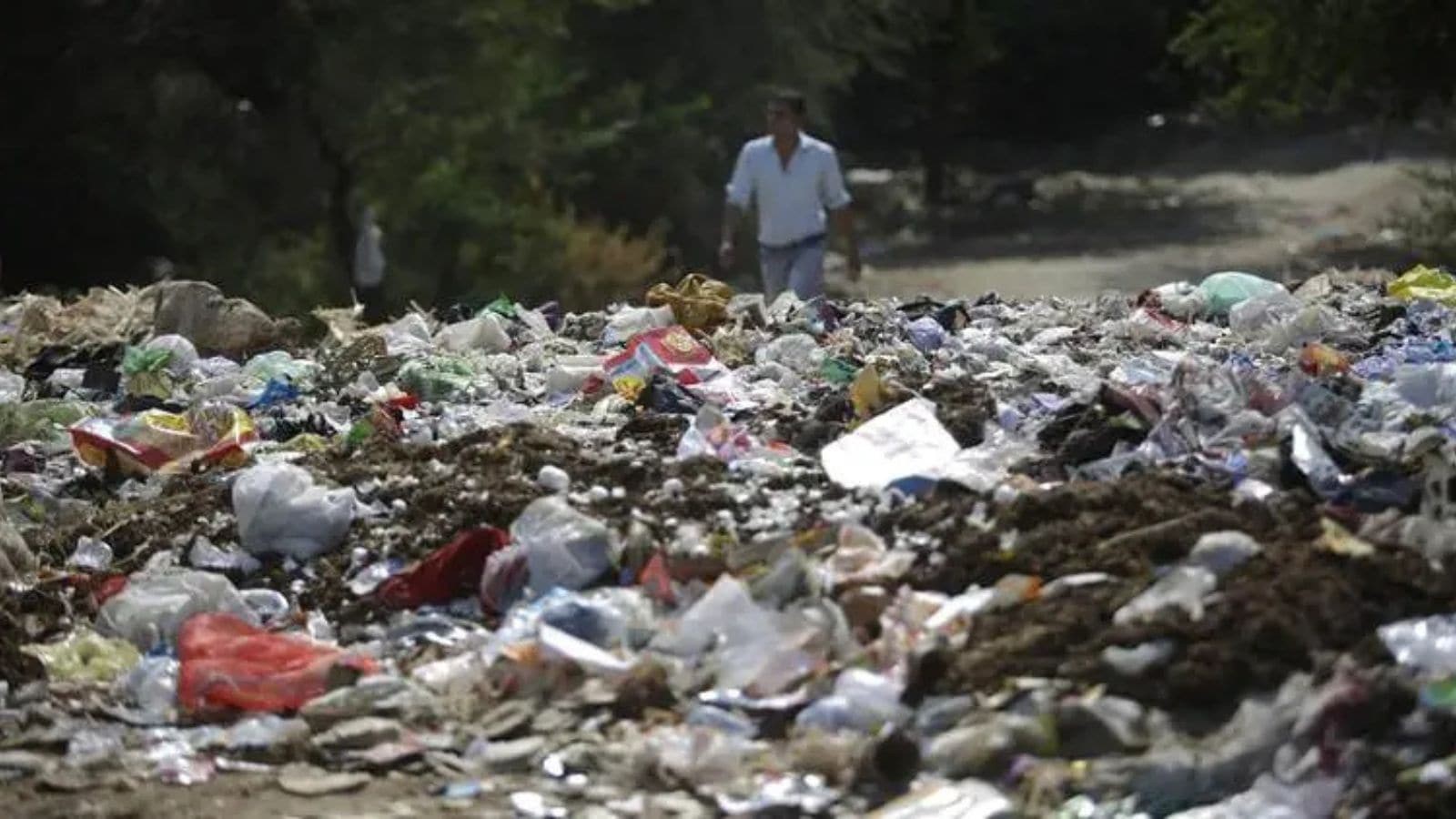
The Ministry of Environment Forest and Climate Change has notified the Solid Waste Management Rules, 2026, replacing the 2016 rules under the Environment Protection Act. The new framework comes into force from 1 April 2026 and aims to strengthen segregation, accountability, and circular use of waste.
Key Objectives
The rules seek to reduce landfill dependence, promote scientific waste processing, operationalise the polluter pays principle, and align waste governance with circular economy goals under urban missions like Swachh Bharat Mission 2.0 and AMRUT 2.0.
Major Features
- Four-Stream Segregation at Source (Mandatory): Households, institutions, and establishments must segregate waste into:
- Wet waste: Kitchen and biodegradable waste; to be composted or bio-methanated
- Dry waste: Plastic, paper, metal, glass, etc.; to be sent to Material Recovery Facilities (MRFs)
- Sanitary waste: Diapers, sanitary pads, etc.; to be securely wrapped and separately stored
- Special care waste: Bulbs, medicines, paint containers, batteries; to be handed to authorised agencies
- Polluter Pays Principle: Environmental compensation will be imposed for violations such as non-registration, false reporting, and improper disposal. Guidelines will be framed by the Central Pollution Control Board, while enforcement will be done by State Pollution Control Boards and Pollution Control Committees.
- Bulk Waste Generators (BWGs) – Clear Definition: Entities are classified as BWGs if they meet any one of these thresholds:
- Floor area ≥ 20,000 sq m
- Water consumption ≥ 40,000 litres/day
- Waste generation ≥ 100 kg/day
This includes government offices, residential societies, institutions, universities, and commercial complexes—together accounting for nearly 30% of total waste.
- Extended Bulk Waste Generator Responsibility (EBWGR): BWGs must process wet waste on-site wherever feasible or obtain an EBWGR certificate. This reduces pressure on urban local bodies and enforces accountability at the source.
- Centralised Digital Monitoring: A national online portal will track registration, authorisation, waste processing, audits, and legacy waste remediation, replacing manual systems and improving transparency.
- Faster Land Allocation for Processing Facilities: Graded siting criteria and buffer norms for facilities handling over 5 tonnes/day will speed up infrastructure creation, guided by CPCB norms.
- Refuse Derived Fuel (RDF) Mandate: Industries such as cement kilns and waste-to-energy plants must increase RDF use from 5% to 15% over six years. RDF is high-calorific fuel made from non-recyclable dry waste, promoting resource recovery.
- Restrictions on Landfilling: Only inert, non-recyclable, and non-energy-recoverable waste can be landfilled. Higher landfill fees for unsegregated waste are intended to incentivise segregation.
- Legacy Waste Remediation: Mandatory biomining and bioremediation of old dumpsites with time-bound targets and quarterly reporting via the portal. District Collectors will oversee audits.
- Duties of Local Bodies and MRFs: Urban local bodies must ensure collection, segregation, and transportation. MRFs are formally recognised as key facilities for sorting and can also receive sanitary and other waste streams.
- Special Provisions for Hilly Areas and Islands: Local bodies can levy tourist user fees, regulate visitor numbers, and promote decentralised processing of biodegradable waste by hotels and institutions.
- Institutional Mechanism: State-level committees chaired by Chief Secretaries (or UT Administrators) will supervise implementation and advise CPCB.
Significance
India generates roughly 1.85 lakh tonnes of municipal solid waste per day (CPCB data). The 2026 rules emphasise prevention, segregation, recycling, and energy recovery before disposal, embedding circular economy principles in urban governance. Scientific waste handling reduces pollution, greenhouse gas emissions from landfills, and public health risks such as vector-borne diseases.
Challenges
Implementation gaps at municipal levels, inadequate processing infrastructure, weak segregation at household level, financial stress on smaller towns, and the need to formally integrate waste pickers remain major hurdles.
Way Forward
Success depends on strengthening urban local body capacity, behavioural change campaigns for segregation, private sector participation in recycling, technological tools for monitoring, and integration with climate, plastic, and renewable energy policies. If effectively executed, the SWM Rules, 2026 can transform India’s waste burden into an opportunity for sustainable and resource-efficient urban development.
Supreme Court Ruling on Menstrual Hygiene in Schools
- 05 Feb 2026
In News:
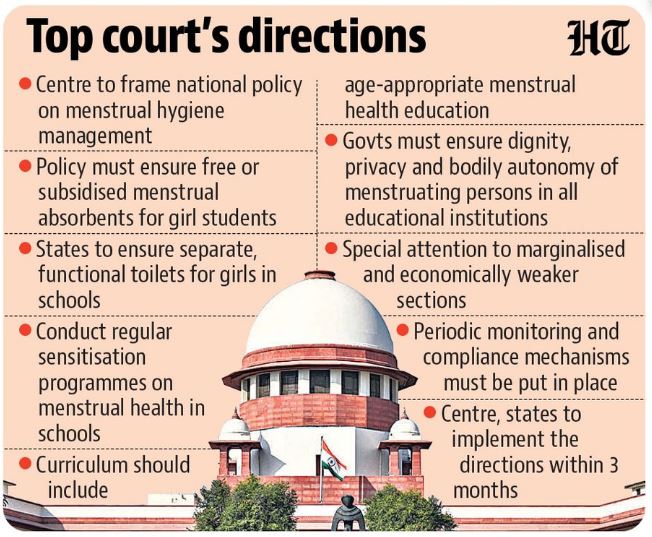
In a landmark decision, the Supreme Court of India recognised menstrual hygiene management (MHM) as part of the fundamental rights of girl students. The Court reframed menstrual health from a welfare issue into a constitutional entitlement linked to equality, dignity, and the right to education, and issued binding directions to ensure implementation across schools.
Constitutional and Legal Foundations
- Substantive Equality under Article 14: The Court clarified that equality does not mean identical treatment. Girls experience a biological process that, without institutional support, becomes a structural barrier to education. Lack of access to sanitary products and safe sanitation facilities places them at a disadvantage compared to boys, amounting to indirect gender discrimination.
- Right to Life and Dignity under Article 21: Menstrual health was interpreted as part of the right to live with dignity. The Court linked denial of menstrual hygiene facilities to stigma, humiliation, and violation of bodily autonomy and privacy. Forcing girls to miss school due to lack of support was held to undermine their dignity and well-being.
- Right to Education and Statutory Interpretation: Reading the Right of Children to Free and Compulsory Education Act in a purposive manner, the Court held that “free education” means removal of all barriers, financial or infrastructural that prevent attendance. When the cost of sanitary products or absence of facilities leads to absenteeism or dropout, the State fails in its statutory duty.
Key Directions to Governments and Schools
The Court issued time-bound directions under a continuing mandamus to ensure compliance.
All schools, whether government-run or private, must provide free sanitary napkins to girl students. Preference has been given to environmentally sustainable, oxo-biodegradable products. Distribution should take place through vending machines installed in toilets or through designated school authorities.
Schools must establish safe and hygienic disposal mechanisms. Covered waste bins must be available and cleaned regularly, along with environmentally compliant systems for disposal.
Every school must have functional, gender-segregated toilets with assured water supply. Toilets must guarantee privacy, be accessible to children with disabilities, and include handwashing facilities with soap and water at all times.
Institutions are required to create Menstrual Hygiene Management corners equipped with emergency supplies such as spare uniforms, innerwear, and disposal bags. This ensures that girls are not forced to leave school due to menstrual emergencies.
Behavioural and Educational Reforms
The Court emphasised that infrastructure alone cannot ensure inclusion unless stigma is addressed. Boys must be sensitised about menstruation to prevent harassment and discrimination. Teachers, irrespective of gender, must receive training to support menstruating students with empathy and awareness.
The National Council of Educational Research and Training (NCERT) and State Councils of Educational Research and Training have been directed to integrate gender-responsive education on puberty and menstruation into school curricula.
Monitoring and Accountability
District Education Officers are required to conduct periodic inspections to verify compliance. The Court also mandated collection of anonymous student feedback to assess the real availability and usability of facilities. By keeping the matter pending through a continuing mandamus, the Court retained supervisory jurisdiction to ensure effective implementation.
Broader Significance
The judgment advances gender justice by recognising menstruation-linked exclusion as a form of structural discrimination. It strengthens educational equity by addressing a key cause of absenteeism among adolescent girls. It also links public health, sanitation, and environmental sustainability with constitutional governance. Most importantly, it transforms menstrual hygiene from a matter of charity into a matter of rights and State accountability.
Conclusion
The ruling represents a shift from formal equality to substantive inclusion. By embedding menstrual hygiene within constitutional guarantees and statutory duties, the Court has affirmed that biological differences must not translate into educational disadvantage. The decision reinforces the vision of a gender-sensitive education system grounded in dignity, access, and equal opportunity.
Exercise Khanjar-XIII

- 05 Feb 2026
In News:
The 13th edition of Exercise KHANJAR, a joint special forces drill between India and Kyrgyzstan, is being conducted at Misamari, Sonitpur district, Assam.
About Exercise KHANJAR
- Type: Annual India–Kyrgyzstan Joint Special Forces Exercise
- Edition: 13th (KHANJAR-XIII)
- Duration: 14 days
- Venue (2026): Misamari, Assam
- First Held: 2011, at Nahan, India
- Frequency: Annual; venues alternate between India and Kyrgyzstan
Participating Forces
- Indian contingent: Special Forces troops of the Indian Army (including elements of the Parachute Regiment)
- Kyrgyz contingent: Elite Scorpion Brigade
Aim of the Exercise
- To enhance interoperability, coordination, and joint operational capability between the Special Forces of both nations, particularly in counter-terrorism and urban warfare environments under a simulated United Nations mandate.
Key Training Modules
- Close Quarter Battle (CQB) techniques
- Room intervention & building clearance
- Hostage rescue simulations
- Sniping and precision engagement
- Counter-terrorism operations
- Joint tactical manoeuvres
- Mountain craft and high-risk terrain operations
Strategic Importance
- Counter-Terror Cooperation: Strengthens joint preparedness for anti-terror operations in complex environments
- Urban Warfare Expertise: Focus reflects modern conflict scenarios involving built-up areas
- Defence Diplomacy: Reinforces India’s military engagement with Central Asian partners
- Regional Security: Enhances collaboration in tackling transnational threats
Previous Edition
- The 12th edition was held in Kyrgyzstan (March 2025) and included high-altitude and specialised counter-terror drills along with cultural exchanges to build mutual trust.
Solid Fuel Ducted Ramjet (SFDR) Technology
- 05 Feb 2026
In News:
The Defence Research and Development Organisation successfully demonstrated Solid Fuel Ducted Ramjet (SFDR) technology from the Integrated Test Range.
What is SFDR Technology?
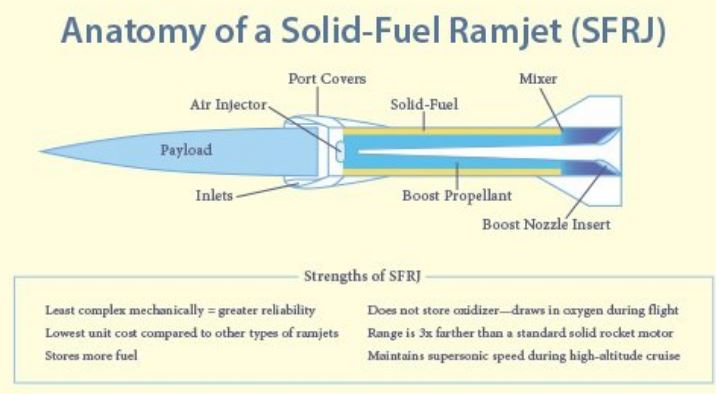
- SFDR is an advanced air-breathing missile propulsion system that uses a solid fuel gas generator combined with ramjet propulsion.
- It is being developed by Defence Research and Development Laboratory along with other DRDO labs.
How It Works
- The missile is first accelerated to supersonic speed (Mach 2+) using a nozzle-less solid booster.
- Once at high speed, the ramjet engine takes over.
- The system draws oxygen from the atmosphere instead of carrying an oxidiser.
- A solid fuel ducted ramjet motor then produces sustained and controllable thrust throughout the missile’s flight.
Key Subsystems Tested
- Nozzle-less Booster
- Solid Fuel Ducted Ramjet Motor
- Fuel Flow Controller
All systems performed as expected during the flight test.
What is a Ramjet?
A ramjet is a jet engine that:
- Has no moving compressor parts
- Uses the missile’s forward speed to compress incoming air
- Works efficiently only at high supersonic speeds
Advantages of SFDR Over Conventional Rockets
|
Feature |
Conventional Rocket |
SFDR System |
|
Oxidiser |
Carried onboard |
Not required (air-breathing) |
|
Weight |
Heavier |
Lighter |
|
Thrust Duration |
Short boost phase |
Sustained throughout flight |
|
Maneuverability |
Reduces after boost |
Maintains high agility till end |
|
Range |
Limited by fuel burn |
Significantly extended |
Strategic Significance
- Long-Range Air-to-Air Missiles (LRAAM): SFDR will power advanced missiles such as future variants of Astra Mark-3, potentially enabling engagement ranges beyond 150–300 km.
- Expanded “No-Escape Zone”: Sustained propulsion allows high-G manoeuvres near the target, making evasion extremely difficult.
- Elite Technology Club: Places India among a select group of nations possessing advanced ramjet missile propulsion capability.
- Future Surface-to-Air Systems: Technology may be adapted for next-generation SAM systems to counter high-speed cruise or hypersonic threats.
PM VIKAS Scheme (Pradhan Mantri Virasat Ka Samvardhan)
- 05 Feb 2026
In News:
The Union Minister for Minority Affairs, Kiren Rijiju, informed the Rajya Sabha about the implementation status of the PM VIKAS scheme.
About the Scheme
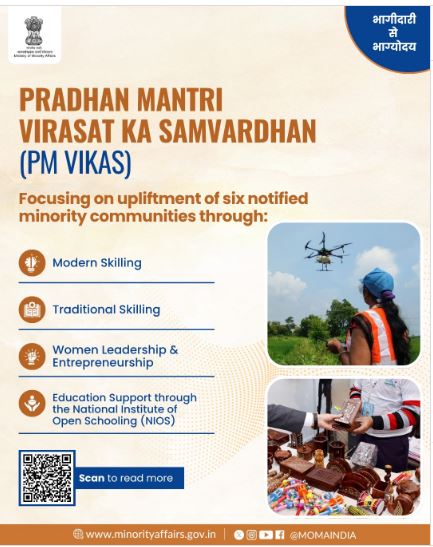
- Full Name: Pradhan Mantri Virasat Ka Samvardhan (PM VIKAS)
- Type: Central Sector Scheme
- Launch: Guidelines approved in January 2025; implementation underway
- Nodal Ministry: Ministry of Minority Affairs
- Target Groups: Socio-economic empowerment of six notified minority communities, with special focus on artisans, women, and youth
Core Objectives
- Skill Development
- Training in both traditional and non-traditional trades
- Employment-linked, need-based courses
- Cultural Preservation
- Promotion of traditional arts, crafts, and literature
- Safeguarding Intangible Cultural Heritage (ICH)
- Educational Inclusion
- Support for school dropouts from minority communities
- Certification at 8th, 10th, and 12th levels through open schooling via the National Institute of Open Schooling
- Women Leadership & Entrepreneurship
- Confidence building, leadership training
- Financial and enterprise support
- Infrastructure Support: Convergence with Pradhan Mantri Jan Vikas Karyakram for minority area development
Key Features
- Financial Support: Provided through the National Minorities Development & Finance Corporation (NMDFC)
- Market Linkages: Facilitated by the Export Promotion Council for Handicrafts
- Artisan Cluster Model: “Hub and Spoke” model to develop Vishwakarma Villages for craft-based livelihoods
- Pan-India Implementation: Funds are not directly allocated to States; projects are executed through approved agencies and PIAs