
Nyaya Setu AI Chatbot
- 03 Apr 2026
In News:
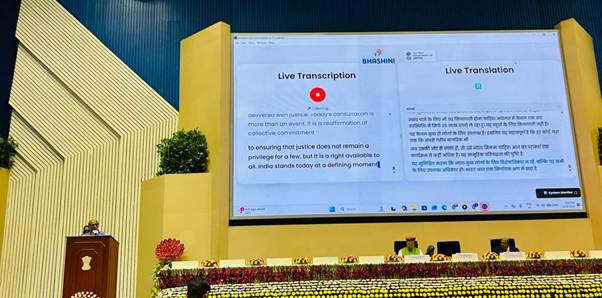
In March 2026, the Vice-President of India, along with the Minister of Law and Justice, unveiled the Nyaya Setu AI Chatbot and its mascot, Dishika, during a national consultation for the DISHA programme. This initiative is designed to democratize legal information, ensuring that geographical, linguistic, and literacy barriers do not impede a citizen's access to the justice system.
Understanding Nyaya Setu: The AI Legal Bridge
Nyaya Setu is a voice-first, multimodal, and multilingual AI assistant. It acts as a digital intermediary that translates complex legal jargon and procedures into simplified, actionable guidance for the common man.
- Development: The platform is a turnkey implementation built and owned by the Digital India BHASHINI Division (DIBD) under the Ministry of Electronics and Information Technology (MeitY).
- The AI Stack: It utilizes an integrated end-to-end voice stack, featuring:
- BHASHINI ASR (Automatic Speech Recognition): To understand diverse Indian accents and spoken queries.
- Natural Language Processing (NLP): To provide context-aware, conversational responses.
- Legal Guardrails: The AI is specifically trained on the Bharatiya Nyaya Sanhita (BNS) and other legal frameworks to ensure responses are legally accurate and safe.
Key Features of the Chatbot
- Linguistic Inclusivity: Supports 36 text languages and 23 voice languages, including complex tribal dialects, catering to India’s diverse demographic.
- User-Centric Design: By prioritizing voice interactions, it assists those who may struggle with formal literacy or digital navigation.
- Scale and Speed: Managed by the National Hub for Language Technology (NHLT), it is capable of processing millions of inferences daily, providing real-time legal guidance.
Dishika: The "Friendly" Face of Justice
To make the digital experience less intimidating, the government introduced Dishika, the official mascot of Nyaya Setu.
- Role: Dishika serves as a digital guide, leading users through their legal queries and explaining the "next steps" in a simplified manner.
- Objective: The mascot is a trust-building tool aimed at rural and digitally underserved populations, transforming a cold AI interface into a relatable digital presence.
Integration with the DISHA Programme
Nyaya Setu is a component of the broader DISHA (Designing Innovative Solutions for Holistic Access to Justice) scheme.
- Context: DISHA is a central sector scheme (2021–2026) that consolidates various legal aid initiatives like Tele-Law, Nyaya Bandhu (Pro-bono services), and Legal Literacy programmes.
- Synergy: While Tele-Law connects citizens with lawyers, Nyaya Setu provides immediate, preliminary legal awareness and procedural information, acting as a "pre-litigation" digital tool.
Indian Accounting Standards (Ind AS)
- 03 Apr 2026
In News:
In March 2026, the Insurance Regulatory and Development Authority of India (IRDAI) notified a comprehensive roadmap for the implementation of Indian Accounting Standards (Ind AS) across the insurance sector. Effective from April 1, 2026, this transition marks the end of the traditional Indian GAAP (Generally Accepted Accounting Principles) era for insurers, aligning them with global financial reporting norms
Key Features and Implications of the Ind AS Framework
Indian Accounting Standards (Ind AS) are a set of accounting principles notified by the Ministry of Corporate Affairs (MCA) in 2015. They are largely converged with the International Financial Reporting Standards (IFRS).
The transition to Ind AS is not merely a bookkeeping change but a structural shift in how financial health is perceived in the industry:
- Principle-Based Reporting: Unlike the rigid rules of IGAAP, Ind AS focuses on the economic substance of transactions. This ensures that the financial statements reflect the actual risks and rewards associated with insurance contracts.
- Fair Value Measurement: Ind AS mandates that assets and liabilities be valued at current market rates. This provides a more realistic and "mark-to-market" view of an insurer’s solvency and financial standing.
- Enhanced Disclosures: The new standards require granular transparency regarding risk management, future cash flows, and the assumptions used in calculating insurance liabilities.
- Ind AS 117: This specific standard is the cornerstone of the transition, as it addresses the complexities of insurance contracts, ensuring that profits are recognized as services are provided rather than when premiums are collected.
The Role of IRDAI: Governance and Supervision
The Insurance Regulatory and Development Authority of India (IRDAI) is the statutory and autonomous body responsible for this transition. Established under the IRDAI Act, 1999, it operates under the Ministry of Finance and is headquartered in Hyderabad.
The authority is composed of a Chairman, five full-time members, and four part-time members, all of whom are appointed by the Government of India. Its primary objectives include:
- Protecting Policyholders: Ensuring fair business conduct and the timely settlement of claims.
- Financial Prudence: Monitoring the solvency and stability of insurers to prevent financial collapses.
- Market Regulation: Licensing insurance and reinsurance companies and preventing unscrupulous pricing or unaffordable premiums.
Humpback Whale
- 03 Apr 2026
In News:
In March and April 2026, a 12.35-meter humpback whale drew global attention after becoming repeatedly stranded in the shallow waters of the Baltic Sea (specifically near Poel Island and the Bay of Wismar, Germany). While the whale successfully freed itself three times, its presence in this region underscores a growing ecological anomaly: the Baltic Sea is not a natural habitat for this species due to its low salinity, shallow depth, and lack of adequate food sources.
Species Profile: Megaptera novaeangliae
The Humpback whale is a quintessential "rorqual" (baleen whale) known for its complex vocalizations and acrobatic breaches.
- Scientific Name:Megaptera novaeangliae (derived from Greek for "big-winged," referring to its massive pectoral fins).
- Distinctive Features:
- Bubble-Net Feeding: A sophisticated cooperative behavior where whales create "nets" of air bubbles to trap schooling fish.
- Sexual Dimorphism: Unlike many mammals, females are larger than males to support the energy demands of gestation and nursing.
- Migration: They hold the record for some of the longest mammal migrations, traveling from polar feeding grounds to tropical breeding waters.
The Baltic Stranding: Causes and Concerns
Strandings, particularly in non-native waters like the Baltic, are often "sentinel events" indicating broader environmental issues.
- Disorientation & Acoustic Pollution: Intense underwater noise from shipping, military sonar, or seismic surveys can interfere with a whale's echolocation, leading to "atypical stranding events."
- Climate Change: Warming ocean temperatures and shifting prey (like capelin and krill) can lure whales into treacherous, shallow coastal corridors.
- Physical Threats: During the 2026 Baltic incident, rescuers found and removed fishing nets wrapped around the whale’s body, highlighting the persistent threat of "ghost gear" and entanglement.
Conservation and Legal Framework
The Humpback whale’s status reflects both the success and the ongoing challenges of international maritime law.
|
Parameter |
Status/Details |
|
IUCN Red List |
Least Concern (following a significant recovery since the 1966 commercial whaling ban). |
|
CITES |
Appendix I (prohibits international commercial trade). |
|
CMS |
Included under the Convention on Migratory Species, requiring trans-boundary protection. |
Strengthening the Blue Water Navy
- 03 Apr 2026
In News:
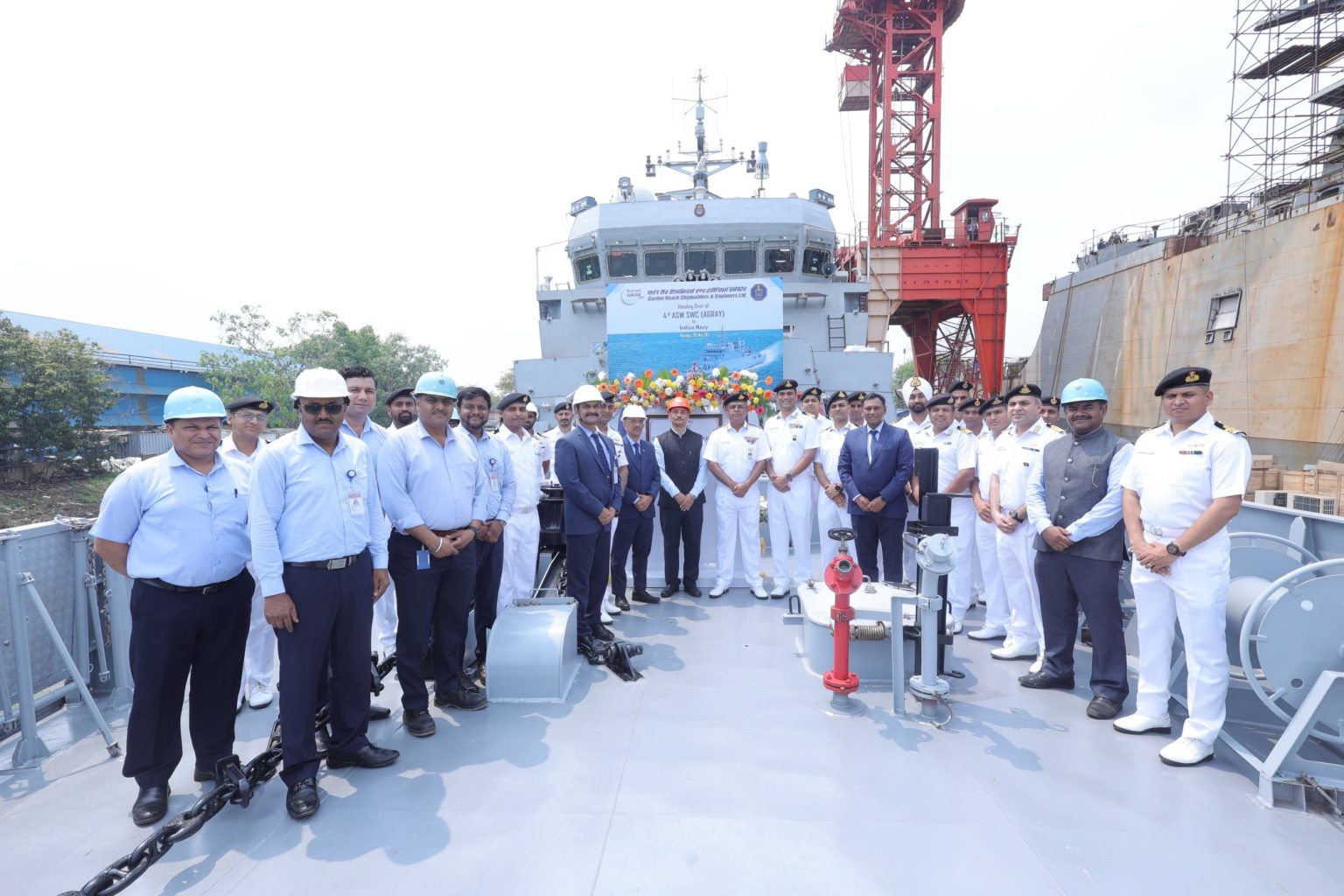
Recently, Garden Reach Shipbuilders and Engineers Ltd (GRSE) achieved a significant milestone by delivering three frontline naval platforms—INS Dunagiri, INS Sanshodhak, and INS Agrayto the Indian Navy in a single day. This achievement brings GRSE’s total warship count to 118, with 80 delivered specifically to the Indian Navy, underscoring the shipyard's role in India's indigenous defense ecosystem.
INS Dunagiri: The Stealth Vanguard (Project 17A)
The INS Dunagiri is the second of three Advanced Stealth Frigates built by GRSE under Project 17A (Nilgiri-class). It is a reincarnation of the erstwhile Leander-class frigate that served from 1977 to 2010.
- Specifications: A 149-meter long, 6,670-tonne vessel.
- Propulsion: Utilizes a Combined Diesel or Gas (CODOG) system for high-speed intercepts and long-endurance patrols.
- Offensive Power: Armed with BrahMos supersonic cruise missiles for precision land and sea strikes.
- Defense & Sensors: Features an Advanced AESA radar and an integrated combat management system (CMS).
- Strategic Role: Designed for multi-dimensional warfare, it can engage threats across air, surface, and sub-surface domains simultaneously.
INS Sanshodhak: The Hydrographic Pioneer (Survey Vessel – Large)
INS Sanshodhak (meaning "Researcher") is the fourth and final vessel in the Survey Vessel (Large) class, replacing the older Sandhayak-class ships.
- Primary Mission: To conduct full-scale hydrographic surveys of ports, harbors, and deep-sea navigation channels.
- Capabilities: Equipped with advanced Autonomous Underwater Vehicles (AUVs) and Remotely Operated Vehicles (ROVs) to collect geophysical and oceanographic data.
- Secondary Roles: Its versatile design allows it to function as a Hospital Ship during Humanitarian Assistance and Disaster Relief (HADR) missions and carry out limited combat roles.
INS Agray: The Littoral Warrior (ASW Shallow Watercraft)
INS Agray is the fifth ship of the Arnala-class, specifically designed for Anti-Submarine Warfare (ASW) in littoral (coastal) waters.
- Indigenous Prowess: Boasts approximately 88% indigenous content, including a GRSE-built 30 mm naval surface gun.
- Weaponry: Features lightweight torpedoes and ASW rockets specifically tuned for shallow-water threats.
- Agility: Powered by waterjet propulsion with a shallow draught of only 2.7 meters, allowing it to operate in coastal areas where larger frigates cannot navigate.
Comparison of Key Features
|
Vessel |
Class/Project |
Primary Role |
Key Technology |
|
INS Dunagiri |
Project 17A Frigate |
Multi-role Combat |
Stealth Design & CODOG |
|
INS Sanshodhak |
Survey Vessel (Large) |
Mapping & HADR |
Hydrographic Data Suite |
|
INS Agray |
ASW SWC |
Coastal Defense |
Waterjet Propulsion |
Census 2027
- 03 Apr 2026
In News:
India is transitioning into a new era of data-driven governance with the 16th Census (8th since Independence). Scheduled to commence its field operations in 2026 and conclude by March 1, 2027, this exercise is not merely a headcount but a structural re-engineering of how India understands its demographic and socio-economic fabric.
Conceptual and Legal Framework
A census is the most credible source of information on demographics (age, sex, literacy), economic activity, and migration.
- Constitutional & Legal Basis: While the Constitution mandates enumeration, the specific timing and periodicity are governed by the Census of India Act, 1948. Notably, the Act does not specify a fixed 10-year interval, though it has historically been decennial.
- Administrative Authority: Conducted by the Office of the Registrar General and Census Commissioner of India (ORGI) under the Ministry of Home Affairs (MHA).
- NPR Integration: The National Population Register (NPR) is conducted alongside the Census but is legally distinct, governed by the Citizenship Act, 1955. Registration in NPR is mandatory for every "usual resident" (one who has resided in a local area for 6 months or more).
Landmark Features of Census 2027
The 2027 exercise introduces three transformative shifts:
- First Fully Digital Census: Moving away from paper schedules, enumerators will use a mobile application (Census HLO/PE App) for real-time data entry.
- Self-Enumeration: A secure web-based portal (se.census.gov.in) will allow citizens to fill their details in 16 scheduled languages before the enumerator’s visit.
- Caste Enumeration: For the first time since 1931, the Census will capture granular data on castes beyond SC/ST. This is expected to provide an empirical basis for "precision governance" and affirmative action policies.
Structural Reorganization: 2011 vs. 2027
The administrative landscape of India has shifted significantly since the last census in 2011, reflecting rapid urbanization and administrative decentralization.
|
Feature |
Census 2011 |
Census 2027 (Projected) |
|
States/UTs |
35 |
36 |
|
Districts |
640 |
784 |
|
Statutory Towns |
4,041 |
5,128 |
|
Census Towns |
3,892 |
4,580 |
|
Methodology |
Paper-based |
Digital/Hybrid (App Portal) |
Implementation Phases and Timeline
The government has allocated an outlay of ?11,718.24 crore for the exercise, which will follow a two-phase rollout:
- Phase I: House Listing & Housing Census (April–September 2026): Focuses on 33 parameters including housing conditions, amenities (water, electricity, LPG), and digital assets. A new question regarding the "main cereal consumed" has been added.
- Phase II: Population Enumeration (February 2027): Captures individual socio-economic data, including the reference date of March 1, 2027 (October 1, 2026, for snow-bound areas).