
Strengthening India’s Tsunami Early Warning System

- 11 Feb 2026
implemented by the Indian National Centre for Ocean Information Services (INCOIS), which operates the Indian Tsunami Early Warning Centre (ITEWC).
Location and Regional Role
- Proposed site: Vijaynagar on Swaraj Dweep, Andaman and Nicobar Islands
- Project cost: ?300 crore
- First-of-its-kind tsunami coordination centre in India
- Will provide warning services to Indian Ocean countries, including Sri Lanka
The Andaman and Nicobar Islands lie close to major tectonic activity zones, making them strategically important for tsunami detection.
Limitations of the Current System
Currently, tsunami warnings are processed at INCOIS headquarters in Hyderabad. The system relies on:
- Seismic signals
- Tidal gauges along the Indian coast
- Surface buoys deployed in the Indian Ocean
- Satellite data
However, the existing system primarily detects earthquake-triggered tsunamis, which account for about 80% of global tsunamis. Nearly 20% are caused by non-seismic sources such as:
- Submarine landslides
- Volcanic eruptions
- Mudslides
Surface buoys are also vulnerable to vandalism and theft, and satellite data sometimes has gaps.
Next-Generation Capabilities
The new RSC will develop a system capable of detecting both seismic and non-seismic tsunamis, significantly enhancing early warning capacity.
Key Technological Features:
- Laying of 270 km-long sub-sea cables along tectonic subduction zones
- Improved monitoring of acoustic signals, which travel faster than conventional seismic signals
- Reduced data gaps compared to surface buoys
Subduction zones are regions where one tectonic plate moves beneath another, often generating earthquakes and volcanic activity.
Vulnerability of Indian Coasts
While India’s east coast has experienced past tsunamis (notably in 2004), experts highlight emerging risks:
- The west coast of India may be vulnerable to non-seismic tsunamis due to fragile marine geology.
- Presence of underwater mud volcanoes along the Makran coast increases risk potential.
- India’s only active volcano at Barren Island in the Andaman Sea also poses a latent threat.
- If an epicentre is located close to the Andaman and Nicobar Islands, the islands themselves could face severe impact.
Network Readiness Index (NRI) 2025
- 11 Feb 2026
In News:
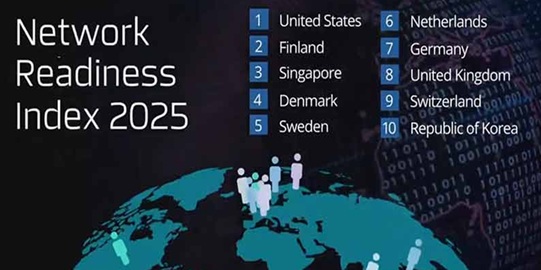
- India has improved its position in the Network Readiness Index 2025 (NRI 2025), moving up four places to secure 45th rank among 127 economies. The index is prepared by the Portulans Institute, a non-profit research and educational institute based in Washington DC.
- India’s overall score increased from 53.63 (2024) to 54.43 (2025), reflecting enhanced digital readiness and technological capacity.
About the Network Readiness Index
The NRI assesses how effectively economies leverage information and communication technologies (ICT) for development.
Coverage and Methodology:
- Covers 127 economies
- Based on 53 indicators
- Structured around four pillars:
- Technology
- People
- Governance
- Impact
The index maps a country’s preparedness to benefit from digital transformation and network-based economies.
India’s Key Achievements in NRI 2025
Global Rank 1 in:
- Annual investment in telecommunication services
- AI scientific publications
- ICT services exports
- E-commerce legislation
This highlights India’s leadership in telecom infrastructure expansion, artificial intelligence research output, digital services exports and regulatory framework for e-commerce.
Rank 2 in:
- Fibre-To-The-Home (FTTH)/Building internet subions
- Mobile broadband internet traffic
- International internet bandwidth
These indicators reflect strong digital infrastructure growth and increasing data consumption.
Rank 3 in:
- Domestic market scale
- Income inequality (indicator within index framework)
India’s large market size enhances its digital ecosystem scalability.
Performance Relative to Income Level
- Ranked 2nd among lower-middle-income countries, after Vietnam.
- The report notes that India demonstrates greater network readiness than expected given its income level, indicating efficient digital transformation relative to economic capacity.
Significance for India
India’s improved ranking reflects:
- Rapid telecom infrastructure expansion
- Growth in AI research and digital innovation
- Strong ICT export performance
- Progressive digital governance and e-commerce regulation
This performance aligns with broader initiatives such as Digital India, expansion of broadband connectivity and promotion of AI-led innovation.
Kimberley Process
- 11 Feb 2026
In News:
India has assumed the Chair of the Kimberley Process (KP) for the year 2026. This marks an important development in global diamond governance, as the KP regulates international trade in rough diamonds to prevent their use in financing armed conflicts.
What is the Kimberley Process?
The Kimberley Process is a tripartite coalition of governments, civil society and the diamond industry established to eliminate the trade in “conflict diamonds.”
Conflict Diamonds Defined
As per UN Security Council Resolution 1459, conflict diamonds are defined as:
“Rough diamonds used by rebel movements or their allies to finance conflict aimed at undermining legitimate governments.”
The KP was established in 2003 based on a United Nations mandate to regulate global trade in rough diamonds.
Structure and Membership
- 60 participants, representing 86 countries (European Union counts as a single participant)
- Covers over 99% of global rough diamond production and trade
- Operates on a consensus-based decision-making mechanism
- Meets twice annually at:
- Intersessional meetings
- Plenary meetings
- Chairmanship rotates annually among participating countries
The KP functions through a tripartite structure involving governments, industry stakeholders and civil society groups.
Kimberley Process Certification Scheme (KPCS)
The operational mechanism of the KP is the Kimberley Process Certification Scheme (KPCS).
Key Features:
- Each shipment of rough diamonds must be accompanied by a Kimberley Process Certificate
- Shipments must be transported in tamper-resistant containers
- Trade is permitted only between participating countries
- Countries must establish:
- National legislation
- Import/export controls
- Transparent statistical data exchange
The certificate verifies that the shipment is conflict-free and complies with KP minimum requirements.
India’s Role in the Kimberley Process
India has been an active participant in the KPCS since 2003. As one of the world’s largest diamond cutting and polishing centres, India plays a crucial role in the global diamond value chain.
Institutional Framework in India:
- Department of Commerce – Nodal department
- Gem & Jewellery Export Promotion Council (GJEPC) – Designated Importing and Exporting Authority
- Issues KP Certificates
- Custodian of certificates received in India
India’s chairmanship in 2026 provides an opportunity to strengthen transparency, improve traceability and enhance institutional credibility within the KP framework.
Ethylene Glycol

- 11 Feb 2026
In News:
Recent laboratory findings in Tamil Nadu detected ethylene glycol adulteration in a batch of Almond Kit syrup, prompting a public health alert. Such incidents highlight the serious risks posed by contamination of pharmaceutical or food products with industrial chemicals like ethylene glycol (EG) and diethylene glycol (DEG).
About Ethylene Glycol (EG)
Ethylene glycol is the simplest member of the glycol family of organic compounds.
Key Properties
- Colourless, odourless, slightly viscous liquid
- Faintly sweet taste
- Miscible with water and alcohol
- Low volatility (does not evaporate quickly)
- Stable over a wide temperature range
- Inexpensive to manufacture
Because of these properties, it is widely used in industry but is highly toxic if ingested.
Uses of Ethylene Glycol
Ethylene glycol has multiple industrial applications:
- Antifreeze and de-icing solutions for cars, aircraft and boats
- Component of hydraulic brake fluids
- Used in printing inks (stamp pads, ballpoint pens, print shops)
- Industrial reagent in the manufacture of:
- Polyesters
- Alkyd resins
- Explosives
- Synthetic waxes
Its chemical stability and freezing-point depression properties make it suitable for coolant systems.
Health Impact and Toxicity
Though industrially valuable, ethylene glycol is highly toxic when consumed. It is not inherently dangerous in small dermal exposures but becomes lethal when ingested.
Mechanism of Toxicity
After ingestion, ethylene glycol is metabolised in the liver into toxic compounds such as:
- Glycolic acid
- Oxalic acid
These metabolites cause:
- Severe metabolic acidosis
- Acute kidney injury
- Nervous system depression
- Multi-organ failure
If untreated, poisoning can result in significant morbidity and mortality. Early medical intervention using antidotes such as fomepizole or ethanol can block toxic metabolism.
Diethylene Glycol (DEG): A Related Public Health Hazard
Diethylene glycol, chemically similar to ethylene glycol, has been implicated in multiple drug adulteration incidents globally. Like ethylene glycol, it is:
- Used as an industrial solvent
- Sweet-tasting and colourless
- Toxic when ingested
DEG contamination in medicines, especially cough syrups, has historically led to mass poisoning incidents due to renal failure and metabolic acidosis. These cases underline the importance of strict pharmaceutical quality control and regulatory vigilance.
Public Health and Regulatory Significance
The recent detection of ethylene glycol in a medicinal syrup underscores:
- The need for stringent drug testing and quality assurance
- Strong enforcement of pharmaceutical manufacturing standards
- Rapid public communication in case of contamination
Such incidents highlight the role of regulatory authorities in preventing industrial chemicals from entering consumable products.
Mons Mouton
- 11 Feb 2026
In News:
India’s upcoming Chandrayaan-4 mission marks a significant leap in its space exploration programme. Approved by the Union Government, Chandrayaan-4 is designed as India’s first lunar sample-return mission and is expected to launch around 2028, as indicated by ISRO leadership. It will be India’s most complex lunar endeavour to date.
Landing Site: Mons Mouton in the Lunar South Polar Region
ISRO scientists have identified the Mons Mouton region in the Moon’s South Polar area as the landing site. Mons Mouton:
- Is a mountain approximately 6,000 metres high
- Lies in the South Circumpolar Region (SCR)
- Is positioned on the rim of the South-Pole-Aitken Basin, the largest and oldest known impact basin on the Moon
- Is officially named after NASA mathematician Melba Roy Mouton
The region is scientifically significant because:
- It is located near permanently shadowed craters believed to contain water-ice deposits
- It receives long-duration sunlight, aiding power generation
- It offers clear line-of-sight communication with Earth
Selection of MM-4 Landing Zone
ISRO shortlisted four potential sites in the Mons Mouton area—MM-1, MM-3, MM-4 and MM-5. After detailed analysis using high-resolution datasets from the Orbiter High Resolution Camera (OHRC), MM-4 was selected.
Key terrain characteristics of MM-4:
- A 1 km × 1 km landing zone
- Mean slope: 5 degrees
- Mean elevation: 5,334 metres
- Highest number of hazard-free grids (24 m × 24 m)
- Least hazardous terrain percentage among shortlisted sites
Safe landing depends on terrain suitability combined with robust navigation, guidance and control systems.
Mission Architecture
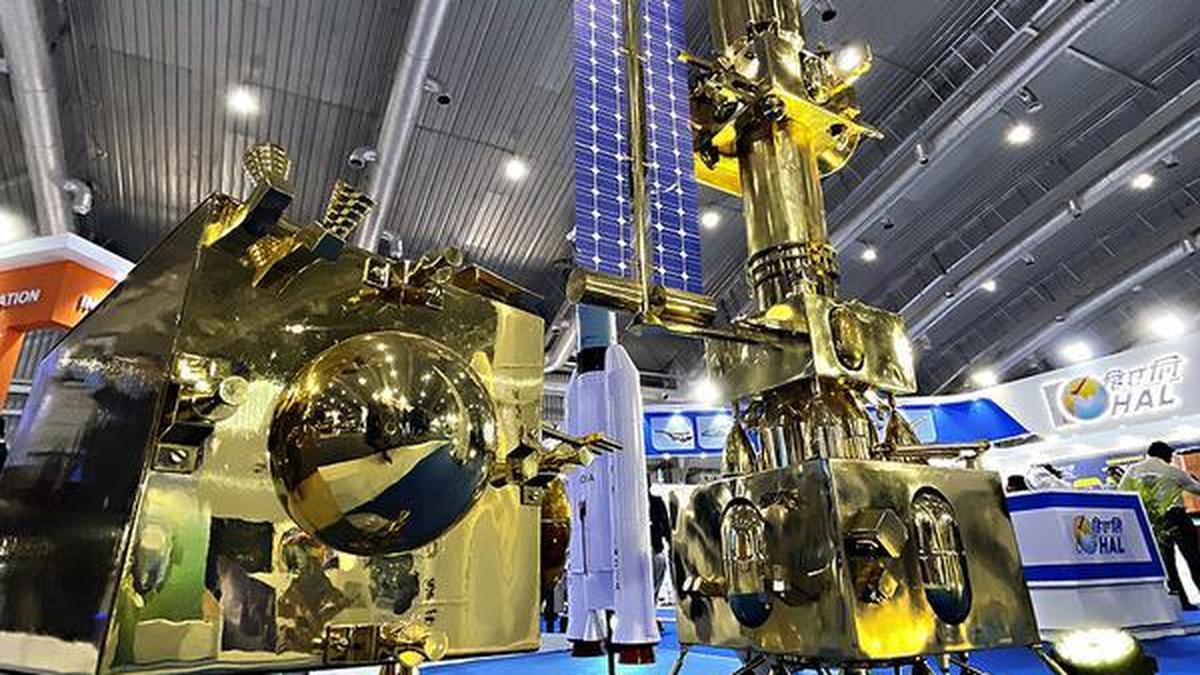
Chandrayaan-4 consists of five major components:
- Propulsion Module (PM)
- Descender Module (DM)
- Ascender Module (AM)
- Transfer Module (TM)
- Re-entry Module (RM)
The combined Descender Ascender stack will execute soft landing at the selected site. After collecting lunar samples, the Ascender Module will lift off from the Moon’s surface, transfer samples to the Return module, and enable re-entry to Earth.
This architecture makes Chandrayaan-4 technologically more complex than previous missions, as it involves:
- Precision soft landing
- Surface operations
- Lunar ascent
- Sample transfer
- Earth re-entry
Scientific Importance
The Mons Mouton region offers major scientific opportunities:
- Study of water-ice and volatile deposits
- Understanding the geological evolution of the South-Pole-Aitken Basin
- Insights into early Solar System history
- Assessment of lunar resources for future human missions