
Mission MITRA
- 07 Apr 2026
In News:
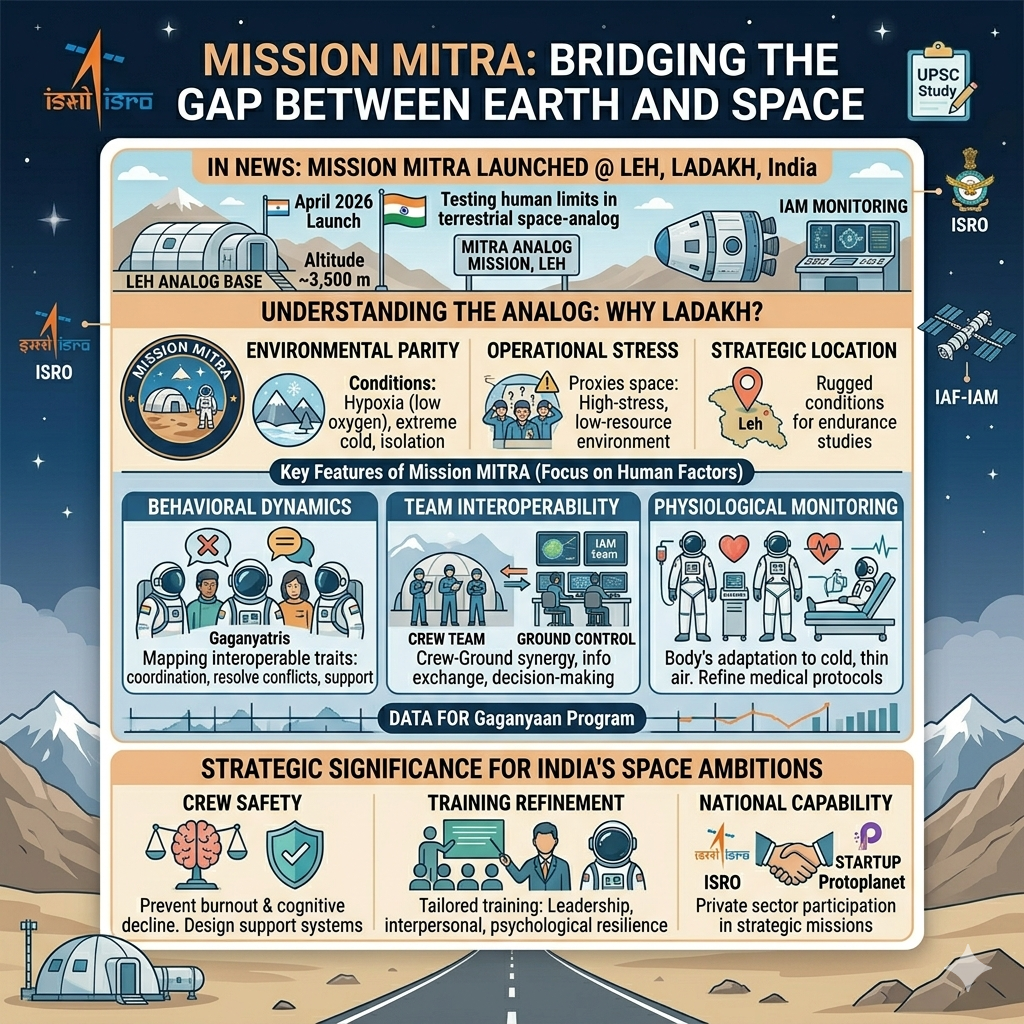
Recently, the Indian Space Research Organisation (ISRO) launched Mission MITRA (Mapping of Interoperable Traits and Response Assessment) in Leh, Ladakh. This pioneering study, conducted in collaboration with the IAF-Institute of Aerospace Medicine (IAM), marks a critical step in India’s Gaganyaan program by testing the behavioral and physiological limits of astronauts in a terrestrial space-analog environment.
The Terrestrial Analog: Why Ladakh?
Space exploration is as much a psychological challenge as it is a technological one. To prepare for the vacuum of space, scientists utilize terrestrial analogues—locations on Earth that mimic space-like stressors.
- Environmental Parity: Situated at an altitude of approximately 3,500 meters, Leh offers conditions of hypoxia (low oxygen), extreme cold, and geographical isolation.
- Operational Stress: These rugged conditions serve as a natural proxy for the high-stress, low-resource environment of a spacecraft, allowing researchers to study human endurance without leaving Earth's atmosphere.
Core Objectives and Design
Mission MITRA is a first-of-its-kind multidisciplinary study focused on the "Human Factor" of spaceflight. It involves India's four designated Gaganyatris (astronauts) and a supporting team of scientists, engineers, medical doctors, and psychologists.
- Behavioral Dynamics: The mission maps interoperable traits—the ability of crew members to coordinate, resolve conflicts, and support one another under pressure.
- Team Interoperability: A key focus is the synergy between the Crew and Ground Control Teams, assessing how information is exchanged and how decision-making holds up under operational stress.
- Physiological Monitoring: Scientists track how the body adapts to freezing temperatures and thin air, providing data that will refine medical protocols for actual spaceflight.
Strategic Significance for India’s Space Ambitions
As India prepares for its first human spaceflight and eyes future long-duration missions to a space station or the Moon, the data from Mission MITRA is invaluable.
- Crew Safety: Understanding psychological resilience helps in designing better support systems to prevent "burnout" or cognitive decline during isolation.
- Training Refinement: Insights from this study will help the Human Space Flight Centre (HSFC) tailor training modules that move beyond physical fitness to include specialized interpersonal and leadership training.
- National Capability: Collaborative efforts with Indian startups like Protoplanet Pvt. Ltd. for facility management signify the growing participation of the private sector in India’s strategic space missions.
BioNEST
- 07 Apr 2026
In News:
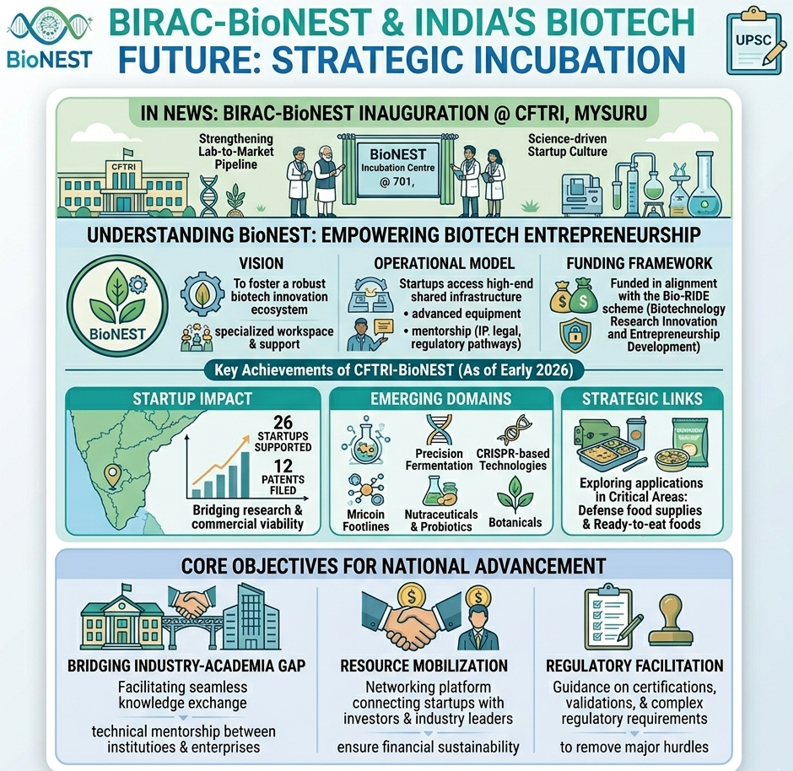
In a significant stride toward strengthening India's "lab-to-market" pipeline, the Union Minister recently inaugurated the BIRAC-BioNEST Incubation Centre at the Central Food Technology & Research Institute (CFTRI) in Mysuru. This development, coinciding with CFTRI’s 75th anniversary, underscores the government's commitment to fostering a science-driven startup culture, particularly in the high-value food and biotechnology sectors.
Understanding BioNEST:
The Bioincubators Nurturing Entrepreneurship for Scaling Technologies (BioNEST) is a flagship scheme launched by the Biotechnology Industry Research Assistance Council (BIRAC), a Public Sector Enterprise under the Department of Biotechnology (DBT).
- Vision: To foster a robust biotech innovation ecosystem by providing specialized workspace and support to entrepreneurs.
- Operational Model: BioNEST centers offer startups access to high-end shared infrastructure, advanced equipment, and comprehensive mentorship spanning Intellectual Property (IP), legal frameworks, and regulatory pathways.
- Funding Framework: These centers are funded in alignment with the Bio-RIDE (Biotechnology Research Innovation and Entrepreneurship Development) scheme, the government's umbrella initiative for promoting biotech R&D and entrepreneurship.
The CFTRI-BioNEST Milestone: A Focus on Food Tech
The newly inaugurated center at CFTRI Mysuru is uniquely positioned to revolutionize the food processing landscape. As of early 2026, the ecosystem has already demonstrated tangible success:
- Startup Impact: The center has supported 26 startups, which have collectively filed 12 patents, bridging the gap between academic research and commercial viability.
- Emerging Domains: Innovation at the center is focused on cutting-edge fields such as precision fermentation, CRISPR-based technologies, nutraceuticals, probiotics, and botanicals.
- Strategic Links: Startups within this ecosystem are exploring applications in critical areas, including defense food supplies and high-growth segments like ready-to-eat convenience foods.
Core Objectives for National Advancement
The broader BioNEST scheme serves three primary functions essential for India’s economic and scientific growth:
- Bridging the Industry-Academia Gap: Facilitating seamless knowledge exchange and technical mentorship between research institutions and private enterprises.
- Resource Mobilization: Providing a networking platform that connects startups with investors and industry leaders to ensure financial sustainability.
- Regulatory Facilitation: Offering guidance on certifications, validations, and complex regulatory requirements, which are often major hurdles for biotech ventures.
S?dhana Saptah Initiative
- 07 Apr 2026
In News:
The S?dhana Saptah (Strengthening Adaptive Development and Humane Aptitude for National Advancement) initiative, held from April 2 to April 8, 2026, represents a landmark in India’s administrative reforms. Organized by the Department of Personnel and Training (DoPT), the Capacity Building Commission (CBC), and Karmayogi Bharat, the event commemorates the foundation of the CBC and five years of Mission Karmayogi.
Mission Karmayogi: The Philosophical Bedrock
S?dhana Saptah is a flagship event under Mission Karmayogi (National Programme for Civil Services Capacity Building). This Central Sector Scheme seeks to shift the civil service paradigm from a "rule-based" to a "role-based" approach. The vision is to create a future-ready, transparent, and accountable bureaucracy equipped with the right competencies to achieve the goals of Viksit Bharat 2047.
The mission is supported by two critical pillars:
- Capacity Building Commission (CBC): Established in 2021, it acts as the custodian of the mission, designing frameworks and setting standards for all ministries.
- Karmayogi Bharat (SPV): A Special Purpose Vehicle set up in 2022 to operate the iGOT (Integrated Government Online Training) digital learning platform.
The Three Sutras of S?dhana Saptah
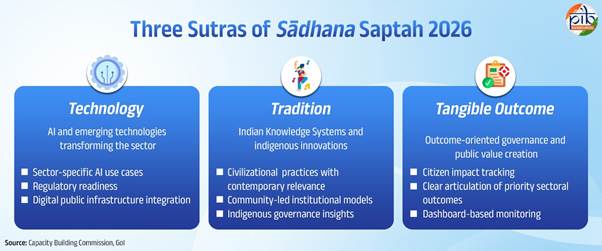
The 2026 initiative is structured around three foundational "Sutras" designed to modernize governance while remaining rooted in Indian values:
1. Technology (Focus: April 3–4) This theme explores how emerging tools can make governance more efficient and citizen-centric. Key areas include the application of Artificial Intelligence (AI) in policy making, utilizing Digital Public Infrastructure (DPI), data-informed decision-making, and mastering modern tools like prompt engineering and automation platforms.
2. Tradition (Focus: April 5–6) This pillar emphasizes the Indian Knowledge Systems (IKS) and ethical frameworks derived from Indian philosophy. It seeks to integrate historical examples of community-based governance into contemporary public administration to make it more attuned to the local needs of citizens.
3. Tangible Outcomes (Focus: April 7–8) The final focus is on accountability. It stresses the importance of measuring "public value," strengthening monitoring frameworks, and ensuring that policies translate into visible grassroots improvements. This includes tracking citizen impact and utilizing dashboard-based monitoring for real-time evaluation.
Key Initiatives Launched in 2026
To deepen the impact of capacity building, several specialized sub-programmes were introduced during the week:
- UNNATI Portal: The Unified New-Age National Training Institutions portal serves as a digital backbone, enabling real-time monitoring and collaboration across the training ecosystem.
- Karmayogi Kshamata Connect: Specifically targets frontline functionaries to improve digital awareness and the efficiency of service delivery.
- Rashtriya Jan Sewa Programme: Promotes the Sewa Bhav (spirit of service) by training youth volunteers and officials as facilitators.
- AI-Powered Amrit Gyaan Kosh Suite: Uses AI tools to analyze and integrate governance case studies into training modules for better problem-solving.
- Capacity Building for Viksit Panchayat: Strengthens grassroots governance through e-learning and AI enabled tools for local decision-makers.
- Administrative Capacity Building for Scientists: A specialized program for scientists transitioning into administrative and leadership roles.
Scale and Expected Impact
S?dhana Saptah has evolved into a massive national movement, involving over 100 Central Ministries, 36 States and Union Territories, and more than 250 Civil Services Training Institutions.
By the end of the week, every Ministry and Department is expected to commit to two priority technology interventions, two sector-relevant traditional models, and three measurable outcome commitments for the 2026–27 financial year. These are compiled into a cross-sectoral compendium covering ten identified sectors, ranging from Infrastructure and Security to Welfare and Agriculture.
Project Chetak
- 07 Apr 2026
In News:
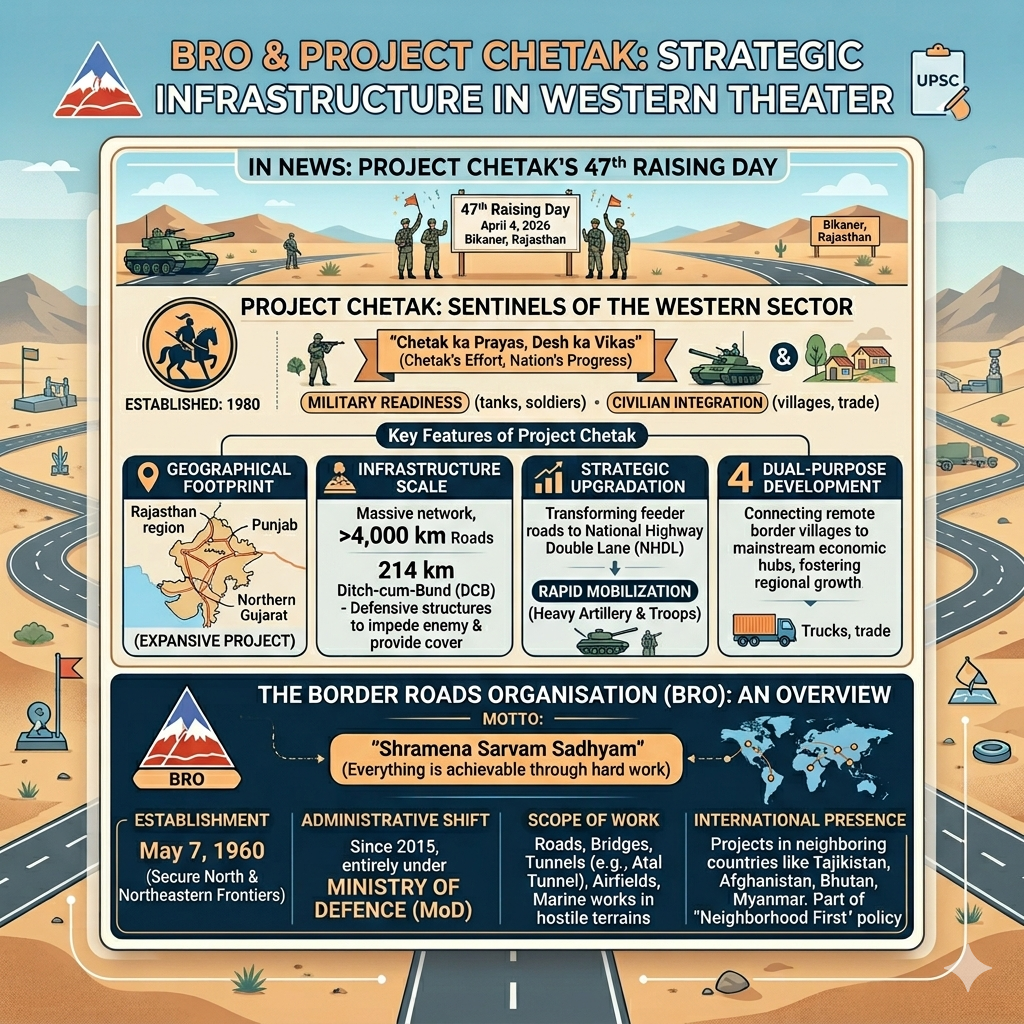
The Border Roads Organisation (BRO) recently commemorated the 47th Raising Day of Project Chetak on April 4, 2026, in Bikaner, Rajasthan.
Project Chetak: Sentinels of the Western Sector
Established in 1980, Project Chetak is a cornerstone of India’s strategic infrastructure in the western theater. Operating under the motto "Chetak ka Prayas, Desh ka Vikas" (Chetak’s Effort, Nation’s Progress), the project is essential for both military readiness and civilian integration.
Key Features and Strategic Reach
- Geographical Footprint: It is one of the BRO’s most expansive projects, overseeing infrastructure in Rajasthan, Punjab, and Northern Gujarat.
- Infrastructure Scale: The project manages a massive network exceeding 4,000 km of roads and 214 km of Ditch-cum-Bund (DCB)—defensive structures designed to impede enemy movement while providing cover for Indian forces.
- Strategic Upgradation: A primary focus remains the conversion of vital feeder roads leading to the International Border into National Highway Double Lane (NHDL) specifications, ensuring rapid mobilization of heavy artillery and troops.
- Dual-Purpose Development: While its primary role is supporting the Indian Armed Forces, the project bridges the gap between remote border villages and mainstream economic hubs, fostering regional development.
The Border Roads Organisation (BRO): An Overview
The BRO serves as a premier construction executive force, specializing in the world's most hostile terrains.
- Establishment: Formed on May 7, 1960, to secure India's north and northeastern frontiers.
- Administrative Shift: Originally working under various ministries, the BRO was brought entirely under the Ministry of Defence (MoD) in 2015 to streamline strategic projects.
- Scope of Work: Its expertise extends beyond roads to include bridges, tunnels (e.g., Atal Tunnel), airfields, and marine works.
- International Presence: The BRO also executes projects in friendly neighboring countries (e.g., Tajikistan, Afghanistan, Bhutan, and Myanmar), serving as a tool for India’s "Neighborhood First" policy.
- Motto: “Shramena Sarvam Sadhyam” (Everything is achievable through hard work).
Coal Gasification Incentive Scheme
- 07 Apr 2026
In News:
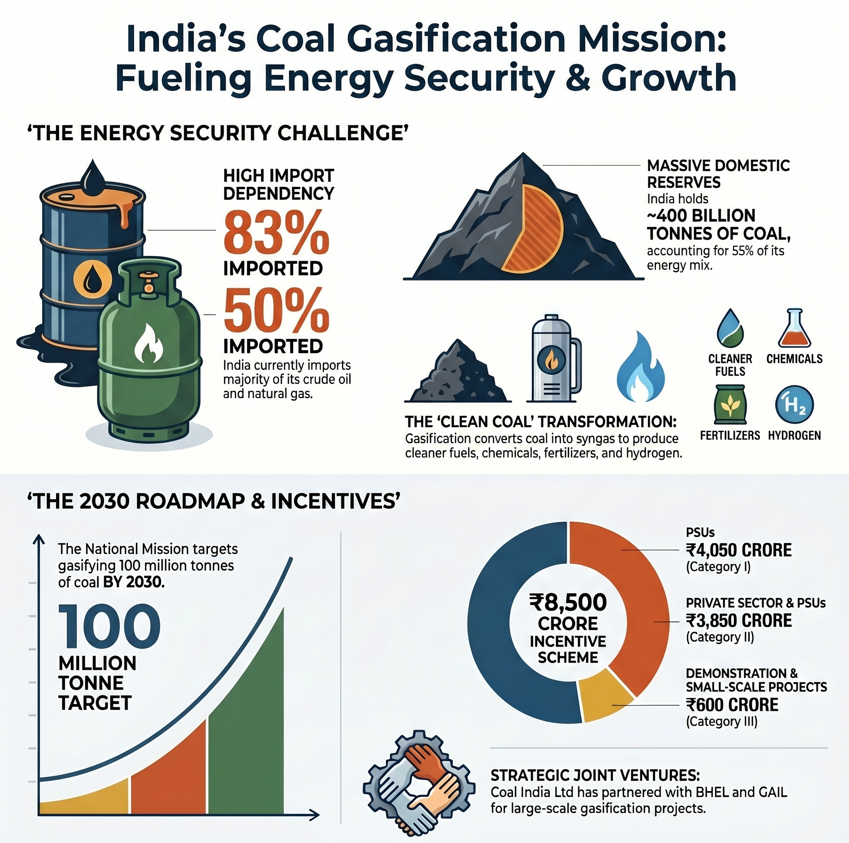
India has unveiled an ambitious roadmap to reduce its dependency on imported petroleum, ammonia, and fertilizers through the promotion of coal gasification technology.
Overview and Objectives
- Approved by the Union Cabinet, the Coal Gasification Incentive Scheme allocates ?8,500 crore to promote coal and lignite gasification projects involving both public sector undertakings (PSUs) and private players.
- The scheme's primary target is to achieve 100 million tonnes of coal gasification by 2030, positioning it as a key component of India's clean coal transition strategy.
Project Categories
The scheme classifies projects into three categories:
|
Category |
Deion |
|
Category I |
PSU-led projects |
|
Category II |
Private sector and PSU joint projects |
|
Category III |
Demonstration and small-scale projects |
This tiered structure encourages participation across the spectrum—from large-scale industrial ventures to pilot projects that test emerging technologies.
Understanding Coal Gasification
The Process
Coal gasification is a thermo-chemical process that converts coal into syngas (synthetic gas), composed primarily of:
- Carbon monoxide (CO)
- Hydrogen (H?)
- Carbon dioxide (CO?)
- Methane (CH?)
- Water vapour (H?O)
The process involves reacting coal at high temperatures (1000–1400°C) with controlled amounts of oxygen and steam.
Steps in Coal Gasification
- Preparation — Coal is finely crushed to increase surface area for efficient reaction
- Gasification reactor — Powdered coal enters a reactor with limited oxygen/air and steam
- Chemical reactions — Partial oxidation breaks coal down into syngas components
- Gas cleaning — Impurities such as tar, sulfur, and dust are removed from raw syngas
Strategic Significance for India
Energy Security
By leveraging domestic coal reserves, India can substantially reduce its reliance on imported petroleum and related products, insulating the economy from global price volatility and supply disruptions.
Industrial Applications
The syngas produced through coal gasification serves as feedstock for manufacturing:
- Ammonia and fertilizers
- Methanol and synthetic fuels
- Chemicals and petrochemical intermediates
This diversification supports the broader goal of Atmanirbhar Bharat in critical industrial sectors.
Environmental Considerations
While coal gasification is positioned within the "clean coal" framework, it represents an incremental improvement over direct coal combustion. The technology enables:
- More efficient capture of pollutants during gas cleaning
- Potential integration with carbon capture technologies
- Controlled emissions compared to conventional coal use