
World Inequality Report 2026
- 14 Dec 2025
In News:
The World Inequality Report 2026, released by the World Inequality Lab, highlights widening disparities in income, wealth, gender earnings, and climate responsibility. India is identified as one of the countries with high concentration of income and wealth at the top.
Global Inequality Trends
- Top 10% of the global population own 75% of total wealth
- Bottom 50% own just 2%
- Top 1% alone control 37% of global wealth, nearly 18 times more than the bottom half of humanity combined
- The ultra-rich (top 0.001%) hold more wealth than billions at the bottom
Gender Inequality
- Women earn 61% of men’s income per working hour (excluding unpaid work)
- Including unpaid care work, this falls to 32%
- Women receive only 26% of global labour income, largely unchanged since 1990
Regional Gender Gaps
- Middle East & North Africa: 16% share of labour income
- South & Southeast Asia: 20%
- Sub-Saharan Africa: 28%
- East Asia: 34%
- Europe/North America/Oceania: ~40%
Climate Inequality
Economic inequality overlaps with environmental injustice:
- Poorest 50% contribute only 3% of carbon emissions linked to private capital
- Top 10% responsible for 77%
- Top 1% alone account for 41%, nearly double the emissions of the bottom 90%
Income Inequality in India
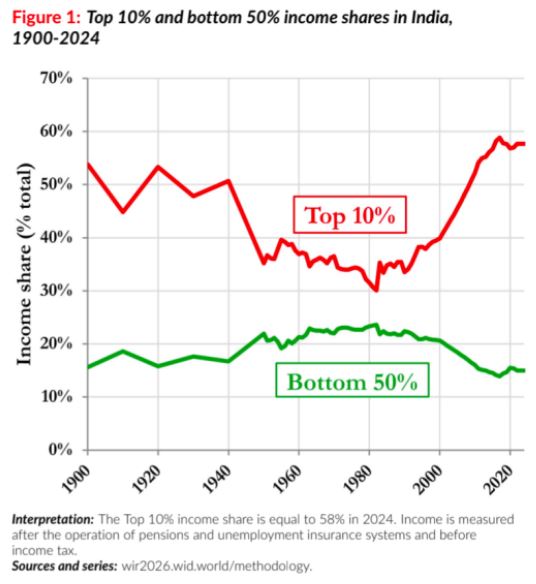
- Top 10% earn 58% of national income
- Bottom 50% receive only 15%
- Female labour income share in India is just 18%, below global average
Wealth Inequality in India
Wealth disparity is even sharper than income inequality:
- Top 10% hold 65% of total wealth
- Top 1% control 40%
- Bottom 50% own less than 6%
Changing Global Economic Geography
1980
- Global elite concentrated in North America & Europe
- India and China largely in the bottom income groups
2025
- China’s population has moved upward into middle and upper-middle income groups
- India’s population remains heavily concentrated in the bottom half of the global distribution
Policy Failures Highlighted
- Ultra-rich often pay lower effective tax rates than middle-income groups
- Regressive tax systems weaken state capacity for:
- Education
- Healthcare
- Social protection
- Climate action
Key Recommendations of the Report
- Progressive Taxation – Higher contributions from the wealthy
- Public Investment – Universal education, healthcare, childcare, nutrition
- Redistributive Measures – Cash transfers, pensions, unemployment benefits
These policies are essential to reduce structural inequality and build inclusive growth.
Generative AI & Copyright: “One Nation, One License, One Payment”
- 14 Dec 2025
In News:
The Government of India released a Working Paper on Generative AI & Copyright proposing a national framework titled “One Nation, One License, One Payment”—India’s first structured model to regulate AI training on copyrighted works while balancing creator rights and AI innovation.
Core Issue
Generative AI (GenAI) models are trained on vast datasets scraped from books, news, music, films, and art—often without permission or compensation to creators.
Legal Gap
India’s Copyright Act, 1957:
- Protects reproduction rights under Section 14
- Provides fair dealing exceptions under Section 52
- Does not explicitly recognise Text & Data Mining (TDM) for commercial AI training
This creates ambiguity on whether large-scale AI training constitutes copyright infringement.
Key Concerns Identified
1. AI Training = Reproduction?
Training requires copying and transforming works, which may amount to reproduction under Section 14.
2. Fair Dealing Limitations: Fair dealing covers private research, criticism, reporting—not commercial AI model training.
3. No Compensation Mechanism: Creators (writers, artists, musicians, journalists) currently receive no royalties despite their works improving AI outputs.
4. Cultural & Economic Risk: Unregulated AI usage may dilute Indian cultural content and reduce long-term incentives for human creativity.
5. Unequal Bargaining Power: Large global AI firms benefit from Indian datasets, while individual creators lack negotiating capacity.
Need for a Balanced Framework
- Protect India’s growing creative economy
- Ensure predictable legal access to data for AI innovation
- Support the IndiaAI Mission and domestic startups
- Maintain cultural diversity and sustainability of creative professions
- Enable fair revenue-sharing between AI firms and Indian creators
Key Proposals of the Working Paper
1. Mandatory Blanket License: AI developers can train on lawfully accessible copyrighted works without individual permissions under a single national licence.
2. Statutory Royalty Payments: Creators will receive royalties linked to AI revenues, ensuring ongoing compensation.
3. Creation of a Collective Management Body: A proposed Copyright Royalties Collective for AI Training (CRCAT) would:
- Collect licence fees
- Distribute royalties to rights holders
- Represent both members and non-members
4. Royalty Rate-Setting Committee: A government-appointed body will determine fair royalty rates with periodic review and oversight.
5. Single-Window Digital Licensing: A simplified compliance system to:
- Reduce legal burden
- Enable startups and MSMEs to innovate
- Provide nationwide validity through one licence → one payment
Why This Model is Significant
- First attempt to align copyright law with AI-era realities
- Seeks to avoid litigation-heavy, opt-out frameworks
- Balances innovation, cultural preservation, and economic justice
- Positions India as a policy pioneer in AI governance
Western Tragopan
- 14 Dec 2025
In News:
Recent studies indicate that suitable habitats for the Western Tragopan exist in Jammu & Kashmir, but habitat fragmentation and human disturbance continue to threaten the species. Meanwhile, a captivebreeding programme at Sarahan Pheasantry (Himachal Pradesh) has helped stabilise its numbers.
About Western Tragopan
- Common Name: Western Tragopan
- Scientific Name:Tragopan melanocephalus
- Also known as Jujurana or “King of Birds”
- State Bird of Himachal Pradesh
- One of the world’s rarest pheasants
Habitat & Distribution
- Found in the Western Himalayas at elevations of 2,400–3,600 metres
- Prefers:
- Moist temperate forests
- Dense undergrowth
- Ringal bamboo thickets
- Rhododendron shrubs
- Conifer forests
Key Strongholds
- Great Himalayan National Park (Himachal Pradesh)
- Kazinag and Limber areas in Jammu & Kashmir
- Pockets in Uttarakhand and northern Pakistan
Populations now survive only in small, fragmented pockets.
Population Status
- IUCN estimates 3,000–9,500 mature individuals remain
- Entire global population forms a single fragile sub-population
- Around a quarter of the population occurs in the Western Himalayas and northern Pakistan
Key Characteristics
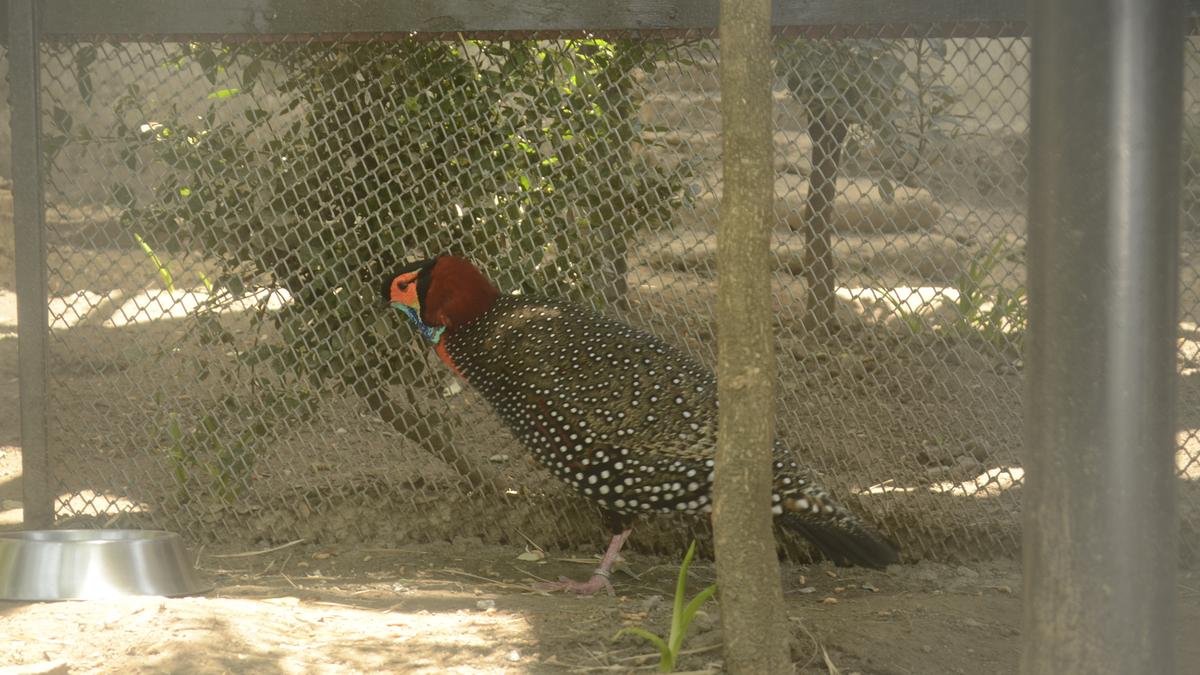
Male
- Velvet-black head
- Bright crimson breast
- White-spotted body
- Distinctive blue and orange facial wattles used in courtship displays
Female
- Smaller, brown and camouflaged
- Immature males resemble females
Behaviour
- Ground-dwelling and shy
- Most active at dawn and dusk
- Diet includes berries, seeds, buds, shoots, and insects
Breeding
- Breeding season: May–June
- Lays 3–5 eggs in well-hidden nests
Threats
- Habitat loss due to forest degradation
- Fragmentation of temperate forests
- Human disturbance (grazing, tourism, infrastructure)
- Hunting and poaching
These pressures reduce safe breeding areas and isolate populations.
Conservation Status
- Listed as Vulnerable on the International Union for Conservation of Nature (IUCN) Red List
- Recognised as a flagship and indicator species of high-altitude forest ecosystem health
Conservation Efforts
- Captive Breeding: The Sarahan Pheasantry in Himachal Pradesh has successfully bred 40+ Western Tragopans, creating an insurance population against extinction.
- Habitat Protection: Protected areas like Great Himalayan National Park and forest reserves in J&K are critical for wild populations.
However, reintroduction into natural habitats remains challenging due to ongoing habitat disturbance.
Sujalam Bharat App
- 14 Dec 2025
In News:
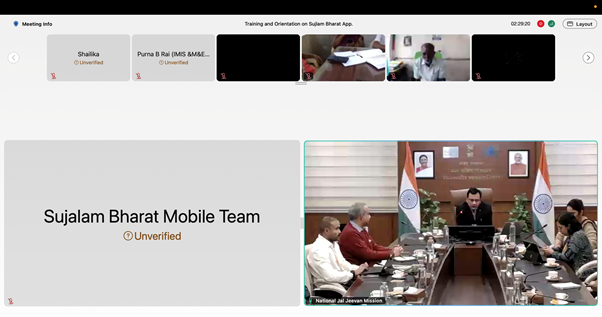
The Union Ministry of Jal Shakti has launched the Sujalam Bharat App, a major digital initiative under the Jal Jeevan Mission (JJM) to create a unified digital system for managing rural drinking water infrastructure across India.
What is the Sujalam Bharat App?
The Sujalam Bharat App is a real-time digital platform designed to integrate and monitor all rural drinking water schemes under Jal Jeevan Mission.
Core Objective
To assign a unique digital identity - Sujal Gaon ID- to every rural habitation and water supply scheme, enabling:
- Clear identification of the source of drinking water
- Tracking of infrastructure condition
- Monitoring of water supply reliability
- Assessment of water quality
- Recording of operation & maintenance (O&M) arrangements
Technological Backbone
The app has been developed with technical support from theBhaskaracharya National Institute for Space Applications and Geo-informatics (BISAG-N).
Key Integrations
- Linked with PM Gati Shakti National Master Plan GIS platform
- Uses geo-referencing and geospatial mapping of water supply networks
- Maintains digital records of:
- Water sources
- Asset inventory
- Scheme designs
- Supply performance
- Water quality reports
- Community feedback
Governance Transformation
The platform shifts rural water governance from fragmented records to a transparent, unified digital registry.
Key Governance Features
- Empowers Gram Panchayats and Village Water & Sanitation Committees (VWSCs)
- Promotes community ownership and accountability
- Enables citizens to access real-time data about their drinking water scheme
- Facilitates monitoring of service providers and maintenance agencies
Why Sujal Gaon ID is Important
The Sujal Gaon ID acts as a digital identity for rural water systems, similar to how Aadhaar provides identity to individuals.
It creates:
- A permanent digital profile for each habitation
- A service history for infrastructure performance
- A system for long-term planning, repair, and expansion
Support for Sustainability & Planning
The Sujalam Bharat digital registry helps maintain records of:
- Infrastructure condition over time
- Maintenance history
- Service-level performance
This ensures better asset management, improved sustainability, and more evidence-based planning for future rural water supply needs.
Deepavali inscribed on UNESCO’s Intangible Cultural Heritage List
- 14 Dec 2025
In News:
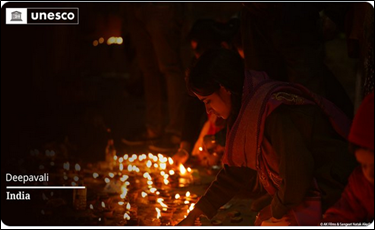
Deepavali (Diwali) has been officially inscribed on the Representative List of the Intangible Cultural Heritage of Humanity by UNESCO during the 20th Session of the Intergovernmental Committee held in New Delhi. It becomes the 16th Indian element on the list.
About Deepavali
- Also known as Diwali, meaning “row of lights”
- Celebrated on Kartik Amavasya (October–November)
- A multi-regional, multi-faith festival symbolising light over darkness, renewal, hope and harmony
- Observed across India and the global diaspora
Cultural and Mythological Significance
Deepavali is associated with multiple traditions across regions:
- Return of Lord Rama to Ayodhya after exile
- Victory of Lord Krishna over Narakasura (Naraka Chaturdashi)
- Worship of Goddess Lakshmi for prosperity
- Mahavira’s Nirvana for Jains
- Kali Puja in eastern India
- Govardhan Puja linked to Krishna traditions
- King Bali’s return celebrated in parts of western India
These diverse narratives reflect India’s cultural pluralism.
Key Features as Living Heritage
- Social practices: Lighting diyas, rangoli, rituals, gift exchange, sweets, community feasts
- Five-day celebration: Dhanteras - Naraka Chaturdashi - Lakshmi Puja - Govardhan/Bali Pratipada - Bhai Dooj
- Livelihood linkages: Potters, artisans, sweet-makers, florists, farmers, jewellers, textile workers benefit economically
- Diaspora dimension: Celebrated across Southeast Asia, Africa, Europe, Gulf countries, Caribbean
- Values embodied: Inclusivity, unity, generosity, wellbeing, moral ideal of “Tamso Ma Jyotirgamaya” (darkness to light)
Environmental & Social Dimensions
- Promotion of eco-friendly celebrations (e.g., green crackers)
- Cleaning rituals reinforce hygiene and wellbeing
- Strengthens family bonds and community cohesion
- Supports charity, food distribution, and care for vulnerable groups
About Intangible Cultural Heritage (ICH)
Definition: ICH includes living traditions, rituals, performing arts, craftsmanship, oral traditions, and knowledge systems that communities recognise as part of their cultural identity.
UNESCO Framework
- Governed by the 2003 Convention for the Safeguarding of Intangible Cultural Heritage
- Came into force in 2006
- India ratified in 2005
Five Domains of ICH
- Oral traditions & expressions
- Performing arts
- Social practices, rituals & festivals
- Knowledge concerning nature & the universe
- Traditional craftsmanship
Representative List
Highlights cultural practices that showcase humanity’s diversity and encourage dialogue.