
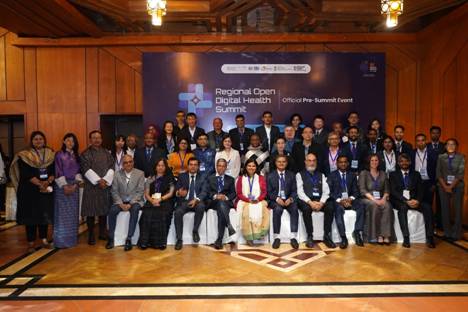
2nd Regional Open Digital Health Summit (RODHS) 2025
- 23 Nov 2025
In News:
India hosted the 2nd Regional Open Digital Health Summit (RODHS) 2025 in New Delhi, bringing together South-East Asian countries to accelerate Universal Health Coverage (UHC) through Digital Public Infrastructure (DPI), open standards, and interoperable digital health systems.
About RODHS 2025
- Nature: A regional, multi-stakeholder platform to advance open, interoperable, people-centred digital health systems across the WHO South-East Asia Region.
- Organisers:
- National e-Governance Division (NeGD), Ministry of Electronics & IT
- National Health Authority (NHA)
- World Health Organization South-East Asia Regional Office (WHO-SEARO)
- UNICEF
- Participation: India, Bangladesh, Sri Lanka, Thailand, Nepal, Maldives and other South-East Asian countries.
- Context: Builds on momentum from the inaugural summit (Nairobi) and aligns digital health with SDGs and health security.
Key Objectives
- Integrate DPI and open standards into national health systems to support UHC.
- Promote interoperability, trust, skills, and community-centric design.
- Develop country-specific roadmaps for scalable digital health implementation.
- Move from pilot projects to population-scale systems.
India’s DPI Showcase
India highlighted its DPI stack and health platforms as scalable digital public goods:
- Aadhaar (digital identity)
- UPI (digital payments)
- CoWIN (vaccination platform)
- Ayushman Bharat Digital Mission (ABDM) (national digital health ecosystem)
These were presented as models for secure data exchange, federated architecture, and nationwide scale.
Major Themes & Discussions
- Open Standards & Interoperability:
- Adoption of WHO SMART Guidelines (Standards-based, Machine-readable, Adaptive, Requirements-based, Testable).
- FHIR as the global standard for health data exchange; emphasis on governance, workforce capacity and sustained investment.
- Foundational DPI for Health:Role of digital identity, payments, registries and data exchange layers in resilient health ecosystems.
- AI & Generative AI in Health:Use-cases in diagnostics, clinical documentation, multilingual engagement and data integration-enabled by interoperable data.
- Equity & Trust:UNICEF and WHO stressed privacy, child-centric design, health-worker enablement, and community adoption.
Outcomes & Significance
- Reinforced regional cooperation for interoperable digital health.
- Positioned DPI + open standards as core enablers of UHC and health system resilience.
- Encouraged joint governance between health and IT ministries to avoid silos.
- Emphasised that success should be measured by health outcomes, not just digital adoption.
Individual Entitlement Survey for Particularly Vulnerable Tribal Groups (PVTGs)
- 23 Nov 2025
In News:
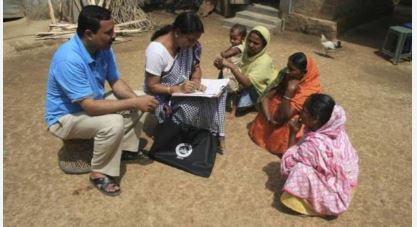
The Union Government will conduct India’s first-ever ‘Individual Entitlement Survey’ covering 10 lakh households of Particularly Vulnerable Tribal Groups (PVTGs) to assess whether benefits of 39 central government schemes are reaching the most vulnerable tribal communities at the grassroots level.
What is the Individual Entitlement Survey?
- Nodal Ministry: Ministry of Tribal Affairs
- Objective:
- To map scheme-wise coverage gaps among PVTG households
- To identify eligible beneficiaries who remain uncovered and enable corrective action by line ministries
- Schemes Covered:
- 39 schemes across 18 central ministries/departments, including:
- Mahatma Gandhi National Rural Employment Guarantee Scheme (MGNREGS)
- Social security schemes for unorganised workers
- Old-age and social pensions
- Financial assistance for meritorious Scheduled Tribe students
- Flagship welfare schemes such as LPG connections
- 39 schemes across 18 central ministries/departments, including:
Scope & Coverage
- Households: ~ 10 lakh PVTG households
- Population Covered: ~ 48 lakh individuals
- Geographical Spread:
- 1,000 blocks dominated by PVTGs
- 75 recognised PVTGs across 18 States and Andaman & Nicobar Islands (UT)
Methodology & Implementation
- Execution: Through State Governments
- Ground Support:States may engage NGOs, panchayat officials, or local functionaries
- Digital Tool:A mobile application developed by the National e-Governance Division (NeGD)
- Data Collection Features:
- House-to-house survey
- Scheme-wise eligibility and benefit status
- Geo-tagging (latitude & longitude) and household photographs
- Post-Survey Outcome:
- Issuance of a ‘Universal Entitlement Card’ to every PVTG household/member
- Card will clearly mention entitlements and coverage status under tracked schemes
What are Particularly Vulnerable Tribal Groups (PVTGs)?
- Definition:A sub-classification of Scheduled Tribes that are more vulnerable due to extreme socio-economic backwardness
- Constitutional Basis:Article 342(1) empowers the President to notify Scheduled Tribes
- Historical Evolution:
- 1973:Dhebar Commission identified Primitive Tribal Groups (PTGs)
- 1975: First list of 52 PTGs notified
- 1993: 23 more groups added
- 2006: Renamed as PVTGs
- Total:75 PVTGs out of 705 Scheduled Tribes
- Key Characteristics:
- Small, isolated and homogeneous populations
- Pre-agricultural or simple subsistence economy
- Low literacy and poor health indicators
- Lack of written language and limited access to infrastructure
- Stagnant or declining population growth
- State-wise Concentration:
- Odisha: Highest number (13)
- Andhra Pradesh & Telangana: 12
- Jharkhand & Bihar: ~9
Major Government Initiatives for PVTGs
- PM-JANMAN (Pradhan Mantri Janjati Adivasi Nyaya Maha Abhiyan):
- Covers 75 PVTGs across 18 States/UTs, 22,544 villages, 220 districts
- Focus on connectivity, services and protection of near-extinct tribes
- PM-PVTG Development Mission:Aims to improve housing, drinking water, sanitation, health, nutrition, education and road access
- Janjatiya Gaurav Divas:
- Celebrated on Birsa Munda’s birth anniversary
- Recognises tribal contributions to India’s cultural heritage and freedom struggle
Geological Survey of India (GSI)
- 23 Nov 2025
In News:
The Union Minister of Coal & Mines inaugurated an international seminar in Jaipur to mark 175 years of the Geological Survey of India-one of the world’s oldest and most respected geoscientific institutions.
About the Geological Survey of India (GSI)
Nature & Status
- India’s premier national geoscientific organisation
- Attached office under the Ministry of Mines
- Mandated to conduct geological surveys, mineral exploration, and maintain national geoscience databases
Establishment
- Formally established:1851
- Original objective: Locate coal resources for the expanding railway network during British rule
Historical Evolution
- 1818–23: Early geological mapping by Survey of India & Army officers (e.g., W. Voysey’s geological map of Hyderabad)
- 1837: Committee formed for investigation of coal and mineral resources
- 1848: Term “Geological Survey of India” first used by John McClelland
- 1851: Sir Thomas Oldham initiated continuous, institutional geological work → considered the true beginning of GSI
- Over 175 years, GSI evolved into India’s national repository of geological and mineral data
Core Functions of GSI
- Geological Mapping & Surveys
- Ground, airborne and marine surveys
- Surface and subsurface geological mapping
- Mineral & Energy Resource Exploration: Scientific assessment of minerals, coal, hydrocarbons and groundwater
- Geohazard & Earth System Studies: Seismotectonics, landslides, glaciology, climate-change-related geostudies
- Geotechnical & Geo-environmental Services: Inputs for infrastructure projects, land stability, environmental impact
- National Geoscience Repository: Geological archives, spatial databases, remote sensing data, museums
- International Collaboration: Partnerships with USGS, BGS, Geoscience Australia and polar research agencies
- Capacity Building & Outreach: Collaboration with universities and training institutions; geoscience popularisation
- Coordination Role: Technical advisory support to Central & State governments in mineral governance
HamaraShauchalaya, HamaraBhavishya Campaign

- 23 Nov 2025
In News:
The Ministry of Jal Shakti launched the nationwide “HamaraShauchalaya, HamaraBhavishya” campaign on World Toilet Day 2025, marking a renewed push to sustain and upgrade rural sanitation outcomes across India.
What is the Campaign?
A national sanitation initiative led by the Department of Drinking Water and Sanitation under the Ministry of Jal Shakti, aimed at improving functionality, maintenance, and community ownership of rural toilets, with emphasis on long-term sustainability beyond toilet construction.
Duration & Coverage
- Launch: World Toilet Day 2025
- Campaign Period: ~3 weeks, concluding on Human Rights Day (10 December 2025)
- Geographical Scope: Nationwide, with implementation at Gram Panchayat, Block, and District levels
Key Focus Areas
- Functionality & Repairs
- Restoration and operation & maintenance (O&M) of:
- Community Sanitary Complexes (CSCs)
- Individual Household Latrines (IHHLs)
- Restoration and operation & maintenance (O&M) of:
- Aesthetic Upgradation: Cleaning, painting, and beautification to enhance dignity and sustained use
- Awareness &Behaviour Change
- School-based hygiene education
- Safe faecal waste handling
- Promotion of climate-resilient sanitation, especially for flood-prone and water-scarce areas
- Community Participation
- Engagement of NSS, NYKS, NCC, youth groups, senior citizens, retired defence personnel, local influencers and Padma awardees
- Recognition of sanitation workers
- On-the-spot distribution of IHHL sanction letters to eligible beneficiaries
Background & Policy Context
- Built on gains of Swachh Bharat Mission (Grameen):
- 11+ crore toilets constructed since 2014
- ODF status achieved by villages by 2019
- SBM-G Phase II (from 2020) shifted focus from construction to sustainability, solid & liquid waste management, and behaviour change—this campaign reinforces that pivot.
Significance
- Post-ODF Sustainability: Moves the sanitation agenda from access to use, upkeep, and resilience
- Public Health Gains: Helps reduce diarrhoeal diseases and improves environmental hygiene
- Climate Resilience: Strengthens sanitation systems against floods, droughts, and climate stresses
- Community Ownership: Embeds responsibility at the grassroots for durable outcomes
Semeru Volcano
- 23 Nov 2025
In News:
Indonesia’s Semeru Volcano on Java Island erupted recently, ejecting massive ash and gas plumes up to ~13 km into the atmosphere, triggering the highest alert level, evacuations of nearby villagers, and safety advisories restricting activity around the crater.
About Semeru Volcano
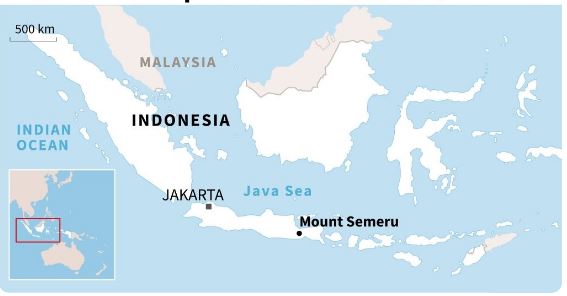
- Location: East Java, Indonesia; ~310 km west of Bali
- Elevation: ~3,676 m (12,060 ft) -highest peak on Java
- Tectonic Setting: Part of the Pacific Ring of Fire, a zone of intense volcanic and seismic activity due to plate convergence
- Volcanic System: Lies at the southern end of a volcanic massif extending north to the Tengger caldera
- Summit Morphology: Complex, with crater positions having shifted NW–SE over time
- Local Name:Mahameru
Eruptive Characteristics
- Among Indonesia’s most active volcanoes
- Known for frequent ash explosions at short intervals (often every 10–30 minutes)
- Recent eruption involved pyroclastic flows (hot mixtures of gas, ash, and volcanic fragments)
- Seismicity: Elevated before and during eruptive phases
Recent Eruption – Key Facts
- Ash Plume Height: Up to ~13 km
- Alert & Safety: Highest alert declared; 8 km exclusion zone around the crater advised
- Human Impact: Preventive evacuations (hundreds relocated to temporary shelters); no immediate casualties reported
- Aviation: Monitoring in place; Bali airport operations initially unaffected