
Two New Ramsar Sites in India

- 17 Dec 2025
In News:
India has added two more wetlands to the list of Ramsar Sites of International Importance-Siliserh Lake in Rajasthan and Kopra Jalashay in Chhattisgarh. These designations highlight the ecological significance of inland water bodies in biodiversity conservation and water security.
Siliserh Lake
- Siliserh Lake is located in Rajasthan, within the buffer zone of the Sariska Tiger Reserve.
- It is a human-made lake constructed in 1845 by Maharaja Vinay Singh to provide drinking water to Alwar city.
- Situated in a semi-arid region, the lake serves as a crucial water source for wildlife and local communities. Its hydrological presence supports diverse habitats in an otherwise water-scarce landscape.
Biodiversity Significance
The wetland supports around 149 bird species and 17 mammal species. Notable fauna include:
- The vulnerable river tern
- The endangered tiger from the adjoining Sariska landscape
It also supports more than 1% of the biogeographic population of the black stork (Ciconia nigra), which is an important criterion under the Ramsar Convention.
Kopra Jalashay
- Kopra Jalashay is located in Chhattisgarh and is a reservoir situated in the upper catchment of the Mahanadi River.
- Its ecological importance arises from strong hydrological and habitat connectivity, which supports multiple wetland-dependent ecosystems.
Biodiversity Significance
The site supports over 60 migratory bird species, making it an important stopover, feeding, and nesting ground along avian migration routes.
Key species recorded here include:
- The vulnerable greater spotted eagle (Aquila clanga)
- The endangered Egyptian vulture (Neophron percnopterus)
Pax Silica Initiative

- 17 Dec 2025
In News:
India’s absence from the U.S.-led Pax Silica Initiative has triggered political debate domestically. The issue gained attention after remarks by opposition leaders questioning India’s exclusion from the grouping, which is aimed at securing high-technology supply chains.
What is the Pax Silica Initiative?
- Pax Silica is a United States–led strategic framework designed to build a secure, resilient, and innovation-driven silicon supply chain.
- The term combines “pax” (Latin for peace and stability) with “silica,” the raw material refined into silicon, which is foundational for semiconductors and AI hardware.
- The initiative focuses on strengthening cooperation among trusted partners across the entire technology value chain fromcritical minerals and energy inputs to chip manufacturing, AI infrastructure, and logistics networks.
- Its broader objective is to reduce coercive dependencies, particularly in sensitive technology sectors, and to ensure that partner nations can develop and deploy advanced technologies such as artificial intelligence at scale.
Member Countries
- The current participants in Pax Silica include:United States, Japan, South Korea, Singapore, Netherlands, United Kingdom, Israel, United Arab Emirates and Australia
- Notably, India is not currently part of the initiative, even though several member countries are key Indo-Pacific technology and security partners.
Areas of Cooperation
Member nations have affirmed cooperation in multiple strategic sectors:
- Securing critical minerals required for semiconductor production
- Semiconductor design, fabrication, and advanced packaging
- Strengthening logistics and transportation networks for tech supply chains
- Expanding compute capacity and AI infrastructure
- Ensuring reliable energy grids and power generation for digital ecosystems
- Developing trusted ICT networks, data centres, fibre-optic connectivity, and AI models
- Encouraging joint ventures and co-investment in emerging technology sectors
- Protecting sensitive technologies and infrastructure from access by countries considered strategic risks
Strategic Significance
Pax Silica reflects the growing geopolitical importance of semiconductor and AI supply chains, which are now seen as central to economic security and national power. The initiative is part of a broader trend where technology alliances are being shaped to reduce overdependence on any single country in high-tech manufacturing.
The grouping also complements other emerging frameworks that aim to create trusted technology ecosystems among like-minded nations.
Preah Vihear Temple
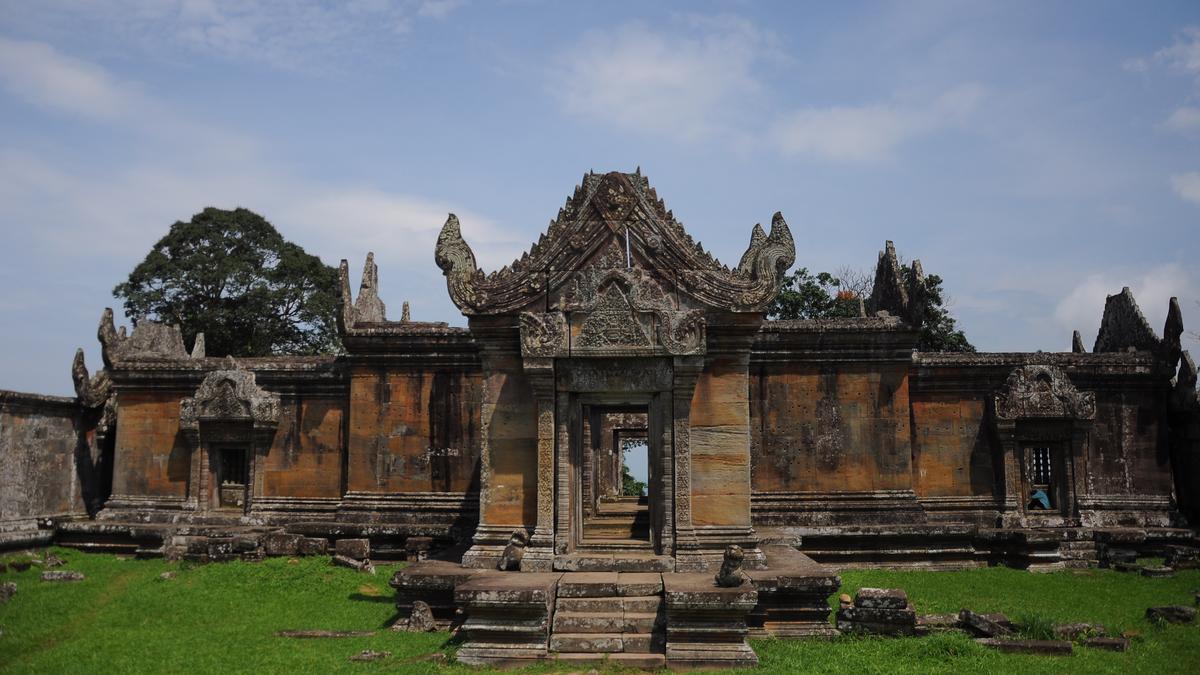
- 17 Dec 2025
In News:
India has expressed concern and called for the protection of the Preah Vihear Temple amid renewed border tensions between Thailand and Cambodia, which reportedly affected areas near the temple complex.
Location and Setting
- Preah Vihear Temple is located in Preah Vihear Province in northern Cambodia, dramatically positioned atop a cliff in the Dangrek Mountain range along the Cambodia–Thailand border.
- Its elevated placement provides commanding views over the surrounding plains and has historically contributed to territorial disputes between the two countries.
Religious Significance
- The temple is dedicated to Lord Shiva and is an important example of Hindu religious architecture in mainland Southeast Asia, reflecting the spread of Indian cultural and religious influences across the region during the medieval period.
Historical Background
- The temple was constructed during the height of the Khmer Empire. Its earliest major construction phase is attributed to Suryavarman I (reigned 1002–1050 CE), and it was later expanded and refined under Suryavarman II (reigned 1113–1150 CE), the same ruler associated with major temple-building activity in the region.
- Preah Vihear was inscribed as a UNESCO World Heritage Site in 2008, recognizing its outstanding universal value in terms of architecture, history, and cultural significance.
Architectural Features
- Preah Vihear is considered an outstanding masterpiece of Khmer temple architecture. Unlike many other Khmer temples that are arranged concentrically, this complex is laid out along a long north–south axis stretching approximately 800 metres.
- The temple comprises a sequence of sanctuaries connected by pavements and steep staircases that climb the hillside. The approach includes multiple monumental gateways known as gopuras more than five in number which are linked by a long causeway rather than enclosed courtyards.
- Several of these gopuras are topped with multi-tiered platforms, and while some feature stone roofs, others historically had wooden superstructures, highlighting a blend of durable and perishable architectural elements.
Ponduru Khadi

- 17 Dec 2025
In News:
Ponduru Khadi, a traditional handspun and handwoven cotton fabric from Andhra Pradesh, has recently been granted the Geographical Indication (GI) tag by the Geographical Indications Registry under the Union Ministry of Commerce and Industry.
About Ponduru Khadi
- Ponduru Khadi is a heritage textile produced in Ponduru, located in Srikakulam district. Locally, it is known as “Patnulu.” The fabric is widely admired for its extremely fine texture and traditional production techniques that have been preserved for generations.
- The product has also been identified under the One District One Product (ODOP) initiative from Srikakulam district, highlighting its cultural and economic importance.
- During India’s freedom struggle, Mahatma Gandhi praised the fabric’s quality in his journal Young India, recognizing it as an example of self-reliant rural craftsmanship.
Key Characteristics
- Ponduru Khadi stands out due to its fully manual production process. Every step i.e. from cotton cleaning to spinning and weaving is done by hand without the use of mechanised tools.
- The cotton used is locally grown in and around Ponduru and comes from traditional varieties such as hill cotton, punasa cotton, and red cotton. These indigenous varieties contribute to the softness and durability of the fabric.
- The yarn used in Ponduru Khadi is extremely fine, with a yarn count ranging between 100 and 120, making it one of the finest handspun cotton fabrics in India.
Unique features that distinguish Ponduru Khadi
- One of the most distinctive aspects of Ponduru Khadi is the traditional cotton-cleaning method. Artisans use the jawbone of a Valuga fish to separate seeds from cotton — a practice not documented elsewhere in the world.
- Spinning is done using a single-spindle charkha with 24 spokes, popularly referred to as the “Gandhi Charkha.”Ponduru is among the very few places in India where this traditional spinning method is still actively practiced.
Why GI Tag Matters
The GI tag legally recognizes Ponduru Khadi as a product with a specific geographical origin and traditional know-how. This helps:
- Protect it from imitation
- Promote rural artisans
- Enhance export and branding potential
- Preserve intangible cultural heritage
Geminid Meteor Shower

- 17 Dec 2025
In News:
The Geminids are one of the brightest and most reliable annual meteor showers, peaking every year in mid-December.
Origin of the Name
- The meteor shower is named after the constellation Gemini, from where the meteors appear to radiate. This apparent point of origin is called the radiant. However, the constellation is only the direction in the sky - not the actual source of the meteors.
Time of Occurrence
- The Geminids occur every year in December, with peak visibility typically during the late-night and pre-dawn hours, when the radiant rises higher in the sky.
Parent Body – A Rare Case
- A unique scientific feature of the Geminids is their origin. Most meteor showers are produced by comet debris, but the Geminids originate from an asteroid called 3200 Phaethon. This makes the Geminids one of the very few major meteor showers linked to an asteroid rather than a comet.
Meteor Characteristics
- Geminid meteors are known for being bright and relatively slow-moving, which makes them easier to spot. They often produce multi-colored streaks in the sky due to the presence of different minerals that burn at different temperatures.
Understanding Meteors
- Meteors are caused by small space particles entering Earth’s atmosphere at very high speeds.
- A meteoroid is a small rocky or metallic object traveling in space. When it enters Earth’s atmosphere and burns due to friction, it produces a streak of light known as a meteor. If any part of it survives the journey and reaches the ground, it is called a meteorite.
- Meteor showers occur when Earth passes through trails of dust and debris left behind by comets or asteroids. These particles collide with the atmosphere and burn up, creating the visible streaks of light.
Why the Geminids Stand Out
The Geminids are considered special because they are linked to an asteroid instead of a comet, they produce a high number of bright meteors, and they are known for their consistent annual activity. Their slower speed compared to many comet-based meteor showers makes them especially visible and spectacular.