
Kosi River
- 06 Mar 2026
In News:
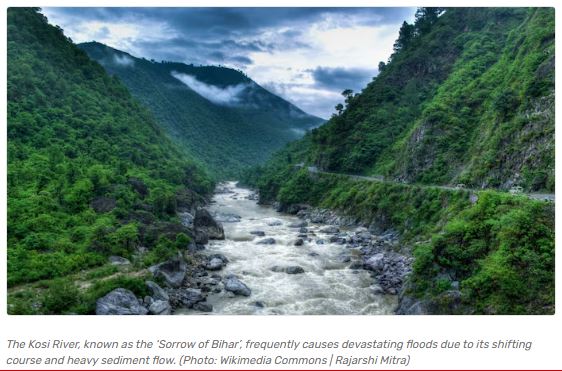
The Kosi River is a major transboundary river of the Ganga River system, flowing through China (Tibet), Nepal, and India. It is widely known as the “Sorrow of Bihar” because of its frequent and devastating floods that affect large parts of northern Bihar.
Recent observations indicate that the river has shifted its course westward by more than 100 km over the past two centuries, highlighting its highly dynamic and unstable nature.
Geographical Features and Course
- The Kosi River originates in the Himalayan region of Nepal and Tibet and flows through Nepal before entering the plains of India.
- Formation: The river is formed by the confluence of three major Himalayan streams: Sun Kosi, Arun Kosi, Tamur Kosi. These rivers originate in the Himalayan mountains and join in eastern Nepal to form the main Kosi River.
Course of the River
- The river flows through mountainous terrain in Nepal and receives several tributaries.
- About 48 km north of the India–Nepal border, it passes through the Chatra Gorge in the Siwalik Hills.
- After emerging from the hills, it enters the alluvial plains of Bihar in northern India.
- Finally, it joins the Ganges River south of Purnea after travelling approximately 724 km.
Drainage Basin
- The Kosi basin covers an area of about 74,500 sq km, of which only around 11,070 sq km lies within India. Most of the catchment area lies in Nepal and the Himalayan region, which strongly influences the river’s hydrology.
- The basin’s sandy and fertile soils support agriculture, particularly the cultivation of maize (corn).
Major Tributaries
- The Kosi river system consists of seven major tributaries, which are collectively known as the Sapta Kosi (Seven Kosis): Sun Kosi, Tama Kosi (Tamba Kosi), Dudh Kosi, Indravati, Likhu, Arun, Tamur (Tamor)
- These tributaries drain large parts of the Himalayan watershed, contributing significant water and sediment to the river.
Why is the Kosi Called the “Sorrow of Bihar”?
Frequent Flooding: The Kosi River is notorious for severe floods in northern Bihar, causing large-scale damage to: agriculture, infrastructure, and settlements.
Heavy Sediment Load: The river carries large amounts of silt and sediment from the young and fragile Himalayan mountains. During the monsoon season, this sediment deposition raises the riverbed, increasing the likelihood of flooding.
Shifting Course: One of the most striking features of the river is its frequent change in course.
- Over the last 200–250 years, the river has shifted more than 100 km from east to west across the plains of Bihar.
- This phenomenon creates new floodplains while abandoning older channels.
Challenges Associated with the Kosi River
The dynamic nature of the Kosi poses several challenges:
- Recurring floods and displacement of populations
- Damage to agriculture and infrastructure
- Riverbank erosion and channel migration
- Transboundary water management issues between India and Nepal
Efforts such as embankment construction and flood-control projects have been implemented, but managing the river remains difficult due to its high sediment load and unstable course.
Debrigarh Wildlife Sanctuary
- 06 Mar 2026
In News:
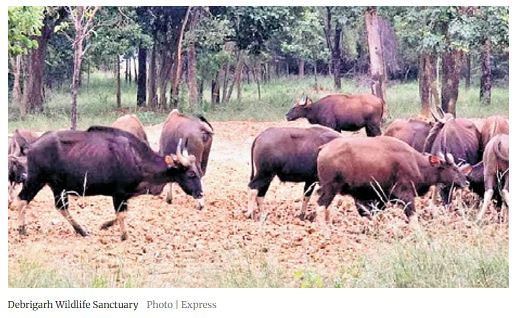
The Debrigarh Wildlife Sanctuary in Odisha is set to host the second edition of the “Indian Bison Fest”, a conservation and eco-tourism initiative aimed at highlighting the sanctuary’s biodiversity and raising awareness about the protection of the Indian bison (Gaur). The event also seeks to promote community participation and sustainable tourism in the region.
Debrigarh Wildlife Sanctuary
Location and Geographical Features
- Debrigarh Wildlife Sanctuary is located in Bargarh district of Odisha, near the famous Hirakud Dam on the Mahanadi River. Hirakud Dam is notable for being the longest earthen dam in the world and one of the longest dams in India.
- The sanctuary forms part of the Hirakud reservoir ecosystem, which supports diverse flora and fauna as well as seasonal migratory birds.
Historical Significance
- The sanctuary holds historical importance due to its association with Veer Surendra Sai, a prominent freedom fighter from Odisha who led resistance against British rule. During the rebellion, his operational base at Barapathara was located within the present sanctuary area.
Ecological Characteristics
- Vegetation: The sanctuary is dominated by mixed and dry deciduous forests. Major plant species include: Sal, Asana, Bija, Amla, Dhaura. These forests provide suitable habitats for several large mammals and birds.
- Faunal Diversity: Debrigarh Wildlife Sanctuary hosts a rich variety of wildlife, including: Indian leopard, Sloth bear, Chousingha (four-horned antelope), Sambar deer, Gaur (Indian bison), Wild boar, Dhole (Indian wild dog). The sanctuary is also an important wintering ground for migratory birds. Common bird species include: Crested serpent eagle, Flowerpeckers, Red-vented bulbul, Tree pie, Drongo, Oriental white-eye
Indian Bison (Gaur)
General Characteristics
Gaur, commonly known as the Indian bison, is the largest species among wild cattle belonging to the Bovidae family. It is characterized by:
- a massive and muscular body,
- a prominent grey ridge on the forehead between the horns,
- large horns that curve upward from the sides of the head.
Distribution: Gaurs are indigenous to South and Southeast Asia, with significant populations found in India’s forested regions.
Habitat
They typically inhabit:
- evergreen and semi-evergreen forests
- moist deciduous forests
- forest landscapes with open grasslands and abundant water sources
Gaurs generally prefer hilly terrains below 1,500–1,800 metres altitude with large undisturbed forest tracts.
Conservation Status
According to the International Union for Conservation of Nature (IUCN):
- Status: Vulnerable
Major threats include habitat fragmentation, disease transmission from livestock, and human-wildlife conflict.
Centre designates Legacy Thrust Territories
- 06 Mar 2026
In News:
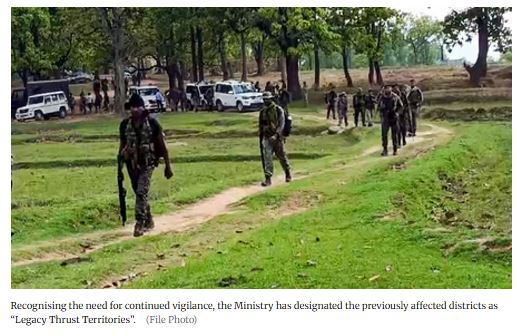
In order to sustain the significant progress made in combating Left Wing Extremism (LWE), the Ministry of Home Affairs (MHA) has introduced the concept of Legacy Thrust Territories (LTTs). This initiative aims to ensure that areas once affected by Naxal violence continue to receive focused security attention and developmental support, thereby preventing the resurgence of extremist activities.
The framework reflects a shift from purely security-centric counter-insurgency operations to governance-led stabilization and development in previously affected regions.
Background: Decline of Left Wing Extremism
Over the past two decades, India has witnessed a sharp decline in LWE-related activities due to coordinated security operations and development initiatives.
Key trends include:
- Around 200 districts were affected by LWE in the early 2000s.
- By 2025, the number of affected districts declined to 38.
- Currently, only seven districts remain under the core LWE list, including:
- Five districts in Chhattisgarh
- One district in Jharkhand
- One district in Odisha
Despite these gains, concerns remain that insurgent groups may attempt to regroup if security and governance efforts weaken.
What are Legacy Thrust Territories?
Legacy Thrust Territories refer to previously Naxal-affected districts that continue to receive focused security monitoring and developmental intervention even after insurgent activities decline.
The approach recognizes that post-conflict regions remain vulnerable to extremist revival if governance gaps persist. Therefore, the initiative seeks to maintain stability while gradually transitioning toward normal governance structures.
Objectives of the Initiative
The Legacy Thrust Territories framework aims to:
- Prevent resurgence of Naxalism after operational successes.
- Ensure a smooth transition from security-led operations to development-led governance.
- Strengthen administrative presence and state legitimacy in former conflict zones.
- Promote socio-economic integration and infrastructure development in historically marginalized regions.
Key Features of the Legacy Thrust Territories Strategy
1. Sustained Security Deployment: Even after a decline in insurgent activity, central armed police forces will continue to maintain a presence in sensitive regions. This prevents security vacuums that insurgent groups could exploit.
2. Development-Oriented Approach: The initiative prioritizes infrastructure and welfare development, including:
- road connectivity
- telecommunications expansion
- improved delivery of public services
- strengthening of local governance institutions.
3. Phased Redeployment of Security Forces: Instead of abrupt withdrawal, security forces will undergo gradual redeployment, ensuring stability while administrative systems take stronger control.
4. Centre–State Coordination: The strategy emphasizes close coordination between the Union Government and State Governments, while allowing operational flexibility for security agencies.
5. Administrative Strengthening: The government aims to enhance bureaucratic responsiveness and governance capacity in previously conflict-affected districts to address long-standing developmental deficits.
6. Monitoring Extremist Propaganda: Security agencies will strengthen intelligence gathering and monitoring of extremist networks, including activities in digital and online spaces.
7. Rehabilitation and Surrender Policy: The initiative will also focus on encouraging surrender and rehabilitation of remaining cadres, combined with targeted operations against residual insurgent elements.
PSB Reforms under EASE 9.0

- 06 Mar 2026
In News:
The Government of India has launched the EASE 9.0 reforms agenda to modernize and strengthen Public Sector Banks (PSBs) by integrating advanced technologies, improving productivity, and adopting new operating models. Initiated by the Department of Financial Services in February 2026, the reform programme seeks to transform PSBs into globally competitive institutions aligned with the vision of Viksit Bharat @2047.
EASE 9.0 emphasizes technology-led modernization, institutional resilience, and enhanced governance through a structured reform framework.
Key Reforms under the EASE 9.0 Agenda
1. Global Capability Centre (GCC) Strategy
PSBs will develop a Global Capability Centre (GCC) strategy during FY 2026–27 along with a capacity-building roadmap.
- The State Bank of India (SBI) has established the first GCC among PSBs in Karnataka, setting a model for other banks.
- GCCs are offshore units that perform high-value strategic functions such as IT services, research and development, data analytics, and business support.
- These centres help institutions improve efficiency, innovation, and global integration.
2. Strengthening Technology Infrastructure
Under EASE 9.0, banks will modernize digital infrastructure to ensure operational resilience and scalability.
Key initiatives include:
- Adoption of active-active data centre models to ensure uninterrupted banking services.
- Development of core artificial intelligence (AI) stacks, including:
- licensing of Large Language Models (LLMs)
- GPU infrastructure strategies
- deployment of private cloud-based AI models.
- Creation of enterprise-wide consent management frameworks.
- Implementation of data tokenisation and anonymisation systems to allow secure and continuous use of data for business and analytics purposes.
3. Collaborative and Digital Banking Solutions
PSBs are encouraged to collaborate in building shared technological solutions to improve efficiency and reduce costs.
Such collaborative initiatives may include:
- Blockchain-based banking systems
- advanced fraud detection models
- AI-driven risk assessment tools
- integrated digital platforms offering comprehensive banking services.
These measures aim to create scalable and secure financial ecosystems.
Banking, Financial Services and Insurance (BFSI) Global Capability Centres
Concept and Role: A BFSI Global Capability Centre (GCC) is a wholly owned offshore subsidiary of a global financial institution that centralizes strategic operations in locations with strong talent pools such as India.
Unlike general GCCs, BFSI GCCs specifically support banking and financial institutions in areas including:
- risk management
- regulatory compliance
- cybersecurity
- fintech development
- advanced data analytics.
Evolution of GCCs
Initially established to achieve cost advantages (often 50–60% savings compared to home markets), GCCs have evolved into innovation hubs performing high-end functions such as:
- Artificial Intelligence (AI) and Machine Learning (ML)
- cybersecurity solutions
- regulatory technology (RegTech)
- financial platform development
- advanced analytics and automation.
India’s Position in the Global BFSI GCC Ecosystem
India has emerged as a major global hub for BFSI GCCs.
Key statistics include:
- Around 185–190 BFSI GCCs currently operate in India.
- They employ approximately 540,000 professionals, accounting for nearly 25% of total GCC employees in the country.
- The sector is projected to grow from USD 40–41 billion in 2023 to about USD 125 billion by 2032.
Major GCC hubs in India include:
- Bengaluru – analytics and engineering
- Hyderabad – fintech innovation
- Mumbai – financial services core operations
- Pune, Chennai and Gurugram/NCR – technology and support services.
Global financial institutions operating GCCs in India include: JPMorgan Chase, HSBC, Wells Fargo, Citigroup, Standard Chartered, Deutsche Bank, Barclays, Bank of America, Goldman Sachs, Morgan Stanley.
Core Framework of EASE 9.0: The R.I.S.E. Pillars
The reform programme is structured around four foundational pillars:
1. Risk and Resilience
- Strengthening financial and credit risk management.
- Enhancing operational resilience and enterprise-wide risk oversight mechanisms.
2. Innovation: Deep integration of advanced technologies including AI, Generative AI (GenAI), machine learning, cloud architectures, and microservices.
3. Socio-economic Impact
- Expanding inclusive banking services.
- Enhancing access to financial services for underserved populations, including gig and platform workers.
4. Excellence
- Improving governance standards and operational efficiency.
- Creating customer-centric banking processes and cost-effective next-generation operating models.
Significance of EASE 9.0 Reforms
The reforms are expected to:
- strengthen the technological competitiveness of PSBs
- enhance digital banking infrastructure and cybersecurity
- enable innovation-driven financial services
- support financial inclusion and economic growth
- position Indian PSBs as globally competitive institutions.
India’s New GDP Series with Base Year 2022-23
- 06 Mar 2026
In News:
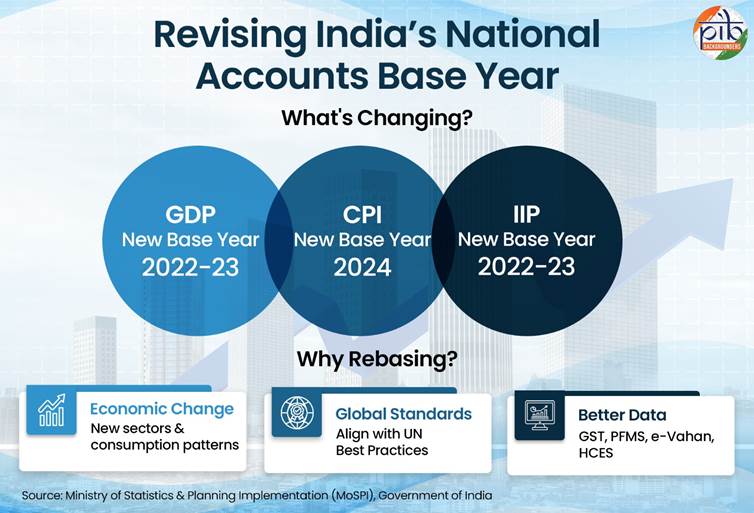
The Ministry of Statistics and Programme Implementation (MoSPI) has introduced a new series of Annual and Quarterly National Accounts Estimates with base year 2022–23, replacing the earlier 2011–12 base year. This revision represents a major statistical update in the measurement of India’s Gross Domestic Product (GDP).
The new series integrates improved data sources, updated sectoral coverage, and refined estimation techniques such as the Supply and Use Tables (SUT) framework and double deflation, ensuring a more accurate representation of the evolving structure of the Indian economy.
Key Highlights of the New GDP Series
Growth Performance
- Real GDP growth is estimated at 7.6% in FY 2025–26, revised upward compared with estimates based on the previous series.
- Growth remained robust at 7.2% in FY 2023–24 and 7.1% in FY 2024–25.
- Nominal GDP growth is estimated at 8.6% in FY 2025–26, after 11.0% (FY 2023–24) and 9.7% (FY 2024–25).
Quarterly Economic Drivers
- The strong performance in FY 2025–26 was driven mainly by:
- Second quarter growth: 8.4%
- Third quarter growth: 7.8%
Sectoral Contributions
- Manufacturing emerged as a key growth driver with double-digit growth in FY 2023–24 and FY 2025–26.
- Secondary and tertiary sectors recorded over 9% growth in FY 2025–26.
- The services segment “Trade, Repair, Hotels, Transport, Communication and Broadcasting-related services” grew by 10.1% at constant prices.
Demand-Side Trends
- Private Final Consumption Expenditure (PFCE) and Gross Fixed Capital Formation (GFCF) both grew above 7% in FY 2025–26, indicating strong consumption and investment demand.
Rationale for Revising the Base Year
1. Reflecting a Normal Post-Pandemic Year: The base year 2022–23 was selected as it represents a stable economic year after the disruptions caused by COVID-19. Earlier years such as 2019–20 and 2020–21 were distorted by lockdowns, supply chain disruptions and abnormal consumption patterns.
2. Capturing Structural Changes in the Economy: India’s economy has evolved significantly over the past decade with the expansion of:
- Digital and platform-based services
- Renewable energy
- Gig economy and platform work
- Changes in consumption and investment patterns
Rebasing ensures GDP estimates better reflect these structural shifts.
3. Improved Data Sources: The new series incorporates richer and more frequent datasets, including:
- Annual Survey of Unincorporated Sector Enterprises (ASUSE)
- Periodic Labour Force Survey (PLFS)
- GST data for manufacturing and services
- e-Vahan portal data for transport-related consumption
- Public Financial Management System (PFMS) for government accounts
- Updated sectoral studies in agriculture, fisheries, dairy and transport
These additions improve granularity, reliability and timeliness of GDP estimates.
Methodological Improvements
1. Double Deflation: Separate deflation of output and input prices is now used in manufacturing and agriculture, replacing the earlier single-deflation approach.
2. Supply and Use Tables (SUT) Framework: Following the **United Nations Statistical Division guidelines under the System of National Accounts 2008, the new series systematically applies the SUT framework, ensuring consistency between production, income and expenditure estimates.
3. Better Corporate Activity Classification: Value added by multi-activity corporations is now distributed across different sectors using detailed corporate filings.
4. Improved Estimation of Consumption
PFCE estimation now combines:
- household survey data,
- administrative records,
- commodity flow methods, and
- the COICOP 2018 classification.
5. Improved State-Level Estimation: The National Statistical Office (NSO) will guide states toward direct estimation of Gross State Domestic Product (GSDP) using better state-level datasets, improving comparability across states.
Implications of the New GDP Series
Lower Nominal GDP: The revised methodology has reduced nominal GDP by about 3–4% for FY 2025–26 and previous years.
Fiscal Deficit Pressures: Because fiscal deficit is measured as a percentage of GDP:
- The FY 2025–26 deficit rises from 4.4% to about 4.5% under the new series.
- Achieving the FY 2026–27 target of 4.3% may require nominal GDP growth of 13–14%, higher than earlier projections.
Higher Debt-to-GDP Ratio: The Centre’s debt ratio increases from 56.2% to 58.1% for FY 2025–26, making fiscal consolidation more challenging.
Impact on the USD 4 Trillion Economy Target: India’s GDP is estimated at about USD 3.8 trillion in FY 2025–26.
Crossing the USD 4-trillion mark in FY 2026–27 will require:
- strong nominal growth, and
- stable exchange rates, since rupee depreciation could delay the milestone.
Sectoral Realignment: Improved data suggests the agricultural sector is about 5% larger, partly due to better measurement of high-value crops and lower input costs such as solar-powered irrigation under schemes like PM KUSUM.
Way Forward: Strengthening India’s Economic Measurement System
- Introduction of Producer Price Index (PPI): Recommended by the Working Group on Producer Price Index chaired by B. N. Goldar, PPI would better capture producer price movements.
- Revision of Wholesale Price Index (WPI) Base Year: Updating WPI is necessary to ensure accurate deflators for GDP calculations.
- Preparation for SNA 2025 Adoption: India must build data infrastructure for the upcoming SNA 2025 framework, which will incorporate digital economy, crypto assets and environmental accounting.
- Better Measurement of MSMEs: Heavy reliance on corporate filings may bias estimates toward large firms; improved mechanisms are required to capture MSME value addition.