
Exercise Suryakiran
- 27 Nov 2025
In News:
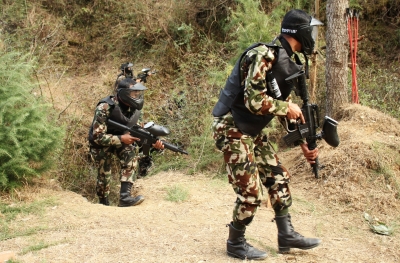
India and Nepal are conducting the 19th edition of the bilateral military exercise Suryakiran from 25 November to 8 December in Pithoragarh, Uttarakhand. The exercise reflects the deep-rooted defence cooperation and operational coordination between the Indian Army and the Nepal Army.
About Exercise Suryakiran
- Nature: Bilateral, annual, battalion-level joint military exercise
- Participating Countries: India and Nepal
- Frequency & Venue: Conducted annually, alternately in India and Nepal
- Last Edition: 18th edition held at Saljhandi, Nepal (Dec 2024–Jan 2025)
Objectives
- Enhance operational synergy in jungle warfare and mountain warfare
- Strengthen cooperation in counter-terrorism operations
- Improve interoperability through integration of niche and modern technologies
- Exchange best practices, tactical doctrines, and operational experiences
Key Features
- High-Altitude & Jungle Warfare Training: Joint drills in forested and mountainous terrain, mirroring Himalayan operational conditions.
- Counter-Terrorism Modules: Includes cordon-and-search operations, room intervention, surveillance, and small-team tactics.
- Technology Integration: Use of modern surveillance systems, secure communications, drones, medical evacuation, and battlefield support tools.
- Comprehensive Participation: Battalion-sized contingents (around 300+ personnel) including specialists in aviation, medical, engineering, and high-altitude warfare.
- Professional Exchange: Platform for soldiers to share combat experiences, survival skills, and standard operating procedures.
Strategic Significance
- Reinforces long-standing military ties based on mutual trust, respect, and historical linkages.
- Helps standardise operational procedures and communication protocols for joint missions.
- Enhances preparedness for counter-terrorism, border security, and disaster response in the Himalayan region.
- Contributes to regional stability and shared commitment to peace and security.
International Day for the Elimination of Violence Against Women
- 27 Nov 2025
In News:
- November 25, observed as the International Day for the Elimination of Violence Against Women, marks the beginning of the 16 Days of Activism against Gender-Based Violence (Nov 25–Dec 10), as recognised by the United Nations General Assembly.
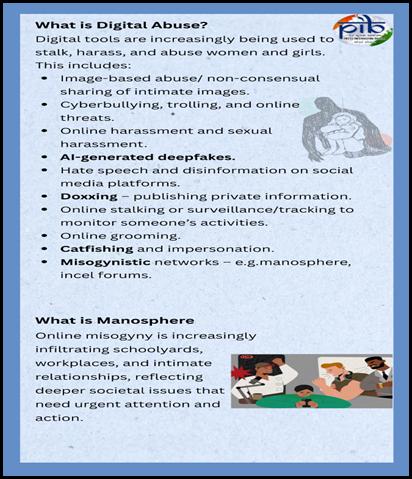
- The 2025 global theme — “UNiTE to End Digital Violence against All Women and Girls” — highlights rising threats such as cyberstalking, online harassment, doxxing, deepfakes, and coordinated misogynistic attacks.
- India has adopted a multi-pronged approach combining legal reforms, institutional mechanisms, digital tools, and welfare schemes to address both offline and online violence against women.
Institutional Framework
National Commission for Women (NCW)
- Established in January 1992 as a statutory body.
- Mandate: Review legal safeguards, recommend law reforms, and address complaints of women’s rights violations.
- Enables online complaint registration and runs 24×7 domestic violence support helplines, integrated with police, hospitals, legal services, and counsellors through Digital India platforms.
Key Legal Provisions
Bharatiya Nyaya Sanhita, 2023
- In force from 1 July 2024, replacing the IPC.
- Introduces stricter punishments for sexual offences, including life imprisonment for rape of minors.
- Expands definitions of sexual crimes, mandates audio-video recording of victim statements, and prioritises fast-track trials for crimes against women and children.
Protection of Women from Domestic Violence Act, 2005 (PWDVA)
- Covers physical, sexual, verbal/emotional, and economic abuse, including dowry-related harassment.
- Applies to women in domestic relationships (by marriage, adoption, or family ties).
Sexual Harassment of Women at Workplace Act, 2013 (POSH Act)
- Applicable to all women, irrespective of age or employment type.
- Mandates Internal Committees (ICs) and Local Committees (LCs).
- Complaints to be resolved within 90 days.
Mission Shakti: Umbrella Scheme
Implemented by the Ministry of Women and Child Development, Mission Shakti integrates:
- Sambal – safety and security
- Samarthya – empowerment and rehabilitation
Major Components
- One Stop Centres (OSCs): District-level centres providing medical, legal, police, counselling, and temporary shelter services under one roof (operational since 2015).
- Swadhar Greh: Shelter, food, legal aid, counselling, and rehabilitation for women in difficult circumstances.
- Stree Manoraksha: Mental health and psycho-social training for OSC staff, implemented with National Institute of Mental Health and Neuro Sciences (NIMHANS).
Helplines and Emergency Support
- Women Helpline (181): 24×7 national support for women in distress.
- Emergency Response Support System (112): Pan-India emergency number for police, fire, and ambulance services (Nirbhaya Fund).
- NCW-supported digital and WhatsApp-based emergency reporting mechanisms.
Technology-Enabled Safety Measures
Digital Shakti Campaign
- Implemented by NCW to digitally empower women and girls, promoting safe online behaviour and awareness against cybercrimes.
SHe-Box Portal
- Centralised online platform for workplace sexual harassment complaints under the POSH Act.
- Automatically routes complaints to the relevant IC/LC and enables real-time tracking.
Other Key Digital Initiatives
- Investigation Tracking System for Sexual Offences (ITSSO): Monitors police investigations to ensure timely completion.
- National Database on Sexual Offenders (NDSO): Registry of convicted sexual offenders.
- Crime Multi-Agency Centre (Cri-MAC): Enables real-time sharing of information on heinous crimes across States/UTs.
Judicial & Policing Mechanisms
- Fast Track Special Courts (FTSCs): Established under the Nirbhaya Fund for speedy trials of rape and POCSO cases.
- Women Help Desks (WHDs): Set up in police stations to ensure gender-sensitive reporting, counselling, and legal aid.
Hayli Gubbi Volcano
- 27 Nov 2025
In News:
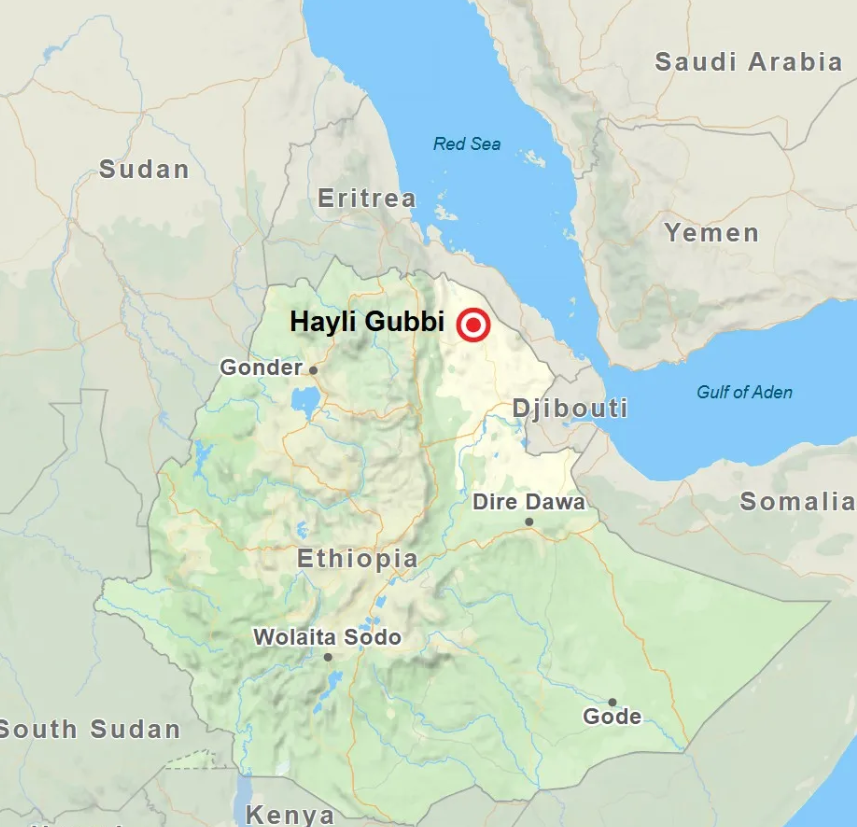
A long-dormant volcano, Hayli Gubbi, in Ethiopia erupted after nearly 12,000 years, releasing massive ash plumes that travelled across the Red Sea towards Yemen, Oman, and even parts of South Asia, including India. The ash cloud led to airspace disruptions and flight diversions, highlighting the transboundary impact of large volcanic eruptions.
Geographical & Tectonic Setting
- Location: Hayli Gubbi volcano lies in Ethiopia’s Afar region, about 800 km northeast of Addis Ababa.
- It is part of the Afar Depression (Danakil Depression), one of the most geologically active regions on Earth.
- The region marks the triple junction of three tectonic plates:
- African (Nubian) Plate
- Somalian Plate
- Arabian Plate
- It forms a critical segment of the East African Rift System (EARS), where the African Plate is splitting into the Nubian (western) and Somalian (eastern) plates.
Volcanism
- Volcanism refers to the process by which magma, gases, and ash escape from Earth’s interior through vents or fissures.
Process of Eruption:
- The asthenosphere (a weak, semi-molten layer in the upper mantle) allows magma to accumulate.
- Buoyant magma rises through cracks in the lithosphere.
- As pressure decreases near the surface, dissolved gases (water vapour, CO?, sulphur gases) expand violently, triggering eruptions.
- When magma reaches the surface, it is called lava (basaltic, andesitic, or rhyolitic depending on composition).
Eruption Products:
- Lava
- Ash and dust
- Pyroclastic debris and volcanic bombs
- Gases (sulphur compounds, nitrogen compounds, CO?, etc.)
Fujiwhara Effect
- 27 Nov 2025
In News:
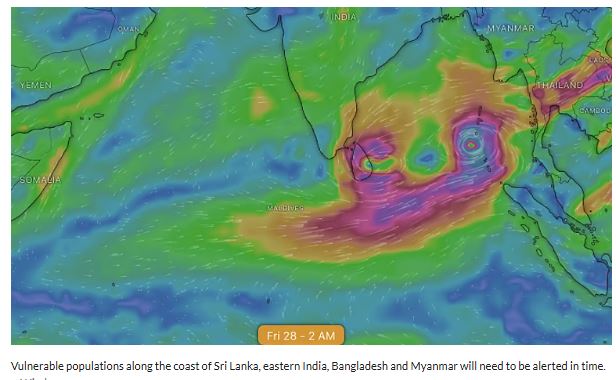
Meteorological agencies are closely monitoring the possible formation of two cyclonic systems in the Bay of Bengal, with global forecast models indicating a rare Fujiwhara-type interaction between them. Such an interaction can significantly increase uncertainty regarding cyclone track, intensity, and landfall, putting large coastal populations of South and Southeast Asia on alert.
Current Meteorological Situation
- The India Meteorological Department (IMD) has identified a well-marked low-pressure area over Malaysia and the adjoining Straits of Malacca, likely to move west-northwestwards.
- This system is expected to intensify into a depression over the South Andaman Sea, and further strengthen into a cyclonic storm over the southern Bay of Bengal within 48 hours thereafter.
- Simultaneously, an upper air cyclonic circulation over the Comorin region may induce another low-pressure area over the southwest Bay of Bengal and Sri Lanka, with potential to intensify further.
Divergence in Global Forecast Models
- Forecasts from the Global Forecast System (GFS) and the European Centre for Medium-Range Weather Forecasting (ECMWF) show significant differences in predicting the formation, interaction, track, and intensity of these systems.
- One scenario suggests the storms may interact and move together, potentially strengthening one system at the expense of the other, while another scenario shows divergent tracks, including possible movement along India’s eastern coast or towards Myanmar.
Fujiwhara Effect:
- Definition: A rare meteorological phenomenon where two nearby cyclonic systems rotate around a common centre due to interaction of their wind circulations.
- Origin: Identified by Sakuhei Fujiwhara (1921).
- Conditions Favoring Occurrence:
- Distance between cyclones usually less than ~1,400 km
- Same rotational direction (counter-clockwise in the Northern Hemisphere)
- Sea Surface Temperature >26°C
- Low vertical wind shear
Possible Outcomes of Fujiwhara Interaction
- Energy Transfer: One cyclone may intensify by drawing energy and moisture from the other.
- Merger: The two systems may fuse into a single, stronger cyclone.
- Deflection: Cyclones may push each other onto altered or diverging paths.
- Weakening: Competition for heat and moisture may weaken one or both systems.
- Stalling: Reduced movement speed can lead to prolonged rainfall over affected regions.
Implications for India and the Region
- Forecast Challenges: Track and intensity prediction becomes difficult, complicating early warning and disaster preparedness.
- Heavy Rainfall Risk: Prolonged rainfall over eastern India, Sri Lanka, Bangladesh, and Myanmar, increasing flood and landslide risk.
- Cyclone Intensification: Sudden strengthening may enhance threats from strong winds, storm surge, and coastal damage.
HAMMER Precision Weapon System
- 27 Nov 2025
In News:
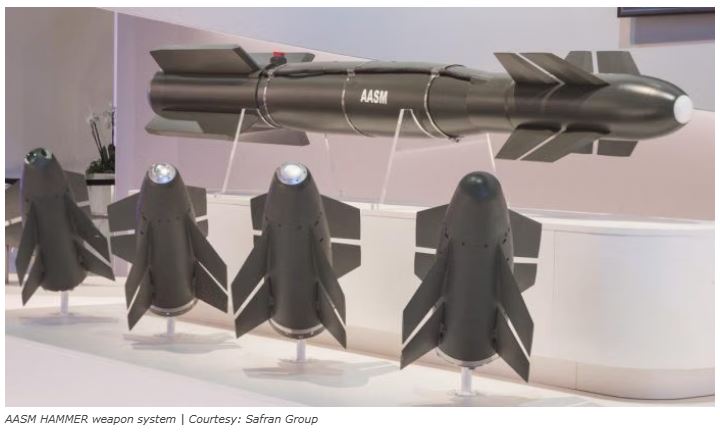
India and France have taken a major step in defence industrial cooperation with the signing of a Joint Venture Cooperation Agreement (JVCA) between Bharat Electronics Limited (BEL) and Safran Electronics & Defence (SED) for the manufacture of the HAMMER (Highly Agile Modular Munition Extended Range) precision-guided air-to-ground weapon system in India.
Key Highlights of the Joint Venture
- The proposed Joint Venture Company (JVC) will be incorporated in India as a private limited company with 50:50 shareholding between BEL and Safran.
- Manufacturing, supply, and maintenance of HAMMER will be localised to meet the operational requirements of the Indian Air Force and the Indian Navy, including integration with Rafale and Rafale Marine aircraft.
- Indigenisation will progressively rise to about 60%, covering key sub-assemblies, electronics, and mechanical components.
- Technology and production transfer will occur in phases, with BEL leading final assembly, testing, and quality assurance.
About HAMMER Precision Weapon System
- Type: Smart, precision-guided, air-to-surface weapon
- Developer: Originally developed by Safran (France)
- Configuration: Modular system comprising a guidance kit and a range-extension kit, which can be fitted onto standard general-purpose bombs of different weights.
Key Features
- High Precision: Multiple guidance options (GPS/INS, infrared, laser) enable accurate strikes on hardened targets such as bunkers, shelters, airstrips, and enemy infrastructure.
- Stand-off Capability: Effective strike range of up to ~70 km, allowing launch aircraft to remain outside hostile air-defence envelopes.
- High Agility: Optimised for mountainous and high-altitude terrain, making it suitable for areas like Ladakh.
- Platform Flexibility: Currently integrated with Rafale; planned integration with indigenous platforms like LCA Tejas.
Operational Background
- HAMMER was procured by the IAF under emergency procurement powers to quickly operationalise Rafale aircraft amid heightened security challenges, as it filled a capability gap for shorter-range precision strikes against hardened targets.
- Its selection was influenced by quicker availability and suitability for mountain warfare compared to alternative systems that would have required additional time and cost for integration.
Strategic Significance
- Make in India & Aatmanirbharta: The JV strengthens indigenous defence manufacturing and reduces long-term import dependence in critical precision weaponry.
- Enhanced Strike Capability: Improves India’s ability to conduct accurate, stand-off precision strikes in contested and high-risk environments.
- Cost and Time Efficiency: Local production lowers lifecycle costs, ensures faster availability, and supports sustained operational readiness.
- Industrial Ecosystem & Exports: Encourages technology absorption, skill development, and potential future export opportunities.