
India’s Energy Transition through the Green Ammonia Route

- 25 Feb 2026
In News:
At India Energy Week (January 2026), the Prime Minister highlighted investment opportunities worth $500 billion in India’s energy sector, signalling a shift from energy security to energy independence. A central pillar of this transition is green hydrogen and its derivative-green ammonia, which is emerging as a strategic fuel for agriculture, industry, shipping, and global trade.
India’s recent landmark auction through the Solar Energy Corporation of India (SECI) has positioned the country as a serious player in the global green ammonia market.
What is Green Ammonia?
Green ammonia is produced by combining:
- Nitrogen (from air)
- Green hydrogen (generated via electrolysis using renewable energy)
Unlike grey ammonia, which uses natural gas and emits significant CO?, green ammonia has a near-zero carbon footprint.
SECI’s Landmark Green Ammonia Auction
Under the Strategic Interventions for Green Hydrogen Transition (SIGHT) programme of the National Green Hydrogen Mission, SECI floated a tender in June 2024 to aggregate demand across fertilizer plants.
Key Features:
- Target Demand: 7,24,000 tonnes per annum (TPA)
- Coverage: 13 fertilizer plants
- Bidders: 15 participants
- Successful Awardees: 7 companies
- Contracts Awarded: 13 delivery contracts
- One company secured 6 contracts (3,70,000 TPA)
- 10-year fixed-price offtake agreements
Discovered Prices:
- ?49.75–?64.74/kg
- $572–$744 per tonne
- Nearly 40–50% lower than EU’s H2Global auction (~$1,153/tonne)
By comparison: Grey ammonia in India ≈ $515/tonne
The price gap has narrowed substantially, especially with production subsidies:
- ?8.82/kg (Year 1)
- ?7.06/kg (Year 2)
- ?5.3/kg (Year 3)
This model created price certainty, payment security, and balanced risk allocation—boosting investor confidence.
Strategic Significance for India
1. Import Substitution and Energy Security
- Contracted volumes account for ~30% of India’s ammonia imports.
- Reduces exposure to global gas price volatility, currency risks, and geopolitical disruptions.
2. Decarbonising Agriculture
- Fertilizer sector is the largest ammonia consumer.
- Example: 75,000 tonnes supply to Paradeep Phosphates marks early transition.
- Supports sustainable food supply chains.
3. Maritime Decarbonisation
- Ammonia is easier to store than hydrogen.
- Can replace heavy fuel oil in shipping.
- Linked to Rotterdam–India–Singapore Green Shipping Corridor initiative.
4. Hydrogen Carrier for Exports
- Acts as a stable medium to transport hydrogen over long distances.
- Ports like Kandla, Paradip, and Tuticorin (VOC) designated as hydrogen hubs.
- Potential exports to Japan and South Korea.
5. Grid Stability & Energy Storage
- Enables long-duration energy storage.
- Hybrid systems (solar wind storage) being piloted for round-the-clock production.
Policy Framework
National Green Hydrogen Mission (2023)
- Target: 5 MMTPA production capacity by 2030
- Investment Potential: ?8 lakh crore
- CO? Reduction Target: ~50 MMT annually by 2030
SIGHT Programme
- Outlay: ?17,490 crore
- Production-linked incentives (PLI) for green hydrogen and derivatives.
Global Context
Other procurement mechanisms:
- EU’s H2Global import tender
- South Korea’s Clean Hydrogen Portfolio Standard (CHPS)
Prahaar Anti Terror Policy
- 25 Feb 2026
In News:
The Ministry of Home Affairs (MHA) has unveiled ‘PRAHAAR’, India’s first comprehensive National Counter-Terrorism Policy and Strategy. This eight-page doctrine-level framework institutionalises a unified, intelligence-led and proactive approach to combat terrorism in all its forms. The policy formalises practices evolved over decades and responds to emerging hybrid threats such as drone-enabled attacks, cyber-terrorism, and transnational organised crime linkages.
Rationale and Context
India has faced persistent threats from cross-border terrorism, radical networks, and globally affiliated organisations such as Al-Qaeda and ISIS attempting to activate sleeper cells. The policy highlights:
- Cross-border terror networks and state-sponsored elements.
- Increasing use of drones in border states such as Punjab and Jammu & Kashmir.
- Growing nexus between terrorism and organised crime.
- Use of encrypted platforms, dark web, cryptocurrencies, and social media for recruitment, propaganda, and financing.
- Risks of chemical, biological, radiological, nuclear (CBRN), explosive, and cyber capabilities.
Given regional instability and the existence of ungoverned spaces, PRAHAAR adopts a multi-layered strategy focused on prevention, rapid response, coordination, and resilience.
Core Philosophy
India reiterates its zero-tolerance approach to terrorism and rejects any attempt to associate terrorism with religion, ethnicity, nationality, or civilisation. The policy underscores strict adherence to human rights, rule of law, and due process under legislations such as the Unlawful Activities (Prevention) Act (UAPA) and newly enacted criminal codes.
Seven Pillars of PRAHAAR
The acronym ‘PRAHAAR’ (meaning “strike”) represents seven core pillars:
- Prevention – Intelligence-led disruption of terror plots and dismantling support ecosystems.
- Response – Swift and proportionate operational action during incidents.
- Aggregation of Capacities – Strengthening institutional coordination and standardisation across central and state agencies.
- Human Rights Compliance – Ensuring lawful, accountable operations.
- Attenuation of Radicalisation – Preventive outreach, community engagement, and de-radicalisation initiatives.
- Aligning International Cooperation – Intelligence sharing, extradition, and support for UN designations of terrorist entities.
- Recovery and Resilience – Victim support, infrastructure restoration, and societal resilience.
Institutional Mechanisms
The policy adopts a whole-of-government and whole-of-society approach.
- Multi Agency Centre (MAC) and Joint Task Force on Intelligence (JTFI) serve as nodal platforms for real-time intelligence sharing.
- Local police act as first responders, supported by specialised state units and national forces such as the National Security Guard (NSG).
- The National Investigation Agency (NIA) leads investigations to ensure effective prosecution and higher conviction rates.
- Standard operating procedures are to be harmonised across states to address operational gaps.
Technology-Centric and Proactive Approach
PRAHAAR shifts focus from reactive policing to pre-emptive disruption. It emphasises:
- Advanced border surveillance across land, maritime, and aerial domains.
- Protection of critical infrastructure—power plants, railways, aviation, ports, defence and space installations, and atomic energy facilities.
- Countering misuse of drones, encrypted messaging apps, cryptocurrency financing, and cyber intrusions.
Counter-Radicalisation and Social Engagement
Recognising radicalisation as a key enabler of terrorism, the policy proposes:
- Community outreach involving civil society and religious leaders.
- Youth engagement and socio-economic interventions.
- Prison monitoring and graded response mechanisms.
This integrates security responses with preventive social strategies.
International Dimension
India will strengthen bilateral and multilateral intelligence-sharing arrangements, pursue extradition of terror suspects, and advocate for comprehensive global counter-terror norms under the United Nations framework.
Anjadip Vessel
- 25 Feb 2026
In News:
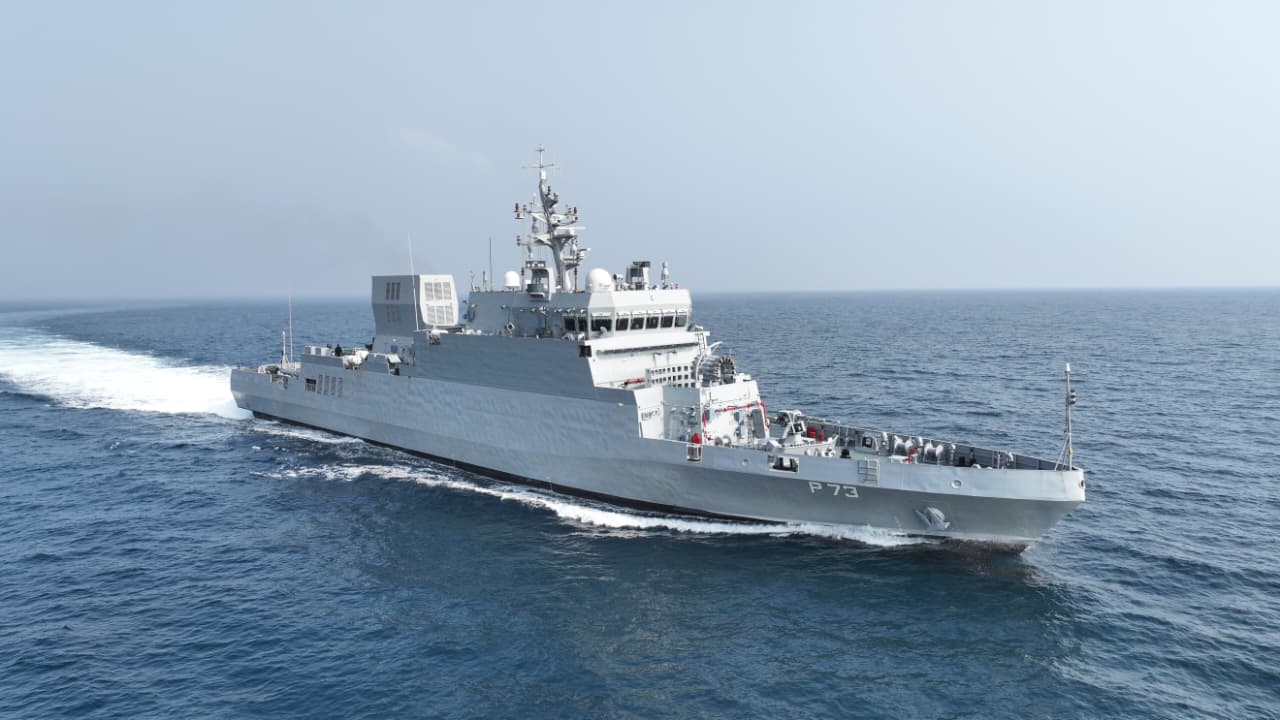
The Indian Navy is set to commission INS Anjadip, an indigenous Anti-Submarine Warfare Shallow Water Craft (ASW-SWC), at the Eastern Naval Command in Chennai. The induction marks a significant milestone in India’s maritime security architecture, particularly in strengthening underwater domain awareness in littoral waters.
Key Details:
- INS Anjadip is the third vessel in the eight-ship ASW-SWC project and has been constructed by Garden Reach Shipbuilders & Engineers (GRSE), Kolkata.
- The project reflects India’s growing defence industrial base and aligns with the broader vision of Aatmanirbhar Bharat in defence production.
- It also symbolizes the transformation of the Indian Navy into a “Builder’s Navy,” emphasizing indigenous warship design and construction.
Strategic Rationale
- India’s maritime geography—bordered by the Arabian Sea, Bay of Bengal, and the wider Indian Ocean Region (IOR) faces increasing underwater security challenges, including the expansion of submarine fleets in the region. Coastal and shallow waters are particularly vulnerable due to their complex acoustic environment, which makes submarine detection difficult.
- ASW-SWC vessels such as INS Anjadip are specifically designed for shallow-water operations, complementing larger destroyers and frigates that operate in deeper seas. Their deployment enhances layered maritime defence, especially near critical ports, sea lanes, and offshore assets.
Role and Capabilities
Often described as a “Dolphin Hunter,” INS Anjadip is engineered to detect, track, and neutralize enemy submarines in coastal waters. Its capabilities include:
- Hull Mounted Sonar ‘Abhay’ – an indigenous sonar system for underwater detection.
- Lightweight Torpedoes – for engaging hostile submarines.
- Anti-Submarine Warfare (ASW) Rockets – for close-range underwater threats.
- High-speed Water-Jet Propulsion System – enabling speeds up to 25 knots for rapid response.
Beyond its core ASW role, the vessel is also capable of:
- Coastal Surveillance
- Low-Intensity Maritime Operations (LIMO)
- Search and Rescue (SAR) missions
Its high manoeuvrability makes it particularly effective in confined and shallow operational environments.
Project Significance
The ASW-SWC project demonstrates India’s progress in indigenous naval shipbuilding. By involving domestic shipyards and indigenous weapon-sensor integration, the programme reduces import dependency and strengthens strategic autonomy.
The commissioning also contributes to:
- Capacity-building in anti-submarine warfare.
- Protection of sea lines of communication (SLOCs).
- Safeguarding strategic coastal infrastructure.
- Enhancing deterrence posture in the Indian Ocean Region.
Historical and Geostrategic Context
The vessel is named after Anjadip Island, located off the coast of Goa in the Arabian Sea. The island holds historical importance as Vasco da Gama claimed it for the Portuguese Crown on 24 September 1498 during his first voyage to India. The naming reflects India’s maritime heritage while reinforcing contemporary strategic priorities in the Arabian Sea region.
International Mother Language Day

- 25 Feb 2026
In News:
As the world marks International Mother Language Day (21 February), declared by UNESCO in 1999 and observed globally since 2000, the theme of linguistic justice has gained renewed urgency. The day commemorates the 1952 Bangla Language Movement in Dhaka and seeks to protect linguistic heritage amid rapid globalization. Against this backdrop, UNESCO’s 7th State of the Education Report (SoER) for India 2025, titled Bhasha Matters: Mother Tongue and Multilingual Education, reframes linguistic diversity as central to quality and inclusive education.
UNESCO SoER 2025: Key Focus
Published by the UNESCO Regional Office for South Asia, the SoER 2025 aligns with SDG 4 (Quality Education) and India’s reform trajectory under the National Education Policy (NEP) 2020. The report calls for strengthening Mother-Tongue-Based Multilingual Education (MTB-MLE) and identifies a persistent gap between policy commitments and classroom realities.
Core Areas of Emphasis:
- Access, Inclusion and Equity: Ensuring tribal children, girls, and children with disabilities learn in languages they understand.
- Contextual Learning: Integrating local knowledge systems across school and teacher education.
- Appreciation of Linguistic Diversity: Recognizing children’s linguistic repertoires as assets.
- Skills for Sustainable Futures: Using multilingualism to build cognitive flexibility and facilitate additional language acquisition.
- Institutionalisation: Embedding MTB-MLE in policy, teacher training, and digital ecosystems.
India’s Linguistic Landscape: Opportunity and Crisis
India represents one of the most linguistically diverse societies in the world:
- 1,369 mother tongues; 121 languages spoken by over 10,000 people.
- Linguistic Diversity Index: 0.914 (among the highest globally).
- Four major language families: Indo-Aryan (78%), Dravidian (20%), Austro-Asiatic (1.2%), and Tibeto-Burman (0.8%).
- Nearly 200 languages are vulnerable or endangered.
The UN estimates that a language disappears every two weeks worldwide. In India, the loss disproportionately affects tribal and minoritized communities. A rigid linguistic hierarchy-English at the top, followed by dominant regional languages-creates a “double divide,” marginalizing indigenous languages from education, governance, and digital spaces.
The Learning Crisis: Language Mismatch
A 2022 NCERT report reveals that 44% of Indian children begin schooling in a language different from their home language. This mismatch contributes to early learning deficits, poor foundational literacy, and higher dropout rates—especially among Adivasi communities facing a “triple disadvantage” (economic, social, linguistic).
Research highlights that early education in the mother tongue:
- Reduces cognitive load.
- Improves comprehension and retention.
- Strengthens critical thinking.
- Builds self-esteem and identity affirmation.
Recognizing this, NEP 2020 mandates instruction in the home language at least till Grade 5, preferably till Grade 8, marking a departure from colonial-era language hierarchies.
Constitutional Safeguards
India’s constitutional framework provides robust linguistic protections:
- Article 29: Right to conserve language, , culture.
- Article 350A: States must provide primary education in the mother tongue for linguistic minorities.
- Article 350B: Special Officer for Linguistic Minorities.
- Part XVII (Articles 343–351): Official language provisions.
- Eighth Schedule: 22 recognized languages.
Despite this framework, implementation gaps remain substantial.
Ground Realities and Innovations
The SoER 2025 highlights promising practices:
- Odisha’s Tribal MLE Programme: Covers 21 tribal languages across 17 districts, reaching nearly 90,000 children.
- Digital initiatives such as DIKSHA, PM eVIDYA, and AI-based language tools are enabling multilingual content creation.
- Community-led curriculum development in languages like Gondi, Santali, Khasi, and Mizo demonstrates the pedagogical value of indigenous knowledge systems.
National Monetisation Pipeline 2.0
- 25 Feb 2026
In News:
The Union Minister for Finance and Corporate Affairs has launched the National Monetisation Pipeline (NMP) 2.0, prepared by NITI Aayog, to operationalise the Asset Monetisation Plan for 2025–30 as announced in the Union Budget 2025–26. The initiative marks a significant step in India’s infrastructure financing strategy, building upon the experience of NMP 1.0.
Background and Performance of NMP 1.0
- The first phase of the National Monetisation Pipeline (2021–25) set a target of ?6 lakh crore. As per official statements, nearly 90% of this target was achieved, establishing institutional mechanisms, transaction templates, and sector-specific best practices. It also mainstreamed asset monetisation as a structured public finance strategy rather than an ad hoc disinvestment measure.
- NMP 1.0 covered operational (brownfield) public assets across sectors such as roads, railways, power transmission, airports, ports, and telecom. The experience gained in valuation, risk allocation, and investor outreach forms the foundation for NMP 2.0.
Rationale: Asset Recycling as a Financing Tool
NMP 2.0 is anchored in the concept of asset recycling, wherein operational public infrastructure assets are monetised to unlock capital. The proceeds are reinvested in new greenfield infrastructure (capital expenditure), without increasing fiscal deficits or immediate budgetary outgo.
This approach serves multiple objectives:
- Enhances efficiency through private sector participation.
- Improves asset utilisation and maintenance.
- Provides upfront capital to the government.
- Reduces pressure on traditional borrowing.
Thus, monetisation is distinct from privatisation; ownership of assets remains with the public authority while usage rights are transferred for a defined concession period.
Scope and Sectoral Coverage
NMP 2.0 expands the scale and ambition of monetisation. The pipeline estimates an aggregate potential of ?16.72 lakh crore, including approximately ?5.8 lakh crore in private sector investment—about 2.6 times the size of NMP 1.0.
Key sectors covered include:
- Roads and Highways
- Railways
- Power (generation and transmission)
- Oil and Gas pipelines
- Civil Aviation (airports)
- Ports
- Telecom infrastructure
- Coal and Mining assets
This broad sectoral spread ensures diversification of revenue streams and investor participation.
Institutional and Governance Framework
To ensure coordinated implementation, progress under NMP 2.0 will be monitored by the Core Group of Secretaries on Asset Monetisation (CGAM), chaired by the Cabinet Secretary. This institutional arrangement reflects a “whole-of-government” approach, integrating ministries, public sector enterprises, and state governments.
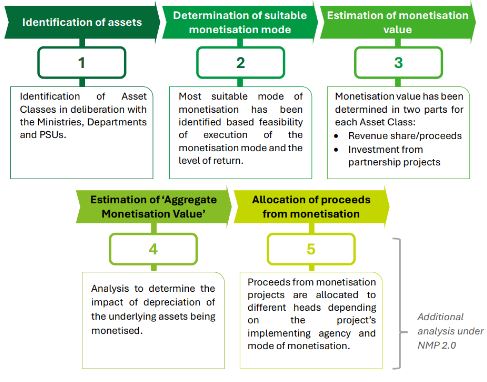
Revenue allocation from monetisation depends on the implementing agency:
- Ministry-led projects: credited to the Consolidated Fund of India.
- PSU/Port Authority projects: retained by the respective entity.
- Mining-related revenues: flow to the State Consolidated Fund (largely through royalties).
- Private investments involving construction or major maintenance are recorded under a separate accounting head.
Monetisation Instruments
Transactions under NMP 2.0 will employ a mix of financial and contractual instruments:
- Public-Private Partnership (PPP) concessions
- Infrastructure Investment Trusts (InvITs)
- Securitisation of cash flows
These instruments aim to attract long-term institutional investors such as pension funds and sovereign wealth funds, thereby deepening India’s infrastructure finance market.
Significance in the Context of Viksit Bharat
Aligned with the broader vision of Viksit Bharat, NMP 2.0 seeks to optimise public asset utilisation and crowd in private capital for infrastructure expansion. By providing medium-term asset visibility and a clear roadmap, it enhances investor confidence and predictability.
At a macroeconomic level, the pipeline complements the government’s high capital expenditure strategy, supports economic growth, and strengthens fiscal sustainability. If implemented effectively with transparency and robust regulatory safeguards, NMP 2.0 could institutionalise asset monetisation as a permanent pillar of India’s public finance architecture.