
National Blood Transfusion Bill 2025
- 18 Dec 2025
In News:
The Government has introduced the National Blood Transfusion Bill, 2025 in Parliament to create a dedicated legal and institutional framework for blood transfusion services in India. At present, blood and blood components are regulated under the Drugs and Cosmetics Act, a law primarily designed for pharmaceuticalsseen as inadequate for managing blood as a life-saving public health resource. The new Bill seeks to move the sector into a clear, safety-first national system with uniform standards and stronger oversight.
Why a New Law?
- Public health sensitivity: Blood transfusion carries risks of transfusion-transmitted infections and adverse reactions, requiring rigorous quality control.
- Regulatory gaps: The existing drug-law framework does not fully address donor management, component therapy, traceability, and haemovigilance.
- Standardisation need: Wide variation in practices across States and facilities necessitates uniform national standards.
Institutional Architecture
The Bill provides for a statutory National Blood Transfusion Authority (NBTA). As the apex technical and regulatory body, NBTA will frame national norms and coordinate with State authorities to ensure consistent implementation.
Core Regulatory Provisions
- Uniform standards across the chain: NBTA will prescribe norms for collection, testing, processing, storage, distribution, issue, and transfusion of whole blood and components (e.g., packed red cells, platelets, plasma).
- Mandatory registration: All blood centres will require registration/authorization, improving traceability and accountability.
- Quality and safety protocols: Emphasis on validated testing, component separation, cold-chain maintenance, and documentation.
- Haemovigilance system: A national haemovigilanceprogramme will monitor and analyse transfusion-related adverse events to improve safety practices.
- Ethics and compliance: The Bill proposes stringent penalties for unsafe collection, improper storage, unlicensed operations, or other unethical practices.
- Promotion of voluntary donation: Strengthened, coordinated efforts to increase voluntary, non-remunerated blood donation, reducing reliance on replacement donations.
Expected Impact
- Patient safety:Standardised screening and monitoring reduce risks of infections and transfusion reactions.
- System efficiency: Better inventory management and component use can improve availability, especially during emergencies.
- Transparency and trust: Clear legal backing and oversight enhance public confidence in blood services.
- Data-driven regulation:Haemovigilance enables continuous quality improvement based on evidence.
India–France Defence Pact on HAMMER (AASM)
- 18 Dec 2025
In News:
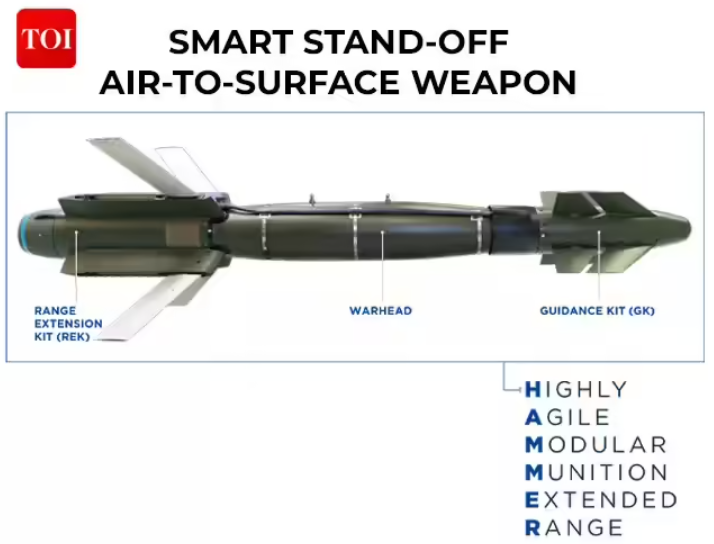
- India has signed an agreement with France’s Safran to jointly manufacture, customise, supply, and maintain the HAMMER (Highly Agile Modular Munition Extended Range) precision-guided air-to-ground weapon system in India.
- The production will take place through a 50:50 joint venture between Bharat Electronics Limited (BEL) and Safran.
What is HAMMER (AASM)?
- HAMMER, also known as Armement Air-Sol Modulaire (AASM), is a modular precision-guided munition that converts unguided “dumb” bombs into smart stand-off weapons using guidance and propulsion kits.
- It provides missile-like accuracy at significantly lower cost than cruise missiles.
Developer & Indian Manufacturing
|
Component |
Details |
|
Original Developer |
Safran Electronics & Defense (France) |
|
Indian Partner |
Bharat Electronics Limited (BEL) |
|
JV Structure |
50% Safran – 50% BEL |
|
Nature of Work |
Manufacturing, customization, maintenance in India |
Key Technical Features
- Modular Design
- Nose-mounted guidance kit
- Tail-mounted range-extension/propulsion kit
- Compatible with standard bomb bodies (125 kg to 1,000 kg, including Mk-80 series)
- Multiple Guidance Options
- INS-GPS → All-weather precision
- INS-GPS + Infrared (IR) → High-precision fixed targets
- Laser guidance → Moving targets
- Stand-off Capability
- Equipped with rocket booster and winglets
- Allows aircraft to strike from outside enemy air-defence range
- Can be launched at off-axis angles
- High Accuracy
- CEP (Circular Error Probability):
- ~10 m (INS-GPS)
- ~1 m (IR guidance)
- CEP (Circular Error Probability):
- Platform Integration
- Already integrated with Dassault Rafale
- Planned integration with HAL Tejas
United Nations Alliance of Civilizations (UNAOC)
- 18 Dec 2025
In News:
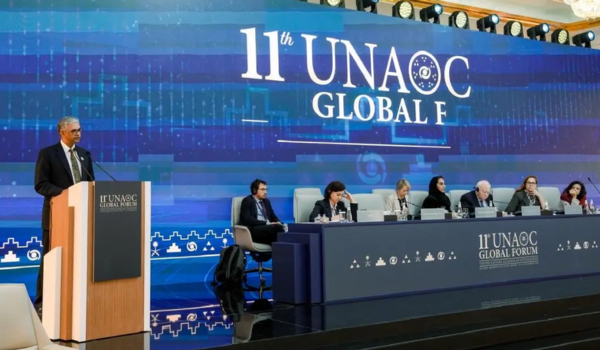
India recently reaffirmed its civilisational philosophy of VasudhaivaKutumbakam (“the world is one family”) and commitment to religious harmony at the 11th UNAOC Global Forum held in Riyadh, Saudi Arabia.
The Indian delegation highlighted India’s long-standing belief in pluralism, intercultural dialogue, and Sarva Dharma Samabhav (equal respect for all religions).
About the UNAOC
|
Feature |
Details |
|
Launched |
2005 |
|
Initiative of |
Kofi Annan (former UN Secretary-General) |
|
Co-sponsored by |
Governments of Spain and Türkiye |
|
Nature |
UN “soft-power” political initiative |
|
Secretariat |
New York, USA |
|
Funding |
Voluntary Trust Fund administered by the UN Secretariat |
|
Participants |
Governments, regional bodies, civil society, private sector, youth groups |
Core Objectives of UNAOC
UNAOC aims to:
- Promote intercultural and interreligious dialogue
- Reduce polarisation, extremism, xenophobia and hate speech
- Encourage mutual respect, inclusion and peaceful coexistence
- Serve as a platform for conflict prevention and resolution through dialogue
Global Forum of UNAOC
The Global Forum is the flagship event of UNAOC:
- Brings together political leaders, religious figures, youth, media and civil society
- Focuses on bridging cultural divides
- Acts as a high-level platform for policy dialogue and partnership-building
The 11th Forum marked two decades of UNAOC’s work in strengthening intercultural cooperation.
Funding Mechanism
- Operates through a Voluntary Trust Fund
- Contributions from:
- UN Member States
- International organizations
- Foundations
- Private sector
- Fund supports projects, outreach, and administrative functions
India – Asian Development Bank (ADB) Development Loan Package (2025)
- 18 Dec 2025
In News:
India and the Asian Development Bank (ADB) have signed five loan agreements worth over $2.2 billion to finance multi-sector development projects. The package supports human capital formation, clean energy transition, urban mobility, healthcare strengthening, and sustainable rural livelihoods.
About the Asian Development Bank (ADB)
- Established: 1966
- Headquarters: Manila, Philippines
- Type: Multilateral development bank
- Members: 69 countries (India is a founding member)
- Voting system: Weighted voting based on capital subscription
- Top shareholders: Japan & USA (~15.6% each), China (~6.4%), India (~6.3%), Australia (~5.8%)
- Mandate: Promote inclusive, environmentally sustainable, and regionally integrated growth in Asia-Pacific
Key Highlights of the $2.2 Billion Loan Package
1. Skilling & Employability – $846 Million
- Supports modernisation of 650 Industrial Training Institutes (ITIs) across 12 states and upgradation of 5 National Skill Training Institutes.
Focus Areas:
- Renewable energy
- Electric mobility
- Advanced manufacturing
Target: Improve employability of 1.3 million youth
2. Rooftop Solar Expansion – $650 Million
Supports Pradhan Mantri Surya Ghar: Muft Bijli Yojana
Objectives:
- Rooftop solar for 10 million households by 2027
- Uniform technical standards
- Affordable collateral-free loans for households
- Expands access to clean and affordable energy
3. Assam Tertiary Healthcare Strengthening – $398.8 Million
Project to modernise medical education and tertiary healthcare in Assam.
Institutions to be upgraded:
- Medical colleges in Guwahati
- Dibrugarh
- Silchar
These will serve as centres of excellence under the state health university system.
4. Urban Mobility – Chennai Metro – $240 Million
Supports Tranche 2 of the Chennai Metro Rail Limited project.
Features:
- ~20 km of new corridors (elevated + underground)
- 18 new metro stations
- Universal accessibility features
- Climate-resilient infrastructure for extreme weather
5. Meghalaya Sustainable Livelihoods & Ecotourism – $77 Million
Supports ecotourism + climate-smart agriculture.
Key Outcomes:
- Improve incomes of 8,000+ local beneficiaries
- Focus on women & indigenous communities
- Promote forest conservation and nature-based tourism
Viksit Bharat–Guarantee for Rozgar and Ajeevika Mission (Gramin) Bill, 2025 (VB-G RaM G)
- 18 Dec 2025
In News:
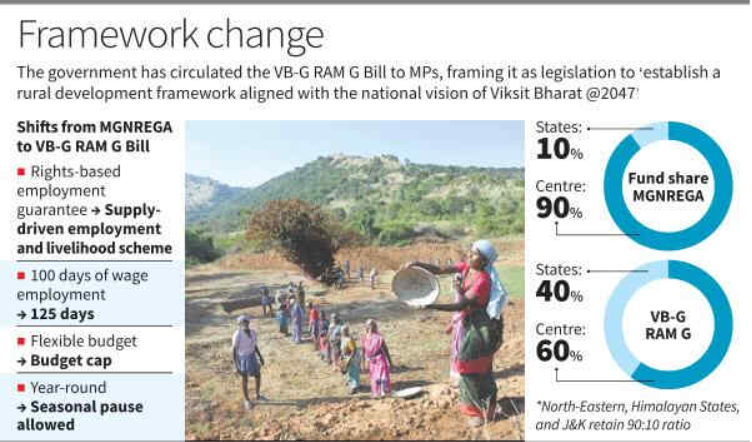
The Union Government has introduced the Viksit Bharat–Guarantee for Rozgar and Ajeevika Mission (Gramin) Bill, 2025 (VB-G RaM G) in the Lok Sabha to replace the Mahatma Gandhi National Rural Employment Guarantee Act (MGNREGA), 2005.
It marks a structural shift in India’s rural wage employment framework in line with the Viksit Bharat @2047 vision.
What is VB-G RaM G?
It is a proposed statutory rural wage employment guarantee law that:
- Assures 125 days of wage employment per rural household per financial year (earlier 100 days under MGNREGA)
- Focuses on durable, productivity-enhancing rural assets
- Integrates employment generation with infrastructure creation, livelihoods, and climate resilience
Core Objectives
- Move from distress-relief employment to development-linked employment
- Ensure convergence of rural schemes
- Create durable and climate-resilient assets
- Improve transparency, digital monitoring, and accountability
Key Features of the Bill
1. Enhanced Employment Guarantee
- Increased from 100 to 125 days
- About 25% higher income potential for rural households
2. Four Priority Work Categories
Works are restricted to:
- Water security (water harvesting, irrigation, conservation)
- Core rural infrastructure (roads, connectivity)
- Livelihood infrastructure (storage, markets, productive assets)
- Climate-resilience works (flood control, drought mitigation, soil conservation)
All works will be mapped into a proposed Viksit Bharat National Rural Infrastructure Stack.
3. Shift to Normative Funding
- Moves from demand-driven (MGNREGA model) to budget-based normative allocation
- Funds distributed to States using objective parameters
- Unemployment allowance still payable if work is not provided
4. Funding Pattern (Centrally Sponsored Scheme)
- 60:40 – Centre : States (most States)
- 90:10 – North-Eastern & Himalayan States
- 100% Central funding – UTs without legislature
5. Digital Governance & Transparency
Mandatory provisions include:
- Biometric attendance
- Aadhaar-linked wage payments
- Geo-tagging of assets
- AI-based fraud detection
- Real-time MIS dashboards
- Weekly public disclosure meetings at Gram Panchayat level
- Strengthened social audits
6. Agricultural Season Safeguard
- States can declare up to 60 days (aggregate) when works will pause during peak sowing/harvesting
- Aims to:
- Ensure farm labour availability
- Prevent wage inflation in agriculture
7. Decentralised Planning
- Works planned through Viksit Gram Panchayat Plans (VGPPs)
- Spatial planning integration with PM Gati Shakti
- Plans aggregated from Gram Panchayat → Block → District → State
8. Institutional Mechanism
- Central & State Gramin Rozgar Guarantee Councils
- States must notify their operational scheme within 6 months of enactment
Why Replace MGNREGA? (Government’s Rationale)
- Rural poverty decline: From 25.7% (2011-12) to ~5% (2023-24)
- Need to shift from relief works to productive infrastructure
- Asset quality issues under MGNREGA
- Reported misappropriation (~?193 crore in 2024-25)
- Only a small % of households completed 100 days post-pandemic
- Rising need for climate-resilient rural infrastructure
Major Differences from MGNREGA
|
Feature |
MGNREGA |
VB-G RaM G (Proposed) |
|
Nature |
Demand-driven legal right |
Normative, budget-linked guarantee |
|
Workdays |
100 |
125 |
|
Work scope |
Broad categories |
4 focused priority sectors |
|
Funding |
Mostly Centre-funded wages |
60:40 cost sharing (most states) |
|
Technology |
Supportive |
Mandatory & codified |
|
Planning |
Gram Sabha-based |
VGPP + national infrastructure stack |