
Project Suncatcher

- 16 Dec 2025
In News:
Google has unveiled Project Suncatcher, a long-term research initiative to explore solar-powered AI data centres in space. The plan envisions orbiting satellites equipped with high-performance AI hardware, potentially launching early prototypes by 2027.
Background: Rising Demand for AI Infrastructure
Artificial Intelligence tools such as ChatGPT and Gemini require enormous computing power, which depends on large data centres. These facilities consume vast quantities of:
- Electricity for processing
- Water for cooling systems
- Land and infrastructure for expansion
Global demand for AI data centres is projected to grow rapidly, raising concerns about energy security, water stress, and carbon emissions.
What is Project Suncatcher?
Project Suncatcher is a “moonshot” research effort to develop constellations of satellites that function as orbiting AI data centres. Instead of storing and processing data on Earth, Google proposes to deploy Tensor Processing Units (TPUs) in space.
These space-based nodes would be connected through free-space optical (laser) communication links, forming a distributed computing network similar in structure to internet satellite constellations, but dedicated to AI processing rather than broadband delivery.
Why put Data Centres in Space?
1. Abundant Solar Energy
In orbit, solar panels can be up to 8 times more productive than on Earth and receive near-continuous sunlight. This could provide a steady, renewable power supply without the intermittency issues of terrestrial solar farms.
2. Reduced Environmental Stress on Earth
Shifting computing loads to space could lower:
- Land use conflicts
- Freshwater consumption for cooling
- Local pollution and noise from massive server farms
3. Infrastructure and Regulatory Flexibility
On Earth, building new data centres often faces delays due to land acquisition, environmental clearances, and local opposition. Space offers fewer regulatory constraints, though governance frameworks are still evolving.
How Would It Work?
Satellites in close formation would host AI accelerators and exchange data using high-speed optical interconnects capable of terabit-per-second transmission. Google suggests satellites may need to remain within hundreds of meters to a kilometre of each other to maintain efficient energy sharing and communication.
The company has also tested the radiation tolerance of its latest TPU chips, reporting encouraging resilience under simulated space radiation conditions.
Major Technical Challenges
1. High-Speed Communication: Maintaining ultra-fast, stable links between rapidly moving satellites is difficult. Current wireless optical technologies are still far from matching fibre-optic speeds used in terrestrial data centres.
2. Cooling in Microgravity: Traditional cooling methods rely on gravity-driven convection. In space, heat dissipation is far more complex and requires advanced thermal management systems.
3. Radiation and Space Weather: Electronics in orbit face constant exposure to cosmic radiation and solar storms, which can damage circuits and reduce hardware lifespan.
4. Orbital Mechanics and Formation Control: Satellites must maintain very tight formations, demanding precise station-keeping and increased fuel consumption.
5. Space Debris Risk: Growing congestion in Earth’s orbit increases the likelihood of collisions, posing a threat to delicate computing infrastructure.
Economic Feasibility
Currently, launch costs make space data centres extremely expensive. However, future reductions in launch prices could improve viability. Google is targeting the mid-2030s as a period when costs may become competitive with Earth-based facilities.
Several private firms are also experimenting with space data storage and processing, indicating growing commercial interest in orbital computing.
Strategic Significance
If successful, space-based AI infrastructure could:
- Transform global computing architecture
- Reduce environmental strain from terrestrial data centres
- Provide resilient, disaster-proof computing networks
However, the concept remains experimental, with major engineering, economic, and regulatory hurdles to overcome.
Tapanuli Orangutan
- 16 Dec 2025
In News:
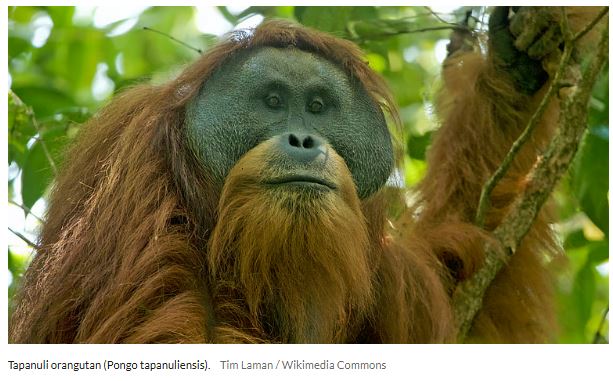
Scientists have warned that Cyclone Senyar-triggered floods and landslides in northern Sumatra may have killed 6–11% of the remaining Tapanuli orangutan population, pushing the species closer to extinction.
About the Tapanuli Orangutan
- The Tapanuli orangutan is the rarest great ape species in the world, formally identified as a distinct species in 2017. Fewer than 800 individuals are believed to survive in the wild.
- Habitat and Distribution
- Tapanuli orangutans are found only in the Batang Toru Ecosystem in North Sumatra, Indonesia.
- Their range is highly fragmented and restricted to upland and submontane rainforests south of Lake Toba, covering less than 3% of their historical range.
- Evidence suggests they were originally better adapted to lower-altitude forests but were pushed into higher terrain due to habitat loss.
- IUCN Status: The species is listed as Critically Endangered on the IUCN Red List due to its extremely small and declining population, restricted range, and ongoing threats.
Physical Characteristics
- Tapanuli orangutans resemble other orangutans in size but have distinct features. They possess smaller skulls, flatter faces, and thicker, frizzier orange fur. Adult flanged males have beards and moustaches, with flatter cheek pads covered in light-colored fuzz.
Behaviour and Ecology
- These orangutans are arboreal and largely solitary, spending most of their lives in the forest canopy.
- They are highly intelligent and known for tool use, using sticks and branches as hooks, scratchers, or to extract insects. Social learning and cultural transmission of behaviors have also been observed.
- Their life history is extremely slow, with one of the longest mother–offspring bonds in mammals (7–11 years). Males exhibit bimaturism, with two forms: unflanged males (smaller, no cheek pads) and dominant flanged males (large cheek pads and throat sacs).
- A unique ecological trait is their diet, which includes certain caterpillars and pinecones not known to be eaten by other orangutan species.
Why the Species is Extremely Vulnerable
The Tapanuli orangutan’s risk of extinction is amplified by:
- Extremely small total population
- Highly restricted and fragmented habitat
- Slow reproduction rate
- Increasing frequency of extreme weather events linked to climate change
- Ongoing habitat pressures from development and infrastructure
Even minor increases in mortality can have irreversible population-level consequences.
Conservation Significance
The Tapanuli orangutan represents the most ancient lineage of orangutans, despite being the most recently described. Its survival is crucial for preserving global great ape diversity and evolutionary history.
The recent cyclone highlights how climate-related disasters can become “extinction-level events” for species already on the brink.
CoalSETU Policy

- 16 Dec 2025
In News:
The Cabinet Committee on Economic Affairs has approved the creation of a new CoalSETU window under the Non-Regulated Sector (NRS) Linkage Policy to enable auction-based allocation of coal linkages for a wider range of industrial uses and exports.
What is CoalSETU?
- CoalSETU (Policy for Auction of Coal Linkage for Seamless, Efficient & Transparent Utilisation) is a reform measure introduced by the Ministry of Coal.
- It creates an additional auction window within the existing NRS Linkage Auction Policy, 2016, allowing industries to access domestic coal in a more flexible and market-driven manner.
- The policy aligns with recent coal sector reforms aimed at liberalising coal allocation and improving efficiency in resource utilisation.
Background: NRS Linkage Policy
Earlier, coal linkages in the Non-Regulated Sector were auctioned only for specified end-use industries such as cement, sponge iron, aluminium, and captive power plants. Each linkage was tied to a defined industrial purpose, limiting flexibility.
With changing market conditions and rising demand, the government reviewed the policy to allow broader participation and reduce dependency on imported coal.
Key Features of the CoalSETU Window
1. Wider Industrial Participation: The CoalSETU window allows any domestic industrial consumer to bid for coal linkages through auctions. Existing eligible sectors under NRS can continue bidding in their respective categories and may also participate in this new window.
2. No End-Use Restrictions
Unlike earlier provisions, coal obtained through CoalSETU can be used for:
- Own industrial consumption
- Coal washing
- Export (subject to limits)
However, resale of coal within India is not permitted, and traders are barred from participating to prevent speculative hoarding.
3. Export Flexibility: Linkage holders can export up to 50% of the allocated coal quantity. Washed coal produced from these linkages can also be exported, opening new trade opportunities.
4. Support for Coal Washeries
The policy encourages coal linkages to washery operators. This is expected to:
- Increase availability of cleaner, washed coal domestically
- Reduce reliance on imported washed coal
- Improve export prospects for value-added coal products
5. Exclusion of Coking Coal: Coking coal is not offered under this window, as it is critical for steel production and has separate allocation mechanisms.
6. Flexibility for Corporate Groups: Companies can distribute the coal secured under CoalSETU among their group companies, allowing better operational planning and efficiency.
Objectives of the Policy
The CoalSETU initiative aims to ensure seamless and transparent utilisation of domestic coal resources. It promotes ease of doing business by providing industries with long-term supply visibility. Another major objective is to reduce India’s dependence on coal imports by increasing domestic availability, especially of washed coal.
Significance of CoalSETU
- Boost to Transparency and Competition: Auction-based allocation ensures a fair and competitive process, moving away from discretionary allotments.
- Reduction in Import Dependence: Improved access to domestic coal and increased supply of washed coal can lower the need for costly imports.
- Support for Industrial Growth: By removing rigid end-use conditions, the policy benefits emerging industries and smaller players that previously struggled to secure coal linkages.
- Alignment with Broader Coal Reforms: CoalSETU complements earlier reforms such as commercial coal mining without end-use restrictions, strengthening India’s move towards a market-driven coal sector.
Rare Early-Universe Supernova Observed by JWST

- 16 Dec 2025
In News:
Astronomers using the James Webb Space Telescope (JWST) have detected a rare supernova in the early universe. The discovery was linked to a distant gamma-ray burst (GRB) that helped scientists trace the explosive death of a massive star dating back to just a few hundred million years after the Big Bang.
What is a Supernova?
A supernova is a powerful and catastrophic explosion marking the end of a star’s life cycle. It is among the most energetic events in the universe.
During a supernova, a star releases an enormous amount of energy in a short time — sometimes emitting more energy in a few seconds than the Sun will produce in its entire lifetime. These explosions can briefly outshine entire galaxies and are visible across vast cosmic distances.
Types of Supernovae
- Type I Supernova: This occurs in a binary star system where a white dwarf star pulls matter from a companion star. When the accumulated mass crosses a critical limit, a runaway nuclear reaction triggers a thermonuclear explosion.
- Type II Supernova: This occurs when a massive star exhausts its nuclear fuel. Without the outward pressure from fusion, gravity causes the core to collapse, leading to a violent explosion known as a core-collapse supernova.
Role of Supernovae in the Universe
Supernovae play a crucial role in cosmic evolution. They are the primary sources of heavy elements such as iron, gold, and uranium, which are later incorporated into new stars, planets, and even living organisms. Thus, they are fundamental to the chemical enrichment of the universe.
How Common are Supernovae?
In a galaxy like the Milky Way, astronomers estimate that about two to three supernovae occur per century. However, since the universe contains billions of galaxies, astronomers observe hundreds of supernovae every year beyond our galaxy.
Significance of the JWST Discovery
The recent observation is particularly important because it captures a supernova from the early universe, only a few hundred million years after the Big Bang. Studying such ancient stellar explosions helps scientists understand:
- The formation of the first generations of stars
- Early chemical enrichment of the universe
- The evolution of galaxies in the cosmic dawn era
The high sensitivity and infrared capabilities of the James Webb Space Telescope make it uniquely suited to observe such distant and ancient cosmic events.
Sustainable Harnessing of Advancement of Nuclear Energy for Transforming India (Shanti Bill)
- 16 Dec 2025
In News:
The Union Cabinet has approved the Atomic Energy Bill, 2025, also called the SHANTI Bill (Sustainable Harnessing of Advancement of Nuclear Technology for India). It represents the biggest reform in India’s nuclear energy governance since the Atomic Energy Act of 1962.
Background of India’s Nuclear Sector
- India’s civilian nuclear power sector has traditionally been under complete government control. Nuclear power plants are operated only by public sector entities such as Nuclear Power Corporation of India Limited (NPCIL) and BharatiyaNabhikiya Vidyut Nigam Limited (BHAVINI).
- Private participation has remained restricted mainly due to the Atomic Energy Act, 1962 and the Civil Liability for Nuclear Damage Act, 2010 (CLND Act), which created legal and liability-related uncertainties for suppliers and investors.
Need for the SHANTI Bill
India has set a target of 100 GW of nuclear power capacity by 2047. Achieving this requires massive investment, advanced technology, and faster project execution. Existing laws were considered outdated, fragmented, and restrictive for modern nuclear expansion, especially with regard to private and foreign participation.
Scope and Nature of the Bill
The SHANTI Bill seeks to create a single, modern legal framework governing nuclear energy in India. It replaces the earlier fragmented legal structure with a unified system covering licensing, safety regulation, liability, and industry participation.
Opening of the Nuclear Value Chain
- The Bill allows private and foreign companies to participate in selected non-strategic areas of the nuclear sector. These include atomic mineral exploration, nuclear fuel fabrication, and the manufacturing of nuclear equipment and components.
- However, sensitive and strategic domains such as nuclear weapons-related activities and certain categories of reactor operations will continue to remain under strict government control.
Reform of the Nuclear Liability Regime
- A key feature of the Bill is the restructuring of the nuclear liability framework. The law aims to clearly define the responsibilities of plant operators, equipment suppliers, and the government in case of a nuclear incident.
- It proposes insurance-backed liability caps to reduce financial uncertainty for private players. Beyond a certain damage threshold, the government will step in to provide additional financial support. This brings India’s framework closer to global nuclear liability practices and addresses long-standing investor concerns under the CLND Act.
Independent Nuclear Safety Authority
- The Bill proposes the establishment of an independent nuclear safety authority. This body will be separate from agencies that promote nuclear energy, ensuring a clear distinction between promotional and regulatory roles. The aim is to enhance transparency, credibility, and adherence to international best practices in nuclear safety.
Dedicated Nuclear Tribunal
A specialised nuclear tribunal will be set up to handle disputes related to nuclear liability, contracts, and compensation. This is expected to ensure faster resolution of cases and reduce legal uncertainty in the sector.
Focus on Advanced Technologies and SMRs
The legislation supports research, development, and deployment of Small Modular Reactors (SMRs). SMRs are considered suitable for industrial decarbonisation, remote regions, and flexible grid integration, and are seen as a key part of the future nuclear expansion strategy.
Strategic Significance
Nuclear energy provides clean and reliable baseload power, which complements intermittent renewable sources like solar and wind. Expansion of nuclear power will help India reduce its dependence on coal and imported fossil fuels, thereby strengthening energy security.
The reform also supports India’s long-term climate commitments, including its net-zero emissions target by 2070, while breaking more than six decades of exclusive state monopoly in the sector.