
Vayu Baan Project

- 26 Mar 2026
In News:
In a major stride toward self-reliance in defense technology, the Indian Air Force (IAF) has unveiled Project Vayu Baan (Air Arrow). This initiative marks the development of India’s first Helicopter-Launched Drone System, officially categorized as an Air-Launched Effect (ALE). Developed by the IAF’s Directorate of Aerospace Design (DAD), the project aims to integrate unmanned systems with manned rotary-wing platforms to enhance lethality and survivability in contested airspaces.
Technical Overview: How Vayu Baan Operates
The Vayu Baan is a compact, autonomous drone engineered for mid-air deployment from moving helicopters.
- Deployment: The drone is dropped from a mother ship (such as the Prachand LCH or ALH Dhruv).
- Activation: Post-release, the system unfolds its wings and activates its propulsion system to transition into controlled flight.
- Mission Profile: It functions as a "Loyal Wingman" for helicopters, capable of switching between high-definition ISR (Intelligence, Surveillance, and Reconnaissance) and acting as a Precision-Guided Munition (Kamikaze drone).
Key Features and Specifications
The Vayu Baan system is tailored for the specific challenges of the modern battlefield, particularly along India's mountainous borders:
- Stand-off Range: The drone can travel over 50 km after release, allowing the host helicopter to remain outside the range of enemy MANPADS (Man-Portable Air-Defense Systems).
- Endurance: It offers a loitering time of approximately 30 minutes, providing a window to scout targets or wait for optimal strike conditions.
- GNSS-Denied Navigation: A critical feature is its ability to operate in electronic warfare (EW) environments. It uses advanced flight control systems to navigate even when GPS/GNSS signals are jammed.
- Advanced Sensors: Equipped with EO/IR (Electro-Optical/Infrared) sensors, ensuring operational efficiency during both day and night missions.
- Swarm Potential: A single helicopter can deploy multiple units, creating a localized "mini-swarm" to overwhelm enemy defenses through saturation.
Reform Express Initiative

- 26 Mar 2026
In News:
In a major push to align Indian Railways with the National Logistics Policy, the Union Ministry of Railways has unveiled five pivotal structural reforms under the "Reform Express" initiative. This brings the total number of policy interventions in 2026 to nine. The initiative targets three critical pillars: Cargo Logistics, Infrastructure Integrity, and Passenger Digital Empowerment, aiming to reduce logistics costs and enhance the ease of travel.
I. Revolutionizing Cargo & Freight Logistics
The reforms specifically target the transport of essential and high-value commodities to increase the railways' modal share in freight.
- Specialized Salt Logistics: India is a top global producer of salt, yet rail transport has historically faced challenges due to the corrosive nature of the commodity.
- Innovation: Introduction of top-loading, stainless steel containers with hydraulic side-discharge mechanisms.
- Impact: Prevents wagon corrosion, eliminates water seepage (common in traditional open wagons), and allows for seamless multimodal "site-to-warehouse" transport.
- Flexible Automobile Transport: Currently, rail accounts for approximately 24% of passenger vehicle movement.
- Innovation: Introduction of route-specific, flexible wagon designs. This allows manufacturers to customize wagons to bypass physical constraints like low-clearance bridges and narrow tunnels.
- Impact: Enhances capacity utilization and accelerates the delivery of automobiles across diverse terrains.
II. Infrastructure Governance and Project Execution
To address delays and "predatory bidding," the Ministry has overhauled the contracting framework for railway projects.
- Stricter Contractor Eligibility: The single-project experience requirement has been raised from 35% to 50% of the total project value. Additionally, at least 20% of prior experience must be in railway-specific works.
- Financial Safeguards: * Bid Security: Fixed at a flat 2% of the project value to deter frivolous bidders.
- Anti-Predatory Measures: If a bid is more than 5% below the estimated cost, the bidder must provide an additional 5% performance guarantee to ensure project quality is not compromised.
- Accountability: Subcontracting limits have been reduced from 70% to 40%, forcing primary contractors to execute at least 60% of the work directly.
III. Enhancing Passenger Experience and Ticketing Integrity
Digital reforms have been implemented to protect genuine travelers from touts and speculative bookings.
- Ticketing Clean-up: Through advanced data analytics and Aadhaar-based OTP verification, the Railways removed nearly 3 crore (30 million) fake accounts from the IRCTC database.
- Revised Cancellation Windows: To curb last-minute speculation, the cancellation slabs have been revised to 72, 24, and 8 hours before departure.
- Note: No refunds are permitted for cancellations made less than 8 hours before departure.
- Dynamic Flexibility:
- Boarding Point Change: Passengers can now digitally change their boarding station up to 30 minutes before the train's departure from its origin.
- Class Upgrades: Digital class upgrades are now permitted up to 30 minutes before departure (previously restricted to before chart preparation).
- Refund Automation: The requirement for filing a Ticket Deposit Receipt (TDR) for e-tickets has been abolished; refunds are now processed automatically upon cancellation.
Space Reactor 1 (SR-1) Freedom Spacecraft

- 26 Mar 2026
In News:
In a significant policy pivot in early 2026, NASA announced a major restructuring of the Artemis mission architecture. The primary objective has transitioned from maintaining a constant orbital presence to establishing a permanent surface foothold.
- De-prioritization of Lunar Gateway: Plans for the Lunar Gateway, a proposed small space station in lunar orbithave been "paused" or scrapped. Resources and hardware are being redirected toward the Artemis Base Camp at the Lunar South Pole.
- Direct-to-Surface Model: Future crewed missions will now bypass an orbital waystation, with astronauts transferring directly from the Orion spacecraft to commercial Human Landing Systems (HLS) like SpaceX’s Starship or Blue Origin’s Blue Moon.
- Mission Timeline:
- Artemis II (2026): Crewed lunar flyby.
- Artemis IV (2028): Target for the first human lunar landing since 1972.
- Artemis V (Late 2028): Commencement of lunar base construction.
Space Reactor 1 (SR-1) Freedom: A Technological Paradigm
NASA has officially announced SR-1 Freedom, a pathfinder spacecraft designed to be the first interplanetary vessel powered by a Nuclear Fission Reactor. Scheduled for a December 2028 launch, it marks the shift from chemical and solar energy to Nuclear Electric Propulsion (NEP).
Technical Specifications and Operation
- Propulsion System: It utilizes NEP, where an onboard fission reactor splits uranium atoms to generate electricity. This power then fuels highly efficient ion thrusters.
- Power Output: The reactor is designed for a 20-kilowatt output, utilizing High-Assay Low-Enriched Uranium (HALEU) fuel.
- Hardware Repurposing: In a cost-saving measure, the SR-1 utilizes the Power and Propulsion Element (PPE) originally built for the Lunar Gateway.
- Thermal Management: To handle the immense heat of fission, the craft employs advanced "heat pipes" and composite titanium heat sinks.
The "Skyfall" Payload: Scouting the Red Planet
The primary mission of SR-1 Freedom is to deliver the Skyfall payload to Mars. This payload consists of a fleet of 3 to 6 Ingenuity-class robotic helicopters.
- Objectives:
- Water-Ice Detection: Using ground-penetrating radar to locate subsurface water deposits essential for life support and propellant production (In-Situ Resource Utilization - ISRU).
- Terrain Mapping: Identifying safe, flat landing zones for future human-scale Mars landers.
- Atmospheric Study: Monitoring Martian dust storms and weather patterns that often render solar-powered rovers inoperable
Minor Planet Centre

- 26 Mar 2026
In News:
In March 2026, the Minor Planet Centre (MPC) announced the discovery of 15 new natural satellites: four orbiting Jupiter and 11 orbiting Saturn. This discovery has pushed Saturn’s total moon count to 285 and Jupiter’s to 101, further intensifying the "moon race" between the two gas giants.
About the Minor Planet Centre (MPC)
The MPC is the single worldwide location for the receipt and distribution of positional measurements for "minor planets" (asteroids), comets, and outer irregular natural satellites.
- Location & Affiliation: Based in Cambridge, Massachusetts, it operates at the Smithsonian Astrophysical Observatory (SAO).
- Governance: It functions under the auspices of Division F of the International Astronomical Union (IAU).
- Funding: It is primarily supported by a grant from NASA’s Near-Earth Object Observations (NEOO) program.
Core Functions and Operational Process
The MPC serves as the international clearinghouse for all data related to small solar system bodies.
- Data Verification: When astronomers detect a moving object, they submit coordinates to the MPC. Experts use these to verify observations and calculate the object’s orbit.
- Designation & Cataloging: If an object is confirmed as new, the MPC assigns it an official designation (e.g., S/2024 J 1). Once an orbit is precisely determined, it receives a permanent Roman numeral designation.
- Near-Earth Object (NEO) Monitoring: One of its most critical roles is tracking space rocks that could potentially threaten Earth. By maintaining a massive database, it allows scientists to predict "close approaches."
- Global Coordination: The MPC publishes Minor Planet Electronic Circulars (MPECs). These alert the global scientific community to new discoveries, allowing observatories worldwide to coordinate follow-up observations.
Case Study: The 2026 Jovian and Saturnian Discoveries
The recent discoveries highlight the increasing capability of terrestrial telescopes (located in Chile and Hawaii) to detect "irregular" moons.
- Physical Characteristics: These moons are typically small (1–3 km in diameter) and extremely faint, with magnitudes between 25 and 27 (roughly 100 million times fainter than what the naked eye can see).
- Orbital Mechanics: Many of these new satellites exhibit retrograde orbits (moving in the opposite direction of the planet’s rotation) and are highly elliptical, suggesting they may be captured asteroids rather than bodies formed alongside the planet.
- Naming Conventions: Under IAU rules, these small irregular satellites are only given proper names (drawn from Gallic, Inuit, or Norse mythology) if they are of significant scientific interest; otherwise, they remain known by their alphanumeric designations.
Variable Rate Repo (VRR) Auctions
- 26 Mar 2026
In News:
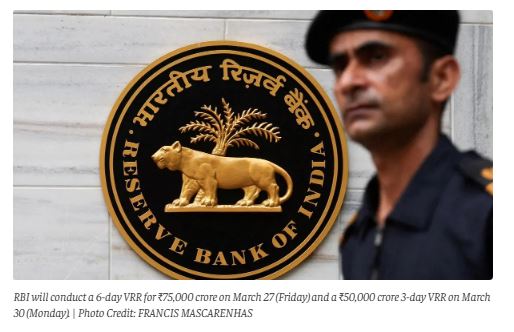
Liquidity management remains a cornerstone of the Reserve Bank of India's (RBI) monetary policy operations. Recently, the RBI injected substantial liquidityincluding a specific instance of ?55,837 crore via a 3-day auctionto counter tightening cash conditions in the banking system. By utilizing tools like the Variable Rate Repo (VRR), the central bank ensures that the credit flow to the economy remains uninterrupted and short-term interest rates stay aligned with the policy repo rate.
What is a Variable Rate Repo (VRR)?
The Variable Rate Repo is a flexible monetary tool under the Liquidity Adjustment Facility (LAF) used by the RBI to inject "transient" (temporary) liquidity into the banking system. Unlike the standard Fixed Rate Repo, where the interest rate is pre-determined by the RBI, the VRR allows the market to determine the cost of funds through a competitive bidding process.
Operational Mechanism
- Notification: The RBI announces an auction with a "notified amount" and a specific tenor (ranging from overnight to 14 days).
- Competitive Bidding: Commercial banks submit bids specifying the amount they require and the interest rate they are willing to pay.
- Cut-off Rate: The RBI accepts bids starting from the highest interest rate offered down to a "cut-off rate." This ensures that funds are allocated to those with the highest demand/valuation.
- Collateralization: As with all repo transactions, banks must provide Government Securities (G-Secs) as collateral, which they agree to repurchase at the end of the term.
Triggers for Liquidity Deficits
The banking system often transitions from a surplus to a deficit mode due to several seasonal and structural factors:
- Advance Tax Outflows: Significant quarterly payments by corporates to the government lead to a temporary migration of funds from the banking system to the government's account with the RBI.
- GST Payments: Monthly Goods and Services Tax collections typically drain liquidity toward the end of the month.
- Festival Demand: Increased physical currency circulation during festive seasons reduces the "currency with the public," thereby lowering bank deposits.
- Year-End Requirements: In March, banks often face heightened demand for funds to meet regulatory requirements and balance sheet closures.
VRR vs. Open Market Operations (OMO)
It is essential to distinguish between tools used for temporary versus durable liquidity:
|
Feature |
Variable Rate Repo (VRR) |
Open Market Operations (OMO) |
|
Nature of Liquidity |
Transient/Temporary (Short-term) |
Durable (Long-term) |
|
Instrument |
Lending against collateral |
Outright purchase/sale of G-Secs |
|
Primary Goal |
Fine-tuning daily liquidity |
Managing long-term money supply |
|
Recent Example |
?55,837 Cr 3-day injection |
?3.50 lakh Cr G-Sec purchase (Jan 2026) |
Macroeconomic Implications for India
- Interest Rate Stability: By preventing the Weighted Average Call Rate (WACR) from spiking above the policy repo rate, the RBI ensures "stability in the corridor." This is crucial for the effective transmission of monetary policy.
- Support for Credit Growth: Adequate liquidity ensures that commercial banks do not tighten lending norms for MSMEs and retail consumers due to temporary cash crunches.
- Market Signaling: High demand in VRR auctions serves as a vital signal to the RBI regarding the underlying stress in the money markets, prompting further intervention if necessary.
- Fiscal Coordination: The RBI’s auctions often coincide with government borrowing schedules (e.g., the H1 FY 2026-27 borrowing target of ?8.20 lakh crore) to ensure that government bond yields remain stable.