
Takydromus ultapanensis
- 08 Mar 2026
In News:
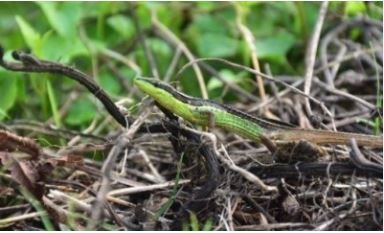
Recent research has led to the discovery of a new species of Asian grass lizard, Takydromus ultapanensis, from the Manas Biosphere landscape in Assam. The finding highlights the rich biodiversity of Northeast India and underscores the importance of conserving fragile forest ecosystems that harbour previously undocumented species.
About the Newly Discovered Species
Takydromus ultapanensis is a newly identified member of the Asian grass lizard genus (Takydromus), a group known for slender bodies and long tails adapted to life in grassland and forest vegetation. The species was discovered in the Ultapani Reserve Forest located in Kokrajhar district of Assam, within the larger Manas landscape.
Unlike many of its related species that typically inhabit montane or subtropical environments, T. ultapanensis occupies lowland semi-evergreen forests interspersed with waterlogged grasslands and patches of ferns. This ecological preference distinguishes it from several of its congeners and indicates adaptation to a unique microhabitat within the Manas ecosystem.
Habitat and Behaviour
Researchers observed individuals of this species basking on fern bushes in open patches of forest. These areas are often intersected by seasonal water channels, creating a moist and complex habitat structure suitable for small reptiles. The lizards appear to rely on vegetation cover and sunlit clearings for thermoregulation and feeding.
Such habitats are characteristic of the Manas Biosphere landscape, a biodiversity-rich region located along the Indo-Bhutan border and known for its mixture of grasslands, forests, and wetlands.
Distinct Morphological Characteristics
The newly identified species exhibits several morphological differences that distinguish it from closely related lizards found in Northeast India. In particular, T. ultapanensis differs from species such as Takydromus khasiensis and Takydromus sikkimensis in:
- Scale patterns
- Body proportions
- Diagnostic head features
These differences were crucial in confirming it as a distinct species rather than a variation of existing grass lizards.
Conservation Concerns
At present, Takydromus ultapanensis has been recorded only from a single forest range in the Ultapani Reserve Forest. Such a limited distribution raises concerns about its vulnerability to habitat disturbance.
The Manas landscape, although ecologically significant, faces pressures from habitat fragmentation, land-use change, and human activities. Species restricted to narrow habitats are particularly vulnerable to environmental change, highlighting the need for continued ecological monitoring and habitat protection.