
State of India’s Bats Report
- 17 Apr 2026
In News:
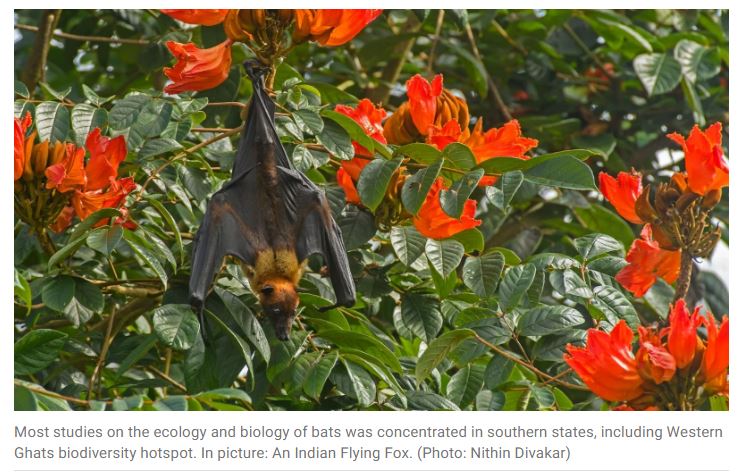
The first-ever national assessment, "State of India’s Bats (2024–25)," was recently released by experts from the Nature Conservation Foundation and Bat Conservation International. The report paints a concerning picture of declining populations and "data dark spots," urging a policy shift to protect these nocturnal mammals that are vital for both environmental stability and public health.
Biodiversity and Endemism
India serves as a significant hub for chiropteran (bat) diversity in the Global South.
- Species Count: India is home to approximately 135 bat species.
- Endemism: Out of these, 16 species are endemic to the region, meaning they are found nowhere else in the world.
- Conservation Status:
- 7 species are currently classified as "Threatened" by the IUCN.
- 35 species remain "Data Deficient" or unassessed, highlighting a critical knowledge gap that hinders effective conservation planning.
- A specific concern was raised regarding the Khasian Leaf-nosed bat, which faces severe pressure from mining and hunting but remains under-classified in terms of protection.
Ecological Functions: The "Silent Providers"
- Pollination: Many bats are primary pollinators for economically significant plants, including durian, agave, and various wild fruit trees.
- Seed Dispersal: Fruit bats (Megachiroptera) play a pivotal role in "reforesting" degraded lands by dispersing seeds over vast distances.
- Pest Control: Insectivorous bats act as natural biopesticides, consuming massive quantities of insects that would otherwise destroy crops, thereby reducing the need for chemical fertilizers.
- Nutrient Cycling: Bat droppings, or guano, are rich in nitrogen and phosphorus, serving as high-quality natural fertilizer for cave and forest ecosystems.
Critical Habitats and Roosting Patterns
Bats are highly selective about their roosting sites, which provide stable microclimates and safety from predators.
- Types of Roosts: Caves, old-growth trees, and historical man-made structures like abandoned buildings and monuments.
- Significant Sites: The report identifies Robber’s Cave in Mahabaleshwar as a site of national importance, hosting one of the largest known roosts of Phillip’s long-fingered bat.
- Threats to Habitats: Urbanization, the demolition of old structures, and mining in karst (limestone) landscapes are destroying these sensitive micro-environments.
Challenges and "Data Dark Spots"
The assessment highlights that the biggest hurdle to bat conservation in India is not just habitat loss, but a lack of scientific data.
- Bureaucratic Hurdles: Researchers often face significant delays in obtaining permissions for field studies, contributing to the "data deficiency" of over 35 species.
- The "Stigma" Factor: Post-COVID-19, bats have been unfairly demonized. While they are linked to certain zoonotic diseases, the report emphasizes that the risk of spillover increases only when humans encroach upon bat habitats, not through the bats' natural existence.
- Anthropogenic Pressures: Land-use changes, deforestation, and the impacts of climate change are altering the migration and hibernation patterns of several species.