
Global Multidimensional Poverty Index (MPI) 2025
- 28 Oct 2025
In News:
- The United Nations Development Programme (UNDP) and the Oxford Poverty and Human Development Initiative (OPHI) released the Global Multidimensional Poverty Index (MPI) 2025 Report, titled “Overlapping Hardships: Poverty and Climate Hazards”.
- The report provides an evidence-based assessment of poverty that goes beyond income measures, highlighting how climate vulnerability and multidimensional deprivation reinforce each other.
About the Global MPI
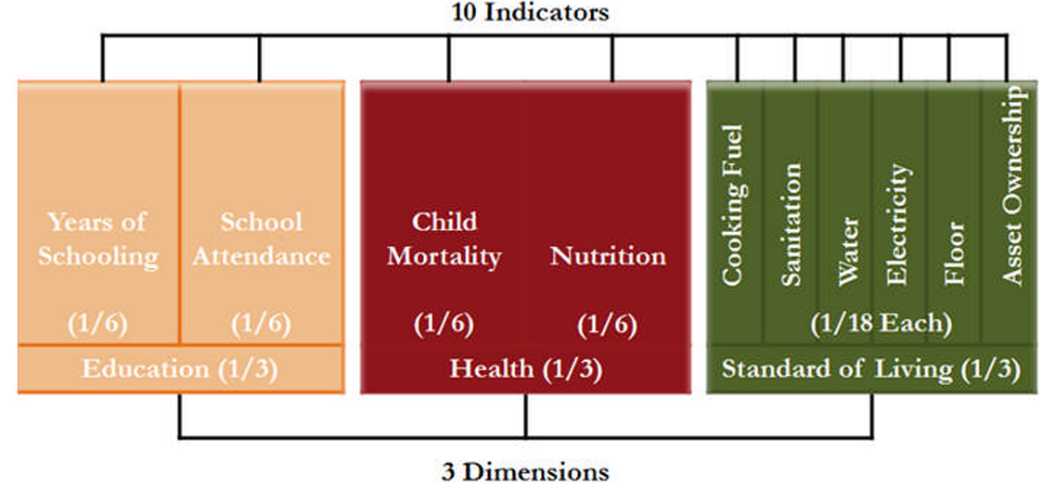
- Nature of Index: The MPI is a global composite measure of acute poverty, capturing simultaneous deprivations in health, education, and standard of living through 10 indicators.
- Introduced: First featured in the 2010 Human Development Report.
- Published by: Jointly by UNDP Human Development Report Office and OPHI, annually since 2010.
- Objective: To assess:
- Who is poor
- How they are poor
- How deprivations overlap across households
- Enabling policymakers to align development strategies with SDG-1 (No Poverty).
- Methodology Highlights:
- 3 Dimensions: Health, Education, Living Standards.
- 10 Indicators: Nutrition, child mortality, years of schooling, school attendance, cooking fuel, sanitation, drinking water, electricity, housing, assets.
Global Trends in the MPI 2025
Poverty Headcount & Severity
- Out of 6.3 billion people assessed across 109 countries, 1.1 billion (18.3%) live in acute multidimensional poverty.
- 43.6% of the poor (≈501 million) experience severe poverty—being deprived in half or more indicators.
Regional Distribution of Poverty
- Sub-Saharan Africa (565 million) and South Asia (390 million) account for 83% of global poverty.
- Sub-Saharan Africa alone contains 49.2% of the world’s multidimensionally poor.
Children Disproportionately Affected
- Children form 33.6% of the global population but 51% of those living in multidimensional poverty.
- Malnutrition and disruption in schooling are primary drivers of child deprivation.
Middle-Income Countries as Core Contributors
- Nearly 740 million of the global poor live in middle-income countries, highlighting inadequacies of income-based poverty classifications.
Rural Concentration
- 83.5% of all multidimensionally poor live in rural areas, despite these areas comprising only 55% of total population.
Climate Hazard Exposure
- Nearly 80% of poor populations live in climate-vulnerable areas.
- Climate hazards include droughts, floods, extreme heat, and erratic precipitation patterns.
- South Asia has the highest number of poor people living in climate hazard zones.
Poverty & Climate Vulnerability in SIDS
- 22 Small Island Developing States (SIDS) show a combined poverty rate of 23.5%, higher than the developing world average.
- Rising sea levels (projected up to 70 cm by 2080–2099) threaten livelihoods in nations such as Belize, Comoros, and Samoa.
Post-Pandemic Stagnation
- Poverty reduction has slowed, with many countries witnessing stagnation or reversal due to:
- Inflation
- Conflict
- Climate shocks
- Post-pandemic economic disruptions
India in Global MPI 2025
Significant Poverty Reduction
- India reduced multidimensional poverty from 55.1% (2005–06) to 16.4% (2019–21).
- Over 414 million people moved out of multidimensional poverty.
- India's progress is among the fastest globally.
Persistent Child Poverty
- Children continue to face high deprivation, particularly in:
- Nutrition
- Sanitation
- Housing
- Cooking fuel
Climate Vulnerability and Poverty Link
- Nearly 99% of India’s poor live in climate-exposed regions.
- Heatwaves, floods, droughts, and air pollution intensify hardship and threaten livelihood security.
Drivers of MPI Improvement
India’s poverty reduction correlates with large-scale welfare and infrastructure missions:
- Swachh Bharat Mission – sanitation improvement
- PM Ujjwala Yojana – access to clean cooking fuel
- PM-Awas Yojana – housing for rural and urban poor
- Jal Jeevan Mission – access to clean drinking water
- Universal electrification initiatives
Key Challenges
- Rural–Urban Divide: 83% of the multidimensionally poor live in rural regions.
- Climate shocks: Frequent floods and droughts reverse development gains.
- Data Gaps: Lack of updated household-level data limits monitoring and policy targeting.
- Gender disparities: Women face inequalities in nutrition, education, healthcare, and asset ownership.
- Financial constraints: Several states struggle with fiscal capacity, affecting social protection and climate adaptation.
Policy Recommendations
- Integrate Climate & Poverty Policy: Adopt climate-resilient strategies combining:
- Green infrastructure
- Social protection
- Disaster risk reduction
- Localised Poverty Tracking: Develop district-level MPI dashboards for real-time, granular monitoring.
- Promote Green Livelihoods: Expand employment in:
- Renewable energy
- Organic farming
- Circular economy sectors
- Enhance Global Support: Strengthen access to:
- Climate finance
-
- Concessional aid
- Technology transfers
- Gender and Child-Focused Interventions: Reinforce programs for:
- Nutrition
- Maternal health
- Education
- Clean cooking energy
Is Poverty Being Underestimated in India?
- 24 Jan 2025
In News:
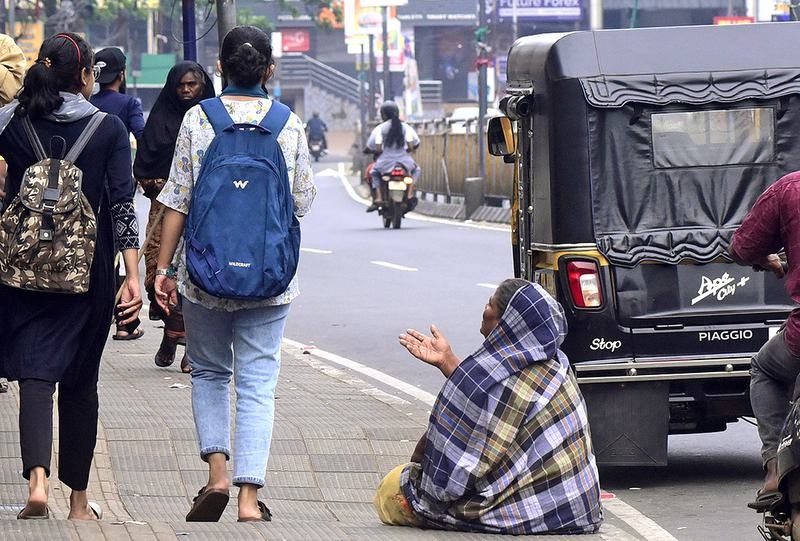
The recent 2023-24 Household Consumption Expenditure Survey (HCES) showed a decline in poverty across rural and urban India. However, questions have emerged about whether poverty is being underestimated, due to changes in methodologies, definitions, and data availability.
Evolution of Poverty Measurement in India
- 1970s to 2005: Poverty was defined based on minimum calorie intake; updated every 5 years using NSSO data.
- Tendulkar Committee introduced in response to divergence between NSSO and National Accounts data.
- Post-2011-12: No official poverty estimates or surveys; alternative indices like Multidimensional Poverty Index (MPI) were used.
Current Data Issues
- Different recall periods in surveys (7-day, 30-day, 365-day) create non-comparability.
- Modified Mixed Recall Period (MMRP) introduced in 2017-18 and improved upon in recent years with three household visits, enhancing recall and thus raising reported expenditures.
- Result: Using older poverty lines on newer, higher expenditure data underestimates poverty.
Diverging Poverty Estimates
- Dr. C. Rangarajan (2022-23): Estimated poverty at around 10%.
- Recent factsheet (2023-24) suggests poverty may have declined to single digits.
- A paper using Rangarajan’s methodology on 2022-23 HCES data estimated 25% poverty, but this is debated.
Reasons for Poverty Reduction
- High GDP growth, increased public expenditure, and improved public delivery systems.
- National Food Security Act covers nearly 80 crore people.
- Broadened definition of poverty now includes non-food items and essential services.
- Decline in poverty estimated around 17-18% between 2011-12 and 2023-24.
Rural-Urban Trends
- Consumption gap between rural and urban areas is narrowing.
- Rural consumption patterns becoming more urban-like.
- 2011 Census definitions outdated — many rural areas are peri-urban in character.
Need for Poverty Line Revision
- Lack of consensus and official backing on methodology hinders creation of a new poverty line suited to current data.
- UNDP’s global poverty line is $2.15/day; India’s poverty was 12.9% in 2019 by that metric.
- NITI Aayog’s estimates do not support 25% poverty claim.
Debate on Multidimensional Poverty Index
- India’s MPI (12 indicators) differs from UNDP’s 10-indicator framework.
- Additions like bank accounts and maternal health are India-specific.
- Criticism: Once indicators (e.g., electricity, bank accounts) are met, they remain met — poverty appears to decline permanently, while income vulnerability is not captured.
Global Multidimensional Poverty Index (MPI) Report 2024
- 18 Dec 2024
In News:
The Global Multidimensional Poverty Index (MPI) Report 2024 was released by the United Nations Development Programme (UNDP) and the Oxford Poverty and Human Development Initiative (OPHI). The report focuses on the theme “Poverty Amid Conflict”, examining the interplay between violent conflict and multidimensional poverty.
Key Findings:
- Global Poverty Levels:
- 1.1 billion people (~18% of the global population) live in acute multidimensional poverty across 112 countries.
- India has the largest number of people living in multidimensional poverty, with 234 million people.
- Multidimensional Poverty Indicators:
- The MPI assesses poverty across three key dimensions:
- Health: Child mortality, malnutrition.
- Education: Years of schooling, school attendance.
- Living Standards: Access to clean water, sanitation, electricity, cooking fuel, housing quality, and ownership of basic assets.
- A person is considered MPI poor if they are deprived in one-third or more of the weighted indicators.
- The MPI assesses poverty across three key dimensions:
- Impact of Conflict:
- Countries experiencing violent conflict exhibit higher deprivations across all 10 MPI indicators when compared to non-conflict nations.
- 40% (455 million people) of those living in poverty are in conflict-affected regions. These regions include active war zones, fragile states, and areas with low peace.
- Child Poverty:
- 584 million children (27.9% of all children globally) are living in extreme poverty, highlighting the disproportionate impact on the younger population.
- In contrast, 13.5% of adults are living in extreme poverty.
- Regional Distribution:
- The regions with the highest poverty rates are Sub-Saharan Africa and South Asia, which together account for 83.2% of the global poor.
- Rural Poverty: A majority of the poor (83.7%, or 962 million people) live in rural areas, with 70.7% of the poor concentrated in rural parts of Sub-Saharan Africa and South Asia.
- Countries with the Highest Poverty:
- India: 234 million people.
- Pakistan: 93 million people.
- Ethiopia: 86 million people.
- Nigeria: 74 million people.
- Democratic Republic of the Congo: 66 million people. These five countries account for 48.1% of the global poor.
- Poverty Amid Conflict:
- The report underscores that 2023 witnessed the highest number of conflicts since World War II, leading to the displacement of 117 million people due to violent conflicts and other factors like natural disasters.
- Conflict zones continue to experience higher poverty, as nearly 40% of the world's poorest people live in these areas.
India's Poverty Situation:
- India's Poor Performance:
- India has 234 million people living in multidimensional poverty, making it the country with the largest share of the global poor.
- Regional Disparities: Poverty rates in rural areas remain high due to poor infrastructure, limited economic opportunities, and underdeveloped services outside of agriculture.
- Poor Nutrition: Malnutrition, especially among children, is a significant concern.
- Education: The quality of education remains subpar, especially in government-run schools, affecting learning outcomes.
- Water and Sanitation: Inadequate access to clean drinking water and sanitation is prevalent, especially in rural areas.
- Economic Setbacks: The COVID-19 pandemic worsened the economic situation, leading to job losses and reduced incomes.
Government Initiatives for Poverty Alleviation:
- National Food Security Act (NFSA): Provides subsidized food grains to 67% of India's population, targeting rural areas (75%) and urban areas (50%).
- Pradhan Mantri Ujjwala Yojana (PMUY): Aims to provide LPG connections to women from Below Poverty Line (BPL) families.
- Ayushman Bharat: Health insurance coverage up to ?5 lakh per family, designed to protect against catastrophic healthcare costs.
- POSHAN Abhiyaan: Focuses on reducing malnutrition, particularly among children, adolescent girls, pregnant women, and lactating mothers.
- Right to Education Act (RTE): Guarantees free and compulsory education for children between 6 and 14 years.
- Swachh Bharat Mission: Works to ensure universal sanitation coverage, including the construction of toilets and promoting cleanliness.
World Bank Report on Poverty in India
- 18 Dec 2024
In News:
The World Bank has set a clear mission: ending extreme poverty and boosting shared prosperity on a livable planet. This new edition of the biennial series, previously titled Poverty and Shared Prosperity, assesses the three components of the mission and emphasizes that reducing poverty and increasing shared prosperity must be achieved without high costs to the environment.
Extreme Poverty in India:
- Current Poverty Status (2024):
- 129 million Indians are living in extreme poverty, defined as earning less than $2.15 (?181) per day.
- This marks a significant improvement from 431 million in 1990, demonstrating progress in poverty alleviation.
- Poverty Trends:
- In 2021, there was a reduction of 38 million people in extreme poverty, bringing the total to 167.49 million.
- However, higher poverty standards (set at $6.85 (?576) per day) now show more Indians below the poverty line than in 1990, mainly due to population growth.
- Survey Methodology:
- The 2022-23 Household Consumption and Expenditure Survey (HCES) in India used the Modified Mixed Reference Period (MMRP) method to improve data accuracy.
- The report suggests the need for careful analysis of the survey data, which may impact future poverty estimates.
Global Poverty Trends:
- Slowdown in Poverty Reduction:
- Global poverty reduction has slowed considerably, with 700 million people (8.5% of the global population) living in extreme poverty in 2024.
- The slowdown is attributed to factors like low economic growth, the COVID-19 pandemic, and increased fragility.
- Challenges in Achieving Targets:
- The global extreme poverty rate is expected to be 7.3% in 2030, which is double the World Bank's target of 3%.
- At current rates, extreme poverty eradication by 2030 is unlikely. It could take decades to eradicate extreme poverty, and over a century to lift people above the $6.85/day threshold.
- Impact of Polycrisis:
- Polycrisis refers to the confluence of multiple crises—slow growth, climate risks, and increased uncertainty—making global poverty reduction more challenging.
- Global prosperity has also been impacted, with slower income growth, particularly after the pandemic.
India's Role in Global Poverty Reduction:
- Contribution to Global Poverty:
- India’s contribution to global extreme poverty is expected to decline significantly over the next decade. However, even if India eradicates its extreme poverty by 2030, the global extreme poverty rate would only fall from 7.31% to 6.72%, still above the UN SDG target of 3%.
Proposed Pathways for Addressing Poverty:
- Faster and Inclusive Growth:
- Focus on increasing labor productivity, income, and employment to boost economic growth inclusively.
- Climate Resilience:
- Strengthen risk management and mitigation efforts to protect vulnerable populations from climate shocks, ensuring that growth does not worsen environmental degradation.
Global Priorities:
- Low-Income Countries: Prioritize poverty reduction through investments in human, physical, and financial capital to foster growth.
- Middle-Income Countries: Focus on inclusive income growth that reduces vulnerability, and seek synergies such as cutting air pollution alongside poverty reduction.
- High-Income Countries: Accelerate climate mitigation efforts while managing the transition costs involved.
Multidimensional Poverty in India (Indian Express)
- 03 Feb 2024
Why is it in the News?
Recently, In her Interim Budget speech, the Union Finance Minister informed that nearly 25 crore people have been raised from multi-dimensional poverty in the last 10 years.
What is Multidimensional Poverty?
- Multidimensional Poverty refers to the complex nature of poverty, where individuals or communities experience various simultaneous disadvantages.
- These may include inadequate health, malnutrition, limited access to clean water and electricity, substandard living conditions, and limited educational or employment opportunities.
- Merely focusing on income as a poverty indicator fails to fully grasp the depth and breadth of deprivation experienced by individuals.
- Multidimensional Poverty recognizes that poverty encompasses more than just economic factors; it encompasses a range of dimensions that impact well-being and quality of life.
- This approach to measuring poverty incorporates not only income or consumption levels but also considers deprivations in education and access to essential infrastructure.
- The international poverty line, set at $2.15 per day (in 2017 purchasing power parity terms) by the World Bank, serves as a benchmark for evaluating monetary value but is complemented by a broader assessment of various dimensions of deprivation.
What is the Global Multidimensional Poverty Index?
- The Global Multidimensional Poverty Index (MPI) serves as a vital tool for assessing acute multidimensional poverty in over 100 developing nations.
- Published collaboratively by the Oxford Poverty and Human Development Initiative (OPHI) and the UNDP's Human Development Report Office, it provides a comprehensive framework for tracking deprivation across three key dimensions and ten indicators.
- This index operates on a scale from 0 to 1, with higher values indicating greater levels of poverty.
- According to MPI methodology, individuals experiencing deprivation in a third or more of the weighted indicators are classified as "MPI poor."
India's Progress and Comparison:
- According to the 2023 Global MPI report, India successfully uplifted 415 million people out of poverty between 2005-06 and 2019-21, marking a significant achievement in poverty alleviation efforts.
- India is among 25 nations that have effectively halved their global MPI values within 15 years.
Comparison with India's National MPI:
- In addition to the global MPI, India has its own National Multidimensional Poverty Index.
- Published by NITI Aayog, India's MPI incorporates two additional indicators:
- Maternal health (under the health dimension) and
- Bank account ownership (under the standard of living dimension).
- This modification aligns the MPI with India's specific national priorities, offering a nuanced understanding of poverty dynamics within the country.