
Hubble Tension
- 17 Apr 2026
In News:
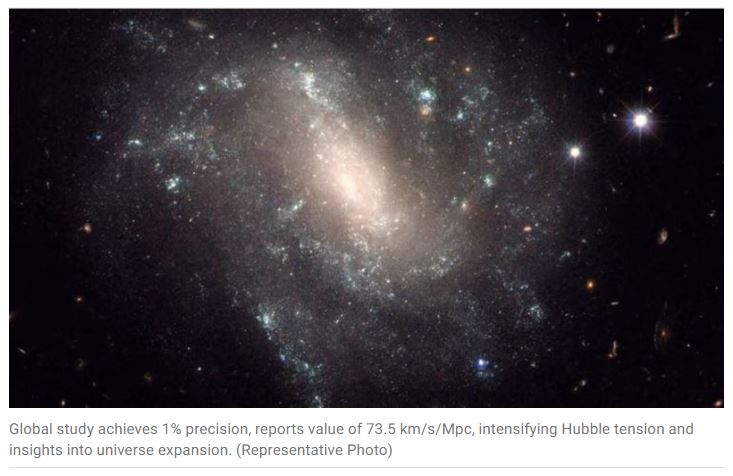
The quest to determine the rate at which our universe is expanding is currently facing a significant scientific bottleneck known as the Hubble Tension. Recent high-precision observations have narrowed the local expansion rate to approximately 73.5 km/s/Mpc, further intensifying a debate that suggests our standard model of cosmology may be incomplete.
Historical Context: Hubble’s Law
In 1929, Edwin Hubble revolutionized our understanding of the cosmos by establishing a quantitative relationship between a galaxy’s distance and its recessional velocity. This principle, known as Hubble’s Law, provided the foundational evidence that the universe is not static but is continuously expanding. The rate of this expansion is captured by a value called the Hubble Constant (H0).
The Core Conflict: Two Paths, Two Results
The "tension" arises because the two primary methods used to calculate the Hubble Constant yield results that are statistically incompatible, despite both being highly precise.
1. The Local Measurement (Late Universe)
This approach utilizes the Cosmic Distance Ladder. Astronomers observe "standard candles"—objects with known luminosity such as pulsating Cepheid stars and Type Ia supernovae. These measurements of the "nearby" universe indicate a faster expansion rate of roughly 73 to 73.5 km/s/Mpc. Recent data from April 2026 has confirmed these figures using multiple cross-validation methods, making the data incredibly robust.
2. The Early Universe Measurement
Scientists analyze the Cosmic Microwave Background (CMB), which is the relic radiation left over from the Big Bang. By applying mathematical models of the early universe's physics, they project this ancient data forward to the present day. This "top-down" approach predicts a significantly slower expansion rate of approximately 67 km/s/Mpc.
Key Discrepancies at a Glance
- The Gap: The difference between the 73.5 km/s/Mpc (Local) and 67 km/s/Mpc (Early Universe) values is what physicists call the Tension.
- Data Source Differences: The Local method relies on direct observation of nearby stars and explosions, while the Early Universe method relies on radiation from the dawn of time projected through mathematical modeling.
- Inference vs. Observation: The local rate is an observation of how the universe behaves now, whereas the CMB rate is an inference of how it should behave based on its state 13.8 billion years ago.
Significance
The persistence of this gap is not merely a mathematical quirk; it represents a potential "crisis in cosmology." If neither side has made a measurement error, the discrepancy implies deep challenges for our current scientific framework:
- Incomplete Physics: The current Standard Model of Cosmology may be missing critical components that explain how the expansion rate changed over time.
- New Physics: There might be undiscovered properties of Dark Energy or Dark Matter driving expansion differently than predicted by current Einsteinian gravity.
- Evolution of Gravity: Our understanding of how gravity operates over cosmic timescales and vast distances may require a fundamental revision.
Physicists are currently investigating whether this mismatch is the result of a subtle systematic error or the first hint of a "new physics" that could reshape our understanding of the origin and ultimate fate of the universe.
Hubble Tension
- 15 Apr 2024
Why is it in the News?
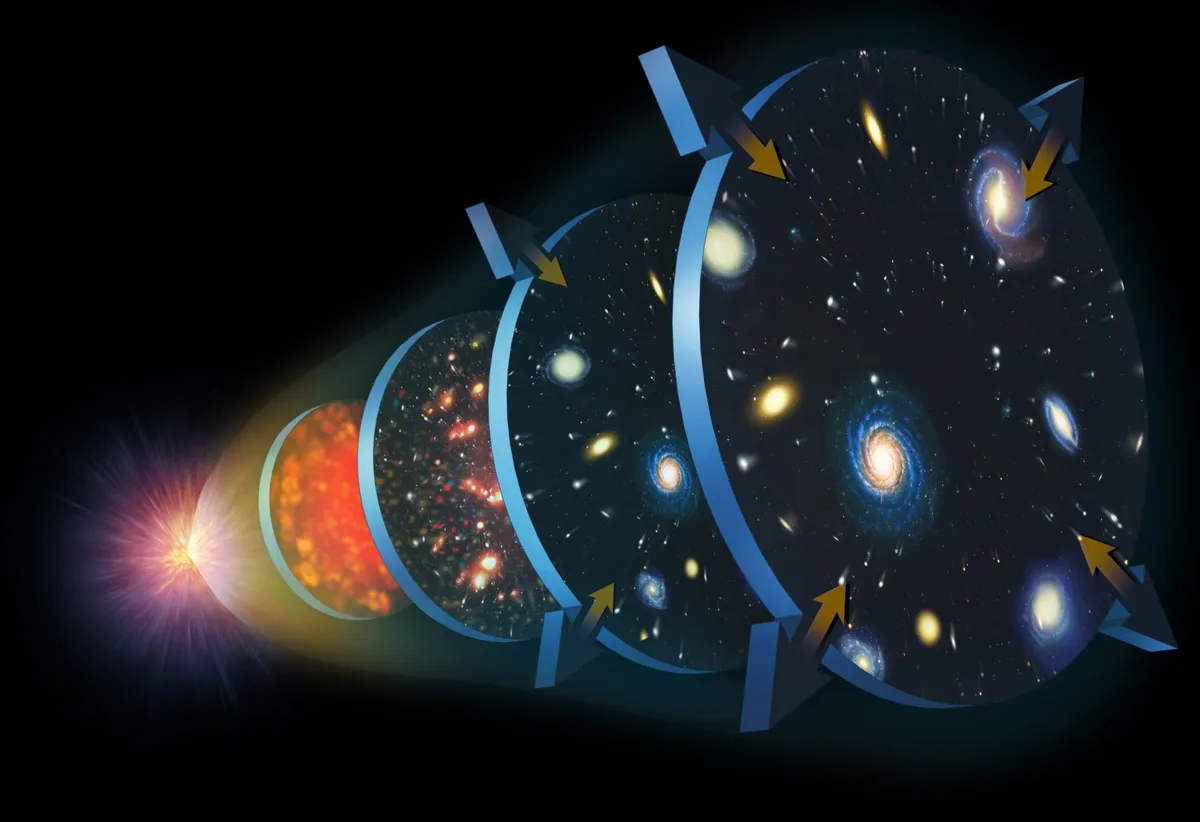
One of the biggest mysteries in cosmology is the ‘Hubble tension’, the puzzle that the expansion of the Universe we see today doesn’t match what we think it should be from looking at the early cosmos.
What is Hubble Tension?
- The Hubble tension refers to a puzzling disagreement between two methods of measuring the universe's expansion rate, represented by the Hubble constant (H0).
- The Hubble constant describes how fast galaxies move away from each other due to cosmic expansion.
- Researchers employ two primary approaches to estimate H0: the cosmic distance ladder and analysis of the cosmic microwave background (CMB).
Cosmic Microwave Background (CMB):
- CMB constitutes a ubiquitous sea of photons, remnants of the Big Bang's aftermath.
- Scientists scrutinize CMB for temperature variations and employ intricate trigonometric techniques to analyze its large-scale properties.
- This analysis culminates in an estimation of cosmic expansion at approximately 68 (km/s)/Mpc.
Cosmic Distance Ladder:
- This method facilitates the measurement of distances to celestial objects spanning various proximity ranges.
- Notably, Cepheid variable stars, which exhibit predictable luminosity fluctuations over time, serve as crucial distance indicators.
- By gauging the brightness of Cepheid variables, researchers can infer their distances, leading to an estimation of H0 around 73 (km/s)/Mpc.
Discrepancy and Hubble Tension:
- The utilization of these two distinct measurement methods yields slightly divergent values for H0, resulting in the emergence of the Hubble tension.
Significance of the Hubble Tension:
- The presence of the Hubble tension suggests potential implications, including unexplored physical phenomena or systematic errors in measurement techniques.
- Resolving this tension is imperative to enhance our comprehension of the universe's expansion dynamics and the fundamental laws governing it.