
India’s 7th National Report to the Convention on Biological Diversity (CBD)
- 08 Mar 2026
In News:
India has submitted its 7th National Report to the Convention on Biological Diversity, assessing the country’s progress toward biodiversity conservation and sustainable use targets by 2030. The report evaluates India’s performance against 23 National Biodiversity Targets (NBTs) that are aligned with the Kunming-Montreal Global Biodiversity Framework.
The assessment indicates that only two of the 23 targets are currently on track, although improvements have been observed in policy frameworks, forest cover, and ecosystem restoration initiatives.
Key Findings of the 7th National Report
The report highlights both achievements and gaps in India’s biodiversity governance.
Progress Areas
- Strengthening of policy and institutional frameworks for biodiversity conservation.
- Improvements in forest cover and ecosystem restoration programmes.
- Greater integration of biodiversity concerns into national development policies.
Areas of Concern
- Only two National Biodiversity Targets are clearly on track.
- Several targets related to species conservation, ecosystem protection, and sustainable use of resources require accelerated action.
- Implementation gaps remain due to limited resources, data gaps, and increasing anthropogenic pressures.
The findings underline the need for stronger implementation measures to achieve biodiversity goals by 2030.
Convention on Biological Diversity (CBD)
The Convention on Biological Diversity is one of the most important international agreements addressing biodiversity conservation.
Origin and Evolution
- Opened for signature at the Rio Earth Summit.
- Entered into force on 29 December 1993.
- The first Conference of the Parties (COP) was held in 1994 in the Bahamas.
Membership and Secretariat
- Ratified by 196 countries, making it one of the most widely adopted international treaties.
- The United States remains the only UN member state that has not ratified the convention.
- Secretariat located in Montreal.
Three Core Objectives
- Conservation of biological diversity
- Sustainable use of biodiversity components
- Fair and equitable sharing of benefits arising from genetic resources
The governing body of the CBD is the Conference of the Parties (COP), which meets every two years.
Related Protocols under the CBD
Two important supplementary agreements strengthen the implementation of the convention:
- Cartagena Protocol on Biosafety – focuses on biosafety in biotechnology.
- Nagoya Protocol – governs equitable sharing of benefits from genetic resources.
Kunming–Montreal Global Biodiversity Framework (KMGBF)
The Kunming-Montreal Global Biodiversity Framework was adopted during COP15 of the CBD in 2022 in Montreal. It is considered a landmark global agreement to address the biodiversity crisis.
Key Features
- 23 global targets to be achieved by 2030.
- Four long-term goals for 2050 aimed at safeguarding biodiversity for present and future generations.
- Focus areas include ecosystem restoration, protection of biodiversity-rich areas, reduction of pollution, and sustainable use of biological resources.
- The framework is not legally binding, but it guides national biodiversity strategies and reporting.
COP16 to the Convention on Biological Diversity (CBD)
- 20 Oct 2024
In News:
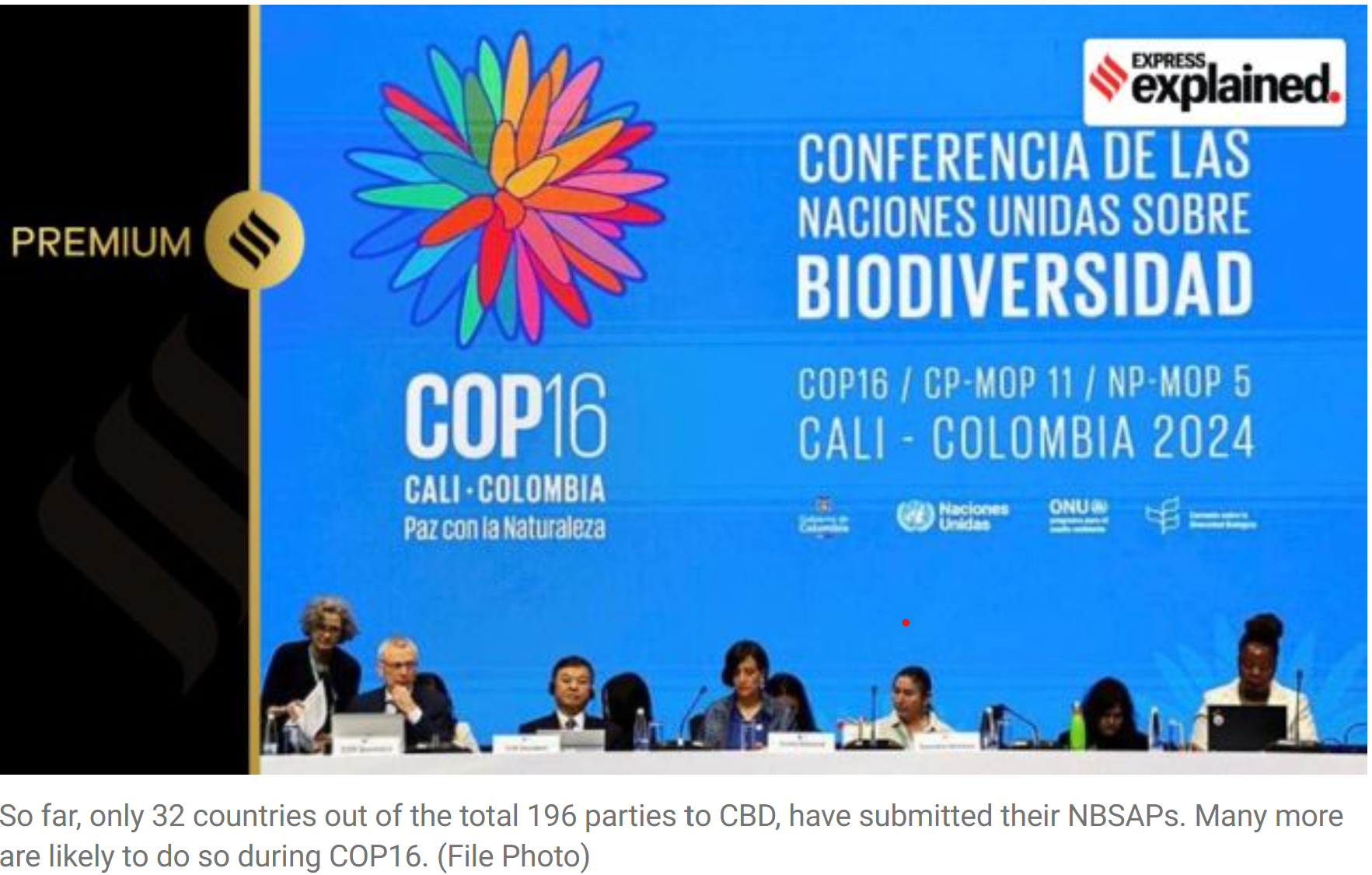
The 16th Conference of the Parties (COP16) to the Convention on Biological Diversity (CBD) will take place in Cali, Colombia, from October 21, 2024. This marks the first gathering since the adoption of the Kunming-Montreal Global Biodiversity Framework (KMGBF) in 2022.
About Convention on Biological Diversity (CBD)
- Adopted in 1992, the CBD is the most comprehensive international treaty focused on biodiversity conservation, the sustainable use of natural resources, and the fair sharing of benefits derived from genetic resources. It has been ratified by 196 countries, making it a key global instrument for biodiversity governance.
Key Objectives of the CBD
- Conservation of Biodiversity: Protecting genetic, species, and ecosystem diversity.
- Sustainable Use of Resources: Ensuring resources are used in a way that does not deplete or degrade biodiversity.
- Fair Sharing of Benefits: Ensuring that benefits from genetic resources are shared equitably with countries of origin.
Notable Frameworks within CBD
- Nagoya Protocol (2010): Establishes a framework for the fair and equitable sharing of benefits from the utilization of genetic resources.
- Cartagena Protocol (2000): Regulates the transboundary movement of living modified organisms (LMOs) resulting from modern biotechnology.
The Kunming-Montreal Global Biodiversity Framework (KMGBF)
- Adoption: The KMGBF was adopted at COP15 in 2022, following the Kunming Declaration.
- Targets: The framework includes 23 targets for 2030 and 4 global goals for 2050, aimed at reversing biodiversity loss and promoting sustainability.
- Notably, the 30x30 Target aims for 30% of the world’s land and oceans to be conserved by 2030. This is a key agenda item at COP16.
- The framework also emphasizes equitable access to genetic resources and the sharing of benefits from their use (Target 13).
Challenges and Issues at COP16
- Benefit-Sharing from Digital Sequence Information (DSI):
- A key issue is the fair sharing of benefits from digital sequence information (DSI) on genetic resources. The adoption of a global mechanism for this issue is still pending, as negotiations between developed and developing countries remain unresolved.
- Developed nations advocate for unrestricted access to genetic materials in exchange for voluntary contributions to a global fund.
- Developing nations seek a more equitable system, aligned with the CBD's principles of fair benefit-sharing.
- A key issue is the fair sharing of benefits from digital sequence information (DSI) on genetic resources. The adoption of a global mechanism for this issue is still pending, as negotiations between developed and developing countries remain unresolved.
- 30x30 Target Progress:
- The 30x30 target, which aims to conserve 30% of land and oceans by 2030, is far from being met:
- 17.5% of land and 8.4% of oceans are currently under protection.
- Concerns persist about the effectiveness of these protected areas, as studies suggest they may not be sufficient for long-term biodiversity conservation.
- The 30x30 target, which aims to conserve 30% of land and oceans by 2030, is far from being met:
- Financial Commitments (Target 19):
- Developed countries have pledged $20 billion annually for biodiversity financing by 2025. However, progress is slow:
- By September 2024, only $8.2 billion (41% of the target) had been committed.
- COP16 will assess whether this target can be met, with further announcements expected.
- Developed countries have pledged $20 billion annually for biodiversity financing by 2025. However, progress is slow:
- Implementation Gaps:
- Countries are required to set national targets aligned with the KMGBF. As of COP16, only 100 parties have submitted their targets, and 30 countries have updated their National Biodiversity Strategies and Action Plans (NBSAPs).
- A significant implementation gap remains in translating these targets into concrete actions.
Focus Areas for COP16
- Strengthening the 30x30 Target:
- COP16 will push for enhanced efforts to meet the 30x30 conservation goal. There is a need for better management and monitoring of protected areas to ensure they contribute to biodiversity preservation.
- Finalizing Benefit-Sharing Mechanism:
- Countries will focus on finalizing the multilateral benefit-sharing mechanism for genetic resources and DSI. The goal is to ensure that countries benefiting from genetic resources share those benefits with the countries of origin, addressing the issue of biopiracy and ensuring equitable access.
- Financial Commitment and Tracking:
- The financial shortfall for biodiversity conservation will be a critical discussion point. Effective monitoring of the biodiversity finance tracker will be needed to ensure that developed countries meet their $20 billion/year commitment.
- Addressing Implementation Gaps:
- There is a need to enhance monitoring and reporting mechanisms, improve national strategies, and align financial support with on-ground conservation efforts.
Convention on Biological Diversity (CBD)
- 14 May 2024
Why is it in the News?
Technical experts from across the world are gathered at the United Nations headquarters in Kenya in preparation for the 16th Conference of Parties to the Convention on Biological Diversity (COP16).
About the Convention on Biological Diversity (CBD):
- The Convention on Biological Diversity (CBD), known informally as the Biodiversity Convention, is a multilateral treaty that has the main objective of developing national strategies for the conservation and sustainable use of biological diversity.
- It is a multilateral treaty established in 1992 at the United Nations Conference on Environment and Development (also known as the Earth Summit) held in Rio de Janeiro, Brazil.
- Signed by 150 government leaders, the Convention on Biological Diversity is dedicated to promoting sustainable development.
- Conceived as a practical tool for translating the principles of Agenda 21 into reality, the Convention recognizes that biological diversity is about more than plants, animals and microorganisms and their ecosystems – it is about people and our need for food security, medicines, fresh air and water, shelter, and a clean and healthy environment in which to live.
The CBD has so far produced two important international agreements:
- The Cartagena Protocol on biosafety entered into force in 2003, seeks to protect the environment from the potential risks of Genetically Modified (GM) organisms.
- The Cartagena Protocol on Biosafety to the Convention on Biological Diversity is an international treaty governing the movements of living modified organisms (LMOs) resulting from modern biotechnology from one country to another.
- It aims to ensure the safe handling, transport, and use of living-modified organisms (LMOs) that may have adverse effects on biological diversity, taking into account human health, especially focusing on transboundary movements.
- The protocol was adopted in January 2000 in Cartagena, Colombia, and entered into force on September 11, 2003.
- The Nagoya Protocol on Access to Genetic Resources entered into force in 2014, aims at sharing the benefits arising from the utilisation of genetic resources in a fair and equitable way.
- The Nagoya Protocol on Access to Genetic Resources and the Fair and Equitable Sharing of Benefits Arising from their Utilization is a supplementary agreement to the Convention on Biological Diversity.
- It provides a legal framework for the fair and equitable sharing of benefits arising from the utilization of genetic resources, with a particular focus on ensuring that benefits are shared with the countries and communities that provide those resources.
- The protocol aims to promote the conservation and sustainable use of biodiversity while also respecting the rights of indigenous and local communities over their traditional knowledge and genetic resources.
- It was adopted in Nagoya, Japan, in 2010 and entered into force in 2014.
- The Conference has also implemented many positive decisions that have contributed to the promotion of environmental integrity and the rights of Indigenous Peoples and Local Communities.
- In 2010, the conference in Nagoya adopted a Strategic Plan for Biodiversity, including the Aichi Biodiversity Targets for the 2011-2020 period.
- The convention provides a framework for member countries to develop national strategies and action plans for the conservation and sustainable use of biological diversity.
- As of now, 196 countries have ratified the convention, making it a widely accepted and crucial international agreement for addressing global environmental issues.