
Sweden–India Technology and Artificial Intelligence Corridor (SITAC)
- 27 Feb 2026
In News:
On the sidelines of the India AI Impact Summit 2026, the IndiaAI Mission and Business Sweden signed a Statement of Intent (SoI) to deepen bilateral cooperation in Artificial Intelligence (AI) and digital technologies. The agreement marks a significant step in institutionalising India–Sweden collaboration in emerging technologies and innovation-driven growth.
Nature and Objectives of the Statement of Intent (SoI)
The SoI establishes a structured framework for collaboration in:
- Development, application, and deployment of AI solutions
- Promotion of trade and investment linkages
- Advancement of responsible and scalable digital innovation
The partnership emphasises real-world industrial and societal outcomes, reflecting a shared commitment to using AI for economic growth, sustainability, and technological transformation while managing associated risks.
Sweden–India Technology and Artificial Intelligence Corridor (SITAC)
Both countries will jointly develop a dedicated programme titled the Sweden–India Technology and Artificial Intelligence Corridor (SITAC).
Key Features:
- Flagship institutional platform for AI cooperation
- Structured engagement between:
- Government agencies
- Industry stakeholders
- Startups
- Academic and research institutions
SITAC aims to serve as a long-term innovation bridge linking the AI ecosystems of both countries.
Areas of Cooperation under SITAC
The framework proposes:
- Conferences, seminars, and thematic workshops
- Ecosystem exchanges between Indian and Swedish AI communities
- Field visits to innovation hubs and Centres of Excellence
- Engagement among companies, investors, researchers, and policymakers
- Joint innovation platforms and investment corridors
- Deployment of AI solutions across priority sectors
This multi-level engagement seeks to translate policy vision into industry-level collaboration.
Strategic Alignment of National Priorities
India’s Objectives (IndiaAI Mission)
- Build a comprehensive AI ecosystem
- Expand access to compute infrastructure, data, and skilled talent
- Promote sovereign and inclusive AI development
- Encourage startup-led innovation
Sweden’s Strengths
- Industrial innovation and advanced R&D
- Strong manufacturing and clean-tech ecosystem
- Leadership in responsible and ethical AI implementation
- Experience in digital governance frameworks
The partnership integrates India’s scale and digital capacity with Sweden’s research depth and industrial expertise.
M.A.N.A.V. Vision for Artificial Intelligence Governance
- 21 Feb 2026
In News:
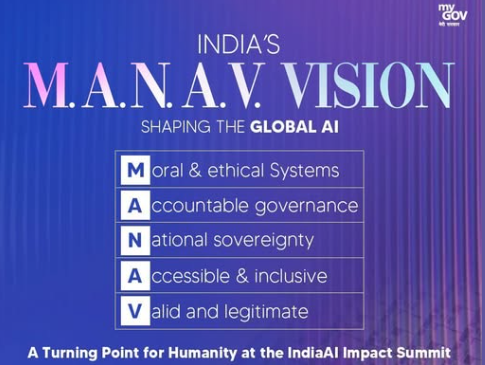
- At the India AI Impact Summit 2026, held at Bharat Mandapam, New Delhi, the Prime Minister Narendra Modi presented the M.A.N.A.V. vision (PM Narendra Modi’s Human-Centric AI Odyssey)-India’s guiding framework for Artificial Intelligence (AI) governance.
- India, home to one-sixth of the global population and one of the largest youth and technology talent pools, positioned itself as both a major AI adopter and a norm-shaper in global AI discourse.
What is M.A.N.A.V.?
M.A.N.A.V. is a human-centric AI governance framework that ensures technological advancement aligns with:
- Human dignity
- Ethical safeguards
- Inclusivity
- Legal accountability
- National interest
It seeks to balance innovation with constitutional values and democratic principles.
Five Pillars of M.A.N.A.V.
1. Moral and Ethical Systems
- AI must be rooted in fairness, transparency, and human oversight.
- Ethical AI principles integrated through National Education Policy 2020.
- Emphasis on AI literacy and computational thinking across educational levels.
- Public awareness initiatives promoted responsible AI usage, including a large-scale AI responsibility pledge campaign.
2. Accountable Governance
- Establishment of transparent regulatory architecture.
- Anchored by the IndiaAI Mission with an outlay exceeding ?10,300 crore.
- Focus areas: compute infrastructure, datasets, skilling, innovation ecosystem.
- AI Governance Guidelines emphasize: Trust, Equity, Accountability, and Explainability
- Ensures AI systems remain lawful and aligned with constitutional values.
3. National Sovereignty
- Extends sovereignty to: Data, Algorithms, and Digital infrastructure
- Promotion of indigenous AI models and domestic compute capacity.
- Supported by:
- India Semiconductor Mission
- Trusted digital public infrastructure
- Objective: Technological self-reliance without digital isolation.
4. Accessible and Inclusive AI
- Democratization of AI access across: Governance, Healthcare, Education, and Agriculture
- Key platforms:
- IndiaAI Compute Portal (shared GPU/TPU access)
- MeghRaj GI Cloud
- IndiaAI Kosh (datasets and AI models)
- Linked with the National Supercomputing Mission and AI Data Labs Network.
- Reduces entry barriers for startups, researchers, and institutions.
5. Valid, Safe and Legitimate Systems
- AI systems must be verifiable, lawful, and transparent.
- Addresses risks from deepfakes and synthetic media.
- Supported by Information Technology (Intermediary Guidelines and Digital Media Ethics Code) Amendment Rules, 2026.
- IndiaAI Mission’s Safe & Trusted AI pillar promotes:
- Bias mitigation
- Privacy-preserving design
- Algorithmic auditing
- Risk assessment frameworks
Copyright Act Reforms for Artificial Intelligence

- 19 Dec 2025
In News:
The Government of India is considering amendments to the Copyright Act to address legal challenges posed by Artificial Intelligence (AI), especially the use of copyrighted works for AI training.
Background
The Copyright Act, 1957 protects original literary, artistic, musical, dramatic works, films, and sound recordings. It grants creators exclusive rights to reproduce, adapt, publish, translate, and communicate their works to the public. However, the rise of generative AI has exposed gaps in the law regarding training data usage and ownership of AI-generated outputs.
Key Proposed Amendments
1. Mandatory Blanket License for AI Training: AI developers may receive a statutory blanket license allowing them to use lawfully accessed copyrighted works for training AI models.
- Individual permission from each copyright owner would no longer be required.
- Rights holders may lose the ability to opt out of AI training use.
2. Statutory Right to Remuneration: Creators would be entitled to royalties when their works are used in AI training.
- Compensation could be calculated as a fixed share of revenue generated by AI systems.
- Payments would become due once AI products are commercialised, not during data collection.
3. Centralised Royalty Collection Mechanism: A government-designated, non-profit bodycomprising copyright societies and collective management organisationsmay be set up to collect and distribute royalties.
4. Concessions for Startups and MSMEs: Differential royalty structures may be introduced to ensure smaller AI firms are not disproportionately burdened.
Why Reform is Needed
- Absence of AI-Specific Definitions: The Act does not define terms such as AI, machine learning, generative AI, or training data, leading to legal uncertainty.
- Ambiguity Over AI Training: It is unclear whether AI training amounts to reproduction or adaptation under Section 14, or whether it qualifies as “fair dealing” under Section 52.
- Uncompensated Use of Creative Works: Mass data scraping for AI training currently occurs without systematic permission or remuneration for creators.
- Authorship of AI-Generated Content: The Act recognises authors in human terms, leaving uncertainty about ownership and protection of AI-created outputs.
- Cross-Border Issues: Existing provisions do not address AI systems trained abroad using Indian works or cloud-based data processing, complicating enforcement.
Key Features of the Copyright Act, 1957
- Section 2: Defines categories of works (literary, dramatic, artistic, etc.)
- Section 13: Extends protection to literary, musical, dramatic works, films, and sound recordings
- Section 14: Grants exclusive rights to copyright owners
- Section 52: Lists exceptions such as fair dealing
- Copyright exists automatically upon creation; registration is not mandatory
Judicial Highlights
Indian courts have emphasised balancing creator rights and public interest:
- Educational photocopying has been upheld as fair dealing
- Digital piracy has been actively restrained through blocking rogue websites
- Limited use of copyrighted content may not always constitute infringement
Global Approaches to AI & Copyright
|
Country/Region |
Approach |
|
United States |
Copyright requires human creativity; purely AI-generated works not protected |
|
European Union |
Focus on AI training data transparency; legal framework evolving |
|
China |
Courts have recognised AI-generated images as protected works in some cases |
|
United Kingdom |
Law assigns authorship of computer-generated works to the person making arrangements, but rarely applied |
India’s proposed model differs by combining mandatory licensing with creator remuneration, aiming to balance innovation and rights protection.
Global Artificial Intelligence (AI) City Index 2025

- 08 Aug 2025
In News:
Bengaluru ranks 26thin Global AI City Index, Singapore secures top spot.
About the Index
- Published by: Market research firm Counterpoint Research.
- Objective: Benchmarks global cities on their AI capacity, investment, and innovation.
- Evaluation Criteria:
- AI R&D ecosystem and startup strength
- Investment inflows & public–private partnerships
- AI applications in transport, healthcare, and education
- Data centre growth & digital infrastructure readiness
- Governance and regulatory frameworks
Global Rankings (2025)
- Top 5 Cities: Singapore (1st), Seoul (2nd), Beijing (3rd), Dubai (4th), San Francisco (5th).
- Key Trends:
- Singapore’s success driven by strong startup ecosystem and public–private collaboration in healthcare, telecom, and transport.
- Seoul excels in AI healthcare and education applications.
- Beijing introduced formal AI education for all primary & secondary school students (2025).
- Investments in supercomputing expected to reduce gap between North America and China.
- Tech industry leaders: Microsoft (most active vendor with AI data centres, training, innovation hubs), followed by Google and Amazon expanding their global AI footprint.
India’s Performance
- Bengaluru: Ranked 26th globally – India’s top AI R&D and data centre hub with a vibrant startup ecosystem attracting foreign investment.
- Other Indian Cities:
- Mumbai & Delhi – Leveraging AI for traffic management and public security.
- Chennai & Kolkata – Emerging AI hubs.
- India’s Challenge: Report highlights need for a comprehensive AI roadmap and robust regulatory framework to maximize growth potential.
Significance
- Establishes Bengaluru as India’s AI capital, strengthening its role in digital infrastructure and innovation.
- Reflects India’s growing presence in the global AI landscape while underlining policy gaps.
- Offers lessons from global leaders like Singapore and Seoul on AI integration in governance, education, and healthcare.
Sovereign Artificial Intelligence
- 13 Jan 2025
In News:
- The growth of Artificial Intelligence (AI) has been remarkable in recent years. In 2018, a 340-million-parameter AI model was considered large, whereas models like ChatGPT now have 1.8 trillion parameters.
- As part of its ambition to make the digital economy worth USD 1 trillion by 2028, India is focusing on AI sovereignty and investing in semiconductors and AI technologies to achieve this goal.
What is Sovereign AI?
Definition
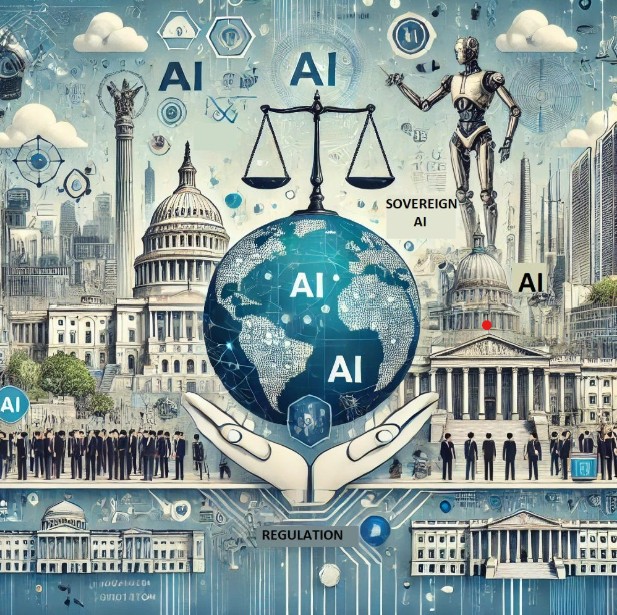
- Sovereign AI refers to a nation’s ability to develop, control, and deploy AI using its own resources, including infrastructure, data, workforce, and business networks.
- This involves not just developing AI models but also creating infrastructure and nurturing homegrown talent to lead AI advancements within the country.
Key Aspects of Sovereign AI
- National Control: Ensures AI technologies align with a country's laws, regulations, and ethical standards.
- Data Sovereignty: Emphasizes control of data within the country’s borders, protecting privacy, security, and national interests.
- AI in Governance: Generative AI is transforming industries, markets, and governance, with AI-powered tools assisting professionals and governments.
- Ethical Considerations: Countries define security protocols and ethical frameworks to govern the use of AI technologies.
- Strategic Autonomy: Reduces reliance on foreign technologies, encouraging domestic development in AI to achieve strategic independence.
- Economic Competitiveness: AI is crucial for industrial innovation. Without it, nations risk falling behind in the global economy.
Growth and Importance of AI
Evolution of AI Models
- In 2018, a 340-million-parameter model was considered a significant achievement.
- Today, ChatGPT uses 1.8 trillion parameters, and Google’s Gemini uses 1.5 trillion parameters. In comparison, China’s DeepSeek has a model with 240 billion parameters.
- Parameters are the internal variables of AI models, adjusted during training to improve their performance and accuracy.
Strategic Applications
- Sovereign AI plays a pivotal role in critical sectors such as:
- Defense
- Healthcare
- Transportation
- Governance
- It helps redefine industries, boost innovation, and streamline operations across various sectors.
India’s Position in Sovereign AI
AI Infrastructure Development
- Tata Group and Reliance are building AI infrastructure in India, including the development of Large Language Models (LLMs).
- India has allocated USD 1.2 billion for a sovereign AI project under the IndiaAI Mission, which includes creating an AI supercomputer with thousands of chips.
Government Initiatives
- The IndiaAI Mission is designed to boost India’s AI capabilities by building infrastructure, fostering talent, and supporting innovation within the country.
Global AI Compact
- A Global AI Compact has been proposed to ensure equitable access to AI technologies across nations.
- The compact advocates for sharing AI resources globally while promoting cooperation and addressing challenges associated with AI governance.
Year of Artificial Intelligence

- 05 Jan 2025
In News:
The All India Council for Technical Education (AICTE) has declared 2025 as the "Year of Artificial Intelligence" (AI), aiming to empower over 14,000 AICTE-approved colleges and benefit 40 million students. This initiative aligns with the Prime Minister’s vision to make India a global leader in AI and technology.
Key Objectives and Features of the AICTE AI Initiative:
- Positioning India as a Global AI Leader:
- Empowering students with AI skills to drive innovation and lead in the emerging AI-driven economy.
- Preparing India’s workforce for the technological advancements of the future.
- Core Elements of the AICTE AI Initiative:
- AI Affirmation Pledge: Institutions will adopt and display an AI Affirmation Pledge, focusing on innovation, ethics, and education in AI.
- Comprehensive AI Integration:
- Introducing interdisciplinary AI courses and research programs.
- Setting up AI labs in collaboration with industries to meet global standards.
- Promoting ethical AI practices with societal benefits in focus.
- AI Awareness Campaign:
- “AI for All: The Future Begins Here” campaign includes workshops, hackathons, and guest lectures.
- Formation of student-driven AI chapters to foster innovation and research.
- Faculty Development & Industry Partnerships:
- Workshops and certification programs for faculty to improve AI teaching.
- Collaboration with companies like Adobe, CISCO, and IBM for student exposure through internships and mentorships.
- Recognition of Excellence: Institutions excelling in AI integration will be recognized, serving as role models for others.
- Action Plan for Institutions:
- All institutions are required to submit AI Implementation Plans by December 31, 2024. These plans will be evaluated by the AICTE Approval Bureau and exemplary submissions will be highlighted as benchmarks.
- Shaping India as a Global AI Leader:
- AICTE aims to revolutionize India’s education system and enhance its position in the global AI race, focusing on building a self-reliant workforce.
Additional Context on AICTE and its Role:
- AICTE Overview:
- A statutory body and national-level council under the Ministry of Education.
- Established in November 1945 as a national-level apex advisory body for technical education in India.
Government Initiatives to Support AI and Consumer Protection:
- AI and Consumer Protection:
- AI-driven tools launched to enhance consumer protection, such as the National Consumer Helpline, e-MAAP Portal, and Jago Grahak Jago mobile application.
- New guidelines for regulating deceptive marketing in e-commerce to ensure consumer confidence in the digital market.
- Tools like the e-Daakhil Portal for online complaint filing.
Impact:
- This initiative will have a far-reaching impact, involving more than 14,000 institutions and 40 million students nationwide, preparing them for leadership roles in AI and technology, and helping India secure its future in the global AI-driven economy.
Project Astra

- 20 May 2024
Why is it in the News?
Recently, during the company's annual developer conference, Google unveiled an early version of Project Astra.
What is Project Astra?
- Project Astra is an experimental “multimodal” AI assistant developed by Google DeepMind.
- It's designed to be a versatile tool that can understand and respond to information from the real world through various means, like text, voice, images, and even videos.
- This makes it different from current AI assistants that mostly rely on internet searches and user input.
- Building on Google’s Gemini language model, Astra has multimodal capabilities to perceive visuals, sounds, and other real-world inputs.
- The aim is to create a universal AI helper that seamlessly assists us in daily life by comprehending the actual environment through sight and sound, not just text.
- Astra represents Google’s vision for next-gen AI assistants.
Key Features of Google's Project Astra:
- Visual Understanding: Astra can interpret and analyze visual input from its camera feed.
- It identifies objects, reads text, and describes scenes and environments in detail, allowing users to show Astra something and ask questions about it.
- Voice Interaction: Astra supports natural conversation without the need to repeatedly use wake words.
- It comprehends context and facilitates back-and-forth dialogue, even allowing users to interrupt its responses.
- Remembering Context: Astra retains memory of previous conversation parts, objects it has seen, and information provided by the user.
- This contextual awareness enhances the fluidity of interactions.
- Multimodal Integration: Astra integrates visual and auditory inputs to form a comprehensive understanding of the current situation, correlating what it sees and hears to fully grasp the context.
- Real-Time Assistance: Astra delivers real-time assistance by rapidly processing sensor data and queries, ensuring a responsive and interactive user experience.
What are Multimodal AI Models?
- Multimodal AI models are advanced artificial intelligence systems that process and integrate multiple types of data inputs, such as text, images, audio, and video, to develop a comprehensive understanding of context.
- By combining these different modalities, these models enhance their ability to interpret complex scenarios more accurately than unimodal systems.
- For instance, in autonomous vehicles, multimodal AI uses data from cameras, lidar, radar, and GPS for better navigation.
- In healthcare, these models integrate medical images with patient history for improved diagnostics.
- Applications also include virtual assistants, which understand and respond to spoken commands while recognizing objects in images, and educational tools that combine text, video, and interactive content for richer learning experiences.
- Multimodal AI models are often implemented using deep learning techniques, which allow the model to learn complex representations of the different data modalities and their interactions.
- As a result, these models can capture the rich, diverse information present in real-world scenarios, where data often comes in multiple forms.
Predictive AI: Its Applications and Advantages

- 18 Mar 2024
Why is it in the News?
Predictive AI is revolutionizing data analysis, decision-making, and industry leadership, offering businesses unprecedented insights and strategic advantages.
What is Predictive Artificial Intelligence (AI)?
- Predictive artificial intelligence (AI) utilizes machine learning techniques to analyze historical data and forecast future events, distinguishing it from traditional AI focused solely on retrospective analysis.
- This cutting-edge technology employs advanced algorithms and machine learning models to sift through extensive datasets, identifying subtle patterns and trends.
- Unlike conventional approaches, Predictive AI doesn't just analyze data; it transforms it into actionable insights, enabling organizations to:
- Anticipate future outcomes,
- Predict market shifts, and
- Make strategic decisions with unprecedented foresight.
- By continuously learning from past data and adapting to changing trends, Predictive AI becomes an invaluable tool, guiding businesses through uncertain landscapes.
How Predictive AI Work?
- Leveraging Big Data: Predictive AI relies on access to extensive datasets, often referred to as "big data," as larger datasets typically lead to more accurate analyses.
- Utilizing Machine Learning (ML): As a subset of AI, ML involves training computer programs to analyze data autonomously, without human intervention.
- In the realm of predictive AI, ML algorithms are applied to vast datasets to extract valuable insights.
- Autonomous Processing: Predictive AI models are capable of autonomously processing massive datasets, eliminating the need for human oversight.
- Pattern Recognition: Through ML techniques, predictive AI learns to recognize patterns within datasets, associating specific data points or occurrences with potential future events.
- By examining numerous factors, predictive AI can identify intricate patterns indicative of recurring events, enabling organizations to anticipate future outcomes effectively.
Difference Between Predictive AI and Generative AI:
- Predictive AI and generative AI both employ machine learning techniques and leverage extensive datasets to generate their outputs.
- However, while predictive AI utilizes machine learning to forecast future outcomes, generative AI employs machine learning to produce original content.
- For instance, a predictive AI model may inform fishermen about impending storms, whereas a generative AI model may craft a fictional narrative depicting various scenarios involving weather and fishing expeditions.
- While both types of AI rely on statistical analysis to discern patterns, their objectives, machine learning methodologies, and applications differ significantly.
Various Applications of Predictive AI:
- Assessing the Impact of Natural Disasters: With the recent eruption of a volcano in Iceland, the potential repercussions on air travel echo concerns from a similar event in 2010, which disrupted flights across Europe.
- Predictive AI leverages data analysis to identify patterns and anticipate the impact of such extreme weather events on air travel. Platforms like Yandex offer interactive maps for real-time monitoring of ash clouds post-eruption.
- Enhancing Oil and Gas Exploration: In the realm of oil and gas exploration, companies possess extensive historical geological data that can inform predictive AI systems.
- By analyzing past drilling successes, these systems can predict optimal locations for new oil wells.
- For instance, Saudi Aramco utilizes its meta-brain generative AI to optimize drilling plans, analyze geological data, and forecast drilling outcomes accurately.
- By analyzing past drilling successes, these systems can predict optimal locations for new oil wells.
- Inventory and Supply chain management: Predictive AI aids in inventory and supply chain management by identifying peak consumer demand periods, facilitating proactive stock adjustments, and optimizing resource allocation to address fluctuations in road congestion and meet increased user demands.
- Marketing campaigns: Just as predictive AI can anticipate user or customer behavior, it can help prognosticate what kinds of content or products prospective customers may be interested in.
- Advancing Medical Research: Predictive AI plays a pivotal role in drug discovery, a cornerstone of contemporary medical research.
- Pharmaceutical companies are increasingly collaborating to leverage predictive AI models for analyzing vast datasets and identifying potential drug candidates. Initiatives like the 'MELLODDY Project', supported by the EU Innovative
- Medicines Initiative and multiple pharmaceutical firms, exemplify this collaborative effort in pooling data and leveraging predictive AI for drug discovery.
Bletchley Declaration 2023 (Indian Express)

- 03 Nov 2023
Why in the News?
The United Kingdom hosted a major Artificial Intelligence (AI) meeting, bringing together political leaders and technological professionals to explore the potential benefits and risks of this fast-evolving technology.
About the Bletchley Declaration:
- The Bletchley Declaration provides a comprehensive overview of the worldwide perspective on the potential benefits and risks associated with artificial intelligence (AI).
- It underlines the necessity of aligning AI systems with human intentions and encourages a deeper exploration of AI's full capabilities.
- Furthermore, the document acknowledges the potential for significant harm caused by AI, whether intentional or unintentional, including the possibility of catastrophic consequences.
- The Bletchley Declaration places great emphasis on safeguarding human rights, promoting transparency, ensuring explainability, upholding fairness, ensuring accountability, establishing regulation, prioritizing safety, incorporating human oversight, adhering to ethical standards, addressing bias issues, safeguarding privacy, and protecting data.
- This document is a reflection of the intricate negotiations between nations with differing interests and legal systems, encompassing countries such as the United States, the United Kingdom, the European Union, and China.
- The Bletchley Declaration highlights the crucial role of civil society in addressing AI safety concerns, despite some criticism from civil society groups that felt excluded from the summit.
- It also places a significant responsibility on companies engaged in the development of cutting-edge AI systems, emphasizing the need to ensure their safety through rigorous testing, evaluation, and the implementation of appropriate measures.