
South Atlantic Anomaly (SAA)
- 14 Apr 2026
In News:
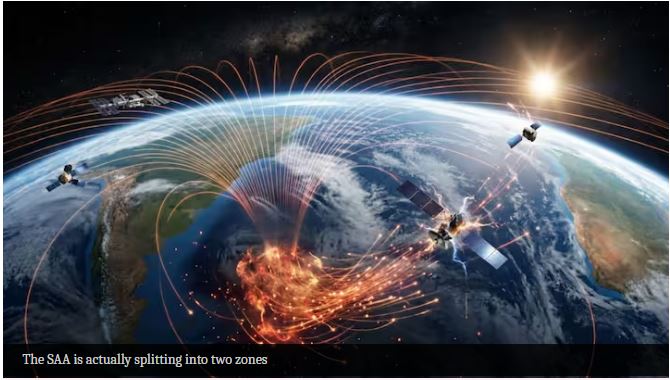
The Earth’s magnetic field, which serves as a vital shield against solar and cosmic radiation, is currently undergoing significant changes. Scientists have observed that the South Atlantic Anomaly (SAA), a region where this magnetic protection is notably weak—is not only expanding but is now splitting into two distinct zones. This evolution poses increasing risks to global satellite infrastructure and space exploration.
Understanding the South Atlantic Anomaly (SAA)
The SAA is an area characterized by a significant "dip" or weakening in the Earth's magnetic field. This allows charged particles and cosmic rays from the Sun to penetrate much deeper into the atmosphere than elsewhere on the planet.
- Location: Geographically situated between South America and Africa (roughly 5° to 40° S latitude and 0° to 80° W longitude).
- Discovery: First identified in the 19th century, its shape, size, and intensity fluctuate seasonally and over long-term geological cycles.
- Scientific Monicker: Often referred to as the "Bermuda Triangle of Space" due to its tendency to cause technical malfunctions in passing spacecraft.
The Role of Van Allen Radiation Belts
To understand why the SAA occurs, one must look at the Van Allen Belts—two doughnut-shaped zones of energetic charged particles trapped by Earth's magnetosphere.
- The Outer Belt: Primarily composed of high-energy particles from solar winds.
- The Inner Belt: Formed by the interaction of cosmic rays with the Earth's atmosphere.
- Mechanism of SAA: The SAA exists because the inner Van Allen belt comes closest to the Earth's surface in this specific region. Because the Earth’s magnetic axis is slightly tilted and offset from its rotational axis, the radiation belt "dips" lower toward the South Atlantic, creating a high-flux zone of energetic particles.
Recent Developments: The "Splitting" Phenomenon
Recent data indicates that the SAA is weakening further and undergoing a structural change. It is currently developing two separate centers of minimum magnetic intensity.
- The Eastern Cell: Moving toward the southwest of Africa.
- The Western Cell: Positioned near South America.
This split makes the region "trickier" for satellite operators to navigate, as the area of potential interference is becoming more complex and geographically dispersed.
Impacts and Risks
The increased flux of particles in the SAA has direct consequences for modern technology and safety:
|
Sector |
Impact |
|
Satellites & LEO |
Low Earth Orbit (LEO) satellites passing through the SAA face "Single Event Upsets" (SEUs)—momentary glitches or permanent damage to electronic circuits. |
|
Space Stations |
Critical missions, such as the International Space Station (ISS), often shut down non-essential systems or delay spacewalks when passing through the anomaly to protect astronauts and equipment. |
|
Aviation & Marine |
High-energy particles can interfere with positioning systems (GPS/GNSS), complicating land, sea, and air navigation in the South Atlantic region. |
|
Scientific Data |
Delicate instruments on board space telescopes (like Hubble) are often "blinded" or powered down while traversing the SAA to avoid data corruption. |