
India’s New GDP Series with Base Year 2022-23
- 06 Mar 2026
In News:
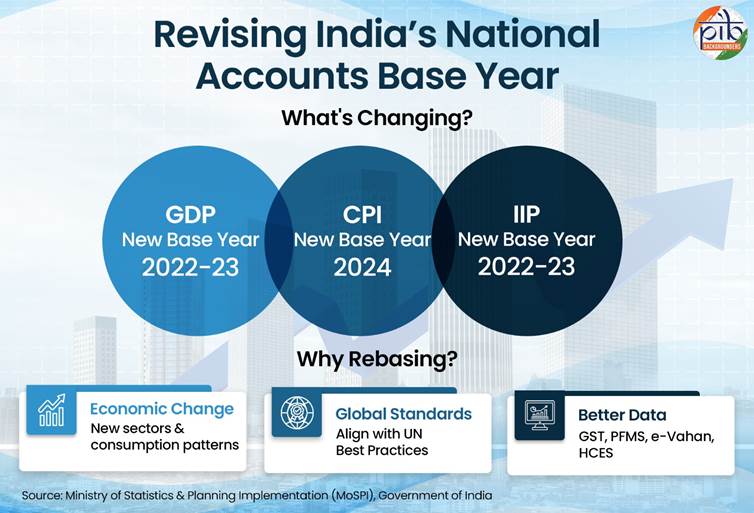
The Ministry of Statistics and Programme Implementation (MoSPI) has introduced a new series of Annual and Quarterly National Accounts Estimates with base year 2022–23, replacing the earlier 2011–12 base year. This revision represents a major statistical update in the measurement of India’s Gross Domestic Product (GDP).
The new series integrates improved data sources, updated sectoral coverage, and refined estimation techniques such as the Supply and Use Tables (SUT) framework and double deflation, ensuring a more accurate representation of the evolving structure of the Indian economy.
Key Highlights of the New GDP Series
Growth Performance
- Real GDP growth is estimated at 7.6% in FY 2025–26, revised upward compared with estimates based on the previous series.
- Growth remained robust at 7.2% in FY 2023–24 and 7.1% in FY 2024–25.
- Nominal GDP growth is estimated at 8.6% in FY 2025–26, after 11.0% (FY 2023–24) and 9.7% (FY 2024–25).
Quarterly Economic Drivers
- The strong performance in FY 2025–26 was driven mainly by:
- Second quarter growth: 8.4%
- Third quarter growth: 7.8%
Sectoral Contributions
- Manufacturing emerged as a key growth driver with double-digit growth in FY 2023–24 and FY 2025–26.
- Secondary and tertiary sectors recorded over 9% growth in FY 2025–26.
- The services segment “Trade, Repair, Hotels, Transport, Communication and Broadcasting-related services” grew by 10.1% at constant prices.
Demand-Side Trends
- Private Final Consumption Expenditure (PFCE) and Gross Fixed Capital Formation (GFCF) both grew above 7% in FY 2025–26, indicating strong consumption and investment demand.
Rationale for Revising the Base Year
1. Reflecting a Normal Post-Pandemic Year: The base year 2022–23 was selected as it represents a stable economic year after the disruptions caused by COVID-19. Earlier years such as 2019–20 and 2020–21 were distorted by lockdowns, supply chain disruptions and abnormal consumption patterns.
2. Capturing Structural Changes in the Economy: India’s economy has evolved significantly over the past decade with the expansion of:
- Digital and platform-based services
- Renewable energy
- Gig economy and platform work
- Changes in consumption and investment patterns
Rebasing ensures GDP estimates better reflect these structural shifts.
3. Improved Data Sources: The new series incorporates richer and more frequent datasets, including:
- Annual Survey of Unincorporated Sector Enterprises (ASUSE)
- Periodic Labour Force Survey (PLFS)
- GST data for manufacturing and services
- e-Vahan portal data for transport-related consumption
- Public Financial Management System (PFMS) for government accounts
- Updated sectoral studies in agriculture, fisheries, dairy and transport
These additions improve granularity, reliability and timeliness of GDP estimates.
Methodological Improvements
1. Double Deflation: Separate deflation of output and input prices is now used in manufacturing and agriculture, replacing the earlier single-deflation approach.
2. Supply and Use Tables (SUT) Framework: Following the **United Nations Statistical Division guidelines under the System of National Accounts 2008, the new series systematically applies the SUT framework, ensuring consistency between production, income and expenditure estimates.
3. Better Corporate Activity Classification: Value added by multi-activity corporations is now distributed across different sectors using detailed corporate filings.
4. Improved Estimation of Consumption
PFCE estimation now combines:
- household survey data,
- administrative records,
- commodity flow methods, and
- the COICOP 2018 classification.
5. Improved State-Level Estimation: The National Statistical Office (NSO) will guide states toward direct estimation of Gross State Domestic Product (GSDP) using better state-level datasets, improving comparability across states.
Implications of the New GDP Series
Lower Nominal GDP: The revised methodology has reduced nominal GDP by about 3–4% for FY 2025–26 and previous years.
Fiscal Deficit Pressures: Because fiscal deficit is measured as a percentage of GDP:
- The FY 2025–26 deficit rises from 4.4% to about 4.5% under the new series.
- Achieving the FY 2026–27 target of 4.3% may require nominal GDP growth of 13–14%, higher than earlier projections.
Higher Debt-to-GDP Ratio: The Centre’s debt ratio increases from 56.2% to 58.1% for FY 2025–26, making fiscal consolidation more challenging.
Impact on the USD 4 Trillion Economy Target: India’s GDP is estimated at about USD 3.8 trillion in FY 2025–26.
Crossing the USD 4-trillion mark in FY 2026–27 will require:
- strong nominal growth, and
- stable exchange rates, since rupee depreciation could delay the milestone.
Sectoral Realignment: Improved data suggests the agricultural sector is about 5% larger, partly due to better measurement of high-value crops and lower input costs such as solar-powered irrigation under schemes like PM KUSUM.
Way Forward: Strengthening India’s Economic Measurement System
- Introduction of Producer Price Index (PPI): Recommended by the Working Group on Producer Price Index chaired by B. N. Goldar, PPI would better capture producer price movements.
- Revision of Wholesale Price Index (WPI) Base Year: Updating WPI is necessary to ensure accurate deflators for GDP calculations.
- Preparation for SNA 2025 Adoption: India must build data infrastructure for the upcoming SNA 2025 framework, which will incorporate digital economy, crypto assets and environmental accounting.
- Better Measurement of MSMEs: Heavy reliance on corporate filings may bias estimates toward large firms; improved mechanisms are required to capture MSME value addition.