
HAMMER Precision Weapon System
- 27 Nov 2025
In News:
India and France have taken a major step in defence industrial cooperation with the signing of a Joint Venture Cooperation Agreement (JVCA) between Bharat Electronics Limited (BEL) and Safran Electronics & Defence (SED) for the manufacture of the HAMMER (Highly Agile Modular Munition Extended Range) precision-guided air-to-ground weapon system in India.
Key Highlights of the Joint Venture
- The proposed Joint Venture Company (JVC) will be incorporated in India as a private limited company with 50:50 shareholding between BEL and Safran.
- Manufacturing, supply, and maintenance of HAMMER will be localised to meet the operational requirements of the Indian Air Force and the Indian Navy, including integration with Rafale and Rafale Marine aircraft.
- Indigenisation will progressively rise to about 60%, covering key sub-assemblies, electronics, and mechanical components.
- Technology and production transfer will occur in phases, with BEL leading final assembly, testing, and quality assurance.
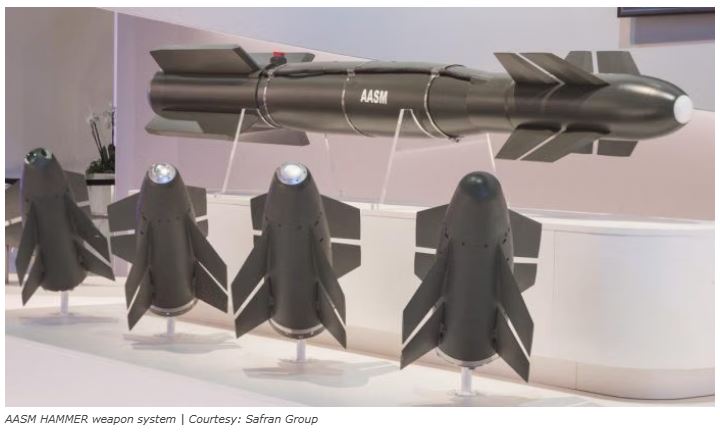
About HAMMER Precision Weapon System
- Type: Smart, precision-guided, air-to-surface weapon
- Developer: Originally developed by Safran (France)
- Configuration: Modular system comprising a guidance kit and a range-extension kit, which can be fitted onto standard general-purpose bombs of different weights.
Key Features
- High Precision: Multiple guidance options (GPS/INS, infrared, laser) enable accurate strikes on hardened targets such as bunkers, shelters, airstrips, and enemy infrastructure.
- Stand-off Capability: Effective strike range of up to ~70 km, allowing launch aircraft to remain outside hostile air-defence envelopes.
- High Agility: Optimised for mountainous and high-altitude terrain, making it suitable for areas like Ladakh.
- Platform Flexibility: Currently integrated with Rafale; planned integration with indigenous platforms like LCA Tejas.
Operational Background
- HAMMER was procured by the IAF under emergency procurement powers to quickly operationalise Rafale aircraft amid heightened security challenges, as it filled a capability gap for shorter-range precision strikes against hardened targets.
- Its selection was influenced by quicker availability and suitability for mountain warfare compared to alternative systems that would have required additional time and cost for integration.
Strategic Significance
- Make in India & Aatmanirbharta: The JV strengthens indigenous defence manufacturing and reduces long-term import dependence in critical precision weaponry.
- Enhanced Strike Capability: Improves India’s ability to conduct accurate, stand-off precision strikes in contested and high-risk environments.
- Cost and Time Efficiency: Local production lowers lifecycle costs, ensures faster availability, and supports sustained operational readiness.
- Industrial Ecosystem & Exports: Encourages technology absorption, skill development, and potential future export opportunities.