
Tapanuli Orangutan
- 16 Dec 2025
In News:
Scientists have warned that Cyclone Senyar-triggered floods and landslides in northern Sumatra may have killed 6–11% of the remaining Tapanuli orangutan population, pushing the species closer to extinction.
About the Tapanuli Orangutan
- The Tapanuli orangutan is the rarest great ape species in the world, formally identified as a distinct species in 2017. Fewer than 800 individuals are believed to survive in the wild.
- Habitat and Distribution
- Tapanuli orangutans are found only in the Batang Toru Ecosystem in North Sumatra, Indonesia.
- Their range is highly fragmented and restricted to upland and submontane rainforests south of Lake Toba, covering less than 3% of their historical range.
- Evidence suggests they were originally better adapted to lower-altitude forests but were pushed into higher terrain due to habitat loss.
- IUCN Status: The species is listed as Critically Endangered on the IUCN Red List due to its extremely small and declining population, restricted range, and ongoing threats.
Physical Characteristics
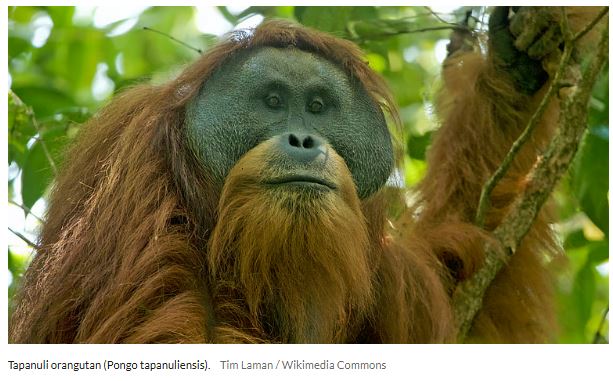
- Tapanuli orangutans resemble other orangutans in size but have distinct features. They possess smaller skulls, flatter faces, and thicker, frizzier orange fur. Adult flanged males have beards and moustaches, with flatter cheek pads covered in light-colored fuzz.
Behaviour and Ecology
- These orangutans are arboreal and largely solitary, spending most of their lives in the forest canopy.
- They are highly intelligent and known for tool use, using sticks and branches as hooks, scratchers, or to extract insects. Social learning and cultural transmission of behaviors have also been observed.
- Their life history is extremely slow, with one of the longest mother–offspring bonds in mammals (7–11 years). Males exhibit bimaturism, with two forms: unflanged males (smaller, no cheek pads) and dominant flanged males (large cheek pads and throat sacs).
- A unique ecological trait is their diet, which includes certain caterpillars and pinecones not known to be eaten by other orangutan species.
Why the Species is Extremely Vulnerable
The Tapanuli orangutan’s risk of extinction is amplified by:
- Extremely small total population
- Highly restricted and fragmented habitat
- Slow reproduction rate
- Increasing frequency of extreme weather events linked to climate change
- Ongoing habitat pressures from development and infrastructure
Even minor increases in mortality can have irreversible population-level consequences.
Conservation Significance
The Tapanuli orangutan represents the most ancient lineage of orangutans, despite being the most recently described. Its survival is crucial for preserving global great ape diversity and evolutionary history.
The recent cyclone highlights how climate-related disasters can become “extinction-level events” for species already on the brink.
Operation Green Scheme

- 27 Dec 2024
In News:
The government’s flagship Operation Greens scheme, designed to stabilise crop prices and benefit farmers, has spent just 34 per cent of its allocated budget for 2024-25, according to a parliamentary report, even as onion farmers in Maharashtra reel from massive losses and potato shortages grip eastern states.
Key Highlights:
Overview:
- Launched: November 2018 under the Pradhan Mantri Kisan SAMPADA Yojana.
- Objective: Stabilize prices and improve farmers' income by enhancing the production and marketing of perishable crops, initially focusing on Tomato, Onion, and Potato (TOP).
- Expanded Scope (2021): Includes 22 perishable crops like mango, banana, ginger, apple, and shrimp.
- Implemented by: Ministry of Food Processing Industries (MoFPI).
- Funding: Managed by the National Agricultural Cooperative Marketing Federation of India (NAFED).
Key Aims:
- Reduce price volatility in agricultural markets.
- Minimize post-harvest losses.
- Strengthen farm-to-market linkages.
- Enhance farmers’ earnings by stabilizing market prices.
- Promote value addition and food processing.
Scheme Components:
- Short-term Interventions:
- Subsidies on transportation (50%) and storage (50%) to protect farmers from distress sales.
- Price stabilization during periods of surplus or shortage.
- Long-term Interventions:
- Development of farm-gate infrastructure like cold storage and processing facilities.
- Strengthening production clusters and Farmer Producer Organizations (FPOs).
- Building efficient agri-logistics systems.
- Promoting food processing and value addition capacities.
Key Features:
- 50% subsidy on transportation and storage costs for eligible crops.
- Projects eligible for 50% subsidy (up to ?50 crore per project), and for FPOs, a 70% subsidy.
- Demand-driven funding based on applications, with no fixed crop or state-wise allocation.
Key Findings from Parliamentary Standing Committee (PSC) Report (2024):
- Underutilisation of Budget: Only 34% (?59.44 crore) of the allocated ?173.40 crore for 2024-25 spent by October 2024, leaving 65.73% unspent.
- Slow Implementation: Out of 10 targeted projects, only 3 were completed by October 2024.
- Limited Impact on Price Stabilization:
- Onion prices fell by nearly 50% in Maharashtra, despite the scheme's intent to stabilize prices.
- Potato shortages in states like Odisha and Jharkhand due to weather-induced production dips in West Bengal.
- Inconsistent Policies: Export bans and fluctuating export duties caused frustration among onion farmers, undermining the scheme’s effectiveness in ensuring fair prices.
Impact on Farmers:
- Price Stabilization: Despite the scheme’s aims, price fluctuations continue to affect farmers, especially in Maharashtra with the onion price crash.
- Post-Harvest Losses: The scheme aims to reduce wastage by building infrastructure like cold storage, but challenges remain in implementation.
- Market Linkages: Attempts to connect farmers and FPOs with retail markets have not yet yielded significant results.
Operational Challenges:
- The scheme faces challenges in fulfilling its dual mandate of ensuring fair prices for farmers while keeping consumer prices affordable.
- The slow utilization of funds and incomplete infrastructure projects raise concerns about the effectiveness of the program.
- Inconsistent policy decisions, like the export ban and imposition of export duties, have contributed to farmer discontent.