
Coconut Promotion Scheme
- 03 Mar 2026
In News:
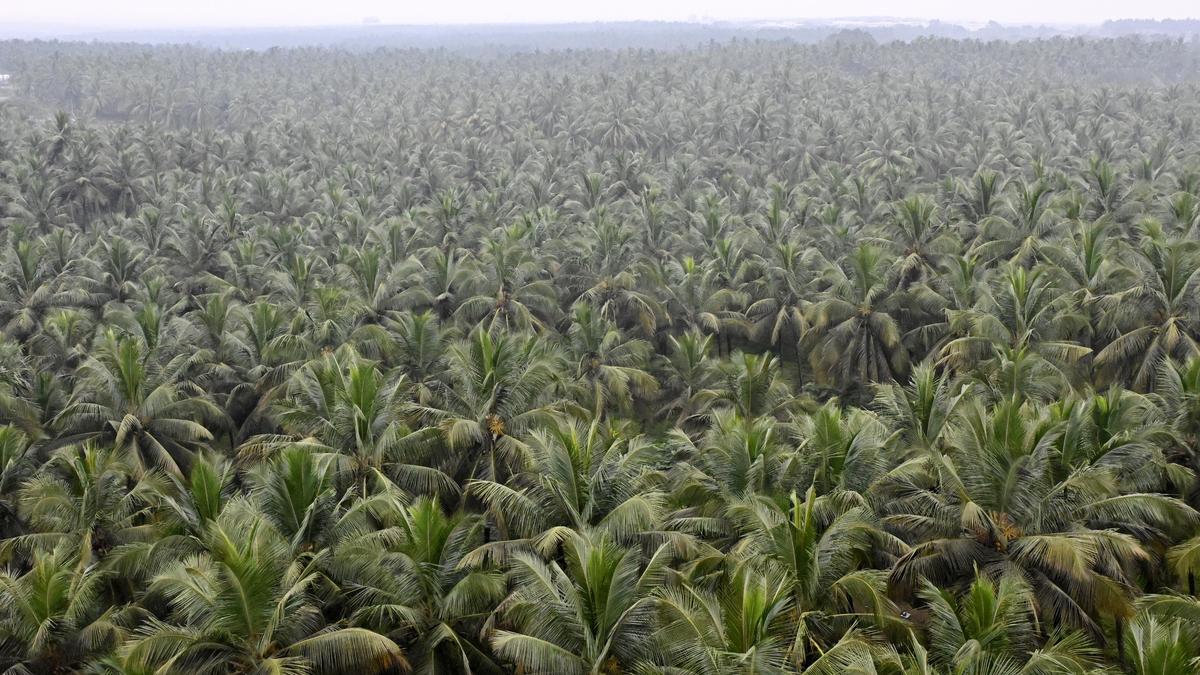
The Union Budget 2026–27 announced a Coconut Promotion Scheme, signalling renewed policy focus on India’s coconut economy. The scheme aims at rejuvenating old, senile, and low-yielding gardens with high-yielding varieties and promoting new plantations, particularly along coastal belts. This aligns with India’s broader objective of strengthening plantation crops for rural livelihoods, export potential, and climate resilience.
Coconut: Botanical and Agro-Climatic Profile
Coconut is a perennial plantation crop and a monocotyledonous palm belonging to the family Arecaceae. It is native to the Indo-Pacific region, with origins commonly traced to Southeast Asia.
Climatic Requirements:
- Warm and humid tropical climate
- Optimum temperature: 25°C–30°C
- High and well-distributed rainfall
- Sensitivity to prolonged drought and extreme weather
Soil Requirements:
- Well-drained sandy loam
- Alluvial soils
- Laterite soils
- Coastal sandy soils
Production and Distribution in India
- India is the world’s largest producer and consumer of coconuts, reflecting both domestic demand and agro-ecological suitability. The crop is predominantly cultivated in: Kerala, Tamil Nadu, Karnataka, Andhra Pradesh, Odisha, Goa, and West Bengal
- In recent years, cultivation has expanded into non-traditional regions such as parts of Gujarat, Assam, and other non-peninsular areas, supported by diversification initiatives of the Coconut Development Board (CDB).
- The coconut sector supports the livelihoods of nearly 30 million people, including around 10 million farmers, highlighting its socio-economic significance.
Institutional Framework: Role of the Coconut Development Board
The Coconut Development Board (CDB) has been implementing schemes for:
- Rejuvenation of senile plantations
- Expansion into new agro-climatic zones
- Quality planting material distribution
- Technology dissemination
- Value addition and market support
The proposed Coconut Promotion Scheme builds on these efforts, aiming to enhance productivity and area expansion.
Emerging Challenge: Productivity vs Sustainability
While productivity enhancement has historically been the policy focus, contemporary challenges necessitate a shift toward sustainable coconut cultivation. Key concerns include:
- Climate Change:
- Increased frequency of droughts, cyclones, and erratic rainfall
- Coastal salinity intrusion
- Temperature stress affecting yield
- Monocropping and Soil Degradation:
- Declining soil fertility
- Reduced biodiversity
- Greater vulnerability to pests and diseases
- Water Stress: Coconut cultivation is water-intensive; inefficient irrigation practices exacerbate groundwater depletion.
- Economic Viability: Price fluctuations and rising input costs affect farmer incomes.
Path Towards Sustainable Coconut Economy
A sustainability-oriented strategy should include:
- Climate-resilient varieties and drought-tolerant hybrids
- Integrated farming systems (intercropping with spices, cocoa, banana)
- Water-use efficiency through drip irrigation and rainwater harvesting
- Organic and natural farming practices
- Value addition (virgin coconut oil, coconut sugar, coir products, activated carbon)
- Strengthened farmer producer organizations (FPOs)
Sustainability enhances long-term productivity while protecting ecological balance and farmer incomes.