
Centre designates Legacy Thrust Territories
- 06 Mar 2026
In News:
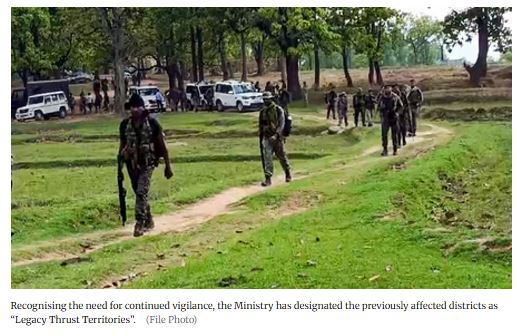
In order to sustain the significant progress made in combating Left Wing Extremism (LWE), the Ministry of Home Affairs (MHA) has introduced the concept of Legacy Thrust Territories (LTTs). This initiative aims to ensure that areas once affected by Naxal violence continue to receive focused security attention and developmental support, thereby preventing the resurgence of extremist activities.
The framework reflects a shift from purely security-centric counter-insurgency operations to governance-led stabilization and development in previously affected regions.
Background: Decline of Left Wing Extremism
Over the past two decades, India has witnessed a sharp decline in LWE-related activities due to coordinated security operations and development initiatives.
Key trends include:
- Around 200 districts were affected by LWE in the early 2000s.
- By 2025, the number of affected districts declined to 38.
- Currently, only seven districts remain under the core LWE list, including:
- Five districts in Chhattisgarh
- One district in Jharkhand
- One district in Odisha
Despite these gains, concerns remain that insurgent groups may attempt to regroup if security and governance efforts weaken.
What are Legacy Thrust Territories?
Legacy Thrust Territories refer to previously Naxal-affected districts that continue to receive focused security monitoring and developmental intervention even after insurgent activities decline.
The approach recognizes that post-conflict regions remain vulnerable to extremist revival if governance gaps persist. Therefore, the initiative seeks to maintain stability while gradually transitioning toward normal governance structures.
Objectives of the Initiative
The Legacy Thrust Territories framework aims to:
- Prevent resurgence of Naxalism after operational successes.
- Ensure a smooth transition from security-led operations to development-led governance.
- Strengthen administrative presence and state legitimacy in former conflict zones.
- Promote socio-economic integration and infrastructure development in historically marginalized regions.
Key Features of the Legacy Thrust Territories Strategy
1. Sustained Security Deployment: Even after a decline in insurgent activity, central armed police forces will continue to maintain a presence in sensitive regions. This prevents security vacuums that insurgent groups could exploit.
2. Development-Oriented Approach: The initiative prioritizes infrastructure and welfare development, including:
- road connectivity
- telecommunications expansion
- improved delivery of public services
- strengthening of local governance institutions.
3. Phased Redeployment of Security Forces: Instead of abrupt withdrawal, security forces will undergo gradual redeployment, ensuring stability while administrative systems take stronger control.
4. Centre–State Coordination: The strategy emphasizes close coordination between the Union Government and State Governments, while allowing operational flexibility for security agencies.
5. Administrative Strengthening: The government aims to enhance bureaucratic responsiveness and governance capacity in previously conflict-affected districts to address long-standing developmental deficits.
6. Monitoring Extremist Propaganda: Security agencies will strengthen intelligence gathering and monitoring of extremist networks, including activities in digital and online spaces.
7. Rehabilitation and Surrender Policy: The initiative will also focus on encouraging surrender and rehabilitation of remaining cadres, combined with targeted operations against residual insurgent elements.