
ALMA Telescope
- 03 Mar 2026
In News:
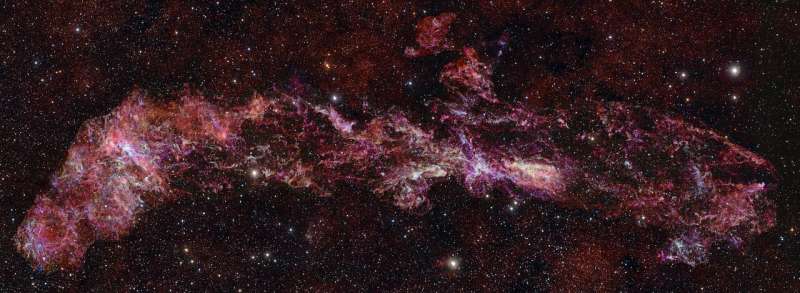
Recent astronomical observations have produced the largest and most detailed image of the central region of the Milky Way, revealing a complex network of filaments of cosmic gas and previously hidden chemical structures. The discovery was made using the Atacama Large Millimeter/submillimeter Array (ALMA), one of the world’s most advanced radio telescope facilities. These observations provide new insights into the chemical composition, gas dynamics, and star-formation processes occurring near the centre of our galaxy.
Atacama Large Millimeter/submillimeter Array (ALMA)
- ALMA is a state-of-the-art radio telescope array designed to study the universe in millimetre and submillimetre wavelengths, which are particularly useful for observing cold gas, dust, and molecular clouds that are often invisible to optical telescopes.
Location and Development
- ALMA is located in the Atacama Desert of northern Chile, one of the driest places on Earth, offering ideal conditions for radio astronomy due to minimal atmospheric moisture.
- The observatory became fully operational in 2013.
- It is a major international collaboration involving:
- National Radio Astronomy Observatory (NRAO), USA
- National Astronomical Observatory of Japan (NAOJ)
- European Southern Observatory (ESO).
Key Features
- 66 high-precision antennas arranged across distances of up to 16 km on the Chajnantor Plateau.
- The antennas can be repositioned, allowing astronomers to adjust resolution similar to a camera’s zoom lens.
- ALMA possesses extremely high sensitivity, enabling detection of very faint radio emissions from distant cosmic objects.
- It functions as an interferometer, combining signals from multiple antennas to produce extremely detailed astronomical images.
Recent Discovery: Mapping the Milky Way’s Central Region
Using ALMA, astronomers recently produced the largest high-resolution image of the Milky Way’s galactic centre at millimetre wavelengths. This region, located about 26,000 light-years from Earth, is dense with gas clouds, dust, and extreme astrophysical activity.
Key Findings
- Network of Gas Filaments
- The observations revealed a vast network of thin filaments of molecular gas distributed across the central region.
- These filaments likely play a crucial role in transporting matter and energy across the galaxy’s core.
- Hidden Chemical Structures
- Scientists identified previously undetected molecules and complex chemical interactions within dense gas clouds.
- These findings help researchers understand the chemical evolution of galaxies and the origins of complex organic molecules in space.
- Star Formation and Galactic Activity
- The galactic centre hosts intense star formation and energetic processes, influenced by strong gravitational forces and radiation.
- Mapping these structures provides clues about how stars form in extreme environments.
- Improved Understanding of Galactic Dynamics
- Detailed imaging allows astronomers to track gas movements, turbulence, and interactions near the Milky Way’s centre.
- This may help explain how matter accumulates around the supermassive black hole Sagittarius A* at the core of the galaxy.
Major Contributions of ALMA to Astronomy
Since becoming operational, ALMA has produced several landmark discoveries:
- Early Starburst Galaxies: ALMA detected starburst galaxies that existed earlier in the universe than previously believed, altering our understanding of galaxy formation.
- Protoplanetary Disc Around HL Tauri: It captured high-resolution images of the protoplanetary disc around HL Tauri, a young star about 450 light-years from Earth, revealing rings where planets are likely forming.
- Observation of Einstein Rings: ALMA has helped scientists study Einstein rings, a phenomenon predicted by Einstein’s theory of general relativity where light from a distant galaxy bends around a massive object, forming a ring-like structure due to gravitational lensing.
Scientific Significance
The recent mapping of the Milky Way’s centre highlights the importance of millimetre and submillimetre astronomy in uncovering cosmic phenomena hidden behind dust clouds. Observations from ALMA help scientists:
- Understand the chemical composition of interstellar space.
- Study the processes of star and planet formation.
- Investigate the dynamics of galactic centres and supermassive black holes.
- Explore the evolution of galaxies across cosmic time.