
Raja Ravi Varma
- 06 Apr 2026
In News:
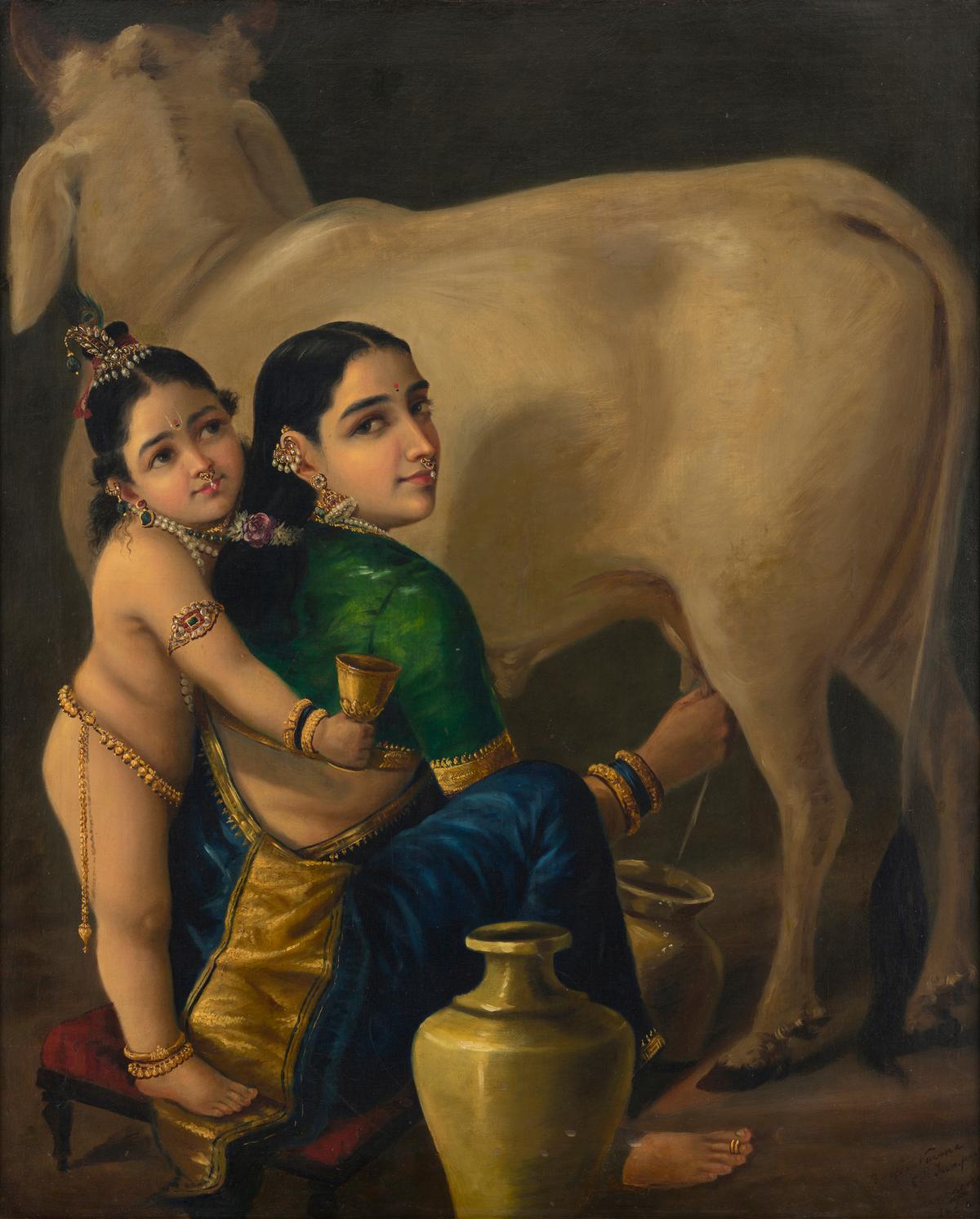
In April 2026, the Indian art market witnessed a watershed moment when Raja Ravi Varma’s iconic oil painting, "Yashoda and Krishna," was sold for a record-breaking ?167.2 crore ($17.9 million) at a Saffronart auction in Mumbai.
- Significance: This sale established a new global benchmark, making it the most expensive work of Indian art ever sold at auction, surpassing the previous record held by M.F. Husain’s Untitled (Gram Yatra).
- The Work: Painted in the 1890s, the canvas depicts an intimate, domestic scene from the Shrimad Bhagavatam where an infant Krishna approaches his mother, Yashoda, as she milks a cow. It is celebrated for its mastery of chiaroscuro (the treatment of light and shade) and its ability to render the divine through a human lens.
About Raja Ravi Varma (1848–1906)
Born on April 29, 1848, in the village of Kilimanoor, Kerala, Raja Ravi Varma belonged to the family of the Koil Thampurans (chieftains). His artistic journey revolutionized Indian art by bridging the gap between traditional Indian aesthetics and Western academic techniques.
Artistic Style and Contribution
- Synthesis of Traditions: He is renowned for blending Hindu mythological themes with European Realism and Naturalism. This style is often referred to as "Academic Realism."
- Pioneer of Oil Painting: Varma was among the first Indian artists to adopt oil paints, a medium previously dominated by European artists in India.
- The "Mona Lisa of Indian Art": His works are characterized by their "everyday divinity," where gods and goddesses are depicted with human emotions, draped in rich silks and adorned with intricate jewelry.
Democratization of Art: The Lithographic Press
Ravi Varma’s greatest legacy lies in making art accessible to the masses:
- In 1894, he established the Ravi Varma Fine Arts Lithographic Press in Maharashtra (initially in Ghatkopar and later moved to Lonavala).
- By producing affordable oleographs (lithographic prints), he ensured that depictions of Hindu deities reached ordinary households, fundamentally shaping the visual imagination of modern India.
Notable Works
- Shakuntala Writing a Love Letter to Dushyanta
- Shri Rama Vanquishing the Sea
- Nair Lady Adorning Her Hair (Won the Governor’s Gold Medal in Madras, 1873, and a Certificate of Merit in Vienna).
Awards and Recognition
- Kaiser-i-Hind Gold Medal (1904): Awarded by Viceroy Lord Curzon on behalf of the British King Emperor for his contribution to the arts. It was during this time that he became popularly known as "Raja."
- International Acclaim: He won prestigious awards at exhibitions in Vienna (1873) and the World’s Columbian Exposition in Chicago (1893).
Legal and Heritage Status: "National Art Treasure"
Under the Antiquities and Art Treasures Act of 1972, Raja Ravi Varma is one of nine designated "National Treasure" artists.
- Implication: His works are considered "non-exportable." While they can be sold within India, they cannot be taken out of the country, ensuring that India’s cultural heritage remains within its borders.
Raja Ravi Varma
- 29 Apr 2024
Why is it in the News?
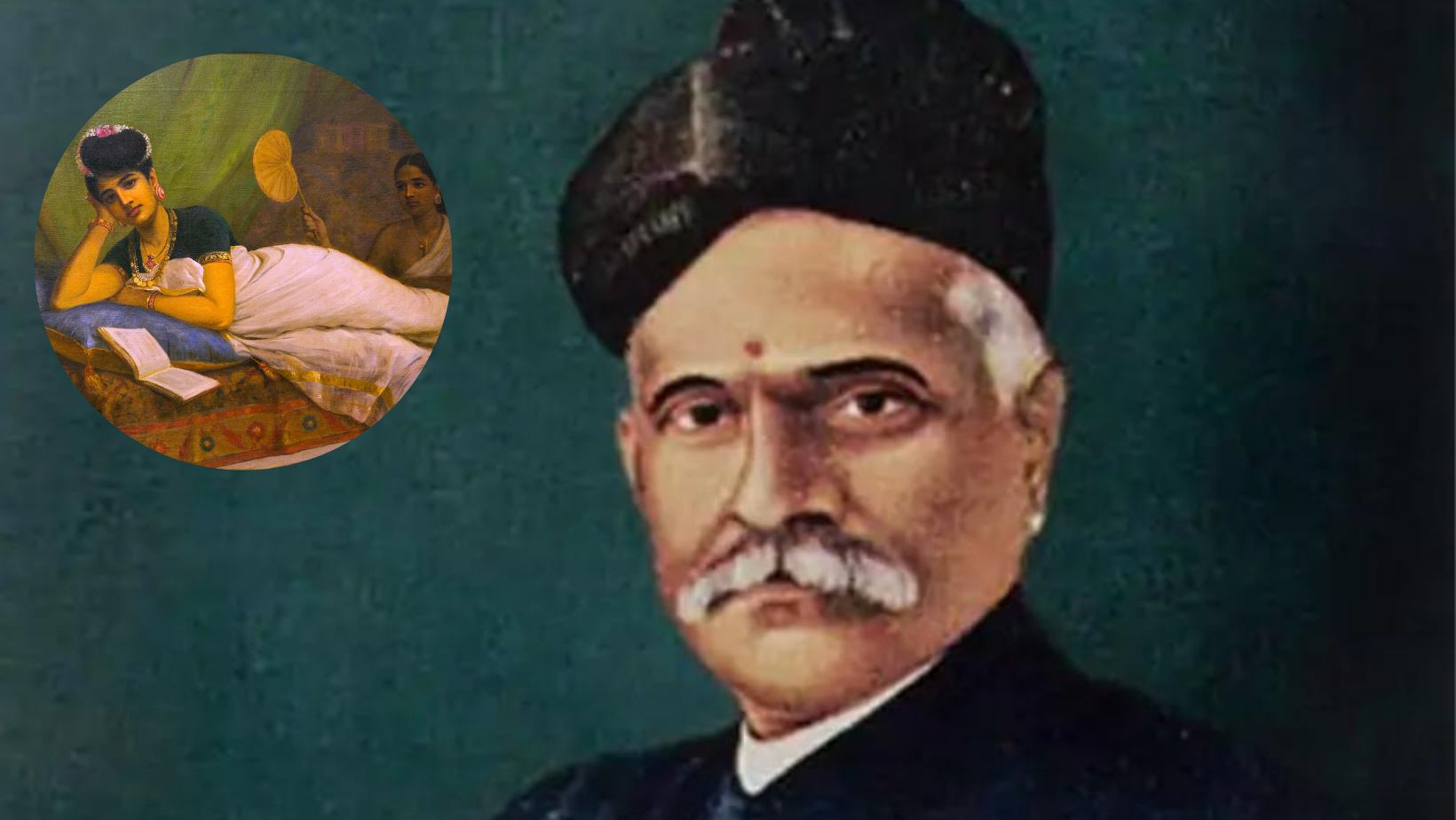
The first true copy of the painting Indulekha by legendary artist Raja Ravi Varma will be unveiled at the Kilimanoor Palace, where the eminent artist was born in 1848, on the occasion of his 176th birth anniversary celebrations.
Who was Raja Ravi Varma?
- Raja Ravi Varma was an Indian painter and artist.
- He is considered among the greatest painters in the history of Indian art.
- His works are one of the best examples of the fusion of European academic art with a purely Indian sensibility and iconography.
- Additionally, he was notable for making affordable lithographs of his paintings available to the public, which greatly enhanced his reach and influence as a painter and public figure.
- His lithographs increased the involvement of common people with fine arts and defined artistic tastes among common people.
- He was part of the royal family of erstwhile Parappanad, Malappuram district.
- He is also celebrated for inventing the first oleograph press in Ghatkopar, Mumbai.
- His paintings depicting Hindu gods and goddesses had a significant influence on their portrayal in art and cinema for many years.
- His artworks found popularity not only among Europeans but also among laymen, who appreciated his work for its simplicity.
- In a time when lower castes were barred from temples, they found solace in Varma's work.
- In addition to Indian mythology, he was admired for highlighting the beauty of South Indian women.
- Viceroy Lord Curzon honored him with the 'Kaisar-i-Hind' Gold Medal for his service.
- His paintings can be broadly classified into three categories: portraits, portrait-based compositions, and theatrical compositions based on myths and legends.
- Some of his popular paintings include 'A Family of Beggars,' 'A Lady Playing Swarbat,' 'Draupadi Dreading to Meet Kichaka,' 'Girl in Sage Kanwa's Hermitage (Rishi-Kanya),' 'Jatayu,' and 'Indulekha' among others.
About Indulekha Painting:
- The painting by Raja Ravi Varma draws inspiration from the novel as he creates an oil painting of Indulekha, who is depicted holding a letter addressed to her lover, Madhavan, the hero of the novel, with the salutation 'Dear Madhavan...' dated 1892.
- The painting, characterized by an over-the-top sense of symmetry and precise attention to micro-details, dates back to the 19th century.
- Another belief suggests that the famous painting 'Reclining Lady' by Ravi Varma was modeled on Indulekha.
- Recently, the painting was restored by Madhan S. of the Heritage Conservation and Research Academy.