
Prototype Fast Breeder Reactor
- 11 Apr 2026
In News:
In a landmark achievement for its energy security, India’s indigenously designed 500 MWe Prototype Fast Breeder Reactor (PFBR) at Kalpakkam, Tamil Nadu, successfully attained first criticality on April 6, 2026. This milestone signifies the initiation of a sustained nuclear chain reaction and officially transitions India into the Second Stage of its visionary three-stage nuclear power programme.
With this breakthrough, India becomes only the second country in the world, after Russia, to operate a commercial-scale fast breeder reactor, reinforcing its position as a global leader in advanced nuclear technology.
Understanding the Fast Breeder Reactor (FBR)
Developed by the Indira Gandhi Centre for Atomic Research (IGCAR) and built by BHAVINI, the PFBR is an engineering marvel that "breeds" more fuel than it consumes.
- Fuel Mechanism: Unlike conventional reactors that use natural uranium, the PFBR utilizes Uranium-Plutonium Mixed Oxide (MOX) fuel.
- The Breeding Process: The reactor core is surrounded by a "blanket" of fertile Uranium-238. When fast neutrons strike this blanket, they transmute it into fissile Plutonium-239, effectively creating new fuel during operation.
- Coolant Technology: It uses liquid sodium as a coolant, which is highly efficient for heat transfer but requires precision engineering due to its reactive nature with air and water.
The Three-Stage Nuclear Roadmap:
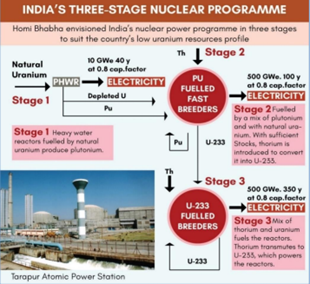
Formulated by Dr. Homi J. Bhabha in the 1950s, this programme is designed to tackle India’s unique resource profile: possessing only 1–2% of global uranium but over 25% of the world’s thorium reserves.
|
Stage |
Technology |
Fuel Source |
Key Outcome |
|
Stage 1 |
PHWRs |
Natural Uranium |
Power generation Plutonium by-product |
|
Stage 2 |
FBRs (Current) |
Plutonium Uranium |
Breeds more fuel; converts Thorium to U-233 |
|
Stage 3 |
AHWRs |
Thorium U-233 |
Massive, long-term energy independence |
Strategic Significance for India
- Energy Sovereignty: FBRs extract up to 60 times more energy from the same amount of uranium compared to conventional reactors, crucial for a uranium-scarce nation.
- The Thorium Bridge: Stage 2 is the essential "gateway" to Stage 3, where India’s vast monazite sands (found in Kerala, Odisha, and Tamil Nadu) will finally be utilized for power.
- Net-Zero by 2070: Nuclear power currently provides a stable baseload of 3.1% of India’s electricity. Scaling this is vital to displace coal and meet climate targets.
- Waste Management: The "closed fuel cycle" reprocesses spent fuel, drastically reducing the volume and long-term radiotoxicity of nuclear waste.
Challenges and the Road to 100 GW
Despite the milestone, accelerating nuclear capacity to the targeted 100 GW by 2047 faces hurdles:
- Technological Complexity: The PFBR faced over a decade of delays due to safety testing and supply chain bottlenecks.
- Supply Chain Vulnerability: Dependence on global partners (like Russia for Kudankulam) remains a risk, as seen during recent geopolitical disruptions.
- Capital Intensity: High initial costs and the "Plutonium Economy" invite intense international safeguards and security requirements.
Future Outlook: Policy and Innovation
The Union Budget 2025–26 and the newly enacted SHANTI Act, 2025 (Sustainable Harnessing and Advancement of Nuclear Energy for Transforming India) have modernized the sector's governance:
- Private Participation: For the first time, limited private sector investment is permitted under strict regulatory oversight.
- Small Modular Reactors (SMRs): A ?20,000 crore allocation aims to develop five indigenous SMRs by 2033, providing flexible, decentralized power.
- Next-Gen Designs: Development of the BSMR-200 and reactors for hydrogen generation is underway to diversify nuclear applications.
India halts Pakistan-bound ship suspected of carrying CNC machines from China
- 05 Mar 2024
Why is it in the News?
Recently, Prime Minister Narendra Modi witnessed the start of the process of core-loading the indigenous prototype fast breeder reactor (PFBR) at the Madras Atomic Power Station in Kalpakkam, Tamil Nadu.
What is the PFBR?
- The PFBR, or Prototype Fast Breeder Reactor, is a nuclear reactor designed to produce more nuclear fuel than it consumes.
- In nuclear fission, the nucleus of an atom absorbs a neutron, becomes unstable, and splits into two, releasing energy.
- If the unstable nucleus releases additional neutrons, the reactor’s facilities can utilize them to initiate more fission reactions.
How does the PFBR work?
- PHWRs use natural or low-enriched U-238 as the fissile material and produce Pu-239 as a byproduct.
- This Pu-239 is combined with more U-238 into a mixed oxide and loaded into the core of a new reactor together with a blanket.
- This is a material the fission products in the core react with to produce more Pu-239.
- A breeder reactor is a nuclear reactor that produces more fissile material than it consumes.
- In a ‘fast’ breeder reactor, the neutrons aren’t slowed, allowing them to trigger specific fission reactions.
- The PFBR is designed to produce more Pu-239 than it consumes.
- It uses liquid sodium, a highly reactive substance, as coolant in two circuits. Coolant in the first circuit enters the reactor and leaves with (heat) energy and radioactivity.
- Via heat-exchangers, it transfers only the heat to the coolant in a secondary circuit.
- The latter transfers the heat to generators to produce electricity.