
Mount Semeru
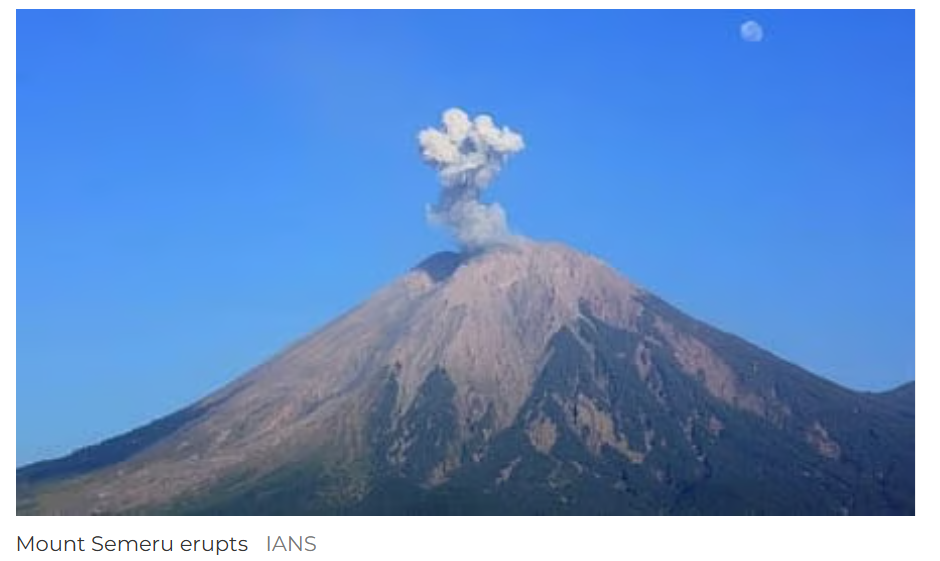
- 09 Apr 2026
In News:
In early 2026, Mount Semeru, one of Indonesia’s most volatile volcanoes, underscored its reputation by erupting repeatedly, propelling thick ash columns up to 1,100 metres above its summit. This recent activity is a stark reminder of the geological instability inherent in the Indonesian archipelago, a region that sits at the crossroads of major tectonic movements.
Geographical and Topographical Profile
Mount Semeru, affectionately known as Mahameru ("The Great Mountain"), is a landmark of the Indonesian landscape.
- Location: It is situated in East Java, Indonesia.
- Peak Altitude: Standing at 3,676 metres (12,060 feet), it holds the title of the highest peak on Java Island.
- Morphology: It is a stratovolcano located at the southern terminus of a volcanic massif that extends northward to the Tengger caldera. Its summit is characterized by complex topography due to the historical shifting of craters from the Northwest (NW) to the Southeast (SE).
The Tectonic Engine: Why It Erupts
Semeru’s frequent activity is the result of its position in one of the world's most active geological zones.
- Subduction Dynamics: The volcano is positioned within a subduction zone, where the Indo-Australian Plate is being forced beneath the Eurasian Plate. This process generates intense heat and pressure, melting the mantle and creating magma that rises to the surface.
- Pacific Ring of Fire:Semeru is a critical link in the Pacific Ring of Fire, a horseshoe-shaped belt in the Pacific Ocean basin where a large majority of the world's earthquakes and volcanic eruptions occur due to the continuous movement of continental and oceanic plates.
Eruption Patterns and Historical Context
Semeru is classified as one of Indonesia’s most active volcanoes, with a documented history of eruptions spanning over 200 years.
- Frequent Activity: It is famous for its "Strombolian" style of regular ash explosions, which historically occur at frequent intervals of 10 to 30 minutes.
- Hazards: Beyond ash fall, Semeru is notorious for producing Lahars (volcanic mudflows) and pyroclastic flows (fast-moving clouds of hot gas and volcanic matter), which pose significant risks to the densely populated agricultural plains of East Java.