
Geological Survey of India (GSI)
- 23 Nov 2025
In News:
The Union Minister of Coal & Mines inaugurated an international seminar in Jaipur to mark 175 years of the Geological Survey of India-one of the world’s oldest and most respected geoscientific institutions.
About the Geological Survey of India (GSI)
Nature & Status
- India’s premier national geoscientific organisation
- Attached office under the Ministry of Mines
- Mandated to conduct geological surveys, mineral exploration, and maintain national geoscience databases
Establishment
- Formally established:1851
- Original objective: Locate coal resources for the expanding railway network during British rule
Historical Evolution
- 1818–23: Early geological mapping by Survey of India & Army officers (e.g., W. Voysey’s geological map of Hyderabad)
- 1837: Committee formed for investigation of coal and mineral resources
- 1848: Term “Geological Survey of India” first used by John McClelland
- 1851: Sir Thomas Oldham initiated continuous, institutional geological work → considered the true beginning of GSI
- Over 175 years, GSI evolved into India’s national repository of geological and mineral data
Core Functions of GSI
- Geological Mapping & Surveys
- Ground, airborne and marine surveys
- Surface and subsurface geological mapping
- Mineral & Energy Resource Exploration: Scientific assessment of minerals, coal, hydrocarbons and groundwater
- Geohazard & Earth System Studies: Seismotectonics, landslides, glaciology, climate-change-related geostudies
- Geotechnical & Geo-environmental Services: Inputs for infrastructure projects, land stability, environmental impact
- National Geoscience Repository: Geological archives, spatial databases, remote sensing data, museums
- International Collaboration: Partnerships with USGS, BGS, Geoscience Australia and polar research agencies
- Capacity Building & Outreach: Collaboration with universities and training institutions; geoscience popularisation
- Coordination Role: Technical advisory support to Central & State governments in mineral governance
Pandavula Gutta designated an exclusive Geo-heritage site in Telangana
- 16 Mar 2024
Why is it in the News?
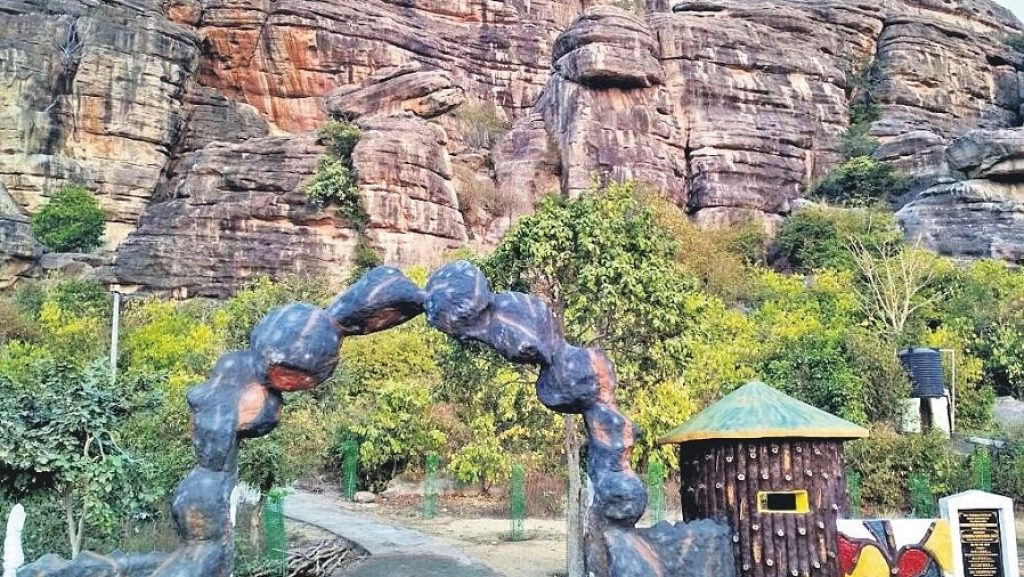
Pandavula Gutta, a geological marvel older than the Himalayan hills, has been officially recognized as the sole Geo-heritage site in Telangana.
What is Pandavula Gutta?
- Pandavula Gutta holds historical significance, being older than the Himalayas and renowned for its ancient rock paintings portraying diverse animals such as bison, antelope, tiger, and leopard, along with intricate geometric designs and symbols like swastikas, circles, and squares.
- These paintings indicate continuous human habitation from the Mesolithic period (around 12,000 to 6,000 BCE) through medieval times.
About Geo-heritage Sites:
- Geo-heritage sites encompass geological features of inherent or cultural significance, providing insights into the Earth's evolution or history, valuable for earth science and educational purposes.
- In India, the Geological Survey of India (GSI) identifies and designates these special places as Geo-Heritage Sites (GHS) to ensure their preservation, akin to UNESCO's protection of world heritage sites worldwide.
About the Geological Survey of India (GSI):
- The Geological Survey of India (GSI), established in 1851 initially to locate coal deposits for the Railways, has evolved into a comprehensive repository of geo-science information vital for various sectors in India.
- Its objective is to provide impartial and current geological expertise and geoscientific data to inform policy-making decisions and address commercial and socio-economic needs.
- Designated as the primary agency for geological mapping and regional mineral resources assessment under the National Mineral Policy (NMP) 2008, GSI emphasizes systematic documentation of geological processes across India and its offshore areas.
- Utilizing advanced techniques and methodologies, including geological, geophysical, and geochemical surveys, the organization operates from its headquarters in Kolkata, along with six regional offices and state units across the country.
- Presently, GSI operates as an attached office to the Ministry of Mines.